


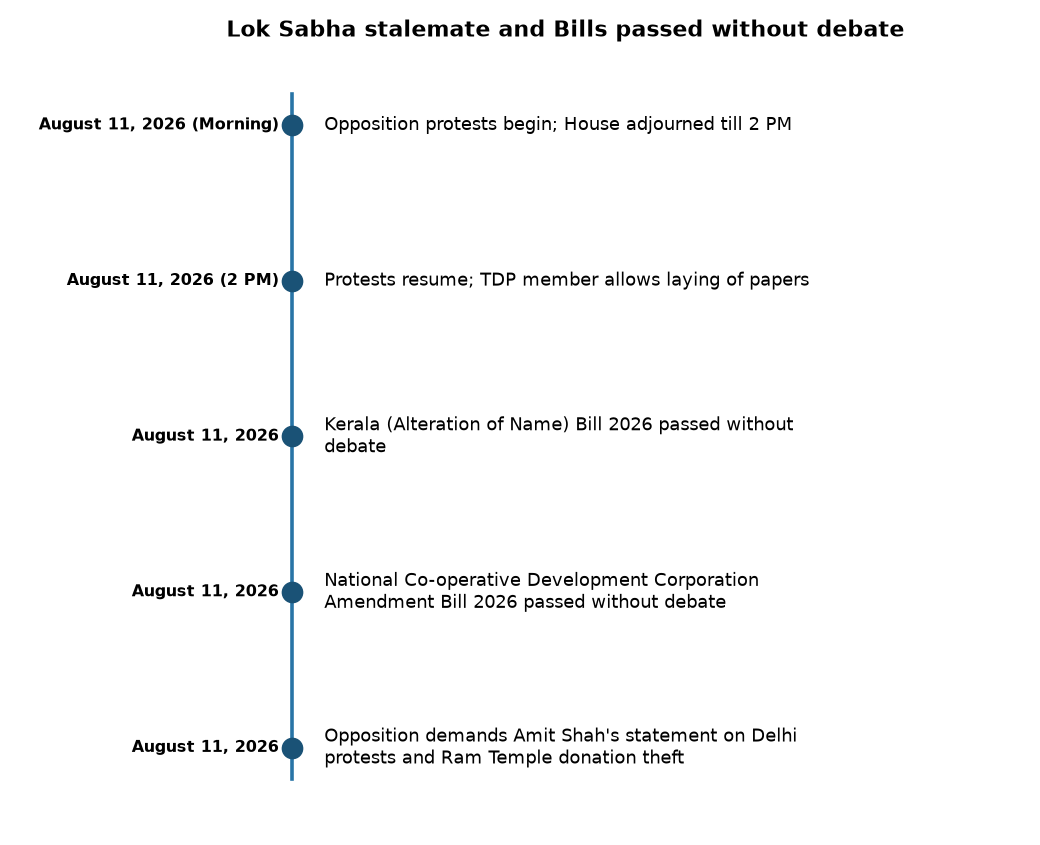
11 Aug Lok Sabha passes Kerala renaming & co-op bills amid Opposition deadlock
✎ The constitutional frameworks governing state name changes and the co-operative sector.
Subject Relevance — Where This Topic Fits
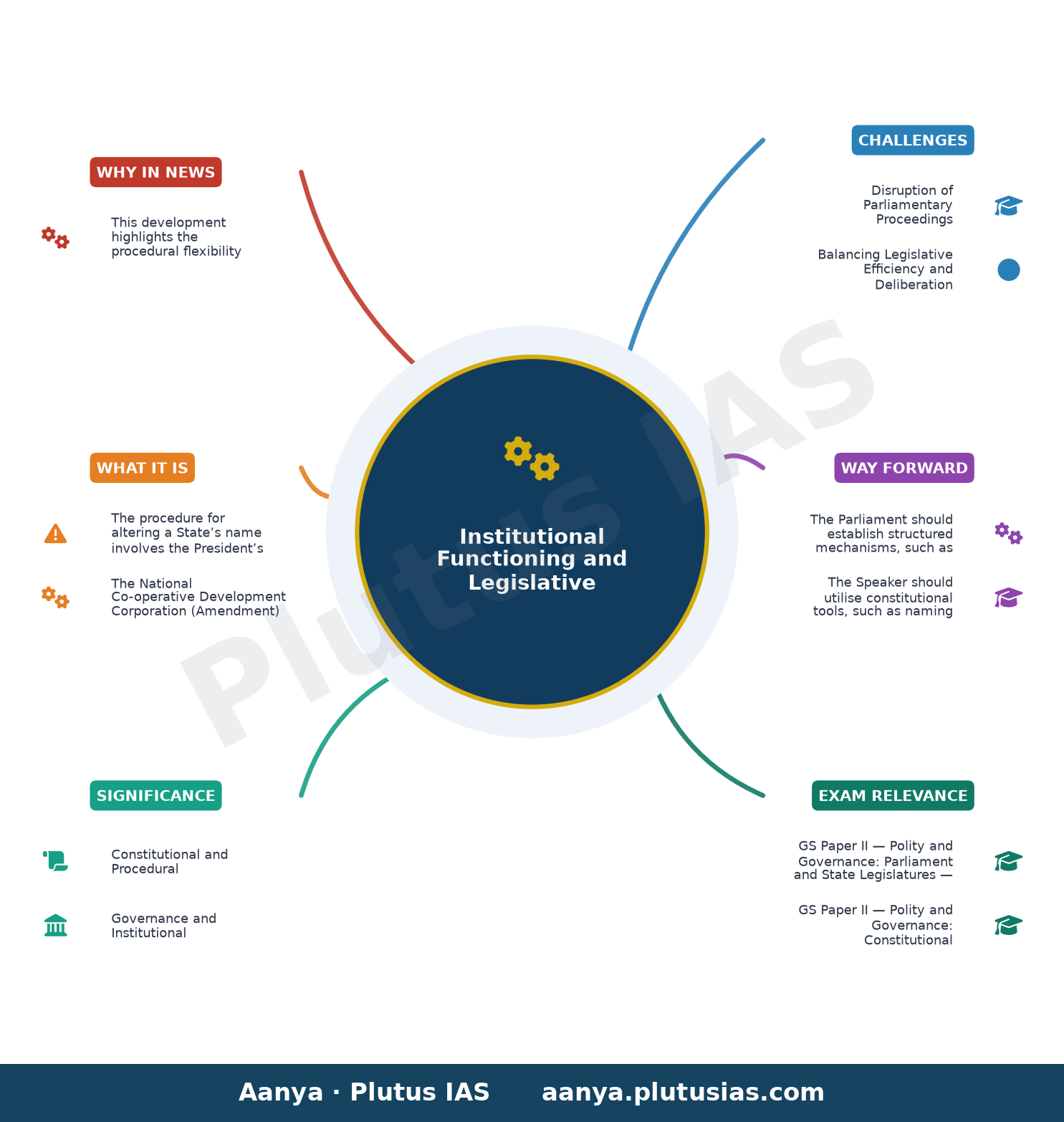
- GS Paper II — Polity and Governance: Parliament and State Legislatures — Structure, Functioning, Conduct of Business, Legislative Procedures | GS Paper II — Polity and Governance: Constitutional Provisions Related to State Reorganisation and Co-operative Societies | GS Paper III — Economy: Role of Co-operative Sector in Economic Development
- Prelims: Lok Sabha, Rajya Sabha, Speaker’s powers, Money Bill, Financial Bill, State Reorganisation Act, 1956, Co-operative Societies Act, 1912, National Co-operative Development Corporation (NCDC), Article 3 of the Constitution, Article 243ZH of the Constitution, Parliamentary deadlock, Voice vote, Division of votes
- Essay: The Role of Parliament in Democratic Governance: Challenges and Reforms, Co-operative Federalism and the Co-operative Sector in India: Strengthening Institutions for Inclusive Growth
Quick Revision: The constitutional frameworks governing state name changes and the co-operative sector.
Why is this in the news?
This development highlights the procedural flexibility of the legislative process in India, the constitutional framework governing state name changes, and the institutional role of the National Co-operative Development Corporation in the co-operative sector. It also underscores the challenges posed by parliamentary deadlocks to deliberative democracy and the functioning of Parliament.
Background
- The Lok Sabha operates under the constitutional framework established by the Constitution of India, which delineates the powers and procedures for the conduct of parliamentary business, including the passage of Bills.
- State name changes in India are governed by Article 3 of the Constitution, which empowers Parliament to alter the name of a State by law, following the prescribed procedure involving the President’s recommendation and the views of the State Legislature.
- The National Co-operative Development Corporation (NCDC) was established in 1963 under the National Co-operative Development Corporation Act, 1962, to promote and develop the co-operative sector in India by providing financial and technical assistance.
- Parliamentary deadlocks, often arising from differences between the Opposition and the government, can impede the legislative process, necessitating procedural adaptations such as the passage of Bills without debate or adjournments.
- The co-operative sector in India plays a significant role in the economy, particularly in agriculture, rural development, and financial inclusion, and is governed by the Constitution (97th Amendment) Act, 2011, and the Multi-State Co-operative Societies Act, 2002.
Key Aspects of the Kerala (Alteration of Name) Bill, 2026 and the National Co-operative Development Corporation (Amendment) Bill, 2026
- The procedure for altering a State’s name involves the President’s recommendation, followed by the introduction of a Bill in Parliament. The Bill must be referred to the concerned State Legislature for its views, though its recommendations are not binding on Parliament.
- The National Co-operative Development Corporation (Amendment) Bill, 2026, seeks to amend the National Co-operative Development Corporation Act, 1962, to enhance the Corporation’s role in promoting and financing co-operative societies, including multi-state co-operative societies.
- The NCDC, established in 1963, functions as the apex financial and developmental institution for the co-operative sector in India, providing financial assistance, capacity-building, and policy support to co-operative societies.
- The Amendment Bill may include provisions to broaden the scope of NCDC’s activities, such as enabling it to provide credit guarantees, facilitate mergers and acquisitions among co-operative societies, and support digital transformation initiatives in the sector.
- The passage of these Bills without discussion highlights the procedural flexibility of Parliament, which allows for the consideration and passage of Bills even in the absence of full deliberation, provided the necessary quorum and procedural requirements are met.
- The constitutional and statutory framework governing state name changes and the co-operative sector ensures that such legislative actions are undertaken within a structured and transparent process, safeguarding the interests of stakeholders and the public.
Key Features
| Feature | Significance |
|---|---|
| Kerala (Alteration of Name) Bill, 2026 | Initiates the constitutional process for renaming a State, as per Article 3 of the Constitution, requiring Parliamentary approval and Presidential assent. |
| National Co-operative Development Corporation (Amendment) Bill, 2026 | Proposes amendments to enhance the regulatory and developmental functions of the NCDC, aligning with the cooperative sector’s evolving needs under the 97th Constitutional Amendment. |
| Voice vote passage without debate | Demonstrates the procedural flexibility of the Lok Sabha to conduct legislative business despite disruptions, though it underscores the erosion of deliberative democracy. |
| Opposition-led stalemate | Highlights the constitutional tension between legislative disruption (Article 105) and the duty of Opposition to hold the government accountable through structured debate. |
| Adjournment sine die | Reflects the Speaker’s constitutional authority under Article 118 to adjourn the House in the absence of a quorum or due to unruly conduct, ensuring procedural continuity. |
Why it Matters
Constitutional and Procedural
- The passage of the Kerala name-change Bill underscores the constitutional mechanism for State renaming, which is a sovereign power vested in Parliament under Article 3, subject to Presidential assent.
- The NCDC Amendment Bill reflects the cooperative sector’s integration into the constitutional framework established by the 97th Amendment (2011), which added Part IXB to the Constitution, mandating democratic governance in cooperatives.
- The procedural anomaly of passing Bills without debate, despite disruptions, raises questions about the balance between legislative efficiency and the principle of informed deliberation enshrined in Article 105 (freedom of speech in Parliament).
Governance and Institutional
- The stalemate highlights the institutional challenge of maintaining parliamentary decorum while ensuring that Opposition demands for accountability are addressed through formal channels rather than disruptive tactics.
- The Speaker’s role in adjourning the House reflects the constitutional safeguard to prevent the collapse of legislative proceedings, even as it may be perceived as a temporary measure to restore order.
- The passage of Bills without discussion, while procedurally valid, risks undermining public trust in legislative processes, particularly when substantive issues remain unresolved.
Cooperative Sector Reforms
- The NCDC Amendment Bill aims to strengthen the cooperative sector, which is a critical component of India’s socio-economic fabric, particularly in rural and agricultural economies.
- Amendments to the NCDC Act may include provisions for enhanced funding, governance reforms, or integration with national development priorities, aligning with the cooperative principles enshrined in Article 43 of the Directive Principles.
Federalism and State Identity
- The Kerala name-change Bill exemplifies the federal principle where States can propose changes to their nomenclature, subject to Parliamentary approval, reflecting the dynamic nature of federal relations.
- Such renaming exercises often carry cultural and historical significance, reinforcing regional identity while adhering to constitutional procedures.
Challenges
1. Disruption of Parliamentary Proceedings
- Prolonged disruptions impede the legislative agenda, delaying critical Bills and undermining the Parliament’s role as the supreme law-making body.
- Disruptions often stem from unresolved political grievances, which, if left unaddressed, can erode the credibility of parliamentary institutions.
- The lack of structured debate on Bills passed without discussion raises concerns about transparency and public scrutiny of legislative decisions.
UPSC Link: Parliamentary procedures and Article 105
2. Balancing Legislative Efficiency and Deliberation
- The Parliament must reconcile the need for expeditious legislation with the constitutional mandate for informed debate and scrutiny.
- Procedural shortcuts, while expedient, risk compromising the quality of legislation and public trust in democratic institutions.
- The Speaker’s discretion in managing disruptions must balance the rights of Members under Article 105 with the duty to maintain order.
UPSC Link: Role of Speaker under Article 118
3. Accountability Mechanisms in Parliamentary Democracy
- The Opposition’s demand for a statement on specific incidents reflects the constitutional duty of the government to account for its actions to Parliament.
- Structured mechanisms, such as adjournment motions or calling attention notices, must be utilised to ensure accountability without disrupting legislative business.
- The absence of such mechanisms can lead to a breakdown in communication between the government and the Opposition, exacerbating institutional distrust.
UPSC Link: Parliamentary accountability tools
4. Federalism and State Autonomy
- While State renaming is a sovereign power, the process must balance regional aspirations with national unity and constitutional propriety.
- Delays in Parliamentary approval for State-specific Bills can create administrative and legal ambiguities, particularly in inter-State relations.
- The Parliament must ensure that such exercises do not become politicised, undermining the federal structure.
UPSC Link: Federalism and Article 3
5. Cooperative Sector Governance
- The cooperative sector, governed by Part IXB of the Constitution, requires robust regulatory frameworks to ensure democratic governance and financial transparency.
- Amendments to the NCDC Act must address challenges such as multi-state cooperative governance, funding mechanisms, and dispute resolution to enhance sectoral efficiency.
- The lack of debate on the Amendment Bill risks overlooking critical stakeholder concerns, particularly from cooperative societies.
UPSC Link: 97th Constitutional Amendment and cooperative governance
Challenges — UPSC Perspective
| Issue | Concern |
|---|---|
| Disruption of Parliamentary Proceedings | Impedes legislative agenda and delays critical Bills, undermining Parliament’s role as the supreme law-making body. |
| Lack of Structured Debate | Passing Bills without discussion risks compromising transparency, public scrutiny, and the quality of legislation. |
| Balancing Efficiency and Deliberation | Procedural shortcuts may expedite legislation but risk eroding public trust in democratic institutions. |
| Accountability Mechanisms | Breakdown in communication between government and Opposition can exacerbate institutional distrust and undermine accountability. |
| Federalism and State Autonomy | Delays in Parliamentary approval for State-specific Bills can create administrative and legal ambiguities. |
| Cooperative Sector Governance | Amendments to the NCDC Act must address regulatory gaps to ensure democratic governance and financial transparency. |
Way Forward
- The Parliament should establish structured mechanisms, such as time-bound discussions or special sessions, to address Opposition demands without disrupting legislative business.
- The Speaker should utilise constitutional tools, such as naming Members or invoking Rule 374A, to maintain decorum while ensuring that legislative proceedings are not indefinitely stalled.
- The government should proactively engage with the Opposition through formal channels, such as the Leader of the Opposition or the Parliamentary Standing Committees, to resolve grievances and restore normalcy.
- Parliamentary committees should conduct post-facto reviews of Bills passed without debate to ensure that substantive issues are not overlooked and that the public interest is safeguarded.
- The cooperative sector should be consulted extensively during the drafting of amendments to the NCDC Act to ensure that reforms align with ground realities and stakeholder needs.
- State governments proposing name changes should engage in pre-legislative consultations with the central government to streamline the Parliamentary approval process and avoid delays.
- The Parliament should explore digital platforms for conducting virtual sittings or consultations to mitigate disruptions caused by physical adjournments.
- Institutional capacity-building for Members of Parliament, particularly on parliamentary procedures and constitutional provisions, should be prioritised to enhance the quality of legislative debate.
UPSC Value Addition
Keywords for Mains Answer-Writing
Parliamentary procedures · Lok Sabha functioning · State name alteration process · Constitutional amendment process · Co-operative sector reforms · Parliamentary deadlock · Bill passage without debate · Role of Speaker in Parliament · Constitutional provisions for State name change · National Co-operative Development Corporation · Parliamentary procedures under Article 3 · Parliamentary deadlock and legislative productivity · Institutional mechanisms in Parliament · Parliamentary sovereignty
Constitutional & Policy Linkages
- Article 3: Alteration of name of a State
- Article 105: Powers, privileges and immunities of Parliament and its Members
- Article 118: Rules of procedure
- 97th Constitutional Amendment: Cooperative societies
Concept Flow
Opposition disruptions in Lok Sabha → Speaker adjourns House → Government proceeds with Bills via voice vote → Passage of Kerala (Alteration of Name) Bill and NCDC Amendment Bill → Constitutional validity of State renaming under Article 3 → Cooperative sector reforms under 97th Amendment → Procedural concerns over lack of debate → Erosion of deliberative democracy → Need for structured accountability mechanisms.
Prelims Practice Questions
Q1. Consider the following statements regarding the process of altering the name of a State in India:
1. The Bill for altering the name of a State must be introduced in the Parliament only after the State Legislature passes a resolution to that effect.
2. The Bill requires the prior recommendation of the President of India before it can be introduced in Parliament.
3. The Bill must be passed by a simple majority in both Houses of Parliament to become an Act.
4. The Constitution (Article 3) empowers Parliament to alter the name of any State without the State’s consent.
How many of the above statements are correct?
- Only one
- Only two
- Only three
- All four
Answer: Only three — Statements 1 and 3 are correct. The process requires a State Legislature resolution (Statement 1) and a simple majority in both Houses (Statement 3). Statement 2 is incorrect as prior presidential recommendation is not mandatory for such Bills. Statement 4 is incorrect as the State’s consent is constitutionally required.
Q2. Assertion (A): The National Co-operative Development Corporation (Amendment) Bill, 2026, seeks to amend the National Co-operative Development Corporation Act, 1962, to enhance the operational scope of the Corporation.
Reason (R): The amendment aims to align the Corporation’s functions with the constitutional directive principles enshrined in Article 43B, which calls for the promotion of co-operative societies.
- Both A and R are true, and R is the correct explanation of A.
- Both A and R are true, but R is NOT the correct explanation of A.
- A is true, but R is false.
- A is false, but R is true.
Answer: A is true, but R is false. — Assertion (A) is true as the Bill seeks to amend the NCDC Act, 1962. Reason (R) is also true, but the amendment’s primary objective is not explicitly tied to Article 43B; it focuses on operational enhancements. Hence, R is not the correct explanation of A.
Q3. Which of the following BEST describes the role of the Speaker of the Lok Sabha in the context of the passage of Bills during a parliamentary deadlock?
- The Speaker can unilaterally pass Bills without debate if the Opposition disrupts proceedings.
- The Speaker must ensure that Bills are passed only after thorough debate and discussion.
- The Speaker can adjourn the House indefinitely to resolve deadlocks.
- The Speaker has the discretion to pass Bills without debate if the Opposition’s demands are deemed unreasonable.
Answer: The Speaker can adjourn the House indefinitely to resolve deadlocks. — The Speaker’s role is to ensure the orderly conduct of proceedings and uphold parliamentary rules. While the Speaker can pass Bills without debate in exceptional circumstances (e.g., during deadlocks), this is not a unilateral power and must align with constitutional and procedural norms.
Mains Practice Question
✍ The passage of Bills without debate in the Lok Sabha, despite ongoing parliamentary deadlocks, raises questions about the robustness of democratic deliberation in India’s legislative process. Critically examine the constitutional and procedural dimensions of this practice, with particular reference to the Kerala (Alteration of Name) Bill, 2026, and the National Co-operative Development Corporation (Amendment) Bill, 2026. (15 Marks)
Approach: MODEL-ANSWER SKELETON:
1. Introduction: Define the context of parliamentary deadlocks and the practice of passing Bills without debate.
2. Constitutional and Procedural Framework:
– Article 3 of the Constitution: Process for altering the name of a State (State Legislature resolution + Parliamentary approval).
– Article 107: Procedure for passing Bills in Parliament (including provisions for passing Bills without debate under Rule 224 of the Rules of Procedure and Conduct of Business in Lok Sabha).
– Role of the Speaker under Article 93 and Rules of Procedure.
3. Analysis of the Kerala (Alteration of Name) Bill, 2026:
– Constitutional validity of the State Legislature’s resolution.
– Procedural compliance with Article 3 and parliamentary rules.
– Implications for federalism and State autonomy.
4. Analysis of the National Co-operative Development Corporation (Amendment) Bill, 2026:
– Legal basis for the amendment (NCDC Act, 1962).
– Procedural aspects of passing the Bill without debate.
– Alignment with constitutional objectives (e.g., Article 43B: Promotion of co-operative societies).
5. Critique of the Practice:
– Democratic deficit: Lack of debate and deliberation.
– Precedents and historical context (e.g., past instances of Bills passed without debate).
– Impact on parliamentary sovereignty and public trust.
6. Counterarguments:
– Necessity of legislative productivity during deadlocks.
– Speaker’s discretion to ensure continuity of governance.
7. Conclusion: Balanced assessment of the practice, its constitutional validity, and recommendations for reform (e.g., mandatory committees for scrutiny).
Source: The Hindu
Generated by AanyaAi for educational purpose.

- मद्रास उच्च न्यायालय में ‘वेट्ट्री पयणम’ योजना को असंवैधानिक घोषित करने की मांग - October 4, 2026
- Gurugram’s groundwater extraction exceeds limit by 212%; HC seeks ban - October 4, 2026
- स्वतंत्रता सेनानी श्यामजी कृष्ण वर्मा की जन्म जयंती पर पीएम का श्रद्धांजलि - October 4, 2026

No Comments