


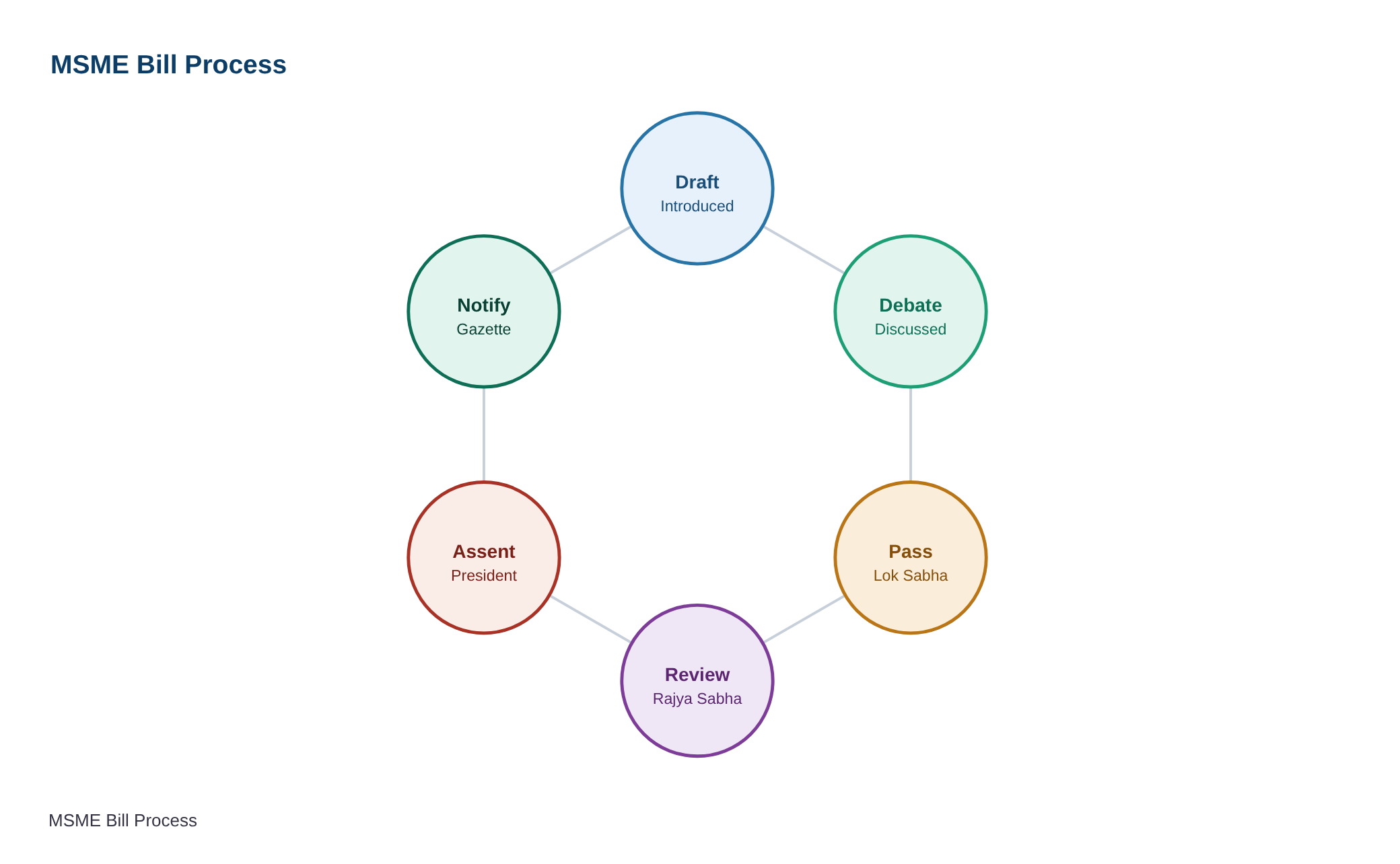
07 Aug Lok Sabha Passes MSME Bill: Key Provisions for UPSC & State PCS
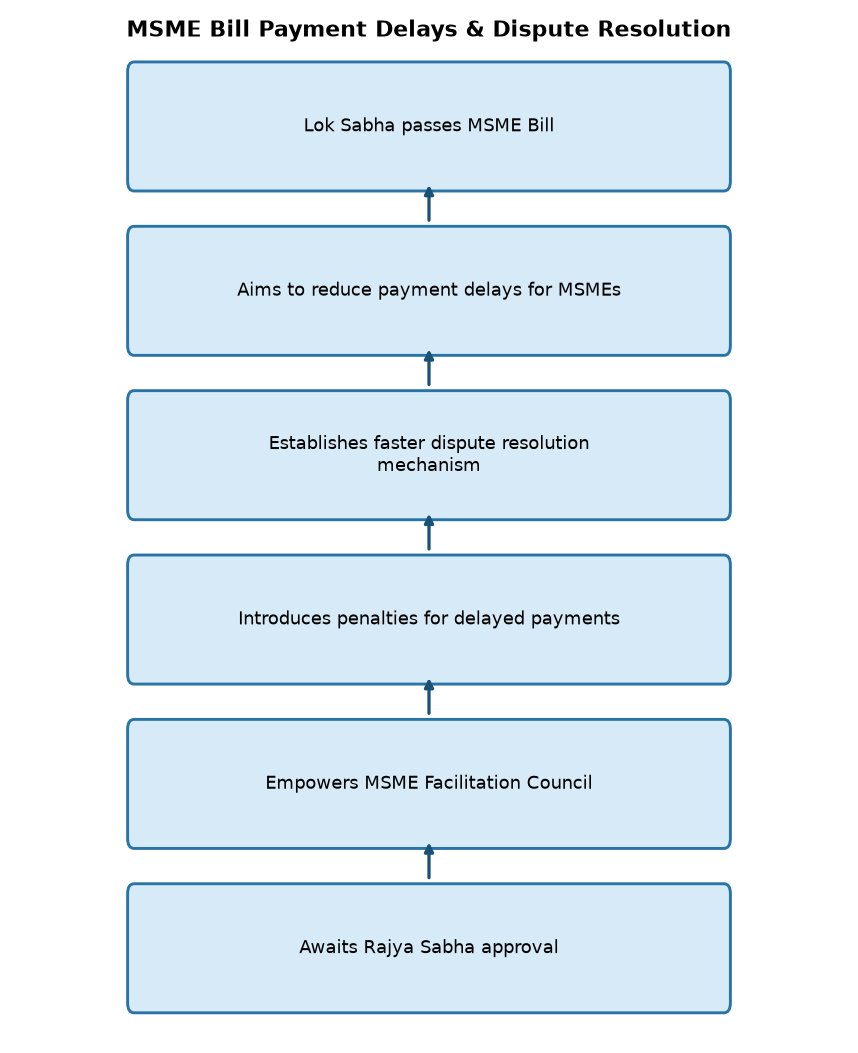
✎ MSME Bill 2024 aims to curb payment delays and disputes via stricter timelines and penalties, benefiting MSMEs and ensuring financial discipline.
Relevance for UPSC & State PCS: Polity
The Lok Sabha recently passed the Micro, Small and Medium Enterprises (MSME) Development (Amendment) Bill, 2024, aimed at addressing persistent challenges of delayed payments and prolonged dispute resolution that plague India’s MSME sector. The bill introduces stricter timelines for settling dues from buyers, mandating that payments must be made within 45 days of acceptance or deemed acceptance of goods or services, failing which the buyer will be liable to pay compound interest at three times the bank rate notified by the Reserve Bank of India. This legislative intervention seeks to alleviate the cash-flow crises that often force small businesses to shut down, thereby preserving employment and fostering economic resilience in the sector. For UPSC and State PCS aspirants, the bill underscores the intersection of constitutional provisions—particularly Directive Principles of State Policy (Article 43) promoting small-scale industries—and the government’s evolving role in economic regulation through statutory frameworks.
The amendment also strengthens the institutional mechanism for dispute resolution by empowering the MSME Facilitation Council to act as a quasi-judicial authority, enabling faster adjudication of payment-related disputes. This aligns with the broader judicial reforms agenda, where reducing pendency in commercial disputes remains a critical policy focus. The bill’s emphasis on time-bound justice reflects the constitutional guarantee of speedy trial (Article 21) and resonates with the government’s ‘Ease of Doing Business’ initiatives. For civil service aspirants, this highlights how legislative amendments can operationalize constitutional ideals in real-world governance, a recurring theme in polity syllabi.
A key provision of the bill is the establishment of a ‘Micro and Small Enterprise Facilitation Portal’ to register and track payment defaults, creating a transparent public record of defaulters. This digital governance tool exemplifies the use of technology in public administration, a subject frequently examined in UPSC’s governance and technology sections. The portal’s data could also inform policy decisions on credit access and financial inclusion for MSMEs, linking the bill to broader economic governance topics like the role of NITI Aayog and RBI in credit regulation. State PCS aspirants should note how such portals enhance accountability in sub-national governance, especially in states with high MSME concentration.
The bill’s passage comes amid growing concerns over the financial health of India’s 6.3 crore MSMEs, which contribute nearly 30% to the GDP and employ over 11 crore people. The amendment’s focus on payment discipline and dispute resolution mirrors global best practices, such as the UK’s Late Payment of Commercial Debts (Interest) Act, making it relevant for comparative governance studies. For UPSC mains, this could be cited in answers on ‘role of state in economic development’ or ‘judicial reforms for ease of doing business.’ State PCS aspirants should analyze how such central legislations interact with state-level MSME policies, particularly in industrial hubs like Gujarat,
Source: ndtv.com
Practice Questions
Q1. What is the primary objective of the MSME Bill recently passed by the Lok Sabha?
- To provide financial subsidies to MSMEs
- To tackle payment delays and speed up dispute resolution for MSMEs
- To increase the tax burden on large corporations
- To mandate a minimum wage for all MSME employees
Answer
To tackle payment delays and speed up dispute resolution for MSMEs — The MSME Bill passed by the Lok Sabha aims to address payment delays faced by Micro, Small, and Medium Enterprises (MSMEs) and expedite the resolution of disputes related to payments, thereby improving their cash flow and operational efficiency.
Q2. Which of the following issues is the MSME Bill primarily designed to address?
- Environmental compliance
- Payment delays and dispute resolution
- Export quotas
- Labor union negotiations
Answer
Payment delays and dispute resolution — The MSME Bill focuses on resolving payment delays and speeding up dispute resolution, which are critical challenges for MSMEs in India.
Generated by AanyaAi for educational purpose.

- एनजीटी ने आगरा के प्रदूषित तालाबों पर 10 सप्ताह में रिपोर्ट मांगी, अतिक्रमण हटाने के निर्देश - September 22, 2026
- NGT Orders Probe into Agra’s Encroached & Polluted Water Bodies in 10 Weeks - September 22, 2026
- यूएनजीए 2026: युद्ध, एआई और सुधार – दुनिया के नेता क्या करेंगे? (UPSC दृष्टिकोण) - September 22, 2026

No Comments