


07 Aug Lok Sabha Passes Taxation (Amendment) Bill 2026: Key Provisions Explained for UPSC
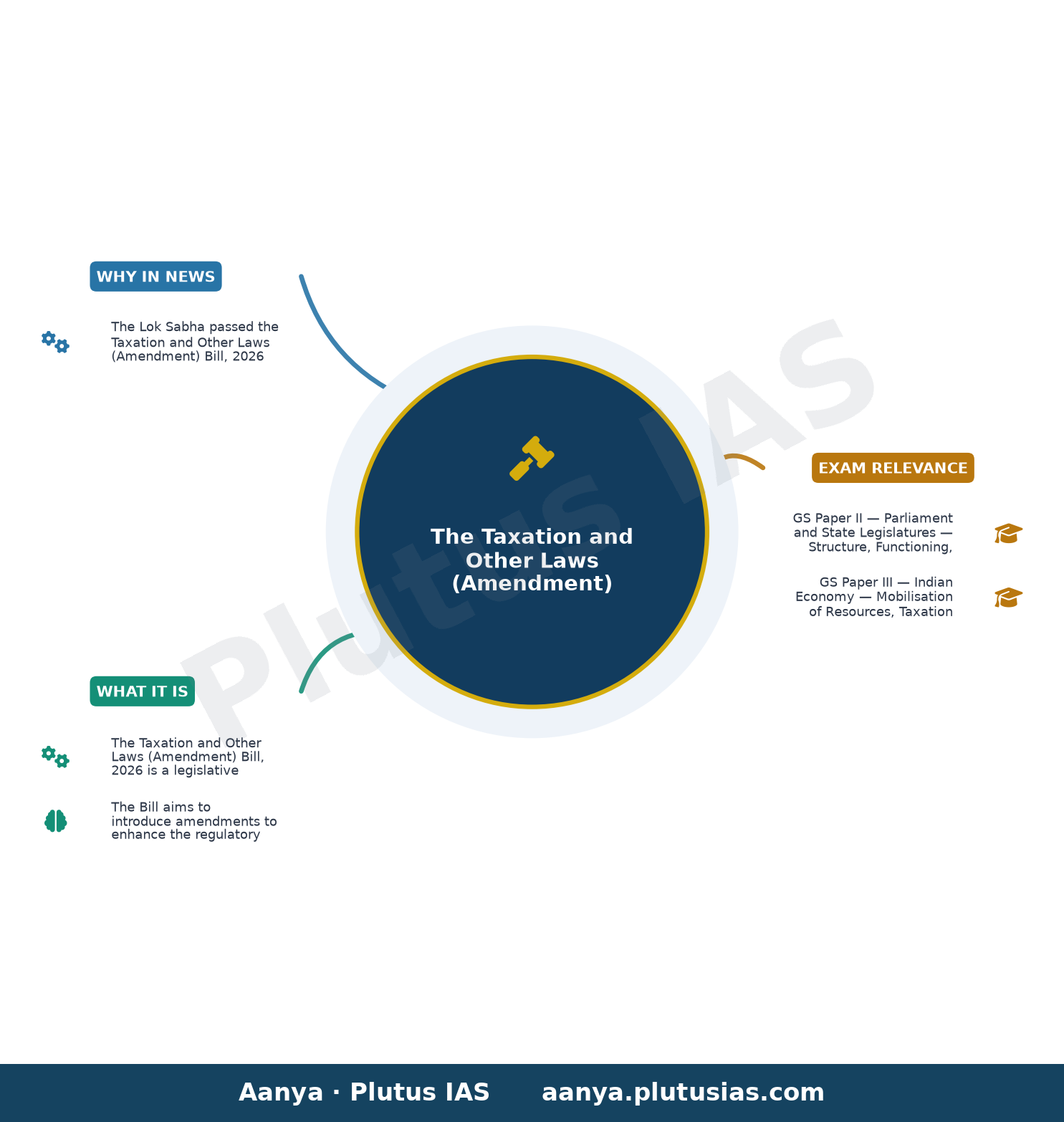
✎ The Taxation and Other Laws (Amendment) Bill, 2026 is a financial legislation aimed at amending the Payment and Settlement Systems Act, 2007, the Income-tax Act, 2025, and the Finance Act, 2026 to enhance regulatory efficiency…
Subject Relevance — Where This Topic Fits
- GS Paper II — Parliament and State Legislatures — Structure, Functioning, Conduct of Business, Powers and Privileges | GS Paper III — Indian Economy — Mobilisation of Resources, Taxation Reforms, Financial Legislations
- Prelims: Taxation and Other Laws (Amendment) Bill, 2026, Payment and Settlement Systems Act, 2007, Income-tax Act, 2025, Finance Act, 2026, Appropriation (No.3) Bill, 2026, Consolidated Fund of India, Parliamentary procedures, Consolidated Fund of India, Farakka Treaty 1996
- Essay: The evolving role of Parliament in economic governance: A study of financial legislations and their socio-economic impact, Taxation as a tool for economic equity and growth: Balancing fiscal policy with public welfare
Quick Revision: The Taxation and Other Laws (Amendment) Bill, 2026 is a financial legislation aimed at amending the Payment and Settlement Systems Act, 2007, the Income-tax Act, 2025, and the Finance Act, 2026 to enhance regulatory efficiency and fiscal governance.
Why is this in the news?
The Lok Sabha passed the Taxation and Other Laws (Amendment) Bill, 2026 on August 6, 2026, without debate, marking a significant legislative development in the Monsoon Session of Parliament. The Bill proposes amendments to critical financial legislations including the Payment and Settlement Systems Act, 2007, the Income-tax Act, 2025, and the Finance Act, 2026. This development is noteworthy as it underscores the procedural dynamics of financial legislations in Parliament and their implications for fiscal policy, digital payments infrastructure, and tax administration. Additionally, the passage of the Appropriation (No.3) Bill, 2026 in the Rajya Sabha highlights the legislative process of authorising government expenditure, a fundamental function of Parliament.
Background
- The Taxation and Other Laws (Amendment) Bill, 2026 is part of the legislative agenda of the Union Government to amend existing financial laws to align with contemporary economic and technological developments.
- The Bill seeks to amend the Payment and Settlement Systems Act, 2007, which regulates payment systems in India, including digital payments, to enhance efficiency, security, and interoperability in the financial ecosystem.
- The Income-tax Act, 2025, is proposed to be amended to address procedural and substantive issues, including tax administration, compliance, and dispute resolution mechanisms.
- The Finance Act, 2026, is a key annual legislation that provides the legal framework for the Union Government’s taxation proposals and other financial matters for the fiscal year.
- The Appropriation (No.3) Bill, 2026 authorises the payment and appropriation of further sums from the Consolidated Fund of India for the financial year 2025-26, ensuring the continuity of government operations and expenditure.
- The Monsoon Session of Parliament has been marked by discussions on legislative efficiency, procedural norms, and the role of Opposition in financial legislations, reflecting broader debates on democratic governance and fiscal accountability.
What is the Taxation and Other Laws (Amendment) Bill, 2026?
- The Taxation and Other Laws (Amendment) Bill, 2026 is a legislative proposal introduced by the Union Government to amend multiple financial laws, including the Payment and Settlement Systems Act, 2007, the Income-tax Act, 2025, and the Finance Act, 2026.
- The Bill aims to introduce amendments to enhance the regulatory framework for payment and settlement systems, ensuring alignment with digital transformation and technological advancements in the financial sector.
- Proposed amendments to the Income-tax Act, 2025 are expected to address issues related to tax administration, compliance, and dispute resolution, potentially improving ease of doing business and reducing litigation.
- The legislative process involves the introduction of the Bill in either House of Parliament, followed by scrutiny, debate, and passage, before receiving the President’s assent to become law.
- The Bill’s passage without debate in the Lok Sabha underscores the procedural flexibility available to the government in financial legislations, though it raises questions about the role of Opposition and democratic scrutiny.
- The amendments are expected to have implications for taxpayers, financial institutions, and the broader economy, particularly in the context of digital payments, tax compliance, and fiscal policy.
- The Bill is part of the Union Government’s broader agenda to modernise financial legislations and align them with global best practices in taxation and financial regulation.
UPSC Value Addition
Keywords for Mains Answer-Writing
Taxation and Other Laws (Amendment) Bill, 2026 · Payment and Settlement Systems Act, 2007 · Income-tax Act, 2025 · Finance Act, 2026 · Consolidated Fund of India · Appropriation Bill · Parliamentary procedures · Union Budget process · Fiscal governance in India · Legislative amendments · Lok Sabha vs Rajya Sabha dynamics · Financial accountability · Taxation reforms · Parliamentary debates · Budgetary appropriations
Prelims Practice Questions
Q1. Consider the following statements regarding the Appropriation Bill in India:
1. An Appropriation Bill authorises the withdrawal of funds from the Consolidated Fund of India.
2. The Appropriation Bill is introduced in the Lok Sabha after the Finance Bill is passed.
3. The Rajya Sabha can only recommend amendments to the Appropriation Bill but cannot reject it.
4. The Appropriation Bill is governed by Article 114 of the Constitution of India.
How many of the above statements are correct?
- Only one
- Only two
- Only three
- All four
Answer: All four — Statements 1, 3, and 4 are correct. Statement 2 is incorrect because the Appropriation Bill is introduced after the General Budget (including the Finance Bill) is presented and discussed in the Lok Sabha, not after the Finance Bill is passed.
Q2. Assertion (A): The Taxation and Other Laws (Amendment) Bill, 2026 seeks to amend the Payment and Settlement Systems Act, 2007.
Reason (R): The amendment aims to regulate digital payment systems and reduce tax evasion in financial transactions.
In the context of the above two statements, which one of the following is correct?
- Both A and R are true, and R is the correct explanation of A.
- Both A and R are true, but R is not the correct explanation of A.
- A is true, but R is false.
- A is false, but R is true.
Answer: A is true, but R is false. — The assertion (A) is true as the Bill does amend the Payment and Settlement Systems Act, 2007. However, the reason (R) is not the correct explanation of (A) because the amendment’s primary objective is not explicitly stated as regulating digital payment systems or reducing tax evasion in the provided context.
Q3. Match the following legislative instruments with their primary functions in India:
Column I (Instrument) | Column II (Function)
1. Finance Bill | A. Authorises withdrawal of funds from the Consolidated Fund of India for government expenditure.
2. Appropriation Bill | B. Provides the legal framework for the Union Government’s taxation proposals for the financial year.
3. Money Bill | C. Deals with matters related to expenditure charged on the Consolidated Fund of India.
4. Demand for Grants | D. Introduced to give effect to the financial proposals of the government, including taxation.
Select the correct match:
- 1-D, 2-A, 3-C, 4-B
- 1-B, 2-A, 3-D, 4-C
- 1-D, 2-C, 3-B, 4-A
- 1-B, 2-D, 3-A, 4-C
Answer: 1-B, 2-A, 3-D, 4-C — The correct matches are: 1-D (Finance Bill provides the legal framework for taxation proposals), 2-A (Appropriation Bill authorises withdrawal of funds), 3-C (Money Bill includes matters related to expenditure charged on the Consolidated Fund), and 4-B (Demand for Grants relates to government expenditure proposals).
Mains Practice Question
✍ The Taxation and Other Laws (Amendment) Bill, 2026, passed by the Lok Sabha, reflects the evolving nature of fiscal governance in India. Critically analyse the legislative process and constitutional provisions governing such amendments, with particular reference to the role of Parliament in taxation reforms. (15 Marks)
Approach: MODEL-ANSWER SKELETON:
1. **Constitutional Framework**:
– Article 109 and Article 117 of the Constitution of India govern Money Bills and Financial Bills, respectively.
– The Taxation and Other Laws (Amendment) Bill, 2026, is a Financial Bill as it amends taxation laws (Income-tax Act, 2025) and other statutes.
– Money Bills (under Article 109) can only be introduced in the Lok Sabha and are deemed passed if not returned by the Rajya Sabha within 14 days.
2. **Legislative Process**:
– Introduction in Lok Sabha: The Bill must be introduced by a Minister, following the rules of procedure.
– Referral to Standing Committee: Optional but common for significant amendments; ensures scrutiny.
– Debate and Voting: The Bill was passed without debate, highlighting procedural efficiency or potential lack of deliberation.
– Rajya Sabha’s Role: The Rajya Sabha can recommend amendments but cannot reject a Money Bill. The Bill was returned to the Lok Sabha after approval.
3. **Taxation Reforms and Governance**:
– Amendments to the Income-tax Act, 2025, and Payment and Settlement Systems Act, 2007, indicate a focus on modernising tax administration and digital payment systems.
– The Finance Act, 2026, provides the legal framework for these amendments, ensuring alignment with fiscal policies.
4. **Parliamentary Accountability**:
– The lack of debate raises questions about transparency and accountability in fiscal governance.
– The Appropriation (No. 3) Bill, 2026, passed alongside, authorises further expenditure from the Consolidated Fund, underscoring Parliament’s role in financial oversight.
5. **Critical Analysis**:
– **Strengths**: The process ensures timely passage of fiscal amendments, crucial for economic governance.
– **Weaknesses**: Limited debate may undermine democratic scrutiny, particularly for significant amendments.
– **Suggestions**: Enhanced pre-legislative consultation and mandatory committee scrutiny for major taxation reforms.
6. **Conclusion**:
– The Bill exemplifies the dynamic nature of fiscal governance but also highlights the need for balanced legislative processes to ensure accountability and transparency.
Source: The Hindu
Generated by AanyaAi for educational purpose.

- संयुक्त राष्ट्र पैनल ने AI एजेंटों की बढ़ती शक्ति पर सुरक्षा बढ़ाने की चेतावनी दी - September 21, 2026
- UN Panel Warns: AI Agents May Outpace Human Control Safeguards - September 21, 2026
- तमिलनाडु में मुर्गे की लड़ाई पर पूर्ण प्रतिबंध नहीं: डीजीपी कार्यालय ने मद्रास उच्च न्यायालय को बताया - September 21, 2026

No Comments