


06 Aug Lok Sabha Passes UPI Charges Bill: Key Implications for UPSC Aspirants
✎ The Payment and Settlement Systems Act, 2007, currently prohibits charges on UPI transactions under Section 10A; the proposed amendment empowers the government to notify specific electronic payment modes on which banks and PSPs…
Subject Relevance — Where This Topic Fits
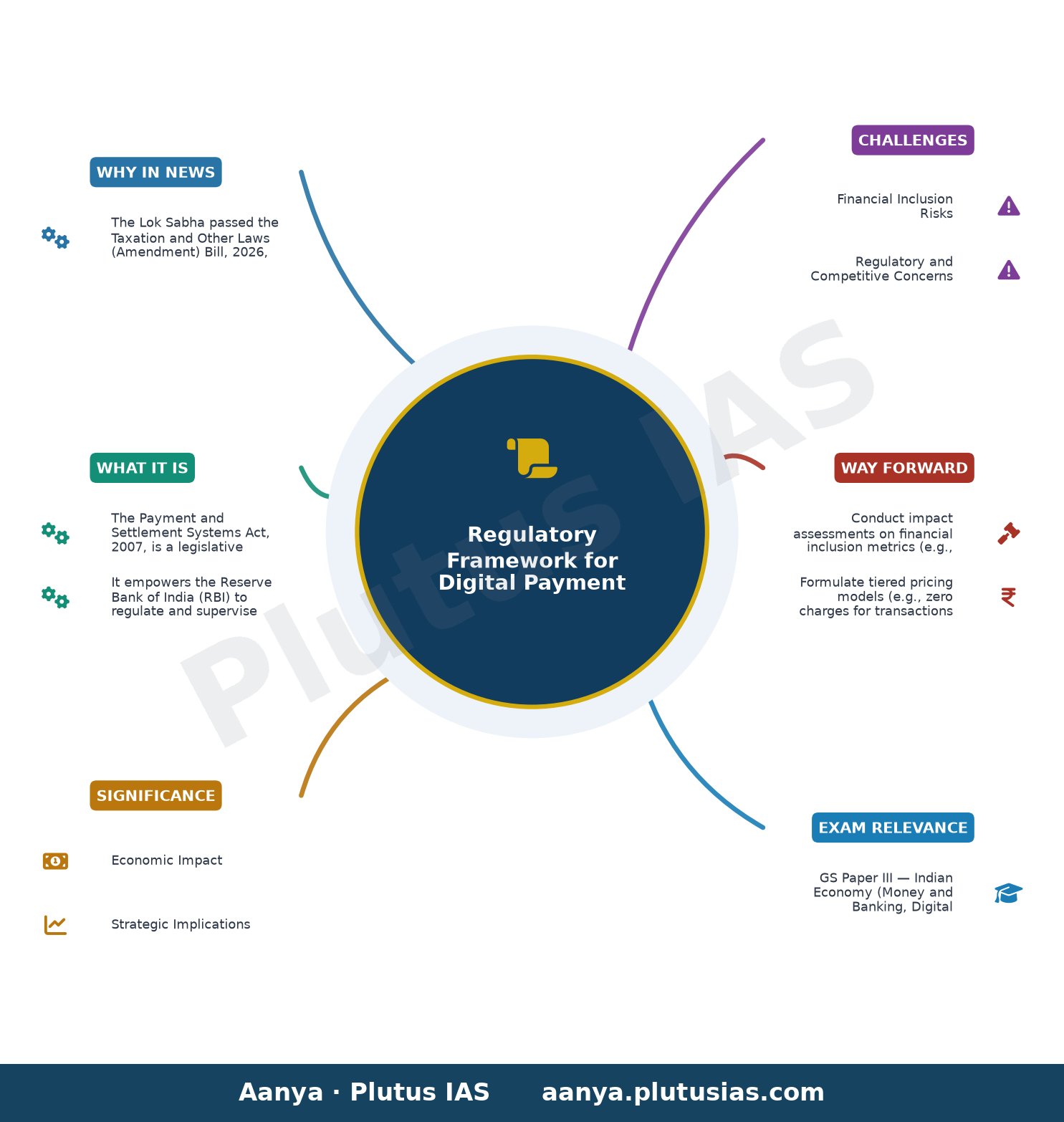
- GS Paper III — Indian Economy (Money and Banking, Digital Payments, Financial Inclusion)
- Prelims: Unified Payments Interface (UPI), Merchant Discount Rate (MDR), Payment and Settlement Systems Act 2007, Digital Payment Ecosystem, Financial Inclusion, RTGS, NEFT, BHIM-UPI, Section 10A of Payment and Settlement Systems Act 2007, Section 269SU of Income Tax Act 1961
- Essay: The Future of Digital Payments in India: Balancing Innovation and Affordability
Quick Revision: The Payment and Settlement Systems Act, 2007, currently prohibits charges on UPI transactions under Section 10A; the proposed amendment empowers the government to notify specific electronic payment modes on which banks and PSPs may levy charges.
Why is this in the news?
The Lok Sabha passed the Taxation and Other Laws (Amendment) Bill, 2026, which includes provisions to amend the Payment and Settlement Systems Act, 2007, enabling the government to authorise banks and payment service providers to levy charges on UPI and other notified electronic payment modes. This development is significant as it marks a potential shift in the long-standing policy of free UPI transactions, raising concerns about the impact on digital payment adoption and financial inclusion.
Background
- The Payment and Settlement Systems Act, 2007, was enacted to regulate payment systems in India, ensuring stability, efficiency, and consumer protection in electronic payments.
- UPI, introduced by the National Payments Corporation of India (NPCI), has been a cornerstone of India’s digital payment revolution, enabling real-time, inter-bank transactions with minimal cost and high convenience.
- Section 10A of the Act currently prohibits banks and payment system providers from imposing charges on electronic payments, including UPI transactions, to promote digital adoption.
- The proposed amendment seeks to replace the existing restrictive clause with a more flexible provision, allowing the government to notify specific electronic payment modes on which charges may be levied.
- The amendment is part of a broader taxation and financial legislation, reflecting the government’s intent to create a sustainable revenue model for banks, payment service providers (PSPs), and infrastructure firms.
What is the Payment and Settlement Systems Act, 2007?
- The Payment and Settlement Systems Act, 2007, is a legislative framework enacted to regulate payment systems in India, ensuring their safety, efficiency, and stability.
- It empowers the Reserve Bank of India (RBI) to regulate and supervise payment systems, including digital payment modes like UPI, NEFT, and RTGS.
- The Act defines the roles and responsibilities of payment system operators, banks, and other stakeholders, while also protecting consumer interests.
- Section 10A of the Act currently prohibits banks and payment system providers from imposing any charges on electronic payments, including UPI transactions.
- The Act is periodically amended to align with technological advancements and evolving market needs, such as the introduction of UPI and other digital payment innovations.
- The Act plays a critical role in fostering a robust digital payment ecosystem, which is essential for financial inclusion and economic growth.
- The proposed amendment seeks to introduce flexibility in charging mechanisms for specific electronic payment modes, subject to government notification.
Key Features
| Feature | Significance |
|---|---|
| Amendment to Payment and Settlement Systems Act, 2007 | Removes legal prohibition on levying charges (MDR) on UPI and other notified electronic payment modes, enabling revenue generation for banks and payment service providers. |
| Substitution in Section 10A of Act, 2007 | Replaces fixed reference to Section 269SU (Income Tax Act) with flexible notification-based specification of electronic modes, allowing future expansion beyond UPI. |
| Exemption from MDR for UPI so far | UPI transactions have been free of charges due to Section 10A, fostering mass adoption and financial inclusion through zero-cost digital payments. |
| Revenue model for digital payments ecosystem | Proposed small charges aim to sustain banks, PSPs, and infrastructure firms while balancing consumer affordability and ecosystem viability. |
| Government’s discretion via notification | Central government may specify which electronic modes attract charges, ensuring adaptability to evolving payment technologies. |
Why it Matters
Economic Impact
- Potential reduction in cross-subsidisation of UPI costs, shifting burden from merchants to end-users, which may impact small businesses and low-income consumers.
- Revenue generation for banks and PSPs could enhance investment in digital payment infrastructure, improving efficiency and security.
- Risk of reduced UPI adoption if charges are perceived as excessive, undermining India’s leadership in real-time digital payments globally.
Strategic Implications
- Aligns with global practices where digital payment charges exist (e.g., credit/debit card fees in many countries), normalising UPI as a paid service.
- May incentivise innovation in alternative low-cost payment modes to circumvent charges, fostering competition.
- Could influence Reserve Bank of India’s (RBI) future regulatory stance on digital payment pricing and interchange fees.
Policy and Governance
- Demonstrates government’s intent to balance fiscal sustainability of digital public infrastructure with inclusivity goals.
- Highlights legislative flexibility in adapting to technological and market changes in payment systems.
- Raises questions about transparency in charge determination and safeguards against arbitrary pricing by dominant players.
Consumer and Market Behaviour
- May lead to behavioural shifts, such as reduced UPI usage for small transactions or increased preference for cash in informal sectors.
- Could accelerate adoption of prepaid instruments or wallets if they remain exempt, altering the competitive landscape.
- Risk of market concentration if only large banks/PSPs can absorb costs, marginalising smaller players.
Challenges
1. Financial Inclusion Risks
- Charges may disproportionately affect low-income users and small merchants, reversing gains in digital inclusion.
- Lack of tiered pricing could discourage adoption in rural and semi-urban areas where digital literacy is lower.
- Potential for exclusion of marginalised groups if alternatives (e.g., Aadhaar-enabled payments) are not prioritised.
UPSC Link: GS3: Digital Payments and Financial Inclusion
2. Regulatory and Competitive Concerns
- Risk of cartelisation if banks/PSPs collude on pricing, necessitating strict oversight by RBI and Competition Commission of India (CCI).
- Uncertainty over interchange fee structures could lead to litigation or market distortions.
- Need for clear guidelines on exemptions (e.g., small transactions, government payments) to prevent arbitrariness.
UPSC Link: GS3: Regulatory Frameworks for Digital Payments
3. Macroeconomic and Fiscal Trade-offs
- Balancing revenue generation with macroeconomic stability, as digital payments drive formalisation and tax compliance.
- Potential inflationary pressures if costs are passed on to consumers, though likely marginal in aggregate.
- Opportunity cost of not utilising UPI’s scale for cross-subsidising other public goods (e.g., healthcare, education).
UPSC Link: GS3: Digital Economy and Fiscal Policy
4. Technological and Infrastructure Gaps
- Charges may exacerbate digital divide if infrastructure (e.g., internet, smartphones) remains inadequate in remote areas.
- Need for robust grievance redressal mechanisms to address disputes over charges or billing errors.
- Risk of cybersecurity vulnerabilities if cost pressures reduce investment in fraud prevention and system upgrades.
UPSC Link: GS3: Digital Infrastructure and Cybersecurity
5. Political and Social Backlash
- Opposition to charges could lead to public protests or political mobilisation, as seen in past debates on digital payment policies.
- Risk of reputational damage to UPI and India’s digital public infrastructure if perceived as regressive.
- Need for proactive communication to explain benefits (e.g., improved services, innovation) to mitigate backlash.
UPSC Link: GS2: Role of Parliament and Public Policy
Challenges — UPSC Perspective
| Issue | Concern |
|---|---|
| Regressive impact on low-income users | Charges may widen the digital divide and reduce financial inclusion gains. |
| Regulatory arbitrage and collusion | Lack of clear pricing rules could lead to anti-competitive practices by dominant players. |
| Macroeconomic uncertainty | Unclear fiscal impact of charges on consumption, savings, and tax compliance. |
| Infrastructure bottlenecks | Inadequate digital infrastructure in rural areas may exacerbate exclusion. |
| Public perception and trust | Perceived as a reversal of pro-poor digital policies, risking social cohesion. |
| Interoperability and fragmentation | Differential charges across payment modes could disrupt seamless transactions. |
Way Forward
- Conduct impact assessments on financial inclusion metrics (e.g., UPI usage in rural areas) post-implementation.
- Formulate tiered pricing models (e.g., zero charges for transactions below ₹500) to protect vulnerable users.
- Strengthen RBI’s oversight on interchange fees and anti-competitive practices in digital payments.
- Enhance digital literacy campaigns in collaboration with state governments to mitigate exclusion risks.
- Introduce sunset clauses for charges to review their necessity after 2–3 years, ensuring adaptability.
- Develop grievance redressal mechanisms for disputes related to billing or service quality.
- Promote alternative low-cost payment modes (e.g., Aadhaar Pay, offline UPI) to diversify options.
- Ensure transparency in charge determination through public consultations and regulatory consultations.
UPSC Value Addition
Keywords for Mains Answer-Writing
Payment and Settlement Systems Act, 2007 · Unified Payments Interface (UPI) · Merchant Discount Rate (MDR) · Digital payments ecosystem · Taxation and Other Laws (Amendment) Bill, 2026 · Section 10A of the Payment and Settlement Systems Act, 2007 · Section 269SU of the Income Tax Act, 1961 · Financial inclusion and digital public infrastructure · Regulatory framework for electronic payment systems · Sustainable revenue models for banks and payment service providers · Parliamentary procedures and legislative amendments · Opposition’s role in legislative debates
Concept Flow
Zero-cost UPI ecosystem → Legal prohibition under Section 10A (Act, 2007) → High adoption and financial inclusion → Government amends Act to permit charges → Potential revenue for banks/PSPs → Risk of reduced adoption and exclusion → Need for safeguards (tiered pricing, exemptions) → Regulatory oversight and public consultation → Balanced digital payment ecosystem.
Prelims Practice Questions
Q1. Consider the following statements regarding the Payment and Settlement Systems Act, 2007:
1. Section 10A of the Act prohibits banks and system providers from imposing any charges on electronic payments.
2. Section 269SU of the Income Tax Act, 1961 mandates large businesses to accept payments through specific electronic modes, including RuPay debit cards and BHIM-UPI QR codes.
3. The Taxation and Other Laws (Amendment) Bill, 2026 seeks to introduce charges on UPI transactions without amending the Payment and Settlement Systems Act, 2007.
How many of the above statements are correct?
- Only one
- Only two
- All three
- None
Answer: Only two — Statement 1 and 2 are correct as per the Act and the Income Tax Act. Statement 3 is incorrect because the Bill specifically amends the Payment and Settlement Systems Act, 2007 to permit charges on UPI transactions.
Q2. Assertion (A): The Payment and Settlement Systems Act, 2007, as amended by the Taxation and Other Laws (Amendment) Bill, 2026, empowers the government to permit banks to levy charges on UPI transactions.
Reason (R): The amendment removes the existing legal provision that prevents banks and payment service providers from charging Merchant Discount Rate (MDR) on notified electronic payment modes.
In the context of the above two statements, which one of the following is correct?
- Both A and R are true, and R is the correct explanation of A.
- Both A and R are true, but R is not the correct explanation of A.
- A is true, but R is false.
- A is false, but R is true.
Answer: Both A and R are true, and R is the correct explanation of A. — Both the Assertion (A) and Reason (R) are true, and R correctly explains A as the amendment directly addresses the removal of the prohibition on MDR charges.
Q3. Match the following columns:
Column I (Provisions)
A. Section 10A of the Payment and Settlement Systems Act, 2007
B. Section 269SU of the Income Tax Act, 1961
C. Merchant Discount Rate (MDR)
D. Unified Payments Interface (UPI)
Column II (Description)
1. Mandates large businesses to accept payments through specific electronic modes
2. Prohibits banks from imposing charges on electronic payments
3. A fee charged to merchants for processing card payments
4. A real-time payment system facilitating inter-bank transactions
Select the correct match:
- A-2, B-1, C-3, D-4
- A-1, B-2, C-3, D-4
- A-3, B-4, C-1, D-2
- A-4, B-3, C-2, D-1
Answer: A-2, B-1, C-3, D-4 — The correct matches are: A-2 (Section 10A prohibits charges), B-1 (Section 269SU mandates acceptance of electronic payments), C-3 (MDR is a fee charged to merchants), and D-4 (UPI is a real-time payment system).
Mains Practice Question
✍ The Taxation and Other Laws (Amendment) Bill, 2026 seeks to amend the Payment and Settlement Systems Act, 2007 to permit banks to levy charges on UPI transactions. Critically examine the implications of this amendment for the digital payments ecosystem, financial inclusion, and the regulatory framework governing electronic payments in India. (15 Marks)
Approach: MODEL-ANSWER SKELETON:
1. **Context and Legislative Change**:
– Briefly explain the Payment and Settlement Systems Act, 2007 and Section 10A.
– Highlight the proposed amendment in the Taxation and Other Laws (Amendment) Bill, 2026 to permit MDR charges on UPI transactions.
– Mention the removal of the prohibition under Section 10A and its linkage with Section 269SU of the Income Tax Act, 1961.
2. **Implications for Digital Payments Ecosystem**:
– **Revenue Model for Banks and PSPs**: Discuss how the amendment could provide a sustainable revenue model for banks, payment service providers (PSPs), and infrastructure firms (e.g., NPCI).
– **Impact on UPI Adoption**: Analyze whether the imposition of charges could deter small businesses and consumers from using UPI, given its current free and seamless nature.
– **Competitive Dynamics**: Examine the potential shift in consumer behavior towards other payment modes (e.g., credit/debit cards, wallets) if UPI charges are introduced.
3. **Financial Inclusion Concerns**:
– **Barrier to Inclusion**: Argue how charges on UPI transactions could disproportionately affect low-income users and small merchants, undermining the goal of financial inclusion.
– **Digital Divide**: Discuss the risk of widening the digital divide if UPI, a key driver of digital inclusion, becomes costly.
4. **Regulatory and Policy Framework**:
– **Government’s Rationale**: Outline the government’s stated objective of ensuring a sustainable revenue model while balancing consumer protection.
– **Regulatory Oversight**: Critically assess whether the amendment aligns with the Reserve Bank of India’s (RBI) guidelines on differential MDR structures and its broader vision for a cashless economy.
– **Comparative Perspective**: Compare India’s approach with global practices (e.g., Singapore’s PayNow, Sweden’s digital payment ecosystem) where UPI-like systems remain free or low-cost.
5. **Balancing Views and Way Forward**:
– Present arguments for and against the amendment (e.g., sustainability vs. inclusion).
– Suggest measures to mitigate adverse effects, such as tiered pricing, subsidies for small merchants, or caps on MDR charges.
– Conclude with a balanced view on whether the amendment strikes the right balance between economic viability and social equity.
Source: The Hindu
Generated by AanyaAi for educational purpose.

- UPSC Civil Services (Main) Examination 2026 — Animal Husbandry and Veterinary Science Optional Paper I: Question Paper | Plutus IAS - September 21, 2026
- UPSC Civil Services (Main) Examination 2026 — Malayalam (Compulsory): Question Paper | Plutus IAS - September 21, 2026
- यूएन महासभा में भारत के विदेश मंत्री जयशंकर के उच्चस्तरीय दौरे का महत्व - September 21, 2026

No Comments