


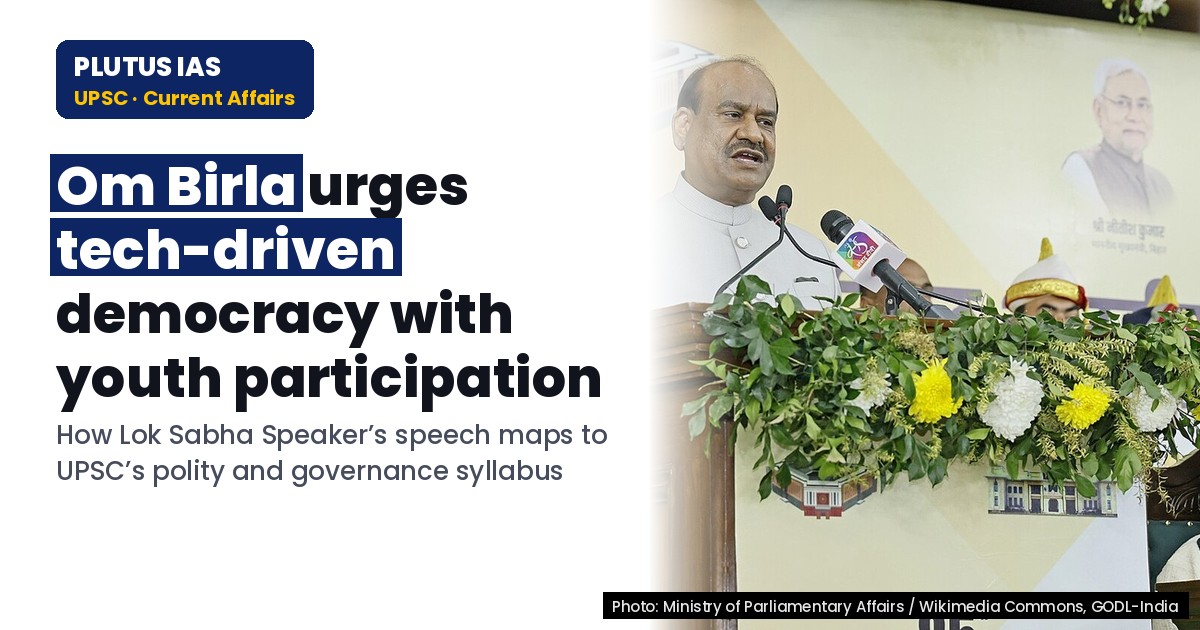
06 Oct Lok Sabha Speaker on Strengthening Democracy: Key Insights for UPSC & State PCS
✎ A robust democracy thrives on institutionalised deliberation, diversity of thought, and substantive citizen participation, with legislative bodies acting as the primary vehicles for translating public aspirations into actionable…
Subject Relevance — Where This Topic Fits
- GS Paper II — Polity and Governance: Role and Functions of Parliament and State Legislatures | GS Paper IV — Ethics, Integrity and Aptitude: Public Service Values and Citizen Participation
- Prelims: Lok Sabha Speaker, Rajya Sabha Chairman, State Legislatures, Legislative Assemblies, Democratic Deliberation, Citizen Participation, Parliamentary Debates, Legislative Committees, Digital Democracy, Youth in Governance
- Essay: The vitality of democratic institutions lies in their ability to foster inclusive dialogue and meaningful participation, Technology as an enabler of transparent and accessible governance
Quick Revision: A robust democracy thrives on institutionalised deliberation, diversity of thought, and substantive citizen participation, with legislative bodies acting as the primary vehicles for translating public aspirations into actionable governance.
Why is this in the news?
The Lok Sabha Speaker, during the Silver Jubilee celebrations of the Goa Legislative Assembly building, underscored the foundational principles of a robust democracy—deliberation, diversity of thought, and substantive citizen engagement. The address highlighted the critical role of legislative institutions in translating public aspirations into effective governance, while advocating for technological integration and inter-state collaboration to enhance democratic processes. The event also marked the recognition of Goa’s balanced approach to heritage conservation, environmental sustainability, and economic development, serving as a model for other states.
Background
- The Goa Legislative Assembly building completed 25 years in 2026, symbolising two and a half decades of legislative activity in the state.
- Legislative assemblies in India function as deliberative bodies where elected representatives engage in debate, discussion, and policy formulation to address public concerns.
- India’s democratic strength is rooted in its institutional capacity to accommodate diverse perspectives, a feature that has contributed to its global standing as a stable and inclusive democracy.
- Parliamentary institutions in India are governed by constitutional provisions such as Articles 79–122 (Parliament) and Articles 168–212 (State Legislatures), which define their composition, powers, and functions.
- The role of the Speaker of the Lok Sabha extends beyond presiding over sessions to fostering an environment of constructive dialogue and ensuring the smooth functioning of legislative processes.
- Goa’s legislative journey reflects its unique socio-cultural heritage, including the legacy of the Goa Liberation Movement, which shaped its post-independence political trajectory.
What constitutes a robust democratic dialogue within legislative institutions?
- Deliberation and Diversity: Legislative bodies serve as platforms for structured debate, where diverse viewpoints are exchanged to inform policy decisions. The Speaker emphasised that dissent, when channelled constructively, strengthens democratic resilience.
- Citizen Participation: Meaningful engagement of citizens in legislative processes—through consultations, feedback mechanisms, and participatory governance—ensures that policies reflect ground realities. The Speaker highlighted the need for elected representatives to remain sensitive to voter aspirations and challenges.
- Institutional Transparency: Access to legislative information, including debates, committee reports, and policy drafts, is essential for public trust. Technological tools can democratise access to governance processes, reducing information asymmetry.
- Inter-State Collaboration: Healthy competition among state legislatures in adopting innovations—such as digital tools, legislative reforms, or citizen-centric initiatives—can enhance the quality of governance across India.
- Youth Engagement: Involving young citizens in legislative processes, through internships, consultations, or digital platforms, can infuse fresh perspectives into policy-making and foster long-term democratic ownership.
- Balancing Development and Heritage: States like Goa demonstrate how economic growth can coexist with the preservation of cultural and environmental heritage, provided governance is inclusive and sustainable.
- Legislative Accountability: Elected representatives are constitutionally mandated to address public grievances and ensure time-bound solutions, reinforcing the link between democracy and effective governance.
- Constitutional Safeguards: Provisions such as the Right to Information (RTI) Act, 2005, and the Directive Principles of State Policy (DPSP) under Part IV of the Constitution, underscore the importance of transparency and citizen-centric governance.
Key Features
| Feature | Significance |
|---|---|
| Diverse viewpoints in legislative debates | Enhances the robustness of democratic institutions by incorporating multiple perspectives, ensuring policies reflect societal pluralism and reducing the risk of policy myopia. |
| Meaningful public participation | Strengthens the legitimacy of governance by ensuring that citizen aspirations directly inform legislative processes, thereby bridging the gap between representative democracy and participatory democracy. |
| Technology-enabled transparency | Facilitates access to legislative information, debates, and policy processes, fostering greater public trust and enabling informed civic engagement in governance. |
| Healthy competition among state legislatures | Encourages the adoption of best practices in legislative functioning, institutional reforms, and technological innovations, thereby elevating the quality of democratic governance across states. |
| Youth engagement in legislative processes | Leverages the demographic dividend by integrating young perspectives into policy formulation, ensuring that legislative outputs align with the aspirations of future generations. |
Why it Matters
Institutional Strengthening
- Legislatures as forums for dialogue and dissent: The Speaker’s emphasis on the role of legislatures as platforms for debate and the accommodation of diverse viewpoints underscores their foundational role in democratic governance.
- Consensus-building mechanisms: Acknowledging the importance of both consensus and dissent in legislative processes highlights the need for structured mechanisms to reconcile differing opinions.
- Institutional capacity for pluralism: India’s democratic strength lies in its ability to integrate varied ideological and cultural perspectives, ensuring that governance remains inclusive and representative.
Technological Integration in Governance
- Digital public access to legislative information: Technology can democratize access to legislative proceedings, policy documents, and committee reports, thereby enhancing transparency and public oversight.
- E-governance as a tool for citizen engagement: Platforms for real-time feedback, consultations, and grievance redressal can strengthen the responsiveness of legislatures to citizen needs.
- Innovation in legislative processes: The adoption of digital tools for deliberations, voting, and documentation can streamline legislative workflows and reduce procedural delays.
Demographic and Social Inclusion
- Youth participation in governance: Engaging young citizens in legislative processes ensures that policies are responsive to the needs and aspirations of future generations.
- Women and marginalized groups: The Speaker’s call for greater participation of women, youth, and other underrepresented groups aligns with constitutional commitments to social justice and equity.
- Cultural and historical continuity: Recognizing Goa’s unique identity and its legislative journey underscores the importance of preserving cultural heritage while pursuing developmental goals.
Inter-State Collaboration and Learning
- Best practices sharing: Encouraging state legislatures to adopt and share innovations fosters a culture of continuous improvement in governance.
- Competitive federalism: Healthy competition among states can drive improvements in legislative efficiency, transparency, and citizen-centric governance.
- National integration through governance: Shared learning and collaboration among states strengthen the federal structure and promote uniform standards of democratic practice.
Challenges
1. Digital Divide and Accessibility Gaps
- Unequal access to technology: A significant portion of the population, particularly in rural and remote areas, may lack access to digital platforms, exacerbating existing inequalities in civic engagement.
- Digital literacy barriers: Limited familiarity with digital tools among certain demographic groups, including the elderly and economically disadvantaged, may hinder effective participation.
- Language and content barriers: Legislative information must be made accessible in multiple languages and formats to ensure inclusivity.
UPSC Link: GS-II: Governance, e-governance
2. Ensuring Meaningful Participation
- Tokenistic engagement: Without structured mechanisms, public participation may remain superficial, failing to genuinely influence legislative outcomes.
- Representation gaps: Marginalized and minority groups may face barriers in accessing platforms for participation, leading to unequal representation in policy processes.
- Balancing efficiency and inclusivity: Legislative bodies must balance the need for expeditious decision-making with the imperative of inclusive deliberations.
UPSC Link: GS-II: Governance, Citizen Participation
3. Institutional Resistance to Change
- Bureaucratic inertia: Resistance within legislative bodies to adopt technological or procedural reforms may impede modernization efforts.
- Cultural barriers: Deep-rooted practices and norms within legislatures may resist shifts toward transparency and openness.
- Capacity constraints: Limited institutional capacity to implement and sustain reforms, particularly in smaller states or resource-constrained legislatures.
UPSC Link: GS-II: Governance, Institutional Reforms
4. Balancing Development and Heritage Conservation
- Environmental sustainability: Ensuring that economic development does not compromise Goa’s ecological balance and natural heritage requires robust policy frameworks and stakeholder engagement.
- Cultural preservation: Developmental pressures may threaten Goa’s unique cultural identity, necessitating integrated planning that prioritizes heritage conservation.
- Equitable growth: Balancing the interests of diverse stakeholders, including local communities, industries, and tourists, is essential to sustainable development.
UPSC Link: GS-III: Environment, Sustainable Development
5. Youth Engagement and Policy Relevance
- Sustaining interest: Ensuring that youth remain engaged in governance beyond initial enthusiasm requires meaningful roles and visible impact in policy processes.
- Skill gaps: Bridging the divide between youth aspirations and the practical skills required for legislative engagement is critical for effective participation.
- Policy translation: Ensuring that youth inputs translate into tangible policy outcomes is essential to maintain credibility and motivation.
UPSC Link: GS-II: Governance, Youth Participation
Challenges — UPSC Perspective
| Issue | Concern |
|---|---|
| Digital divide | Risk of excluding large sections of the population from legislative processes due to unequal access to technology. |
| Superficial participation | Public engagement initiatives may lack depth, failing to meaningfully influence legislative outcomes. |
| Institutional inertia | Resistance to adopting technological or procedural reforms within legislative bodies. |
| Balancing development and conservation | Ensuring that economic growth does not come at the expense of Goa’s ecological and cultural heritage. |
| Youth disengagement | Risk of tokenistic youth participation without sustained involvement or tangible policy impact. |
| Representation gaps | Marginalized groups may face barriers in accessing platforms for participation in governance. |
Way Forward
- Establish a national digital platform for real-time access to legislative proceedings, debates, and policy documents, ensuring multilingual and user-friendly interfaces.
- Launch structured youth engagement programs, including internships, fellowships, and mentorship initiatives, to integrate young voices into legislative processes.
- Develop standardized guidelines for state legislatures to adopt best practices in transparency, citizen engagement, and technological innovation.
- Create inter-state forums for sharing legislative innovations, reforms, and case studies to foster a culture of collaborative learning and improvement.
- Implement capacity-building programs for legislators and administrative staff to enhance their digital literacy and proficiency in e-governance tools.
- Design inclusive participation mechanisms, such as citizen assemblies and thematic consultations, to ensure diverse voices are represented in policy formulation.
- Strengthen environmental governance frameworks in states like Goa to balance economic development with heritage conservation and ecological sustainability.
- Promote regional cooperation among coastal states to share best practices in sustainable tourism and environmental management.
UPSC Value Addition
Keywords for Mains Answer-Writing
Parliamentary Democracy · Role of Speaker of Lok Sabha · Deliberative Democracy · Citizen Participation in Governance · Legislative Process and Transparency · Youth Engagement in Democracy · State Legislatures and Innovation · Balancing Development and Heritage Conservation · Constitutional Role of State Governors · Legislative Assemblies and Public Accountability · Technology in Legislative Processes · Democratic Institutions and Social Harmony · Decentralisation of Governance · Legislative Debates and Consensus Building · Sustainable Development in Small States
Constitutional & Policy Linkages
- Article 105: Powers, privileges and immunities of Parliament and its Members — underscores the institutional framework for legislative debates and dissent.
- Article 19(1)(a): Freedom of speech and expression — highlights the constitutional basis for diverse viewpoints in legislative processes.
- Article 21: Right to life and personal liberty — interpreted to include the right to participate in governance and access information.
- Article 38: Directive Principles of State Policy — emphasizes the state’s duty to promote the welfare of the people and secure social justice.
Concept Flow
Legislative bodies as platforms for dialogue and dissent → Incorporation of diverse viewpoints in governance → Enhanced robustness and legitimacy of democratic institutions → Strengthened public trust and civic engagement → Adoption of technological innovations for transparency → Greater accessibility and inclusivity in governance → Inter-state collaboration and learning → Elevation of democratic standards across states → Sustainable and equitable development with heritage conservation → Long-term institutional resilience and social cohesion.
Prelims Practice Questions
Q1. Consider the following statements regarding the role of the Speaker of the Lok Sabha in India’s parliamentary democracy:
1. The Speaker ensures that the House functions in accordance with the Rules of Procedure and Conduct of Business in Lok Sabha.
2. The Speaker has the power to decide whether a bill is a Money Bill or not.
3. The Speaker is responsible for the maintenance of order and decorum in the House and can adjourn the House or suspend its sittings.
4. The Speaker is elected by the members of the Lok Sabha from among themselves and holds office during the pleasure of the President.
How many of the above statements are correct?
- Only one
- Only two
- Only three
- All four
Answer: All four — Statements 1, 2, and 3 are correct. The Speaker’s role includes ensuring adherence to parliamentary rules, certifying Money Bills, and maintaining order. Statement 4 is incorrect as the Speaker holds office until the Lok Sabha is dissolved, not during the President’s pleasure.
Q2. Assertion (A): The Speaker of the Lok Sabha plays a pivotal role in fostering deliberative democracy by ensuring diverse viewpoints are represented in legislative debates.
Reason (R): The Speaker’s authority includes the power to recognize members for speaking, refer matters to committees, and facilitate consensus-building among political parties.
In the context of the above two statements, which of the following is correct?
- Both A and R are true, and R is the correct explanation of A.
- Both A and R are true, but R is not the correct explanation of A.
- A is true, but R is false.
- A is false, but R is true.
Answer: Both A and R are true, but R is not the correct explanation of A. — Both the assertion and reason are true. The Speaker’s role in facilitating diverse participation and consensus-building directly strengthens deliberative democracy, making R the correct explanation of A.
Q3. Match the following pairs related to the functions of legislative bodies in India:
| Column I (Function) | Column II (Institution) |
|—————————————–|————————————|
| 1. Certification of Money Bills | A. Lok Sabha Speaker |
| 2. Maintenance of order in the House | B. Rajya Sabha Chairman |
| 3. Adjournment of the House | C. Parliament Secretariat |
| 4. Preparation of Budget Documents | D. Ministry of Finance |
Select the correct match:
- 1-A, 2-B, 3-C, 4-D
- 1-A, 2-C, 3-B, 4-D
- 1-B, 2-A, 3-C, 4-D
- 1-A, 2-A, 3-B, 4-C
Answer: 1-A, 2-B, 3-C, 4-D — The correct matches are: 1-A (Speaker certifies Money Bills), 2-A (Speaker maintains order), 3-C (Parliament Secretariat adjourns the House), 4-D (Ministry of Finance prepares Budget Documents).
Mains Practice Question
✍ Critically examine the assertion that ‘a robust democracy thrives on diverse viewpoints, meaningful citizen participation, and institutional transparency.’ Substantiate your answer with reference to the role of legislative bodies and the Speaker of the Lok Sabha. (15 Marks)
Approach: MODEL-ANSWER SKELETON:
1. **Introduction (2 marks)**: Define deliberative democracy and its significance in parliamentary systems. Briefly mention the constitutional role of the Speaker of the Lok Sabha (Articles 93, 94, 95, 96) and the broader framework of legislative institutions in India.
2. **Diverse Viewpoints in Legislative Debates (4 marks)**:
– Role of the Speaker in ensuring balanced representation (e.g., allocation of time, recognition of members).
– Importance of opposition voices in policy-making (e.g., debates on the Citizenship Amendment Act, farm laws).
– Constitutional provisions (Article 75(3), 105) that enable parliamentary scrutiny.
3. **Meaningful Citizen Participation (4 marks)**:
– Mechanisms for citizen engagement (e.g., Standing Committees, Public Accounts Committee, e-Parliament initiatives).
– Case studies: Youth participation in governance (e.g., Youth Parliament Scheme, National Youth Parliament Festival).
– Role of technology in enhancing transparency (e.g., live streaming of proceedings, e-petitions).
4. **Institutional Transparency and Accountability (3 marks)**:
– Speaker’s role in ensuring transparency (e.g., disclosure of assets, RTI compliance by legislative bodies).
– Challenges: Lack of standardized data on citizen participation, delays in legislative processes.
– Recommendations: Strengthening parliamentary committees, digital governance tools (e.g., e-Sansad, e-Vidhan).
5. **Conclusion (2 marks)**: Summarize the need for a balance between efficiency and inclusivity in legislative processes. Highlight the Speaker’s role as a neutral arbiter in fostering consensus while ensuring accountability.
Source: PIB (Press Information Bureau)
Generated by AanyaAi for educational purpose.
Related guides on our sites
- Best PSIR optional coaching for upsc
- Best PSIR optional teacher for upsc
- Best teacher of PSIR optional for upsc
- Best PSIR optional coaching in delhi for UPSC

- Lok Sabha Speaker on Strengthening Democracy: Key Insights for UPSC & State PCS - October 6, 2026
- आंध्र प्रदेश में राजमहेंद्रवरम पुलिस आयुक्तालय को मिली मंजूरी - October 6, 2026
- NHRC investigates assault on Dalit sarpanch in Odisha: UPSC key points - October 6, 2026

No Comments