


08 Aug Lok Sabha to Introduce National Tribunal Commission Bill Next Week
✎ The National Tribunals Commission (NTC) is a proposed statutory body to ensure independent, transparent, and merit-based appointments to tribunals, replacing the executive-led system struck down by the Supreme Court.
Subject Relevance — Where This Topic Fits
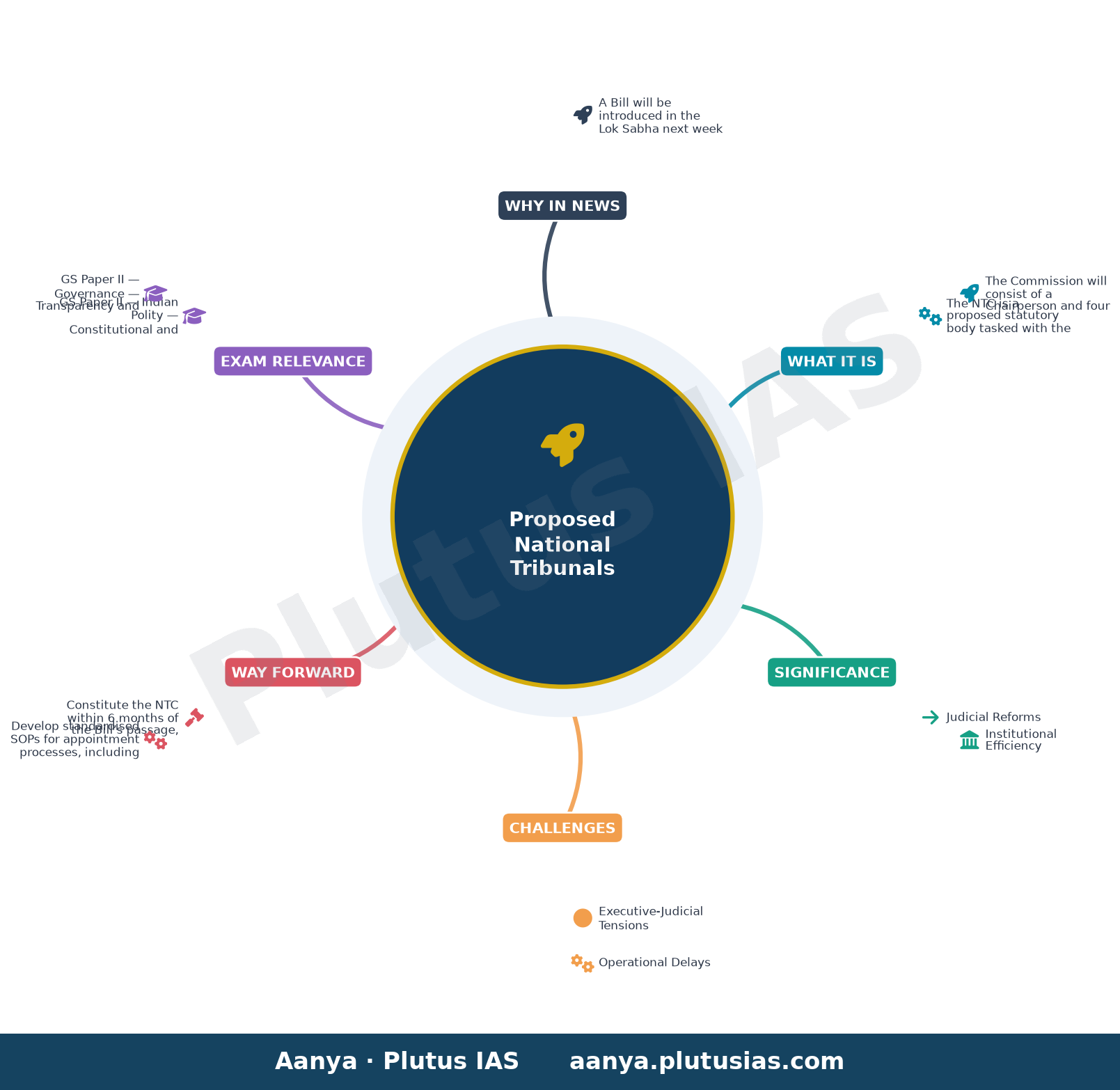
- GS Paper II — Indian Polity — Constitutional and Statutory Bodies | GS Paper II — Governance — Transparency and Accountability in Administration
- Prelims: Tribunal Reforms Act, 2021, National Tribunals Commission (NTC), Supreme Court directives on tribunal appointments, Separation of Powers, Judicial Independence
- Essay: The judiciary must remain independent of executive interference to uphold constitutional democracy, Institutional mechanisms for transparency and accountability in governance
Quick Revision: The National Tribunals Commission (NTC) is a proposed statutory body to ensure independent, transparent, and merit-based appointments to tribunals, replacing the executive-led system struck down by the Supreme Court.
Why is this in the news?
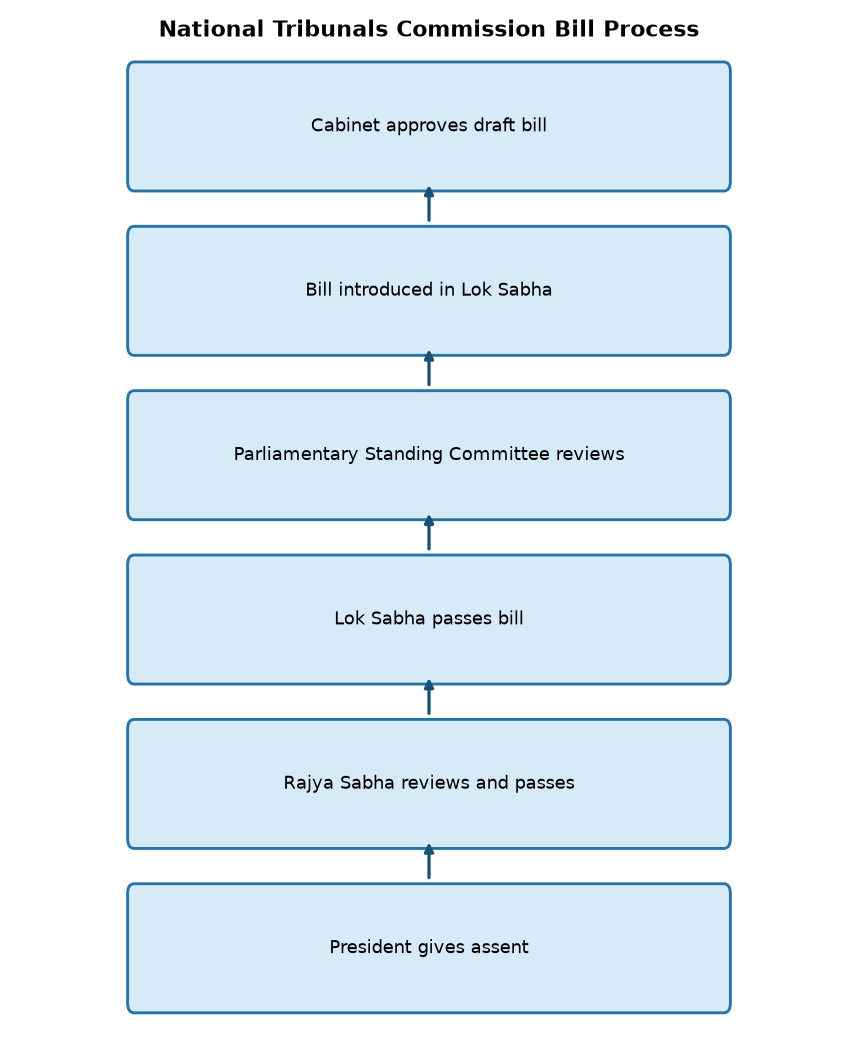
A Bill will be introduced in the Lok Sabha next week to establish a National Tribunals Commission (NTC) for the appointment of Chairpersons and Members of various tribunals. This legislative initiative follows the Supreme Court’s judgment striking down key provisions of the Tribunal Reforms Act, 2021, citing violations of the doctrine of separation of powers and judicial independence. The proposed NTC aims to institutionalise transparent, merit-based, and independent appointment processes for tribunals, addressing long-standing concerns over executive overreach in judicial appointments.
Background
- The Tribunal Reforms Act, 2021, was enacted to streamline the functioning of tribunals and reduce the backlog of cases pending before various judicial bodies.
- The Supreme Court recently struck down certain provisions of the Act, including those related to the composition and powers of the search-cum-selection committees for tribunal appointments.
- The Court held that the Act violated the principle of separation of powers by vesting excessive control over tribunal appointments in the executive, thereby compromising judicial independence.
- The Supreme Court directed the Union Government to constitute an independent National Tribunals Commission (NTC) to oversee the selection and appointment of tribunal members.
- The proposed NTC is intended to replace the existing system of ad-hoc and executive-led appointments with a structured, transparent, and professional mechanism.
- The Bill is expected to be tabled in the Lok Sabha during the upcoming monsoon session, marking a significant step toward judicial reform.
What is the National Tribunals Commission (NTC)?
- The NTC is a proposed statutory body tasked with the appointment of Chairpersons and Members of various tribunals in India, ensuring independence, transparency, and professionalism in the selection process.
- The Commission will consist of a Chairperson and four Members, including two judicial members (retired Supreme Court judges or retired Chief Justices of High Courts) and two technical members with domain expertise in relevant fields.
- The NTC will operate independently of the executive, thereby safeguarding judicial appointments from political interference and ensuring adherence to constitutional principles.
- The proposed body will establish clear eligibility criteria, selection procedures, and performance benchmarks for tribunal members, reducing subjectivity and favouritism in appointments.
- The NTC will also monitor the functioning of tribunals, ensuring accountability and efficiency in their operations, and may recommend disciplinary action or removal of members in cases of misconduct or underperformance.
- The establishment of the NTC aligns with the Supreme Court’s directive, which emphasised the need for an independent mechanism to oversee tribunal appointments.
- The NTC is expected to replace the existing system of executive-led appointments, which has been criticised for lacking transparency and undermining judicial independence.
Key Features
| Feature | Significance |
|---|---|
| National Tribunals Commission (NTC) | Establishes a statutory, independent body to oversee appointments to tribunals, ensuring institutional autonomy and reducing executive interference. |
| Composition: Chairperson + 4 Members | Includes two judicial members (retired SC/HC judges) and two technical members (domain experts), balancing legal and functional expertise. |
| Transparent Selection Process | Standardised eligibility criteria, merit-based recruitment, and public consultation mechanisms to enhance credibility. |
| Tenure and Removal Provisions | Fixed terms for members with safeguards against arbitrary removal, aligning with judicial independence principles. |
| Repeal of Tribunals Reforms Act, 2021 | Replaces the Act, addressing SC’s concerns over separation of powers and adherence to judicial precedents. |
Why it Matters
Judicial Reforms
- Strengthens the separation of powers by insulating tribunals from executive influence, a core constitutional principle.
- Aligns with the Supreme Court’s directive in Rojer Mathew v. South India Bank Ltd. (2020) to establish an independent appointments body.
- Ensures uniformity in appointment standards across 26+ tribunals, reducing ad-hocism and favouritism.
Institutional Efficiency
- Reduces pendency in tribunals by appointing qualified, full-time members with domain expertise.
- Enhances functional independence of tribunals, critical for specialised dispute resolution (e.g., NCLT, ITAT, CAT).
- Promotes consistency in judicial outcomes, fostering investor confidence in regulatory frameworks.
Constitutional Safeguards
- Upholds Article 50 (separation of judiciary) by ensuring judicial appointments are not controlled by the executive.
- Complies with the doctrine of ‘institutional competence’ as outlined in the Second and Third Judges Cases.
- Mitigates risks of ‘judicial overreach’ by clearly delineating the NTC’s role vis-à-vis tribunals.
Economic Governance
- Bolsters ease of doing business by ensuring predictable, meritocratic tribunal appointments in commercial disputes.
- Strengthens regulatory bodies (e.g., SEBI, CCI) by reducing delays in dispute resolution.
- Supports the ‘Minimum Government, Maximum Governance’ principle through streamlined administrative processes.
Challenges
1. Executive-Judicial Tensions
- Risk of executive overreach in appointments if the NTC’s autonomy is compromised by political interference.
- Potential conflict between the NTC’s recommendations and existing parliamentary oversight mechanisms.
UPSC Link: GS-II: Separation of Powers
2. Operational Delays
- Slow implementation due to bureaucratic hurdles in setting up the NTC’s secretariat and recruitment processes.
- Likelihood of prolonged vacancies in tribunals if the NTC faces capacity constraints.
UPSC Link: GS-II: Judicial Appointments
3. Expertise Shortages
- Difficulty in recruiting domain experts (e.g., tax, telecom) due to stringent eligibility criteria and competitive compensation gaps.
- Risk of ‘revolving door’ appointments where experts prioritise private sector over tribunal roles.
UPSC Link: GS-II: Tribunals
4. Judicial Precedent Compliance
- Ensuring the NTC’s processes align with evolving SC rulings (e.g., Madras Bar Association v. Union of India, 2021).
- Balancing flexibility in appointments with the need for judicial consistency across tribunals.
UPSC Link: GS-II: Judicial Review
5. Resource Allocation
- High fiscal burden in establishing the NTC’s infrastructure, training, and digital platforms for transparent processes.
- Potential underutilisation if tribunals continue to rely on ad-hoc appointments despite the NTC’s existence.
UPSC Link: GS-III: Fiscal Federalism
Challenges — UPSC Perspective
| Issue | Concern |
|---|---|
| Appointment Delays | Risk of prolonged vacancies in tribunals due to bureaucratic or legal hurdles in NTC’s functioning. |
| Expertise Gaps | Shortage of qualified domain experts willing to serve on tribunals, impacting decision quality. |
| Political Interference | Possibility of executive pressure on the NTC to favour certain candidates or dilute selection criteria. |
| Judicial Overreach | Tension between the NTC’s recommendations and the judiciary’s role in interpreting tribunal appointments. |
| Implementation Costs | High initial costs for setting up the NTC’s secretariat, digital platforms, and training programs. |
| Monitoring Mechanisms | Challenge of ensuring the NTC’s decisions are implemented uniformly across 26+ tribunals. |
Way Forward
- Constitute the NTC within 6 months of the Bill’s passage, ensuring a diverse and expert-led composition.
- Develop standardised SOPs for appointment processes, including merit-based evaluations and public disclosures.
- Establish a dedicated secretariat for the NTC with digital tools for transparent recruitment and grievance redressal.
- Collaborate with judicial academies and domain-specific institutions to identify and train potential members.
- Enact safeguards against arbitrary removals, including a judicial review mechanism for NTC decisions.
- Pilot the NTC’s functioning in 3-4 major tribunals (e.g., NCLT, ITAT, CAT) before nationwide rollout.
- Conduct periodic audits of the NTC’s performance by a parliamentary committee to ensure accountability.
- Amend the Tribunals Reforms Act, 2021, to align it with the NTC’s framework and repeal redundant provisions.
UPSC Value Addition
Keywords for Mains Answer-Writing
National Tribunals Commission Bill 2026 · Tribunal reforms in India · Supreme Court directives on tribunals · Separation of powers and judicial independence · Appointment process for tribunal members · Judicial and technical expertise in tribunals · Transparency in judicial appointments · Tribunal Reforms Act 2021 · Constitutional validity of tribunal appointments · Judicial review and tribunal autonomy
Constitutional & Policy Linkages
- Article 50: Separation of Judiciary from Executive (ensuring tribunal autonomy).
- Article 14: Equality before Law (standardised appointment criteria).
- Article 227: High Court’s power of superintendence over tribunals (functional oversight).
Concept Flow
Supreme Court’s directive (2020-21) → Need for independent appointments body → Proposal for NTC → Legislative action (Tribunals Reforms Bill) → Parliamentary scrutiny → Enactment → NTC constitution → Transparent appointments → Reduced pendency → Strengthened judicial independence.
Prelims Practice Questions
Q1. Consider the following statements regarding the proposed National Tribunals Commission (NTC):
1. The NTC will be headed by a retired Chief Justice of India.
2. The NTC will include two judicial members and two technical members.
3. The NTC will be responsible for the appointment, tenure, and performance evaluation of tribunal members.
How many of the above statements are correct?
- Only one
- Only two
- All three
- None
Answer: All three — Statements 2 and 3 are correct. Statement 1 is incorrect as the NTC will be headed by a retired Supreme Court judge or a retired Chief Justice of a High Court, not necessarily the Chief Justice of India.
Q2. Assertion (A): The Supreme Court has directed the establishment of a National Tribunals Commission to ensure transparency and independence in tribunal appointments.
Reason (R): The Tribunal Reforms Act, 2021 was struck down by the Supreme Court for violating the principle of separation of powers.
In the context of the above two statements, which one of the following is correct?
- Both A and R are true, and R is the correct explanation of A.
- Both A and R are true, but R is not the correct explanation of A.
- A is true, but R is false.
- A is false, but R is true.
Answer: Both A and R are true, but R is not the correct explanation of A. — Both assertions are correct. The Supreme Court indeed directed the creation of the NTC (A), and the Tribunal Reforms Act, 2021 was struck down for violating the separation of powers and judicial independence (R). R correctly explains A.
Q3. Which of the following is NOT a function of the proposed National Tribunals Commission (NTC)?
- Appointment of tribunal members
- Determination of tribunal members’ tenure
- Conducting judicial review of tribunal decisions
- Ensuring transparency in the appointment process
Answer: Conducting judicial review of tribunal decisions — The NTC is proposed to handle appointments, tenure, and transparency in tribunal appointments. Conducting judicial review of tribunal decisions is not a function of the NTC but falls under the jurisdiction of higher courts.
Mains Practice Question
✍ Critically examine the constitutional and institutional necessity of establishing a National Tribunals Commission (NTC) in India. How far does the proposed NTC address the concerns raised by the Supreme Court regarding the Tribunal Reforms Act, 2021? Also, assess the potential implications of the NTC on judicial independence and the separation of powers. (15 Marks)
Approach: MODEL-ANSWER SKELETON:
1. **Constitutional Necessity**:
– Discuss the constitutional principle of separation of powers (Art. 50) and judicial independence (Art. 50, 124, 217).
– Explain how tribunals, as quasi-judicial bodies, must adhere to these principles.
– Reference the Supreme Court’s observations in the *Rojer Mathew v. South Indian Bank Ltd.* (2020) case, which struck down key provisions of the Tribunal Reforms Act, 2021 for violating these principles.
2. **Institutional Necessity**:
– Highlight the proliferation of tribunals in India (e.g., NCLT, CESTAT, ITAT) and the need for a uniform, transparent appointment process.
– Discuss the lack of standardized criteria for appointments, leading to allegations of executive interference.
– Reference the *SP Sampath Kumar v. Union of India* (1987) case, which emphasized the need for judicial independence in tribunals.
3. **Proposed NTC and its Provisions**:
– Structure of the NTC: Chairman (retired SC judge or HC CJ), 2 judicial members, 2 technical members.
– Functions: Appointment, tenure determination, performance evaluation, and ensuring transparency.
– Compare with the Tribunal Reforms Act, 2021, which was struck down for vesting excessive powers in the executive.
4. **Addressing Supreme Court Concerns**:
– The NTC aims to address the Court’s concerns by:
– Reducing executive dominance in appointments.
– Ensuring judicial and technical expertise in the selection process.
– Introducing a transparent, merit-based process.
– Discuss whether the NTC sufficiently addresses the Court’s directives on independence and separation of powers.
5. **Potential Implications**:
– **Positive**: Enhanced judicial independence, reduced executive interference, and improved efficiency in tribunals.
– **Negative**: Possible delays in appointments due to multi-layered processes, potential over-centralization of power in the NTC, and challenges in defining ‘technical expertise’.
– Reference the *Union of India v. R. Gandhi* (2010) case, which underscored the need for judicial control over tribunals.
6. **Conclusion**:
– The NTC is a step toward institutionalizing transparency and independence in tribunal appointments.
– However, its success depends on the composition, autonomy, and accountability mechanisms of the NTC. Suggest further reforms, such as judicial review of NTC decisions, to ensure balance.
Source: amarujala.com
Generated by AanyaAi for educational purpose.

- महाराष्ट्र में त्योहार जुलूसों पर बॉम्बे हाईकोर्ट का बड़ा फैसला: पटाखे, लेजर और संगीत पर रोक - September 24, 2026
- Bombay HC Bans Firecrackers, Music in Maharashtra Processions: Key UPSC Analysis - September 24, 2026
- तमिलनाडु में महिला कर्मचारियों के लिए सवैतनिक माहवारी अवकाश नीति पर HC का आदेश - September 24, 2026

No Comments