


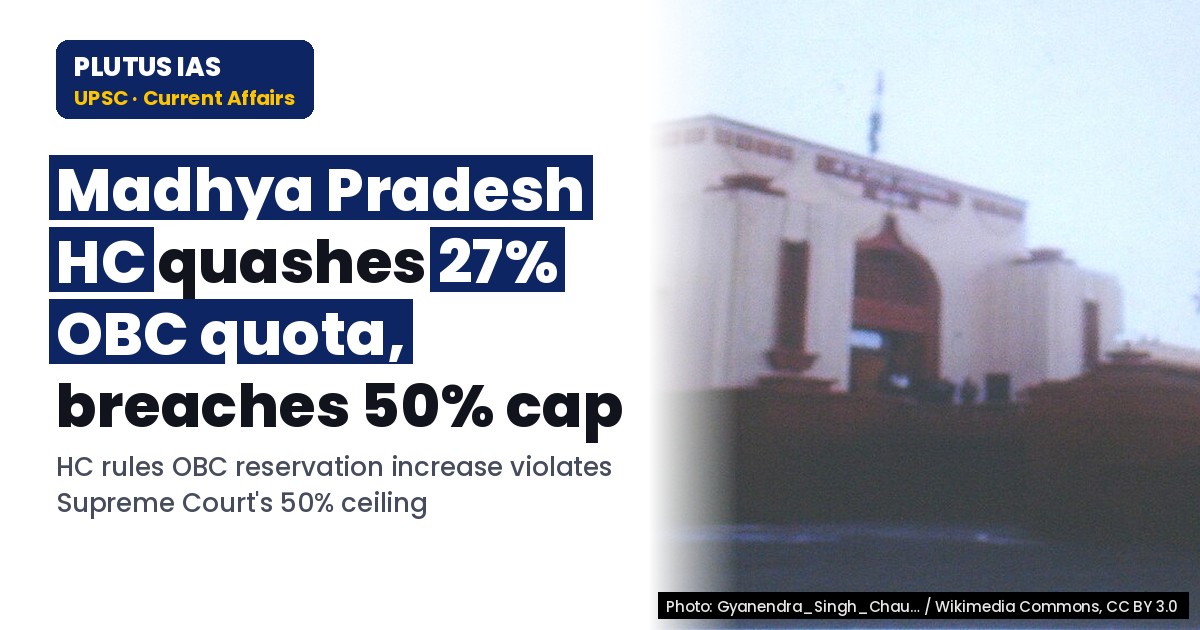
10 Oct Madhya Pradesh HC strikes down 27% OBC quota citing 50% cap breach
✎ The 50% reservation ceiling, established by the Supreme Court in *Indra Sawhney v. Union of India* (1992), is a constitutional limitation that cannot be breached without exceptional circumstances, which must be empirically…
Subject Relevance — Where This Topic Fits
- GS Paper II — Constitutional and Non-Constitutional Bodies (Judiciary) | GS Paper II — Government Policies and Interventions for Development in various sectors | GS Paper II — Issues Relating to Development and Management of Social Sector/Services relating to Health, Education, Human Resources | GS Paper IV — Ethics and Human Interface: Role of Judiciary in Upholding Constitutional Values
- Prelims: Constitutional provisions on reservation (Articles 15, 16, 340, 342A), 50% reservation ceiling (Indra Sawhney case, 1992), OBC reservation in Madhya Pradesh (14% to 27% increase, 2019), Judicial review of executive and legislative actions, Public Service Commission (MPPSC, MPES), Jean-Jacques Rousseau’s ‘The Social Contract’ and constitutional philosophy
- Essay: The interplay of social justice and constitutional limits in reservation policies, Judicial activism vs. legislative competence in matters of affirmative action
Quick Revision: The 50% reservation ceiling, established by the Supreme Court in *Indra Sawhney v. Union of India* (1992), is a constitutional limitation that cannot be breached without exceptional circumstances, which must be empirically justified and subject to judicial review.
Why is this in the news?
The Madhya Pradesh High Court, in a landmark judgment delivered on October 10, 2026, struck down the state’s 2019 legislation increasing the reservation for Other Backward Classes (OBCs) from 14% to 27%. The court held that the state had failed to justify the breach of the Supreme Court-mandated 50% ceiling on reservations, citing adequacy of OBC representation in political, educational, and economic spheres. The verdict underscores the judiciary’s role in enforcing constitutional boundaries on affirmative action policies, while also engaging with philosophical principles of equality and liberty.
Background
- In 2019, the then Congress-led government in Madhya Pradesh enacted a law increasing the OBC reservation from 14% to 27%, citing the OBC population of approximately 50% in the state and the need for proportional representation.
- The bill was subsequently supported by the BJP-led government after assuming office in 2020, reflecting bipartisan political consensus on the issue.
- The legislation faced legal challenges, with petitions arguing that the increase violated the Supreme Court’s 50% reservation ceiling and lacked empirical justification for the quantum of enhancement.
- The Madhya Pradesh High Court’s verdict aligns with the Supreme Court’s landmark judgment in *Indra Sawhney v. Union of India* (1992), which capped total reservations at 50% and mandated that any breach must be justified by exceptional circumstances.
- The court’s reliance on data on OBC representation in political, educational, and economic domains reflects the judiciary’s increasing emphasis on evidence-based policymaking in matters of reservation.
What is the legal framework governing OBC reservation in India?
- The Constitution of India, through Articles 15(4) and 16(4), empowers the state to make special provisions for the advancement of socially and educationally backward classes, including the OBCs.
- The Supreme Court, in the *Indra Sawhney v. Union of India* (1992) case, established the 50% ceiling on total reservations, holding that exceeding this limit would violate the principle of equality enshrined in Article 14 of the Constitution.
- The 103rd Constitution Amendment Act, 2019, introduced Article 15(6) and Article 16(6), enabling the state to provide up to 10% reservation for economically weaker sections (EWS) among the unreserved categories.
- The Madhya Pradesh High Court’s verdict underscores the judiciary’s role in scrutinizing the adequacy of data and the justification for breaching the 50% ceiling, ensuring that reservation policies remain within constitutional bounds.
- The court’s reference to Jean-Jacques Rousseau highlights the philosophical underpinnings of constitutional principles such as liberty, equality, and fraternity, which guide the interpretation of reservation policies.
Key Features
| Feature | Significance |
|---|---|
| Madhya Pradesh High Court Judgment (2026) | Strikes down the 2019 law increasing OBC reservation from 14% to 27%, citing failure to justify breach of the 50% reservation ceiling. |
| Supreme Court-Mandated 50% Ceiling | Establishes the constitutional limit on total reservations, derived from the Indra Sawhney (1992) judgment, to prevent excessive reservation beyond socially and educationally backward classes. |
| OBC Representation Data | High Court examined socio-economic and educational data to assess adequacy of OBC representation in public employment and higher education. |
| Political Dominance of OBCs in MP | Observed that OBCs hold significant political representation, including four consecutive Chief Ministers and over 25% of MLAs and Ministers. |
| Rousseau’s The Social Contract Reference | Bench invoked Rousseau’s principles of natural freedom and societal restrictions to contextualise constitutional provisions on equality and reservation. |
| Protected Appointments (2019–2022) | Court safeguarded appointments made under the 27% quota during March 2019–September 2022 by adjusting them against future recruitments. |
Why it Matters
Constitutional Governance
- Reaffirms the constitutional principle of equality under Article 14, balancing reservation with meritocracy and administrative efficiency.
- Demonstrates the judiciary’s role in scrutinising executive actions on reservation policies to prevent arbitrary deviations from constitutional limits.
- Highlights the need for evidence-based policymaking in reservation matters, relying on empirical data rather than political considerations.
Reservation Policy Framework
- Reinforces the 50% ceiling on reservations, a cornerstone of the Indra Sawhney judgment, to prevent disproportionate reservation beyond socially and educationally backward classes.
- Emphasises that reservation is a tool for inclusion, not a blanket entitlement, and must be justified by demonstrable inadequacy of representation.
- Clarifies that political representation alone does not constitute grounds for increasing reservation quotas in public employment and education.
Judicial Review of Executive Actions
- Showcases the judiciary’s power to strike down laws that violate constitutional principles, even when enacted with legislative majority.
- Illustrates the application of judicial review to assess the proportionality of reservation policies against constitutional benchmarks.
- Sets a precedent for future challenges to reservation increases, requiring robust data and justification.
Political Representation vs. Reservation in Employment
- Distinguishes between political representation (a democratic outcome) and reservation in public employment (a constitutional affirmative action measure).
- Underscores that political dominance does not automatically translate to inadequacy in public employment or higher education representation.
- Reinforces the need for separate criteria to assess reservation requirements in employment and education.
Challenges
1. Balancing Reservation with Constitutional Limits
- Ensuring reservation policies do not breach the 50% ceiling while addressing historical injustices and social backwardness.
- Avoiding populist increases in reservation quotas that lack empirical justification.
- Preventing reservation from becoming a permanent feature rather than a temporary corrective measure.
UPSC Link: GS2: Fundamental Rights and Reservation Policies
2. Empirical Justification for Reservation Policies
- Gathering and analysing socio-economic data to assess adequacy of representation in public employment and education.
- Avoiding politically motivated reservation increases without verifiable data on underrepresentation.
- Ensuring reservation policies are grounded in constitutional principles rather than electoral considerations.
UPSC Link: GS2: Reservation and Social Justice
3. Judicial Scrutiny of Executive Actions
- Maintaining judicial independence while reviewing reservation policies enacted by the executive.
- Ensuring that judicial interventions do not encroach upon the legislative domain or undermine democratic processes.
- Balancing the need for judicial review with the principle of separation of powers.
UPSC Link: GS2: Separation of Powers and Judicial Review
4. Protecting Existing Appointments While Upholding Law
- Addressing the rights of individuals appointed under an unconstitutional reservation policy without penalising them.
- Ensuring administrative continuity and preventing disruption in public service delivery.
- Balancing legal correctness with social equity in transitional arrangements.
UPSC Link: GS4: Ethical Governance and Administrative Law
5. Interpreting Rousseau’s Principles in Constitutional Context
- Applying philosophical principles (e.g., Rousseau’s ‘Social Contract’) to constitutional interpretations of equality and liberty.
- Ensuring that philosophical references do not overshadow constitutional provisions and judicial reasoning.
- Balancing abstract principles with concrete legal and policy considerations.
UPSC Link: GS2: Constitutional Philosophy and Governance
Challenges — UPSC Perspective
| Issue | Concern |
|---|---|
| Breach of 50% Reservation Ceiling | Risk of normalising excessive reservation beyond constitutional limits, undermining meritocracy. |
| Lack of Empirical Justification | Reservation increases driven by political considerations rather than verifiable data on underrepresentation. |
| Judicial Overreach vs. Legislative Domain | Potential conflict between judicial review and the principle of legislative supremacy in policy formulation. |
| Protecting Appointments vs. Upholding Law | Balancing the rights of individuals appointed under unconstitutional policies with the need for legal rectification. |
| Political Dominance vs. Reservation Policy | Risk of conflating political representation with inadequacy in public employment and education. |
| Data Reliability in Reservation Policies | Ensuring that socio-economic and educational data used to justify reservation is accurate, comprehensive, and unbiased. |
Way Forward
- Constitute a high-powered committee to review and standardise data collection methods for assessing OBC representation in public employment and higher education.
- Amend the Madhya Pradesh Public Service Commission (MPPSC) recruitment rules to align with the High Court’s judgment, ensuring future recruitments adhere to the 14% OBC quota.
- Strengthen the State Backward Classes Commission to conduct periodic, independent assessments of OBC representation and socio-economic conditions.
- Develop a transparent mechanism for public scrutiny of reservation policies, including publishing data on representation and justification for any proposed increases.
- Enhance capacity-building programmes for OBC communities to improve access to higher education and competitive examinations, reducing reliance on reservation as a sole measure.
- Encourage state governments to adopt a uniform approach to reservation policies, guided by Supreme Court judgments and empirical evidence.
- Promote inter-state collaboration to share best practices in data-driven reservation policies and social inclusion programmes.
- Sensitise policymakers and administrators on the constitutional limits of reservation and the importance of evidence-based policymaking.
UPSC Value Addition
Keywords for Mains Answer-Writing
Reservation policy in India · Constitutional provisions on reservation · Indra Sawhney case (1992) · 50% reservation ceiling · Madhya Pradesh High Court judgment on OBC quota · Judicial review of reservation policies · Political representation and reservation · Jean-Jacques Rousseau’s Social Contract · Constitutional principles of equality, liberty, and fraternity · Socio-economic data and adequacy of representation · Judicial interpretation of Articles 15(4) and 16(4) · Reservation in public employment and higher education
Constitutional & Policy Linkages
- Article 14 (Right to Equality)
- Article 15(4) (Special Provisions for Advancement of Backward Classes)
- Article 16(4) (Reservation in Public Employment)
- Indra Sawhney v. Union of India (1992) Judgment (50% Ceiling)
- Article 340 (Appointment of Backward Classes Commission)
Concept Flow
Political demand for increased OBC reservation → State legislature enacts 27% quota (2019) → Legal challenges filed → High Court examines socio-economic and educational data → Court strikes down 27% quota as unconstitutional → Judgment reinforces 50% reservation ceiling → Court protects appointments made under the unconstitutional policy → State directed to implement 14% quota with adjustments → Judgment underscores need for evidence-based reservation policies.
Prelims Practice Questions
Q1. Consider the following statements about the constitutional provisions on reservation in India:
1. The Supreme Court in the Indra Sawhney case (1992) upheld the 50% ceiling on total reservations.
2. The Constitution (103rd Amendment) Act, 2019 introduced 10% reservation for Economically Weaker Sections (EWS) beyond the 50% ceiling.
3. The Madhya Pradesh High Court in its 2026 judgment struck down the 27% OBC quota by citing inadequacy of socio-economic data.
How many of the above statements are correct?
- Only one
- Only two
- All three
- None
Answer: Only two — Statement 1 is correct: The Indra Sawhney case (1992) established the 50% ceiling on total reservations. Statement 2 is correct: The 103rd Amendment introduced EWS reservation beyond the 50% ceiling. Statement 3 is incorrect: The High Court struck down the 27% OBC quota citing adequacy of representation, not inadequacy of data.
Q2. Assertion (A): The 50% ceiling on reservations is a judicially mandated principle in India.
Reason (R): The Supreme Court in the Indra Sawhney case (1992) held that reservations exceeding 50% would be violative of the right to equality under Article 14 of the Constitution.
- Both A and R are true, and R is the correct explanation of A
- Both A and R are true, but R is NOT the correct explanation of A
- A is true, but R is false
- A is false, but R is true
Answer: Both A and R are true, and R is the correct explanation of A — Assertion (A) is true: The 50% ceiling is judicially mandated. Reason (R) is also true and correctly explains A: The Supreme Court in Indra Sawhney (1992) held that reservations exceeding 50% would violate Article 14.
Q3. Match the following provisions with their respective constitutional articles:
Column I (Provision) Column II (Article)
A. Reservation for socially and educationally backward classes in public employment 1. Article 15(4)
B. Reservation for Scheduled Castes and Scheduled Tribes in public employment 2. Article 16(4)
C. Reservation for economically weaker sections beyond the 50% ceiling 3. Article 15(6)
D. Prohibition of discrimination on grounds of religion, race, caste, sex, or place of birth 4. Article 14
- A-1, B-2, C-3, D-4; A-2, B-1, C-3, D-4; A-1, B-2, C-4, D-3; A-2, B-1, C-4, D-3
- answer_options_indexed_as_list_in_explain_field_above
- answer_explanation_field_above
Answer: A-1, B-2, C-3, D-4; A-2, B-1, C-3, D-4; A-1, B-2, C-4, D-3; A-2, B-1, C-4, D-3 — Correct match: A-1 (Article 15(4) empowers the state to make special provisions for socially and educationally backward classes), B-2 (Article 16(4) empowers the state to make provisions for reservation in public employment for backward classes), C-3 (Article 15(6) introduced by the 103rd Amendment provides for EWS reservation), D-4 (Article 14 guarantees equality before law and equal protection of laws).
Mains Practice Question
✍ Critically examine the constitutional and judicial framework governing reservations in India, with particular reference to the 50% ceiling and the recent Madhya Pradesh High Court judgment striking down the 27% OBC quota. (15 Marks)
Approach: MODEL-ANSWER SKELETON:
1. **Constitutional Basis of Reservation** (2 Marks)
– Articles 15(4) and 16(4): Empower the state to make special provisions for socially and educationally backward classes and Scheduled Castes/Scheduled Tribes.
– Article 14: Right to equality; Article 16(1): Equality of opportunity in public employment.
2. **Judicial Interpretation and the 50% Ceiling** (3 Marks)
– Indra Sawhney vs Union of India (1992): Established the 50% ceiling on total reservations to prevent excessive backwardness-based quotas from violating Article 14.
– Subsequent judgments: Upholding the ceiling (e.g., M. Nagaraj vs Union of India, 2006; Jarnail Singh vs Lachhmi Narain Gupta, 2018).
– Exceptional circumstances: The ceiling can be breached only in extraordinary situations, with rigorous data proving inadequacy of representation.
3. **Madhya Pradesh High Court Judgment (2026) – Key Observations** (4 Marks)
– Issue: Validity of the 2019 law increasing OBC reservation from 14% to 27%.
– Court’s reasoning: Adequacy of representation of OBCs in MP (political dominance, MLAs/Ministers from OBCs, socio-economic data).
– Reference to Rousseau: Linking natural freedom and societal restrictions to constitutional principles of liberty, equality, and fraternity.
– Direction: Existing appointments under the 27% quota to be adjusted in future recruitments; no removal of appointees.
4. **Balancing Competing Claims** (3 Marks)
– Arguments for higher reservation: Social justice, historical discrimination, political representation deficits.
– Arguments against: Violation of equality principle, administrative efficiency, meritocracy concerns.
– Role of data: Courts increasingly demand empirical evidence to justify reservation breaches.
5. **Contemporary Developments and Implications** (3 Marks)
– 103rd Amendment (2019): Introduced 10% EWS reservation beyond the 50% ceiling; judicial scrutiny pending.
– State-specific variations: Some states (e.g., Tamil Nadu) have breached the 50% ceiling; others (e.g., MP) face judicial pushback.
– Future outlook: Need for a national policy on reservation limits, balancing social justice with constitutional principles.
Source: The Indian Express
Madhya Pradesh PCS (MPPSC) — State PCS Practice
Prelims: Recently, the Madhya Pradesh High Court struck down the 27% reservation for OBCs in local body elections, citing remarks by OBC Chief Ministers of the state. Which of the following principles was primarily invoked by the court to justify its decision?
- A. Principle of equality under Article 14 of the Constitution
- B. Principle of ‘General Will’ as propounded by Rousseau
- C. Principle of federalism under Article 1 of the Constitution
- D. Principle of secularism under Article 25 of the Constitution
Answer: B. Principle of ‘General Will’ as propounded by Rousseau — The court cited Rousseau’s concept of ‘General Will’ to argue that reservations should not override the principle of equal participation in local governance.
Mains: Critically examine the Madhya Pradesh High Court’s judgment striking down the 27% OBC reservation in local body elections, with special reference to the court’s invocation of Rousseau’s philosophy and the role of OBC Chief Ministers in the state’s political context. Discuss the implications of this judgment on the constitutional scheme of reservations and social justice in Madhya Pradesh.
Generated by AanyaAi for educational purpose.
Related guides on our sites
- Best PSIR optional coaching for upsc
- Best PSIR optional teacher for upsc
- Best teacher of PSIR optional for upsc
- Best PSIR optional coaching in delhi for UPSC

- मुंबई फ्लेमिंगो अभयारण्य बफर जोन में सड़क निर्माण: 680 मैनग्रोव होंगे प्रभावित - October 21, 2026
- RBI Hikes Repo Rate by 25 bps: MPC Minutes Reveal Inflation Concerns - October 21, 2026
- आरबीआई की 63वीं बैठक: रेपो रेट में 25 आधार अंकों की बढ़ोतरी, जानें पूरा विवरण - October 21, 2026

No Comments