


23 Sep Madras HC: No Sanction Needed to Prosecute Public Servants for Disproportionate Assets
✎ Prosecution of public servants for disproportionate assets under the Prevention of Corruption Act does not require prior sanction under Section 197 Cr.P.C. or Section 218 BNSS, as such offences lack a nexus with official duties.
Subject Relevance — Where This Topic Fits
- GS Paper II — Polity and Governance | GS Paper III — Ethics, Integrity and Aptitude | GS Paper IV — Case Studies in Governance
- Prelims: Bharatiya Nagarik Suraksha Sanhita (BNSS), Prevention of Corruption Act, 1988, Section 197 of Cr.P.C., Section 218 of BNSS, Sanction for prosecution of public servants, Disproportionate assets under PC Act, Directorate of Vigilance and Anti-Corruption (DVAC), Judicial review of executive actions
- Essay: The balance between accountability and immunity in public service, Judicial interpretation of statutory provisions: Protecting integrity or enabling impunity?
Quick Revision: Prosecution of public servants for disproportionate assets under the Prevention of Corruption Act does not require prior sanction under Section 197 Cr.P.C. or Section 218 BNSS, as such offences lack a nexus with official duties.
Why is this in the news?
The Madras High Court held that no prior sanction under the Bharatiya Nagarik Suraksha Sanhita (BNSS) or the Code of Criminal Procedure (Cr.P.C.) is required to prosecute public servants for offences involving disproportionate assets under the Prevention of Corruption Act. The ruling clarifies the scope of legal immunity for public servants and reinforces the principle that prosecution for amassing wealth beyond known sources of income does not require a nexus with official duties. This decision has significant implications for anti-corruption enforcement against retired and serving officials alike.
Background
- The Prevention of Corruption Act, 1988, criminalises acts of corruption by public servants, including the offence of possessing assets disproportionate to known sources of income (Section 13(1)(e) read with Section 13(2)).
- Section 19 of the Prevention of Corruption Act mandates prior sanction for prosecuting public servants for offences committed while in office, unless the offence is unrelated to official duties.
- Section 197 of the Code of Criminal Procedure (Cr.P.C.) and its equivalent, Section 218 of the Bharatiya Nagarik Suraksha Sanhita (BNSS), provide immunity to public servants by requiring sanction before prosecution if the alleged offence is connected to the discharge of official duties.
- The Directorate of Vigilance and Anti-Corruption (DVAC) is a state-level anti-corruption agency in Tamil Nadu tasked with investigating corruption cases involving public servants.
- The case pertains to allegations against a former Minister of Tamil Nadu, M.R.K. Panneerselvam, and his family members, who were accused of amassing disproportionate assets during his tenure (2006–2011).
- The Cuddalore Principal District and Sessions Court had rejected the accused’s plea for discharge in June 2026, leading to a criminal revision petition before the Madras High Court.
Legal Framework Governing Prosecution of Public Servants for Corruption and Disproportionate Assets
- The Prevention of Corruption Act, 1988, is the primary legislation addressing corruption by public servants, including offences such as bribery, criminal misconduct, and possession of disproportionate assets.
- Section 13(1)(e) of the Act criminalises the possession of assets disproportionate to known sources of income, with Section 13(2) prescribing punishment for such offences.
- Section 19 of the Act mandates prior sanction for prosecuting public servants for offences committed while in office, unless the offence is unrelated to official duties. This sanction is a safeguard against frivolous prosecutions.
- Section 197 of the Code of Criminal Procedure (Cr.P.C.), 1973, and its successor, Section 218 of the Bharatiya Nagarik Suraksha Sanhita (BNSS), 2023, provide immunity to public servants by requiring prior sanction before prosecution if the alleged offence is connected to the discharge of official duties.
- The rationale behind Section 197 Cr.P.C./Section 218 BNSS is to prevent the harassment of public servants for acts performed in the course of their official duties, thereby ensuring functional autonomy and efficiency in governance.
- However, the Madras High Court clarified that offences involving disproportionate assets do not have a nexus with the discharge of official duties, as the act of amassing wealth beyond known sources is inherently personal and unrelated to official functions.
- The ruling underscores that the immunity under Section 197 Cr.P.C./Section 218 BNSS is not absolute and does not extend to offences that are not connected to the performance of official duties.
- The decision reinforces the role of anti-corruption agencies like the DVAC in investigating and prosecuting cases of disproportionate assets, even against retired public servants.
Key Features
| Feature | Significance |
|---|---|
| Disproportionate Assets Prosecution | Establishes that offences under Section 13(1)(e) of the Prevention of Corruption Act (amassing wealth beyond known sources) do not require prior sanction under Section 197 Cr.P.C. or Section 218 BNSS, as they lack nexus with official duties. |
| Section 197 Cr.P.C. / Section 218 BNSS | Provides immunity to public servants for acts done in discharge of official duties. Excludes offences unrelated to official functions, such as disproportionate asset accumulation. |
| Prevention of Corruption Act, 1988 (Section 13(1)(e)) | Criminalises amassing wealth disproportionate to known sources of income by public servants. Mandates prosecution without requiring prior sanction if the act is not connected to official duties. |
| Bharatiya Nagarik Suraksha Sanhita (BNSS) | Replaces the Cr.P.C. with updated procedural law. Retains the provision for sanction under Section 218, which the court interpreted restrictively in this case. |
| Directorate of Vigilance and Anti-Corruption (DVAC) | State-level anti-corruption agency responsible for investigating disproportionate asset cases. Operates under the Tamil Nadu Lokayukta Act, 2018. |
Why it Matters
Legal and Judicial
- Clarifies the scope of Section 197 Cr.P.C. / Section 218 BNSS, limiting immunity to acts directly related to official duties and excluding acts of personal corruption such as disproportionate asset accumulation.
Governance and Accountability
- Reinforces the principle that public servants cannot evade prosecution for financial misconduct by claiming immunity under procedural laws designed for acts performed in official capacity.
Anti-Corruption Framework
- Strengthens the enforcement of the Prevention of Corruption Act by removing procedural barriers to prosecution in cases of disproportionate assets, thereby enhancing deterrence against corruption.
Judicial Precedent
- Sets a binding precedent in Tamil Nadu (and persuasive elsewhere) that disproportionate asset cases against public servants need not await sanction, provided the offence is not connected to official duties.
Challenges
1. Interpretation of Official Duty Nexus
- Determining whether an offence has a nexus with official duties remains a contentious issue, leading to prolonged litigation and potential delays in prosecution.
- Courts must carefully distinguish between acts performed in official capacity and acts of personal corruption to avoid misapplication of immunity provisions.
UPSC Link: Polity: Immunities and Privileges (L1)
2. Procedural Delays in Corruption Cases
- Even after the dismissal of discharge petitions, prolonged trials and multiple revisions can delay justice, undermining public trust in anti-corruption mechanisms.
- The accused’s filing of a second discharge petition highlights procedural redundancies that may be exploited to prolong litigation.
UPSC Link: Law: Criminal Procedure (L1)
3. Asset Tracing and Proof of Disproportion
- Proving disproportionate assets requires meticulous documentation of income sources, expenditures, and asset acquisitions over extended periods, which is resource-intensive for investigating agencies.
- The burden of proof on the prosecution to establish disproportionate assets beyond reasonable doubt remains a significant challenge.
UPSC Link: Economy: Money Laundering and Black Money (L2)
4. Coordination Among Agencies
- Effective prosecution of disproportionate asset cases requires seamless coordination between anti-corruption agencies, financial intelligence units, and courts, which is often hindered by bureaucratic and institutional silos.
UPSC Link: Governance: Role of Institutions (L1)
5. Public Perception and Political Sensitivity
- High-profile disproportionate asset cases involving serving or former ministers often attract political scrutiny, which can influence public perception and the pace of judicial proceedings.
UPSC Link: Polity: Role of Media and Civil Society (L2)
Challenges — UPSC Perspective
| Issue | Concern |
|---|---|
| Nexus with Official Duty | Courts must rigorously assess whether the alleged offence is connected to official functions to determine the applicability of sanction provisions. |
| Procedural Redundancies | Multiple discharge petitions and revisions can delay trials, reducing the efficacy of anti-corruption laws. |
| Asset Tracing Complexity | Proving disproportionate assets requires extensive financial forensics, which is time-consuming and resource-intensive. |
| Institutional Coordination | Lack of seamless coordination between agencies like DVAC, ED, and courts can hinder effective prosecution. |
| Political Sensitivity | High-profile cases may face undue scrutiny or delays due to their political implications. |
Way Forward
- Clarify judicial guidelines on the interpretation of ‘nexus with official duty’ to reduce ambiguity in sanction provisions under Section 197 Cr.P.C. / Section 218 BNSS.
- Strengthen the capacity of anti-corruption agencies (e.g., DVAC, CBI) in financial forensics and asset tracing to expedite disproportionate asset cases.
- Streamline procedural timelines for discharge petitions and revisions to prevent unnecessary delays in corruption trials.
- Enhance inter-agency coordination by establishing dedicated task forces for disproportionate asset cases involving high-profile public servants.
- Promote transparency in asset declarations by public servants through digital platforms and mandatory third-party audits to deter financial misconduct.
- Conduct periodic training for judges and prosecutors on the nuances of corruption laws, particularly the Prevention of Corruption Act and BNSS.
- Encourage the use of plea bargaining in disproportionate asset cases to expedite disposal while ensuring deterrence against corruption.
UPSC Value Addition
Keywords for Mains Answer-Writing
Prevention of Corruption Act, 1988 · Bharatiya Nagarik Suraksha Sanhita (BNSS) · Section 13(1)(e) of PC Act · Section 197 Cr.P.C. · Section 218 BNSS · sanction for prosecution of public servants · disproportionate assets · Madras High Court judgment · Directorate of Vigilance and Anti-Corruption (DVAC) · public duty nexus test · Section 19 of Prevention of Corruption Act · official duties and corruption · judicial interpretation of corruption laws · prosecution of retired public servants · doctrine of nexus in criminal law
Constitutional & Policy Linkages
- Article 311 (2) – Protection against arbitrary dismissal of public servants, though not directly applicable here, underscores the need for procedural fairness in disciplinary and criminal cases involving them.
Concept Flow
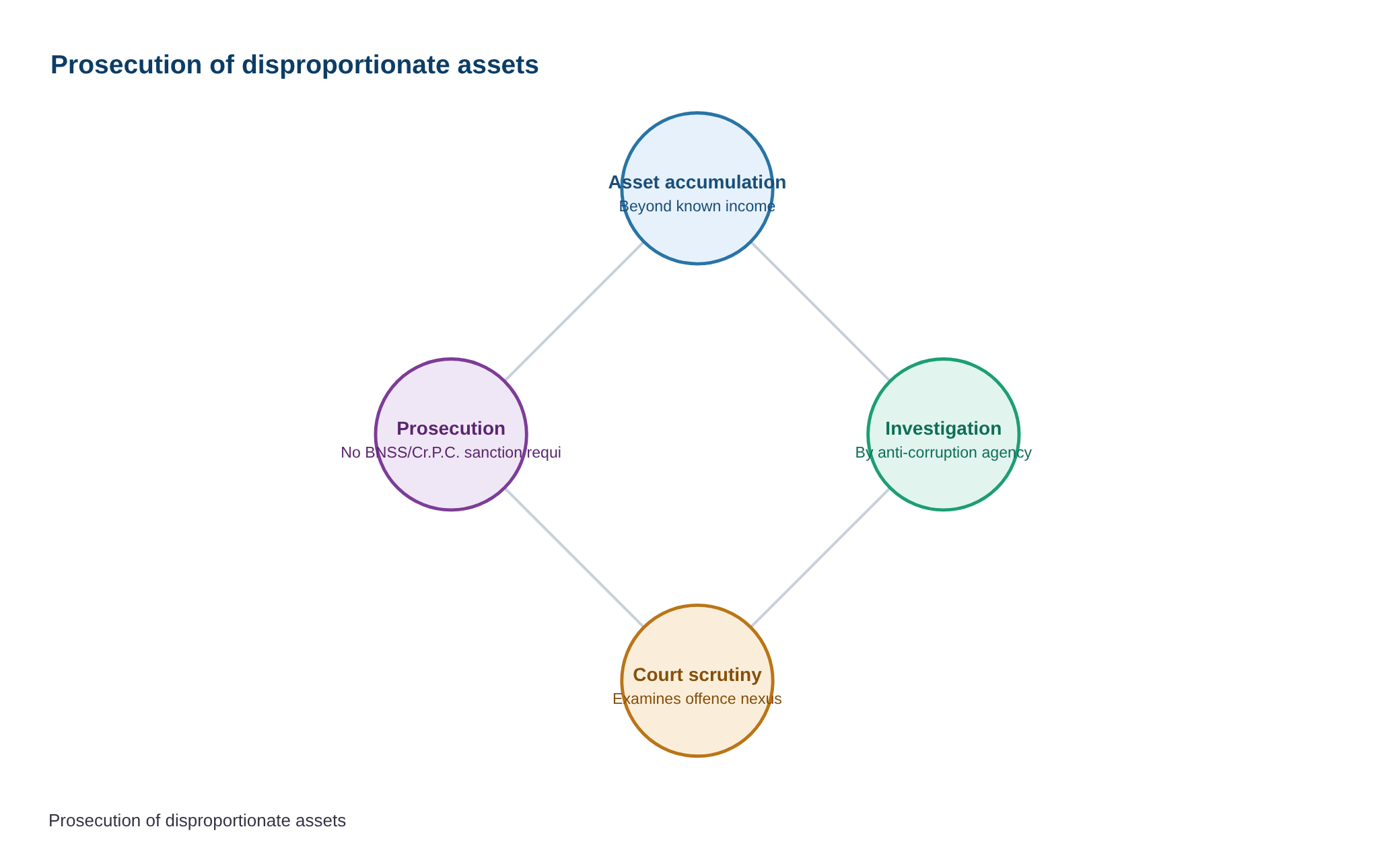
Public servant accumulates assets disproportionate to known income sources → Investigation initiated by anti-corruption agency (e.g., DVAC) under Prevention of Corruption Act → Court examines whether the offence has nexus with official duties to determine sanction requirement under Section 197 Cr.P.C. / Section 218 BNSS → Madras High Court rules that disproportionate asset accumulation lacks such nexus, hence no sanction required → Prosecution proceeds without prior sanction, subject to evidence and procedural fairness → Trial concludes with conviction or acquittal based on proof of disproportionate assets → Judicial precedent strengthens anti-corruption framework by removing procedural barriers
Prelims Practice Questions
Q1. Consider the following statements regarding the prosecution of public servants for disproportionate assets under the Prevention of Corruption Act, 1988:
1. Sanction under Section 197 of the Code of Criminal Procedure (Cr.P.C.) is mandatory for prosecuting public servants for all offences under the Act.
2. The Bharatiya Nagarik Suraksha Sanhita (BNSS) replaces the Cr.P.C. and contains a corresponding provision under Section 218.
3. The Madras High Court has held that amassing disproportionate assets does not require sanction as it lacks nexus with the discharge of official duties.
How many of the above statements are correct?
- Only one
- Only two
- Only three
- None
Answer: Only three — Statement 1 is incorrect because sanction under Section 197 Cr.P.C. is required only when the offence has a reasonable connection with the discharge of official duties. Statement 2 is correct as BNSS replaces Cr.P.C. and includes Section 218 corresponding to Section 197. Statement 3 is correct as per the Madras High Court ruling.
Q2. Assertion (A): The Prevention of Corruption Act, 1988, mandates prior sanction for prosecuting public servants under Section 19.
Reason (R): The sanction is required to protect public servants from frivolous prosecutions related to acts performed in the discharge of official duties.
Options:
A. Both A and R are true, and R is the correct explanation of A.
B. Both A and R are true, but R is not the correct explanation of A.
C. A is true, but R is false.
D. A is false, but R is true.
Answer: ? — Assertion (A) is true as Section 19 of the Prevention of Corruption Act requires prior sanction for prosecuting public servants. Reason (R) is also true and correctly explains the rationale behind the provision, which is to prevent misuse of the legal process against public servants for acts performed in their official capacity.
Q3. Match the following provisions with their corresponding legal instruments:
Column I
1. Section 197 Cr.P.C.
2. Section 13(1)(e) of the Prevention of Corruption Act
3. Section 19 of the Prevention of Corruption Act
4. Section 218 of the BNSS
Column II
A. Mandates prior sanction for prosecuting public servants
B. Deals with disproportionate assets
C. Corresponds to Section 197 Cr.P.C. in BNSS
D. Provides protection for acts done in discharge of official duties
- 1-D, 2-B, 3-A, 4-C
- 1-A, 2-B, 3-D, 4-C
- 1-C, 2-B, 3-A, 4-D
- 1-D, 2-A, 3-B, 4-C
Answer: 1-D, 2-B, 3-A, 4-C — 1-D: Section 197 Cr.P.C. provides protection for acts done in discharge of official duties. 2-B: Section 13(1)(e) of the Prevention of Corruption Act deals with disproportionate assets. 3-A: Section 19 of the Prevention of Corruption Act mandates prior sanction for prosecuting public servants. 4-C: Section 218 of the BNSS corresponds to Section 197 Cr.P.C.
Mains Practice Question
✍ The Madras High Court has recently held that no prior sanction is required under the Bharatiya Nagarik Suraksha Sanhita (BNSS) or the Code of Criminal Procedure (Cr.P.C.) to prosecute public servants for amassing disproportionate assets. Critically examine the legal and constitutional basis for this judicial interpretation, with reference to the Prevention of Corruption Act, 1988, and relevant judicial precedents. Also, analyse the implications of this judgment for the prosecution of corruption cases involving public servants in India. (15 Marks)
Approach: MODEL-ANSWER SKELETON:
1. **Legal Basis for the Judgment**:
– Explain the provisions of Section 13(1)(e) read with Section 13(2) of the Prevention of Corruption Act, 1988, which criminalise amassing disproportionate assets.
– Discuss the judicial interpretation of Section 197 Cr.P.C. (now Section 218 BNSS) and its nexus requirement with official duties, citing the Madras High Court’s reasoning in the present case.
– Reference the doctrine of nexus in criminal law and its application to corruption cases.
2. **Constitutional and Policy Context**:
– Examine the constitutional mandate under Article 311(2) for protection of civil servants and its distinction from the present case involving disproportionate assets.
– Discuss the policy objective of the Prevention of Corruption Act to curb corruption and the need for effective prosecution mechanisms.
– Reference the Supreme Court’s observations in *State of Punjab v. Rajesh Syal* (2002) and *State of Maharashtra v. Narayan Rao* (2011) on the nexus requirement.
3. **Implications of the Judgment**:
– Analyse how the judgment strengthens the prosecution of corruption cases by removing procedural hurdles for disproportionate assets cases.
– Discuss the potential impact on the accountability of public servants and the deterrent effect on corruption.
– Consider the balance between protecting public servants from frivolous prosecutions and ensuring accountability for corrupt acts.
4. **Critical Evaluation**:
– Evaluate whether the judgment aligns with the intent of the Prevention of Corruption Act and the broader anti-corruption framework.
– Discuss any potential unintended consequences, such as increased litigation or challenges in proving disproportionate assets.
– Reference comparative legal frameworks, such as the UK’s Bribery Act or the US Foreign Corrupt Practices Act, for contextual understanding.
5. **Conclusion**:
– Summarise the key takeaways and the significance of the judgment in the context of anti-corruption jurisprudence in India.
Source: The Hindu
Generated by AanyaAi for educational purpose.
Related guides on our sites
- Best PSIR optional coaching for upsc
- Best PSIR optional teacher for upsc
- Best teacher of PSIR optional for upsc
- Best PSIR optional coaching in delhi for UPSC

- Kerala’s AMR Crisis: Rising Drug Resistance Threatens Public Health in 2025 - September 23, 2026
- सुप्रीम कोर्ट ने दवाओं की ऊंची कीमतों को ‘लूट’ बताया, सरकार से पूछा- क्या है कानून? - September 23, 2026
- Supreme Court slams ‘extortion’ in drug pricing; calls for Jan Aushadhi expansion - September 23, 2026

No Comments