


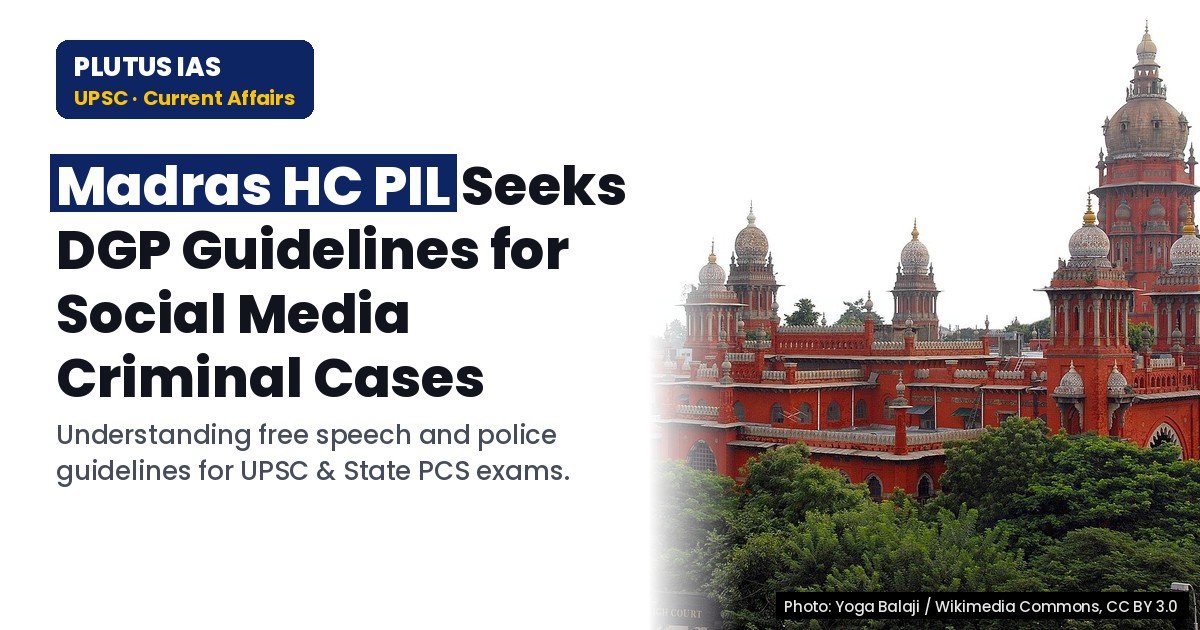
05 Nov Madras HC PIL: Guidelines for Social Media Criminal Cases
✎ The Madras High Court PIL highlights the ongoing judicial scrutiny over the application of criminal law to online speech, emphasizing the need for clear police guidelines to safeguard the fundamental right to freedom of speech…
Subject Relevance — Where This Topic Fits
- GS Paper II — Polity and Governance | GS Paper II — Fundamental Rights | GS Paper II — Judiciary
- Prelims: Public Interest Litigation (PIL), Article 19(1)(a), Freedom of Speech and Expression, Reasonable Restrictions, Director General of Police (DGP), Cognizable Offence, Non-Cognizable Offence, First Information Report (FIR), Madras High Court, Telangana High Court
- Essay: The delicate balance between freedom of speech and public order in the digital age., Judicial activism and its role in safeguarding fundamental rights.
Quick Revision: The Madras High Court PIL highlights the ongoing judicial scrutiny over the application of criminal law to online speech, emphasizing the need for clear police guidelines to safeguard the fundamental right to freedom of speech and expression under Article 19(1)(a) against arbitrary action.
Why is this in the news?
A Public Interest Litigation (PIL) has been filed before the Madras High Court, seeking a directive to the Director General of Police (DGP) of Tamil Nadu to formulate uniform guidelines for police personnel when registering criminal cases related to social media posts, political criticism, and online speech. The petitioner highlighted the increasing number of cases against individuals for expressing critical political opinions and democratic dissent online, arguing that police often register complaints mechanically without assessing whether the speech is protected under constitutional provisions.
Background
- Article 19(1)(a) of the Indian Constitution guarantees all citizens the right to freedom of speech and expression, which includes the right to express one’s views, opinions, beliefs, and convictions freely by word of mouth, writing, printing, picturing, or in any other manner.
- This fundamental right is not absolute and is subject to reasonable restrictions under Article 19(2) in the interests of the sovereignty and integrity of India, the security of the State, friendly relations with foreign States, public order, decency or morality, or in relation to contempt of court, defamation, or incitement to an offence.
- The registration of criminal cases for online speech often involves sections of the Indian Penal Code (IPC) such as defamation (Sections 499, 500), promoting enmity between different groups (Section 153A), statements conducive to public mischief (Section 505), and sometimes sections of the Information Technology Act, 2000.
- A ‘cognizable offence’ is one for which a police officer may arrest without a warrant, and an FIR can be registered directly. A ‘non-cognizable offence’ requires a magistrate’s order for the police to investigate, and an FIR cannot be registered without such an order.
- The Telangana High Court, in September 2025, issued eight guidelines for police to prevent the misuse of criminal law in matters concerning political speech and social media posts, including verifying the complainant’s locus standi, conducting preliminary inquiries for cognizable offences, and applying a high threshold for online speech-related offences.
- Public Interest Litigation (PIL) is a legal mechanism that allows individuals or groups to approach the court on behalf of the public interest, seeking redress for a public wrong or injury, or to enforce public duty.
Understanding Freedom of Speech and its Limitations in India
- Freedom of speech and expression is a cornerstone of Indian democracy, enabling citizens to participate in public discourse and hold the government accountable.
- The Supreme Court has consistently held that this right is crucial for a healthy democracy, encompassing not just factual assertions but also opinions, criticisms, and even satire.
- The ‘reasonable restrictions’ clause in Article 19(2) is critical, allowing the State to impose limitations that are proportionate and necessary for the specified grounds, ensuring that the right is not absolute.
- The judiciary plays a vital role in interpreting these restrictions, ensuring they are not used to stifle legitimate dissent or criticism, and upholding the spirit of free expression.
- Defamation, as defined under the IPC, is generally a non-cognizable offence, meaning police cannot register an FIR without a magistrate’s order, a procedural safeguard against arbitrary action.
- The increasing prevalence of social media has amplified concerns regarding the balance between free speech and the potential for misuse, leading to calls for clear guidelines for law enforcement.
- The guidelines sought by the PIL aim to ensure that police action on online speech complaints is not arbitrary or mechanical but is based on a careful assessment of constitutional protections and legal thresholds.
- The role of the Director General of Police (DGP) as the Head of Police Force (HoPF) in a state includes ensuring uniform application of law and order procedures and issuing administrative guidelines to police personnel.
Key Features
| Feature | Significance |
|---|---|
| Public Interest Litigation (PIL) | A legal mechanism allowing individuals or groups to seek judicial intervention on matters of public importance, ensuring access to justice for societal concerns. |
| Madras High Court | A High Court exercising original and appellate jurisdiction over the state of Tamil Nadu and the Union Territory of Puducherry, a vital part of the Indian judiciary. |
| Director General of Police (DGP) / Head of Police Force (HoPF) | The highest-ranking police officer in a state or union territory, responsible for the overall administration and operational efficiency of the police force. |
| Guidelines for Social Media Cases | Standardised protocols for police action regarding complaints related to online speech, political criticism, and social media posts, aiming for consistent and lawful application of criminal law. |
| Telangana High Court Precedent | A judicial ruling from another High Court providing a framework for police conduct in similar matters, potentially influencing judicial decisions and policy formulation in other states. |
| Supreme Court’s Refusal to Interfere | The highest court’s decision not to overturn a High Court’s guidelines, reinforcing the validity and legal standing of those guidelines. |
Why it Matters
Governance and Rule of Law
- The PIL underscores the imperative for transparent and uniform procedures in law enforcement, particularly concerning fundamental rights, to prevent arbitrary application of criminal statutes.
- It highlights the judiciary’s role in ensuring accountability of executive agencies and safeguarding constitutional liberties against potential overreach or misuse of power.
- The initiative aims to promote a more nuanced and legally sound approach by the police in handling sensitive cases involving online expression, thereby strengthening the rule of law.
Constitutional Rights
- The plea directly addresses the protection of fundamental rights, specifically freedom of speech and expression under Article 19(1)(a) of the Constitution, in the digital sphere.
- It seeks to prevent the mechanical registration of criminal cases that could stifle legitimate political criticism, satire, and democratic dissent, which are integral to a vibrant democracy.
- The proposed guidelines are intended to ensure that any restrictions on speech are proportionate, reasonable, and adhere to the limitations prescribed under Article 19(2).
Judicial Activism and Precedent
- The reference to the Telangana High Court’s guidelines and the Supreme Court’s affirmation demonstrates the judiciary’s proactive role in interpreting laws and setting standards for executive action.
- It establishes a precedent for other High Courts to consider similar directives, fostering a degree of uniformity in legal interpretation and police practices across states.
- The case exemplifies how judicial pronouncements can shape administrative policies and operational protocols within law enforcement agencies, ensuring adherence to constitutional principles.
Challenges
1. Balancing Freedom of Speech with Public Order
- Ensuring that legitimate criticism and dissent are protected while preventing speech that incites violence, defamation, or public disorder, requires a fine balance in legal interpretation and enforcement.
- Distinguishing between genuine political criticism and malicious content that crosses legal boundaries poses a significant challenge for law enforcement agencies.
UPSC Link: Fundamental Rights; Public Order
2. Police Discretion and Training
- The exercise of discretion by police officers in registering cases related to social media posts can be subjective, necessitating comprehensive training on constitutional provisions and legal nuances.
- Lack of adequate training or understanding of digital speech complexities can lead to arbitrary arrests or the filing of frivolous cases, impinging on individual liberties.
UPSC Link: Police Reforms; Law Enforcement
3. Defining ‘High Threshold’ for Online Offences
- Establishing a clear and consistent ‘high threshold’ for initiating criminal proceedings for social media posts and public speech-related offences is crucial to prevent misuse of laws.
- The evolving nature of online communication and the rapid dissemination of content make it challenging to apply traditional legal frameworks effectively.
UPSC Link: Cyber Laws; Legal Frameworks
4. Preventing Misuse of Criminal Law
- The potential for criminal law to be used to silence political opponents or critics through motivated complaints necessitates robust safeguards and stringent verification processes.
- Ensuring that non-cognisable offences like defamation are handled appropriately, requiring judicial magistrate’s orders before FIR registration, is vital to prevent police overreach.
UPSC Link: Criminal Justice System; Due Process
Challenges — UPSC Perspective
| Issue | Concern |
|---|---|
| Subjectivity in Interpreting Online Speech | The inherent difficulty for police personnel to objectively assess whether a social media post constitutes legitimate criticism or a criminal offence. |
| Lack of Uniform Guidelines | Absence of standardised procedures across police divisions leading to inconsistent application of law and potential for arbitrary actions. |
| Mechanical Registration of Cases | Tendency to register First Information Reports (FIRs) without adequate preliminary inquiry or assessment of constitutional protections. |
| Misuse of Defamation Laws | Registration of FIRs for defamation, a non-cognisable offence, without prior judicial magistrate’s order, bypassing due legal process. |
| Impact on Democratic Dissent | The potential chilling effect on free speech and political criticism due to fear of arbitrary legal action, undermining democratic participation. |
| Need for Specialized Training | Police personnel often lack specific training on cyber laws, digital forensics, and constitutional aspects related to online content. |
Way Forward
- The Director General of Police (DGP) should formulate comprehensive and unambiguous guidelines for handling social media-related complaints, drawing lessons from the Telangana High Court’s directives.
- Implement mandatory training programs for all police personnel on constitutional provisions related to freedom of speech, cyber laws, and the judicious application of criminal statutes in online contexts.
- Establish a robust preliminary inquiry mechanism for all complaints concerning online speech, ensuring that the locus standi of the complainant and the nature of the alleged offence are thoroughly verified before registering an FIR.
- Mandate a ‘high threshold’ for initiating criminal proceedings for social media posts and public speech, ensuring that only genuinely unlawful content is acted upon, while protecting legitimate criticism and dissent.
- Strengthen internal oversight mechanisms within the police force to monitor the registration of cases related to online speech, preventing arbitrary actions and ensuring accountability.
- Promote awareness among citizens regarding their rights concerning online expression and the legal recourse available against misuse of criminal law.
- Encourage inter-state collaboration and sharing of best practices among police forces and judicial bodies to evolve a consistent national approach to regulating online speech.
UPSC Value Addition
Keywords for Mains Answer-Writing
Freedom of Speech and Expression · Article 19(1)(a) · Reasonable Restrictions · Public Interest Litigation (PIL) · Judicial Review · Police Guidelines · Criminal Defamation · Cognizable vs. Non-Cognizable Offences · Misuse of Law · Democratic Dissent · Social Media Regulation · Rule of Law
Constitutional & Policy Linkages
- Article 19(1)(a): Freedom of Speech and Expression
- Article 19(2): Reasonable restrictions on speech
- Article 21: Protection of Life and Personal Liberty
- Article 32: Right to Constitutional Remedies
- Article 226: High Courts’ power to issue writs
Concept Flow
Increasing criminal cases for online speech → PIL filed in Madras High Court → Plea for uniform police guidelines → Reference to Telangana High Court precedent → Supreme Court affirms Telangana guidelines → Madras High Court to consider directives
Prelims Practice Questions
Q1. Consider the following statements regarding freedom of speech and expression in India:
1. Article 19(1)(a) of the Constitution of India guarantees the right to freedom of speech and expression to all persons, including foreign nationals.
2. The grounds for imposing reasonable restrictions on this right are exhaustively listed in Article 19(2).
3. Defamation is a ground for imposing reasonable restrictions on freedom of speech and expression.
How many of the above statements are correct?
- Only one
- Only two
- Only three
- None
Answer: Only two — Statement 1 is incorrect: Article 19(1)(a) guarantees the right to freedom of speech and expression only to citizens of India. Statement 2 is correct: Article 19(2) explicitly lists the grounds for reasonable restrictions, such as sovereignty and integrity of India, security of the State, friendly relations with foreign States, public order, decency or morality, contempt of court, defamation, and incitement to an offence. Statement 3 is correct: Defamation is indeed one of the specified grounds under Article 19(2) for imposing reasonable restrictions.
Q2. Which of the following statements is/are correct regarding the registration of criminal cases in India?
1. A First Information Report (FIR) can be registered by the police only for cognizable offences.
2. In a non-cognizable offence, the police cannot investigate without an order from a judicial magistrate.
3. The Supreme Court has, in various judgments, emphasized the need for preliminary inquiry in certain types of cases before registering an FIR.
- 1 and 2 only
- 2 and 3 only
- 1 and 3 only
- 1, 2 and 3
Answer: 1, 2 and 3 — Statement 1 is correct: As per the Code of Criminal Procedure (CrPC), an FIR is registered for cognizable offences, which are serious offences where the police can arrest without a warrant. Statement 2 is correct: For non-cognizable offences, the police require an order from a judicial magistrate to investigate. Statement 3 is correct: Landmark judgments, such as Lalita Kumari v. Government of U.P. (2014), have laid down guidelines for preliminary inquiry in specific categories of cases before mandatory FIR registration.
Mains Practice Question
✍ Critically examine the balance between the fundamental right to freedom of speech and expression and the need for maintaining public order and preventing misuse of criminal law, particularly in the context of social media and political criticism. Discuss with reference to recent judicial pronouncements and the role of police guidelines. (15 Marks)
Approach: MODEL-ANSWER SKELETON:
1. **Introduction**: Briefly define Article 19(1)(a) and the concept of reasonable restrictions under Article 19(2). Introduce the contemporary challenge posed by social media and political criticism.
2. **Freedom of Speech and Expression (Article 19(1)(a))**: Explain its significance as a cornerstone of democracy, enabling democratic dissent, political commentary, and public discourse.
3. **Reasonable Restrictions (Article 19(2))**: Detail the grounds for restrictions, such as defamation, public order, incitement to an offence. Emphasize that these restrictions must be ‘reasonable’ and proportionate.
4. **Challenges in the Digital Age**: Discuss how social media amplifies speech, leading to increased instances of alleged defamation, hate speech, and incitement. Highlight the difficulty in distinguishing legitimate criticism from unlawful content.
5. **Misuse of Criminal Law**: Address the concern of mechanical registration of criminal cases for online speech and political criticism, leading to chilling effects on free speech. Mention instances where police may entertain complaints without proper scrutiny.
6. **Role of Police Guidelines**: Explain the necessity of clear, uniform guidelines for police personnel when dealing with complaints related to online speech. Refer to the Telangana High Court guidelines (verification of locus standi, preliminary inquiry, high threshold for offences, caution against mechanical arrests, judicial magistrate’s order for non-cognizable offences like defamation, closing frivolous complaints) and the Supreme Court’s affirmation of these.
7. **Judicial Pronouncements**: Cite relevant Supreme Court and High Court judgments that have upheld free speech, cautioned against arbitrary arrests, and emphasized due process (e.g., Shreya Singhal v. Union of India on Section 66A IT Act, Lalita Kumari v. Government of U.P. on preliminary inquiry, and the recent Telangana High Court guidelines affirmed by the Supreme Court).
8. **Conclusion**: Summarize the delicate balance required between protecting fundamental rights and ensuring law and order. Advocate for robust police training, adherence to judicial guidelines, and a nuanced approach to online speech complaints to prevent the chilling effect on democratic dissent.
Source: The Hindu
Generated by AanyaAi for educational purpose.
Related guides on our sites
- Best PSIR optional coaching for upsc
- Best sociology optional coaching for upsc
- Which is best sociology optional coaching for upsc
- Best PSIR optional teacher for upsc

- ईपीएफओ का विशेष अभियान 6: जनसेवा, स्वच्छता और रिकॉर्ड प्रबंधन में सफलता - November 8, 2026
- Andhra Pradesh: Drought to Deluge & Cyclones Impact - November 8, 2026
- नरसिंहपुर एनकाउंटर: सीबीआई जांच, राज्य सरकार की अनुशंसा - November 8, 2026

No Comments