


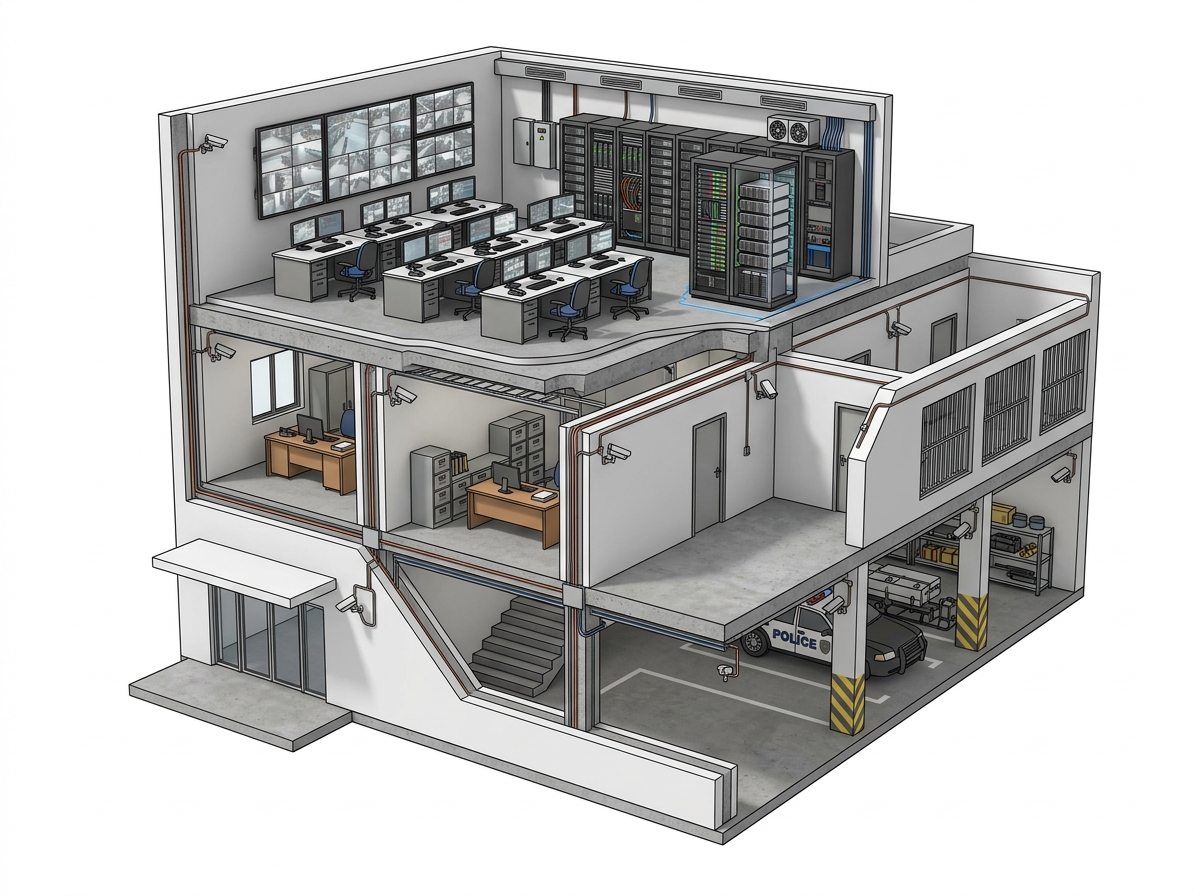
04 Sep Madras HC questions Tamil Nadu Police over 18-month CCTV retention policy
✎ CCTV footage in police stations must be retained for a minimum of 18 months as per Supreme Court and High Court directives to ensure transparency, prevent custodial violence, and preserve evidence for legal proceedings.
Subject Relevance — Where This Topic Fits
- GS Paper II — Governance, Constitution and Polity | GS Paper III — Internal Security and Cyber Security
- Prelims: CCTV surveillance policy, Paramvir Singh Saini vs Baljit Singh (2021), Madras High Court directions, Vigilance and Anti-Corruption Bureau, Digital Video Recorder (DVR) retention policy, Public Distribution System (PDS) corruption, Supreme Court guidelines on evidence preservation
- Essay: Surveillance, Privacy, and Accountability in Democratic Governance, The Role of Technology in Ensuring Transparency in Public Institutions
Quick Revision: CCTV footage in police stations must be retained for a minimum of 18 months as per Supreme Court and High Court directives to ensure transparency, prevent custodial violence, and preserve evidence for legal proceedings.
Why is this in the news?
The Madras High Court has directed the Tamil Nadu Director General of Police to clarify whether CCTV footage from police stations across the state is being retained for the mandated period of 18 months, as per Supreme Court and High Court orders. The directive follows a discrepancy reported in the retention period of footage by the Vigilance and Anti-Corruption (V&AC) office in Coimbatore, where footage is retained for only 15 days, raising concerns about compliance with judicial mandates and the preservation of evidence in corruption cases.
Background
- The Supreme Court, in *Paramvir Singh Saini vs Baljit Singh* (2021), issued comprehensive guidelines for the installation and maintenance of CCTV cameras in police stations, including the mandatory retention of footage for a minimum of 18 months to ensure transparency and accountability.
- The Madras High Court, in a 2024 order, reiterated these guidelines and directed all police stations in Tamil Nadu to comply strictly with the 18-month retention period for CCTV footage.
- CCTV surveillance in police stations is intended to deter custodial violence, corruption, and procedural lapses, while also providing objective evidence in cases of alleged misconduct by law enforcement personnel.
- The discrepancy in retention periods across different units (e.g., 15 days in the V&AC office, Coimbatore) undermines the uniformity and effectiveness of these safeguards, potentially compromising the integrity of investigations.
- The case before the Madras High Court arose from a petition by a Sub Inspector of Police, accused of corruption, who sought to preserve CCTV footage to disprove false charges, highlighting the practical implications of non-compliance with retention norms.
- The directive to the DGP underscores the judiciary’s role in ensuring adherence to procedural safeguards in governance, particularly in institutions entrusted with law enforcement and public accountability.
What is the legal and institutional framework governing CCTV footage retention in police stations?
- The *Paramvir Singh Saini vs Baljit Singh* (2021) judgment by the Supreme Court mandated the installation of CCTV cameras in all police stations, including interrogation rooms, lock-ups, and other areas where detainees are held, to prevent custodial violence and ensure transparency.
- The Court directed that CCTV footage must be preserved for a minimum of 18 months, with provisions for extended retention in specific cases, such as those involving allegations of custodial torture or corruption.
- The footage must be stored in secure, tamper-proof digital repositories, and access to it must be strictly regulated to prevent misuse or deletion. The guidelines also emphasize the need for periodic audits and accountability mechanisms.
- The Madras High Court, in its 2024 order, reinforced these directives and directed the Tamil Nadu Police to ensure strict compliance across all police stations in the state, including those under the jurisdiction of the Vigilance and Anti-Corruption Bureau.
- The discrepancy in retention periods, such as the 15-day limit in the V&AC office, Coimbatore, reflects systemic gaps in implementation, which may arise from inadequate infrastructure, lack of training, or procedural oversights.
- The judiciary’s intervention in this matter underscores the importance of judicial oversight in ensuring that executive agencies adhere to legal mandates, particularly in areas critical to public trust and institutional integrity.
- The case also highlights the role of CCTV footage as a tool for exonerating individuals falsely accused of misconduct, as demonstrated by the petitioner’s request to preserve footage to disprove corruption charges.
UPSC Value Addition
Keywords for Mains Answer-Writing
CCTV surveillance in police stations · evidence preservation protocols · Madras High Court directives · Paramvir Singh Saini vs Baljit Singh (2021) · Supreme Court guidelines on CCTV footage retention · Vigilance and Anti-Corruption (V&AC) offices · digital evidence integrity · procedural safeguards in criminal investigations · judicial oversight of police functioning · right to fair trial and evidence preservation
Prelims Practice Questions
Q1. Consider the following statements regarding the retention of CCTV footage in police stations in India:
1. The Supreme Court in Paramvir Singh Saini vs Baljit Singh (2021) directed that CCTV footage from police stations must be retained for a minimum period of 18 months.
2. The directive applies uniformly to all police stations across all states without exception.
3. The Madras High Court has recently sought clarification from the Tamil Nadu DGP regarding compliance with the 18-month retention period.
How many of the above statements are correct?
- Only one
- Only two
- All three
- None
Answer: Only two — Statement 1 is correct as the Supreme Court in Paramvir Singh Saini vs Baljit Singh (2021) mandated 18-month retention. Statement 2 is incorrect because the directive does not apply uniformly without exception; state-specific compliance varies. Statement 3 is correct as the Madras High Court has recently sought clarification from the Tamil Nadu DGP on this issue.
Q2. Assertion (A): The retention of CCTV footage for less than 18 months in police stations constitutes a breach of judicial directives.
Reason (R): The Supreme Court in Paramvir Singh Saini vs Baljit Singh (2021) explicitly mandated a minimum retention period of 18 months for CCTV footage in police stations to ensure transparency and accountability.
Options:
A. Both A and R are true, and R is the correct explanation of A.
B. Both A and R are true, but R is not the correct explanation of A.
C. A is true, but R is false.
D. A is false, but R is true.
- A
- B
- C
- D
Answer: A — Both the Assertion (A) and Reason (R) are true. The Supreme Court’s directive in Paramvir Singh Saini vs Baljit Singh (2021) explicitly mandates a minimum retention period of 18 months for CCTV footage in police stations. The Reason (R) correctly explains the Assertion (A).
Q3. Match the following columns regarding judicial directives on CCTV footage retention in police stations:
Column I (Judicial Body) Column II (Directive on CCTV Footage Retention)
A. Supreme Court of India 1. Mandated 18-month retention for police stations
B. Madras High Court 2. Directed DGP to clarify compliance in Tamil Nadu
C. Delhi High Court 3. Ordered installation of CCTV in police stations
D. Kerala High Court 4. No specific directive on retention period
Options:
A-1, B-2, C-3, D-4
A-2, B-1, C-4, D-3
A-1, B-2, C-4, D-3
A-3, B-1, C-2, D-4
- A-1, B-2, C-3, D-4
- A-2, B-1, C-4, D-3
- A-1, B-2, C-4, D-3
- A-3, B-1, C-2, D-4
Answer: A-1, B-2, C-4, D-3 — A-1: The Supreme Court in Paramvir Singh Saini vs Baljit Singh (2021) mandated 18-month retention. B-2: The Madras High Court recently directed the Tamil Nadu DGP to clarify compliance. C-4: The Delhi High Court has not issued a specific directive on retention period. D-3: The Kerala High Court ordered installation of CCTV in police stations but not a specific retention period.
Mains Practice Question
✍ The preservation of CCTV footage in police stations is not merely a procedural formality but a critical safeguard for ensuring transparency, accountability, and the right to a fair trial. Critically examine the legal and institutional framework governing the retention of CCTV footage in police stations in India, with particular reference to the Supreme Court’s directives in Paramvir Singh Saini vs Baljit Singh (2021) and the recent judicial intervention by the Madras High Court. Also, analyse the implications of non-compliance with these directives on the criminal justice system. (15 Marks)
Approach: MODEL-ANSWER SKELETON:
1. **Legal Framework and Supreme Court Directives**:
– Cite Paramvir Singh Saini vs Baljit Singh (2021) where the Supreme Court mandated the installation of CCTV cameras in police stations and directed the preservation of footage for a minimum of 18 months.
– Highlight the rationale: preventing custodial violence, ensuring transparency, and protecting the rights of accused persons.
– Reference the constitutional provisions underpinning this: Article 21 (Right to Life and Personal Liberty) and Article 22 (Protection against arrest and detention).
2. **Judicial Oversight and Recent Intervention**:
– Discuss the Madras High Court’s recent directive to the Tamil Nadu DGP to clarify compliance with the 18-month retention period.
– Explain the court’s emphasis on the breach of judicial orders if retention falls short of 18 months.
– Mention the discrepancy observed in the Vigilance and Anti-Corruption (V&AC) office in Coimbatore, where footage was retained only for 15 days.
3. **Institutional and Procedural Safeguards**:
– Outline the role of the Director General of Police (DGP) in ensuring compliance across police stations.
– Discuss the need for standard operating procedures (SOPs) for data storage, backup, and retrieval of CCTV footage.
– Highlight the importance of digital evidence integrity and chain of custody.
4. **Implications of Non-Compliance**:
– **On Criminal Justice System**: Erosion of public trust, potential for misuse of power, and challenges in proving or disproving allegations of misconduct.
– **On Right to Fair Trial**: Inability to present or challenge evidence, leading to miscarriages of justice.
– **On Police Accountability**: Weakening of mechanisms to hold errant officers accountable.
5. **Balancing Views and Way Forward**:
– Acknowledge the logistical and financial challenges in implementing uniform retention policies across states.
– Suggest measures: regular audits, technological upgrades, and capacity building for police personnel.
– Conclude with the necessity of judicial and executive cooperation to uphold constitutional guarantees.
Source: The Hindu
Tamil Nadu PCS (TNPSC) — State PCS Practice
Prelims: As per the Madras High Court’s directive to the Director General of Police (DGP) regarding CCTV footage retention in Tamil Nadu, what is the stipulated minimum duration for which police stations must retain such footage?
- 12 months
- 18 months
- 24 months
- 36 months
Answer: 18 months — The Madras High Court has specifically asked the DGP to ensure that all police stations in Tamil Nadu retain CCTV footage for a minimum of 18 months.
Mains: Critically examine the challenges faced by Tamil Nadu Police in ensuring compliance with the Madras High Court’s directive on retaining CCTV footage for 18 months. Suggest measures to address these challenges while balancing operational efficiency and legal requirements.
Generated by AanyaAi for educational purpose.
Related guides on our sites
- Anthropology VS PSIR
- Best PSIR optional coaching
- Best PSIR optional coaching online
- Best PSIR optional teacher

- India-Australia AUSTRAHIND 2026 Exercise: Key Highlights for UPSC & State PCS - October 22, 2026
- एससीओ बैठक में भारत का आतंकवाद विरोध: क्षेत्रीय सहयोग पर जोर - October 22, 2026
- SEC Directs Strict SC Order Compliance for Andhra ULB Polls - October 22, 2026

No Comments