


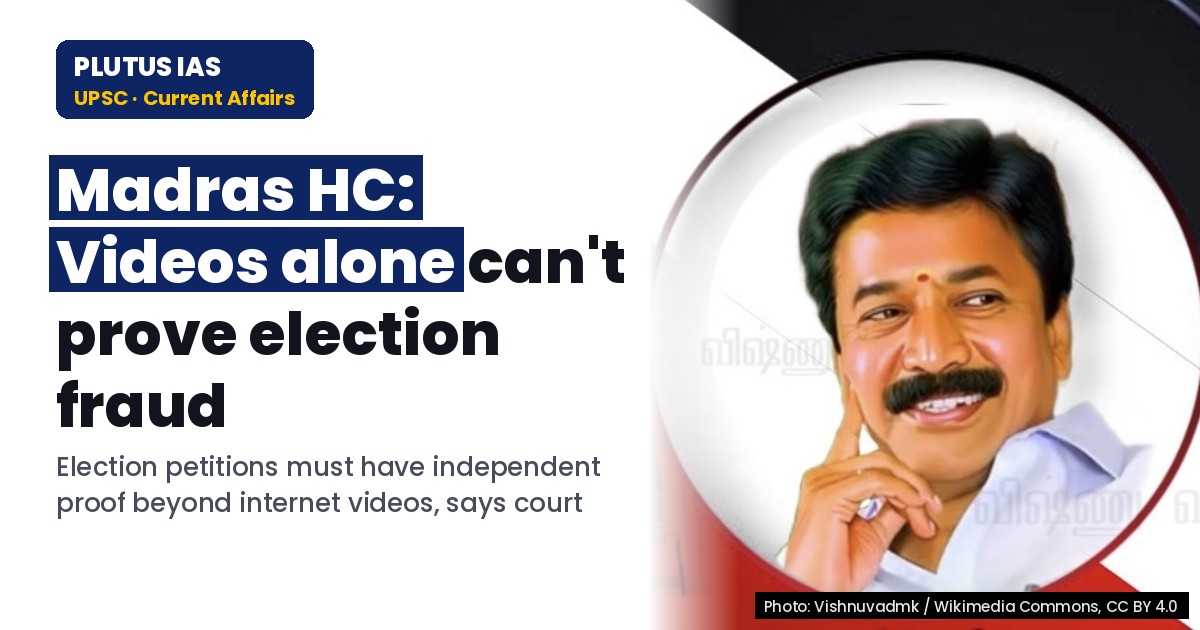
23 Oct Madras HC Ruling: Videos Alone Insufficient for Election Petitions
✎ Election petitions under the Representation of the People Act, 1951, must be supported by credible, independent documentary evidence to substantiate allegations of corrupt practices; unverified digital material is insufficient.
Subject Relevance — Where This Topic Fits
- GS Paper II — Polity and Governance: Electoral Reforms, Judicial Review, and Constitutional Provisions | GS Paper IV — Ethics and Integrity in Governance: Standards of Evidence and Accountability
- Prelims: Election petition, Corrupt practices under Representation of the People Act, 1951, Electoral bribery, Madras High Court, Judicial scrutiny of election disputes, Evidentiary standards in election petitions, Section 83 of the Representation of the People Act, 1951, Hearsay evidence, Documentary evidence in electoral disputes
- Essay: The role of judiciary in upholding electoral integrity and democratic principles, Balancing freedom of expression with the necessity of credible evidence in legal proceedings
Quick Revision: Election petitions under the Representation of the People Act, 1951, must be supported by credible, independent documentary evidence to substantiate allegations of corrupt practices; unverified digital material is insufficient.
Why is this in the news?
The Madras High Court, in a landmark judgment delivered on October 22, 2026, ruled that election petitions cannot be filed solely on the basis of unverified videos downloaded from the internet. The court emphasised the necessity of independent documentary material to substantiate allegations of corrupt practices against a returned candidate, thereby setting a precedent for the evidentiary standards required in election disputes. This ruling underscores the judiciary’s commitment to preventing frivolous petitions while ensuring that genuine electoral malpractices are not overlooked due to inadequate evidence.
Background
- The Representation of the People Act, 1951 (RP Act) governs the conduct of elections in India and provides a legal framework for challenging election results through election petitions under Section 81.
- Election petitions are filed under Section 81 of the RP Act to challenge the validity of an election result on grounds such as corrupt practices, improper rejection of nomination papers, or other electoral irregularities.
- Corrupt practices under the RP Act include bribery, undue influence, and other illegal acts that may interfere with the free exercise of electoral rights, as defined in Section 123 of the Act.
- The Supreme Court, in several judgments, has reiterated the importance of strict adherence to procedural and evidentiary standards in election petitions to prevent misuse of the electoral process.
- The Madras High Court’s ruling aligns with the constitutional mandate under Article 329(b) of the Constitution of India, which bars the interference of courts in electoral matters except through election petitions as prescribed by law.
- Recent years have seen a rise in the use of digital evidence, including videos and social media posts, in election-related disputes, necessitating judicial clarification on their admissibility and reliability.
What is an Election Petition and What Constitutes Corrupt Practices?
- An election petition is a legal challenge filed under Section 81 of the Representation of the People Act, 1951, to contest the validity of an election result in a constituency.
- The petitioner must allege and prove that the returned candidate or their agents engaged in corrupt practices, improper conduct, or other electoral irregularities that materially affected the election outcome.
- Corrupt practices under the RP Act are defined in Section 123 and include bribery (Section 123(1)) and undue influence (Section 123(2)).
- Bribery, as per Section 123(1), involves offering or accepting money, gifts, or other inducements to influence voters or prevent them from exercising their franchise freely.
- The burden of proof lies entirely on the petitioner to establish the allegations with credible evidence, failing which the petition is liable to be dismissed.
- Section 83 of the RP Act mandates that an election petition must contain a concise statement of the material facts on which the petitioner relies, failing which it may be rejected as insufficiently pleaded.
- Evidence in election petitions must meet the standards of the Indian Evidence Act, 1872, and must be admissible, relevant, and reliable. Hearsay evidence, such as unverified videos or social media posts, is generally inadmissible unless corroborated by independent documentary or testimonial evidence.
- The judiciary plays a pivotal role in scrutinising election petitions to ensure that electoral disputes are resolved on the basis of credible evidence, thereby upholding the integrity of the electoral process.
Key Features
| Feature | Significance |
|---|---|
| Requirement of independent documentary evidence | The ruling underscores that election petitions must be substantiated by verifiable evidence, not merely speculative or hearsay material such as unverified internet videos. |
| Mandate for material particulars in petitions | The judgment highlights the necessity of disclosing specific details—such as amounts, recipients, and dates—when alleging corrupt practices, ensuring petitions are not frivolous or vague. |
| Judicial scrutiny of electoral corrupt practices | The court’s rejection of the petition demonstrates the judiciary’s role in filtering baseless claims, thereby upholding the integrity of electoral processes. |
| Personal knowledge requirement for petitioners | The ruling clarifies that petitioners must possess firsthand knowledge of alleged corrupt practices, preventing the use of third-party information as sole evidence. |
| Rejection of hearsay allegations | The judgment reinforces that election petitions cannot rely on unverified claims or secondary sources, ensuring fairness and credibility in electoral disputes. |
Why it Matters
Legal and Judicial
- The ruling sets a precedent for the standard of evidence required in election petitions, particularly in cases involving allegations of electoral bribery.
- It reinforces the judiciary’s role in safeguarding electoral integrity by dismissing petitions lacking substantive proof.
- The judgment clarifies the burden of proof on petitioners, ensuring that allegations are not based on speculation or unverified sources.
Electoral Integrity
- The decision underscores the importance of verifiable evidence in maintaining public trust in electoral outcomes.
- It discourages frivolous election petitions that could undermine the credibility of democratic processes.
- The ruling aligns with constitutional provisions aimed at preventing corrupt practices in elections.
Governance and Accountability
- The judgment highlights the need for transparency in electoral processes, particularly in allegations of financial inducements to voters.
- It ensures that electoral disputes are resolved based on concrete evidence rather than unsubstantiated claims.
- The ruling may deter potential misuse of election petitions as a political tool, thereby promoting fair electoral competition.
Challenges
1. Verification of Digital Evidence in Electoral Disputes
- The proliferation of unverified digital content (e.g., videos) poses challenges in establishing authenticity and reliability in election petitions.
- Courts must grapple with the admissibility of such evidence, balancing technological advancements with legal standards of proof.
- The lack of a standardized mechanism to authenticate digital evidence complicates judicial proceedings in electoral disputes.
UPSC Link: PAPER II: Judiciary – Standards of Evidence
2. Preventing Frivolous Election Petitions
- Frivolous petitions can clog judicial systems and undermine public confidence in electoral outcomes.
- The ruling sets a higher threshold for filing petitions, reducing the risk of politically motivated or baseless challenges.
- However, this may also discourage genuine petitioners from pursuing valid claims due to stringent evidentiary requirements.
UPSC Link: PAPER II: Election Laws – Dispute Resolution
3. Ensuring Personal Knowledge in Petitions
- Petitioners often rely on third-party information, which may lack credibility or firsthand verification.
- The judgment’s emphasis on personal knowledge may inadvertently limit access to justice for those who lack direct evidence but have credible sources.
- Balancing the requirement for personal knowledge with the practical realities of gathering evidence remains a challenge.
UPSC Link: PAPER II: Electoral Reforms – Transparency
Challenges — UPSC Perspective
| Issue | Concern |
|---|---|
| Authenticity of digital evidence | Unverified videos or recordings may lack credibility, complicating judicial scrutiny in election petitions. |
| Burden of proof on petitioners | High evidentiary standards may deter genuine claims, while low standards risk frivolous petitions. |
| Judicial capacity to assess evidence | Courts may face difficulties in evaluating digital evidence without technical expertise or standardized protocols. |
| Balancing transparency and fairness | Strict evidentiary rules may protect against misuse but could also limit access to justice for valid claims. |
| Political misuse of election petitions | Despite stringent standards, petitions may still be filed for political purposes, straining judicial resources. |
Way Forward
- Strengthen mechanisms for authenticating digital evidence in electoral disputes, possibly through collaboration with forensic agencies.
- Develop guidelines for courts to assess the admissibility and reliability of digital content in election petitions.
- Enhance awareness among petitioners about the evidentiary requirements for filing election petitions, reducing frivolous filings.
- Encourage the use of independent documentary evidence (e.g., bank records, witness testimonies) to substantiate allegations of electoral corrupt practices.
- Explore the establishment of specialized tribunals or fast-track courts to handle election petitions efficiently.
- Promote transparency in electoral processes by mandating the disclosure of campaign expenditures and financial transactions.
- Conduct periodic judicial training programs on emerging challenges in electoral disputes, including digital evidence and corrupt practices.
UPSC Value Addition
Keywords for Mains Answer-Writing
Election Petitions · Corrupt Practices under Representation of the People Act, 1951 · Electoral Bribery · Madras High Court Judgment · Evidentiary Standards in Election Petitions · Hearsay Evidence · Independent Documentary Evidence · Electoral Reforms · Constitutional Provisions on Elections · Judicial Scrutiny of Electoral Disputes · Right to Free and Fair Elections · Electoral Corruption · Legal Framework for Election Disputes · Judicial Activism in Electoral Matters
Constitutional & Policy Linkages
- [‘Article 329(b) – Bar to interference by courts in electoral matters’, ‘Limits judicial review of electoral disputes post-election.’]
- [‘Article 19(1)(a) – Freedom of speech and expression’, ‘Balances with the need to prevent false or misleading claims in petitions.’]
- [‘Article 14 – Equality before law’, ‘Ensures uniform standards in adjudicating election petitions across cases.’]
Concept Flow
Allegation of electoral corrupt practices (e.g., cash distribution) → Filing of election petition based on unverified digital evidence → Court’s scrutiny of evidence authenticity → Rejection of petition due to lack of independent documentary proof → Judgment reinforcing evidentiary standards for future petitions → Potential impact on electoral integrity and judicial efficiency.
Prelims Practice Questions
Q1. Consider the following statements regarding election petitions in India:
1. An election petition can be filed solely on the basis of videos downloaded from the internet without independent documentary evidence.
2. The Representation of the People Act, 1951, defines corrupt practices such as bribery, undue influence, and booth capturing.
3. The High Court is the sole authority to try election petitions under the Constitution of India.
How many of the above statements are correct?
- Only one
- Only two
- All
- None
Answer: Only two — Statement 1 is incorrect as the Madras High Court has held that election petitions cannot be filed merely on the basis of videos downloaded from the internet without independent documentary material. Statement 2 is correct as the Representation of the People Act, 1951, explicitly defines corrupt practices. Statement 3 is incorrect as election petitions are tried by the High Court as per the Representation of the People Act, 1951, not solely under the Constitution.
Q2. Assertion (A): The Madras High Court in its recent judgment has emphasized the necessity of independent documentary evidence to establish corrupt practices in election petitions.
Reason (R): The Court held that hearsay allegations and unverified videos downloaded from the internet are insufficient to constitute a complete cause of action under electoral laws.
- Both A and R are true, and R is the correct explanation of A
- Both A and R are true, but R is not the correct explanation of A
- A is true but R is false
- A is false but R is true
Answer: Both A and R are true, and R is the correct explanation of A — Both Assertion (A) and Reason (R) are true, and Reason (R) correctly explains Assertion (A). The Court explicitly stated that election petitions must be supported by independent documentary evidence and cannot rely solely on unverified videos or hearsay allegations.
Q3. Match the following terms with their correct definitions as per the Representation of the People Act, 1951:
Column I
1. Corrupt Practice
2. Election Petition
3. Returning Officer
4. Electoral Roll
Column II
A. A formal written complaint challenging the validity of an election result.
B. A document listing all eligible voters in a constituency.
C. Any illegal act or omission that influences the outcome of an election.
D. The official responsible for conducting elections in a constituency.
- 1-C, 2-A, 3-D, 4-B
- 1-A, 2-C, 3-B, 4-D
- 1-D, 2-B, 3-A, 4-C
- 1-B, 2-D, 3-C, 4-A
Answer: 1-C, 2-A, 3-D, 4-B — 1-C: Corrupt Practice is defined as any illegal act or omission that influences the outcome of an election under the Representation of the People Act, 1951. 2-A: An Election Petition is a formal written complaint challenging the validity of an election result. 3-D: The Returning Officer is the official responsible for conducting elections in a constituency. 4-B: The Electoral Roll is a document listing all eligible voters in a constituency.
Mains Practice Question
✍ The Madras High Court has held that election petitions cannot be filed solely on the basis of unverified videos downloaded from the internet. In this context, critically examine the legal framework governing election petitions in India, with particular reference to the evidentiary standards required to establish corrupt practices. Also, analyse the implications of this judgment for electoral integrity and judicial scrutiny of election disputes. (15 Marks)
Approach: MODEL-ANSWER SKELETON:
1. **Introduction (2 Marks)**
– Define election petitions and their constitutional significance under Articles 329(b) and 19(1)(a) of the Constitution.
– State the role of the High Court in adjudicating election petitions under the Representation of the People Act, 1951 (RPA, 1951), Section 80.
2. **Legal Framework Governing Election Petitions (4 Marks)**
– **Representation of the People Act, 1951**: Sections 80-84, 123 (corrupt practices), and 125 (disqualification for corrupt practices).
– **Evidentiary Standards**: Section 123(2) (bribery), Section 123(3) (undue influence), and Section 123(4) (booth capturing).
– **Burden of Proof**: The petitioner must prove allegations beyond reasonable doubt (Laxmi Raman Acharya v. Dr. Anand Mohan, 1996).
– **Hearsay Evidence**: Discuss the inadmissibility of hearsay under the Indian Evidence Act, 1872, Sections 60-61.
3. **Judicial Interpretation and Precedents (4 Marks)**
– **Madras High Court Judgment (2026)**: Highlight the Court’s emphasis on independent documentary evidence and the rejection of unverified videos.
– **Supreme Court Precedents**: Cite cases such as Mohinder Singh Gill v. Chief Election Commissioner (1978) and Krishnamoorthy v. Sivakumar (2015) on the necessity of strict evidentiary standards.
– **Electoral Bribery**: Reference Section 123(2) of the RPA, 1951, and the requirement to prove actual distribution of money or goods.
4. **Implications for Electoral Integrity (3 Marks)**
– **Preventing Frivolous Petitions**: Discuss how the judgment discourages politically motivated petitions based on unverified claims.
– **Judicial Scrutiny**: Emphasise the role of the judiciary in ensuring free and fair elections under Article 324 of the Constitution.
– **Electoral Reforms**: Suggest measures such as stricter verification of evidence, digital forensics, and penalties for frivolous petitions.
5. **Conclusion (2 Marks)**
– Summarise the importance of maintaining high evidentiary standards in election petitions to uphold democratic principles.
– Conclude with a balanced view on the judgment’s contribution to electoral integrity and judicial accountability.
Source: The Hindu
Generated by AanyaAi for educational purpose.
Related guides on our sites
- Best PSIR optional coaching for upsc
- Best Law optional coaching for upsc
- Best PSIR optional teacher for upsc
- Best teacher of PSIR optional for upsc

- भारतीय AI स्टार्टअप्स के मूल्यांकन पर वैश्विक तकनीकी शेयरों में गिरावट का प्रभाव - November 8, 2026
- Swachh Survekshan: MP’s 9 Cities Honored by President - November 8, 2026
- ईपीएफओ का विशेष अभियान 6: जनसेवा, स्वच्छता और रिकॉर्ड प्रबंधन में सफलता - November 8, 2026

No Comments