


09 Aug Madras HC to Hear VC Appointment Cases on Sept 2: Key UPSC Polity Insights
✎ The appointment of Vice-Chancellors in state universities is a constitutional function of the Governor under state statutes, and any legislative amendment transferring this power must comply with constitutional principles and the…
Subject Relevance — Where This Topic Fits
- GS Paper II — Constitutional and Statutory Bodies (Governor, State Legislatures, Judiciary) | GS Paper II — Functions and Responsibilities of the Union and the States (Education)
- Prelims: Governor’s discretionary powers under Article 163, University Grants Commission (UGC) Regulations, 2018, Constitutional provisions related to appointments in higher education institutions, Judicial review of legislative amendments, Interim orders and stays in writ petitions
- Essay: The role of constitutional morality in governance: A case study of Tamil Nadu’s higher education reforms, Judicial activism vs. legislative sovereignty: Balancing constitutional governance
Quick Revision: The appointment of Vice-Chancellors in state universities is a constitutional function of the Governor under state statutes, and any legislative amendment transferring this power must comply with constitutional principles and the doctrine of constitutional morality.
Why is this in the news?
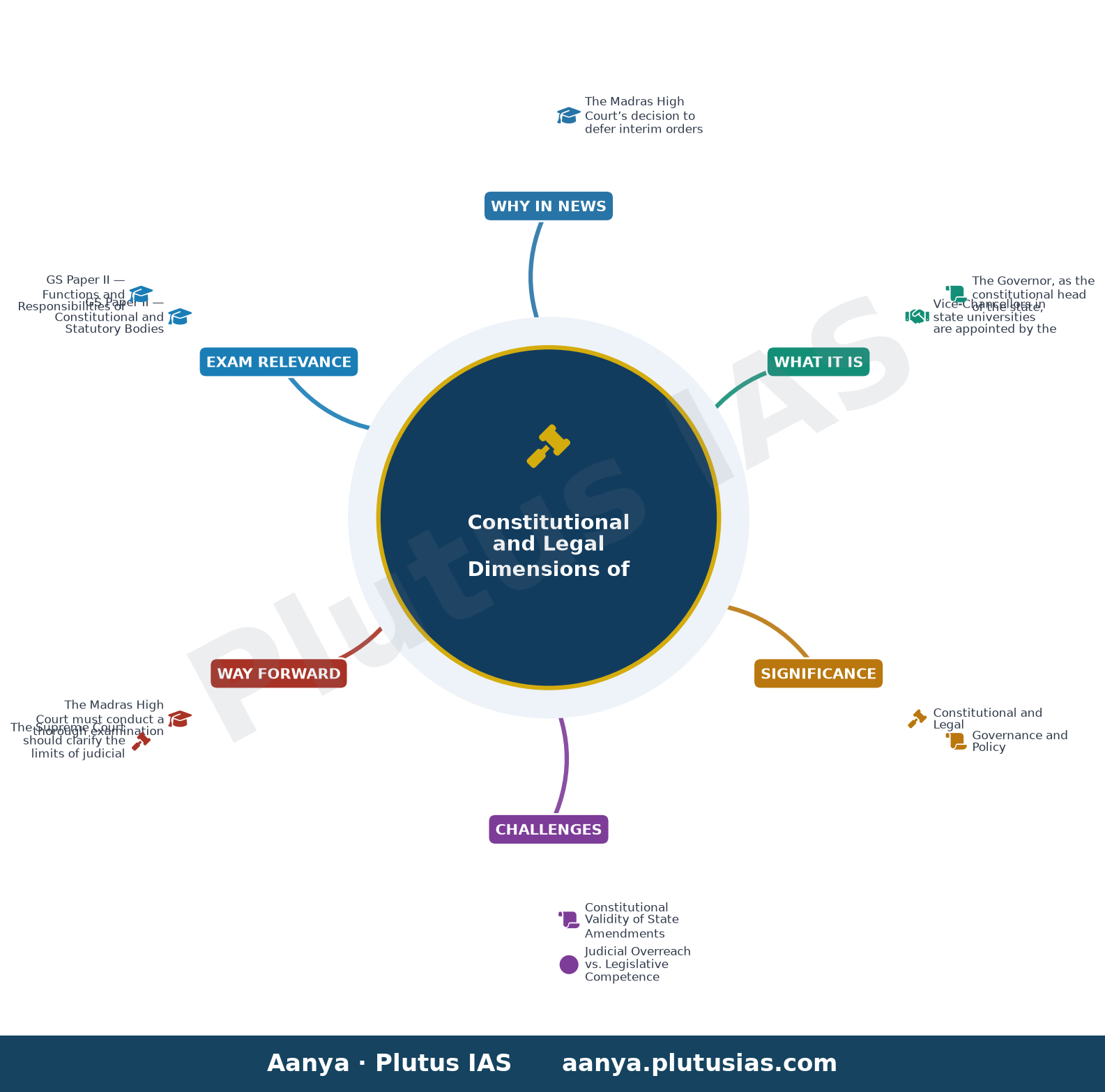
The Madras High Court’s decision to defer interim orders and schedule a final hearing for September 2, 2026, on writ petitions challenging the Tamil Nadu government’s amendments to university statutes—particularly those transferring Vice-Chancellor appointment powers from the Governor to the State government—highlights a critical constitutional conflict. This case underscores the tension between state legislative authority and the Governor’s constitutional role, while also examining the judiciary’s power to review such amendments. The absence of Vice-Chancellors in state-run universities due to this dispute further exacerbates governance challenges in higher education.
Background
- The Tamil Nadu government passed legislative amendments in 2025 to the statutes governing state-run universities, transferring the power to appoint Vice-Chancellors from the Governor to the State government.
- The Madras High Court, in May 2025, stayed these amendments and restored the Governor’s authority to appoint Vice-Chancellors, citing potential unconstitutionality.
- The Supreme Court, on appeal by the State government, stayed the High Court’s order and directed the State government not to appoint Vice-Chancellors until the High Court’s final decision.
- Subsequently, a second writ petition was filed in 2026 by a citizen, highlighting the prolonged vacancies in Vice-Chancellor positions due to the dispute over appointing authority.
- The Advocate General of Tamil Nadu argued that the State government should be permitted to appoint Vice-Chancellors, given the Supreme Court’s stay on the High Court’s interim order and the operation of the amended statutes.
- The High Court, noting incomplete pleadings and pending counter-affidavits from official respondents, deferred interim relief and scheduled the matter for final hearing on September 2, 2026.
What are Vice-Chancellor appointments in state universities, and why are they constitutionally significant?
- Vice-Chancellors in state universities are appointed by the Chancellor (Governor) under the provisions of the respective state university statutes, typically based on recommendations from search committees.
- The Governor, as the constitutional head of the state, exercises a quasi-judicial role in such appointments, ensuring adherence to constitutional and statutory norms.
- State legislatures may amend university statutes to alter appointment processes, but such amendments must not violate constitutional principles, including the Governor’s constitutional role and the doctrine of separation of powers.
- The UGC (University Grants Commission) Regulations, 2018, mandate that the appointment of Vice-Chancellors should be transparent, merit-based, and free from political interference, aligning with the principles of autonomy in higher education institutions.
- Judicial review of legislative amendments to university statutes is permissible under Article 226 of the Constitution, enabling the High Court to examine the constitutional validity of such amendments.
- The doctrine of constitutional morality requires that legislative actions respect the spirit of the Constitution, including the balance between state autonomy and constitutional safeguards for higher education governance.
- Prolonged vacancies in Vice-Chancellor positions can disrupt academic governance, leading to administrative inefficiencies and potential violations of students’ and faculty members’ rights.
- The Governor’s role in appointing Vice-Chancellors is not merely ceremonial but involves ensuring that the appointee meets statutory and academic qualifications, thereby safeguarding the integrity of higher education institutions.
Key Features
| Feature | Significance |
|---|---|
| Judicial intervention in university appointments | Highlights the judiciary’s role in safeguarding constitutional principles in higher education governance, particularly the balance of powers between the executive and the judiciary. |
| Interim stay on amendments to university statutes | Demonstrates the judiciary’s power to temporarily halt legislative changes that may contravene constitutional provisions, ensuring no irreversible damage occurs pending final adjudication. |
| Supreme Court’s conditional stay on High Court order | Illustrates the hierarchy of courts and the Supreme Court’s role in maintaining the status quo while higher constitutional questions are resolved. |
| State government’s claim to appoint Vice-Chancellors | Raises questions about the executive’s authority in educational appointments, testing the limits of legislative power under the Constitution. |
| Search panels for Vice-Chancellor selection | Reflects the procedural safeguards in academic leadership appointments, though their constitutionality is now under judicial scrutiny. |
Why it Matters
Constitutional and Legal
- The case underscores the constitutional principle of separation of powers, particularly between the legislature and the judiciary, in matters of university governance.
- It examines the validity of state legislation that alters the appointment process of Vice-Chancellors, potentially encroaching upon the Governor’s constitutional role under Article 163.
- The Supreme Court’s intervention highlights the need for judicial oversight in legislative actions that may undermine institutional autonomy in higher education.
- The dispute tests the interpretation of ‘state’ under the Seventh Schedule, Entry 25 (education), and Entry 66 (coordination and determination of standards in institutions for higher education).
Governance and Policy
- The case reflects tensions between state governments and constitutional authorities (Governor) in the administration of higher education institutions.
- It raises questions about the efficacy of search committees in ensuring meritocratic and transparent appointments in state-run universities.
- The prolonged absence of Vice-Chancellors in state universities due to legal disputes highlights governance gaps in higher education administration.
- The executive’s claim to appoint Vice-Chancellors challenges the traditional role of the Chancellor (Governor) in academic leadership appointments.
Judicial Process and Precedents
- The case exemplifies the judiciary’s power to grant interim relief to prevent irreparable harm, as seen in the High Court’s stay on amendments.
- It demonstrates the Supreme Court’s role in preserving the status quo pending final adjudication, ensuring stability in governance.
- The matter may set a precedent for future disputes involving the appointment of heads of autonomous institutions under state control.
Challenges
1. Constitutional Validity of State Amendments
- The amendments vesting the power to appoint Vice-Chancellors with the State government may be challenged as ultra vires the Constitution, particularly if they infringe upon the Governor’s constitutional role.
- The case tests the boundaries of legislative competence under the Seventh Schedule, Entry 25 (education), vis-à-vis Entry 66 (standards in higher education).
- The judiciary must balance the need for executive efficiency with constitutional safeguards against arbitrary exercise of power.
UPSC Link: GS-II: Constitutional framework, Statutory bodies
2. Judicial Overreach vs. Legislative Competence
- The case raises concerns about judicial activism in matters traditionally within the domain of the executive or legislature.
- The judiciary’s power to stay legislative amendments may be scrutinised for its impact on democratic governance and separation of powers.
- The Supreme Court’s conditional stay reflects a cautious approach to avoid encroaching on legislative or executive domains.
UPSC Link: GS-II: Separation of powers, Judicial review
3. Governance Vacuum in Higher Education
- The prolonged absence of Vice-Chancellors in state universities due to legal disputes disrupts academic governance and institutional stability.
- The case highlights the need for expedited judicial resolution to prevent long-term damage to higher education institutions.
- It underscores the importance of clear and unambiguous legislative and constitutional provisions for university governance.
UPSC Link: GS-II: Education, Governance
4. Institutional Autonomy vs. State Control
- The dispute tests the delicate balance between state control over higher education institutions and the need for institutional autonomy.
- The Governor’s traditional role in appointing Vice-Chancellors may be seen as a safeguard against political interference in universities.
- The case may influence future debates on the autonomy of state-run universities in India.
UPSC Link: GS-II: Federalism, Autonomy of institutions
Challenges — UPSC Perspective
| Issue | Concern |
|---|---|
| Constitutional validity of state amendments | Whether the amendments violate the constitutional scheme of separation of powers and the Governor’s role. |
| Judicial intervention in executive functions | The extent to which the judiciary can intervene in matters of university governance traditionally handled by the executive. |
| Governance vacuum in universities | The disruption caused by the absence of Vice-Chancellors and its impact on academic and administrative functions. |
| Balance between state control and institutional autonomy | The tension between the state’s authority over universities and the need for academic independence. |
| Meritocracy in Vice-Chancellor appointments | The effectiveness of search committees in ensuring transparent and merit-based appointments. |
Way Forward
- The Madras High Court must conduct a thorough examination of the constitutional validity of the state amendments, ensuring adherence to the principles of federalism and separation of powers.
- The Supreme Court should clarify the limits of judicial intervention in executive and legislative matters, particularly in the context of university governance.
- State governments must ensure that any amendments to university statutes comply with constitutional provisions and do not encroach upon the autonomy of higher education institutions.
- Search committees for Vice-Chancellor appointments should be reconstituted to ensure transparency, meritocracy, and adherence to constitutional norms.
- The Governor’s role in appointing Vice-Chancellors should be reaffirmed or redefined through clear constitutional provisions to avoid future disputes.
- Universities must develop contingency plans to mitigate the impact of prolonged vacancies in key leadership positions.
- Legal reforms should be considered to expedite the resolution of disputes involving constitutional and governance matters in higher education.
- Aspirants should study the balance of powers between the judiciary, legislature, and executive as outlined in the Constitution, particularly in the context of education.
UPSC Value Addition
Keywords for Mains Answer-Writing
Vice-Chancellor appointment · Madras High Court · Governor vs State Government · University Statutes Amendment · Search Committee · Article 124B · Tamil Nadu Higher Education · Judicial Review of Executive Actions · Constitutional Functionaries · Federalism in Education · Interim Orders in Writ Petitions · Appointment of Chancellors · Supreme Court Stays · State Legislature Powers · Higher Education Governance
Constitutional & Policy Linkages
- Article 163: Council of Ministers to aid and advise the Governor.
- Article 246: Distribution of legislative powers between the Union and the States.
- Seventh Schedule, Entry 25: Education.
- Seventh Schedule, Entry 66: Coordination and determination of standards in institutions for higher education.
Concept Flow
State legislature amends university statutes to vest Vice-Chancellor appointment power in the State government → High Court stays the amendments, citing potential constitutional violations → Supreme Court stays the High Court’s order, preserving the status quo → State government claims authority to appoint Vice-Chancellors under the amended statutes → Writ petitions challenge the amendments and the governance vacuum in universities → Madras High Court lists the matter for final hearing on September 2, 2026 → Judicial resolution will determine the constitutional validity of the amendments and the balance of powers in university governance
Prelims Practice Questions
Q1. Consider the following statements regarding the appointment of Vice-Chancellors to State-run universities in India:
1. The Governor of the State, as Chancellor, traditionally appoints Vice-Chancellors.
2. The State Legislature can amend university statutes to vest the power of appointment with the State Government.
3. The Supreme Court can stay the operation of a High Court’s interim order on such appointments.
4. The Union Government has the constitutional authority to directly appoint Vice-Chancellors to State universities.
How many of the above statements are correct?
- Only one
- Only two
- Only three
- All four
Answer: Only three — Statements 1, 2, and 3 are correct. Statement 4 is incorrect as the Union Government does not have direct constitutional authority to appoint Vice-Chancellors to State universities.
Q2. Assertion (A): The Governor of a State, in the capacity of Chancellor, has the constitutional power to appoint Vice-Chancellors to State-run universities.
Reason (R): The Governor’s role as Chancellor is derived from the provisions of the State Universities Act and is not explicitly mentioned in the Constitution of India.
Options:
A. Both A and R are true, and R is the correct explanation of A.
B. Both A and R are true, but R is not the correct explanation of A.
C. A is true, but R is false.
D. A is false, but R is true.
Answer: ? — Assertion (A) is true as the Governor, as Chancellor, traditionally appoints Vice-Chancellors. Reason (R) is also true but does not explain the assertion, as the Governor’s role as Chancellor is statutorily defined under State laws, not the Constitution.
Q3. Match the following constitutional provisions with their respective roles in higher education governance:
Column I (Provision) | Column II (Role)
———————————————–|————————————————–
1. Article 124B | A. Empowers the Governor to act as Chancellor
2. State Universities Act | B. Provides for the establishment of the National Judicial Appointments Commission
3. Article 213 | C. Grants the Governor power to promulgate ordinances
4. Article 161 | D. Deals with the powers of the Governor to grant pardons
Options:
A. 1-A, 2-B, 3-C, 4-D
B. 1-B, 2-A, 3-C, 4-D
C. 1-B, 2-D, 3-A, 4-C
D. 1-A, 2-C, 3-B, 4-D
Answer: ? — 1-B (Article 124B establishes the National Judicial Appointments Commission, not directly related to higher education governance), 2-A (State Universities Act empowers the Governor as Chancellor), 3-C (Article 213 grants the Governor power to promulgate ordinances), 4-D (Article 161 deals with the Governor’s power to grant pardons).
Mains Practice Question
✍ The vesting of the power to appoint Vice-Chancellors to State-run universities with the State Government, rather than the Governor (as Chancellor), reflects a shift in the governance of higher education institutions. Critically examine the constitutional, legal, and federal dimensions of this issue. Also, analyze the implications of such amendments on the autonomy of universities and the federal structure of India. (15 Marks)
Approach: MODEL-ANSWER SKELETON:
1. **Constitutional and Legal Framework**:
– Role of the Governor as Chancellor under State Universities Acts (e.g., Tamil Nadu Universities Act, 1976).
– Constitutional provisions: Article 161 (Governor’s pardoning power), Article 213 (Ordinance-making power), and the doctrine of constitutional morality.
– Judicial precedents: Supreme Court rulings on the Governor’s role (e.g., *B.P. Singhal v. Union of India*, 2010; *Rameshwar Prasad v. Union of India*, 2006).
2. **Federal Dimensions**:
– Distribution of powers under the Seventh Schedule (State List, Entry 25: Education).
– Tension between State autonomy and Union oversight in higher education.
– Impact of amendments on cooperative federalism and the principle of ‘cooperative conflict’ (Granville Austin).
3. **University Autonomy**:
– Concept of academic freedom and institutional autonomy (e.g., *T.M.A. Pai Foundation v. State of Karnataka*, 2002).
– Risks of political interference in appointments and governance.
– Role of search committees and transparency in appointments.
4. **Recent Judicial Interventions**:
– Madras High Court’s interim orders and the Supreme Court’s stay (2025–2026 case).
– Judicial review of legislative amendments under the doctrine of pith and substance.
5. **Balancing Views**:
– Arguments for State Government control: efficiency, accountability, and alignment with electoral mandates.
– Arguments against: erosion of institutional autonomy and potential for misuse of power.
6. **Conclusion**:
– The need for a balanced approach that safeguards both federal principles and institutional autonomy.
– Recommendations: Strengthening statutory safeguards, judicial oversight, and stakeholder consultations in amendments.
Source: The Hindu
Generated by AanyaAi for educational purpose.

- RODTEP Scheme Extended to Dec 2026: UPSC Polity & Governance Insights - October 2, 2026
- बक्सा टाइगर रिजर्व में पहली बार बाघिन का पुनर्वास: जानिए पूरा मामला - October 2, 2026
- Steel Ministry Launches Special Campaign 6 for Pending Cases - October 2, 2026

No Comments