


08 Aug Madras HC to hear VC appointment cases on Sept 2: Key UPSC Polity insights
✎ The appointment of Vice-Chancellors in State universities is a constitutional and statutory matter where the Governor’s role as Chancellor must balance State legislative amendments with judicial scrutiny under Article 226 and…
Subject Relevance — Where This Topic Fits
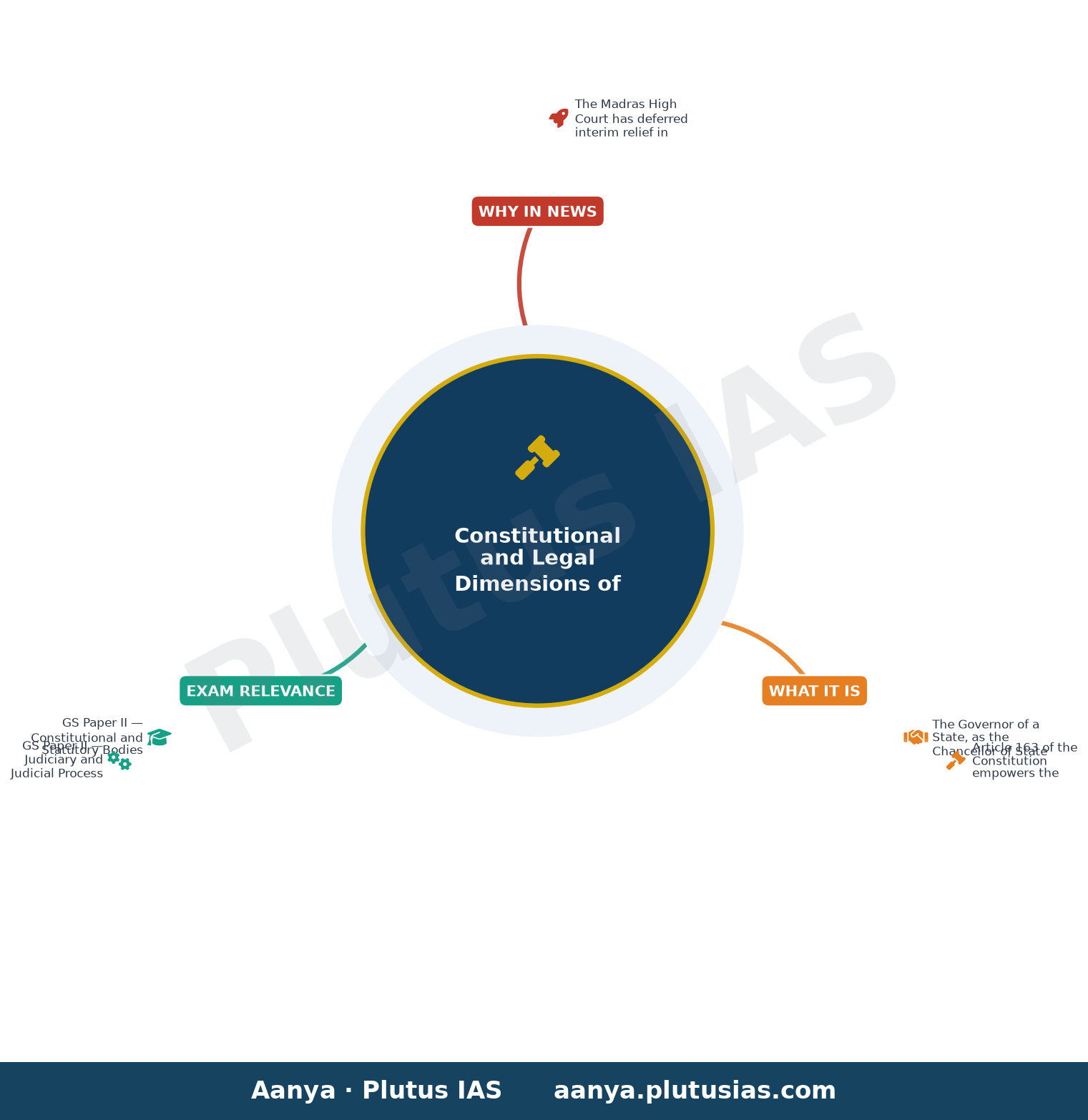
- GS Paper II — Constitutional and Statutory Bodies (Governor’s Role) | GS Paper II — Judiciary and Judicial Process | GS Paper III — Higher Education: Governance and Autonomy
- Prelims: Governor’s discretionary powers under Article 163, Appointment of Vice-Chancellors under State Universities Act, Judicial review of legislative amendments, Interim orders and stays in writ jurisdiction, Search committees for university appointments
- Essay: Judicial activism and the balance of powers in higher education governance, Federalism and the role of State governments in educational administration
Quick Revision: The appointment of Vice-Chancellors in State universities is a constitutional and statutory matter where the Governor’s role as Chancellor must balance State legislative amendments with judicial scrutiny under Article 226 and constitutional principles.
Why is this in the news?
The Madras High Court has deferred interim relief in two writ petitions challenging the constitutional validity of Tamil Nadu’s legislative amendments vesting the power to appoint Vice-Chancellors in the State government rather than the Governor. The court has scheduled the final hearing for September 2, 2026, following submissions by the Advocate General that the State government should be permitted to appoint Vice-Chancellors until the dispute is resolved, given the Supreme Court’s stay on the High Court’s earlier interim order. This case underscores the ongoing tension between State legislative authority, gubernatorial constitutional role, and judicial oversight in higher education governance.
Background
- The appointment of Vice-Chancellors in State-run universities in India is governed by respective State University Acts, which typically vest the power with the Governor (as Chancellor) or a State government-appointed authority.
- In 2025, the Tamil Nadu legislature amended statutes governing State universities, transferring the power to appoint Vice-Chancellors from the Governor to the State government.
- A Division Bench of the Madras High Court, in May 2025, stayed the operation of these amendments, holding that the amendments took away the power of appointment from the Chancellor (Governor).
- The Supreme Court, in an appeal by the State government, stayed the High Court’s interim order and directed that no Vice-Chancellors be appointed until the High Court’s final decision, creating a vacuum in university leadership.
- Subsequently, a second writ petition was filed in 2026 by a citizen, highlighting the operational dysfunction in universities due to prolonged vacancies in Vice-Chancellor positions.
- The Advocate General argued that the Supreme Court’s stay implied the amendments were in force, and thus the State government should be permitted to appoint Vice-Chancellors via search committees, as per the amended statutes.
What is the constitutional and legal framework governing Vice-Chancellor appointments?
- The Governor of a State, as the Chancellor of State universities, traditionally holds the power to appoint Vice-Chancellors, often based on recommendations from search committees or State government inputs.
- Article 163 of the Constitution empowers the Governor to act on the aid and advice of the State Council of Ministers, except in matters where the Constitution requires discretionary exercise of power.
- State University Acts, such as the Tamil Nadu Universities Act, 1976, delineate the procedure for appointments, including the composition of search committees and the Governor’s role in final selection.
- Judicial review of legislative amendments is permissible under Article 226 of the Constitution, where the court examines whether the amendments violate constitutional principles such as federalism, separation of powers, or fundamental rights.
- Interim orders in writ petitions are granted to preserve the status quo until the final disposal of the case, as seen in the Madras High Court’s stay on the amendments in 2025.
- The Supreme Court’s jurisdiction under Article 136 allows it to stay High Court orders if it deems necessary, as in the present case, where the stay on interim relief led to a legislative vacuum.
UPSC Value Addition
Keywords for Mains Answer-Writing
Vice-Chancellor appointment · Governor-Chancellor powers · State vs Central role in higher education · University statutes amendment · Madras High Court jurisdiction · Supreme Court stay on High Court orders · Search panels for Vice-Chancellor selection · Interim orders in constitutional disputes · State legislature vs constitutional provisions · Judicial review of university governance · Tamil Nadu higher education policy · Appointment of statutory authorities
Prelims Practice Questions
Q1. Consider the following statements regarding the appointment of Vice-Chancellors in State-run universities in India:
1. The Governor (as Chancellor) traditionally appoints Vice-Chancellors in most States.
2. The Supreme Court has the power to stay High Court orders in matters of university governance.
3. State legislatures can amend university statutes to alter the appointment process of Vice-Chancellors.
4. The Union Government has exclusive authority to appoint Vice-Chancellors in all State-run universities.
How many of the above statements are correct?
- Only one
- Only two
- Only three
- All
Answer: Only three — Statements 1, 2, and 3 are correct. Statement 4 is incorrect as the Union Government does not have exclusive authority; appointments are governed by State statutes and constitutional provisions.
Q2. Assertion (A): The Madras High Court stayed the operation of amendments that vested the power of appointing Vice-Chancellors with the State government.
Reason (R): The Supreme Court later stayed the High Court’s order, allowing the State government to appoint Vice-Chancellors.
In the context of the above statements, which of the following is correct?
- Both A and R are true, and R is the correct explanation of A.
- Both A and R are true, but R is not the correct explanation of A.
- A is true, but R is false.
- A is false, but R is true.
Answer: A is true, but R is false. — Assertion (A) is true as the Madras High Court did stay the amendments. Reason (R) is also true, but it does not explain the assertion; rather, it describes a subsequent judicial action.
Q3. Match the following constitutional provisions with their correct descriptions:
Column I (Provisions)
A. Article 153
B. Article 161
C. Article 254
D. Article 323B
Column II (Descriptions)
1. Power of the Governor to grant pardons, reprieves, respites or remissions of punishment
2. Provision for the appointment of the Governor in each State
3. Power of Parliament to legislate on matters in the State List in the national interest
4. Establishment of tribunals for adjudication of disputes relating to recruitment and conditions of service of persons appointed to public services and posts in connection with the affairs of the Union or of any State
Select the correct match:
- A-2, B-1, C-3, D-4
- A-1, B-2, C-3, D-4
- A-3, B-1, C-2, D-4
- A-2, B-3, C-1, D-4
Answer: A-2, B-1, C-3, D-4 — A-2 (Article 153: Appointment of Governor), B-1 (Article 161: Governor’s pardoning power), C-3 (Article 254: Parliament’s power to legislate on State List matters), D-4 (Article 323B: Tribunals for public service disputes).
Mains Practice Question
✍ The appointment of Vice-Chancellors to State-run universities has become a site of constitutional contestation between the Governor (as Chancellor) and the State government. Critically examine the legal and institutional dimensions of this dispute in the context of recent judicial interventions, including the Madras High Court’s order and the Supreme Court’s stay. Also, analyse the implications of vesting the appointing authority with the State government. (15 Marks)
Approach: MODEL-ANSWER SKELETON:
1. **Constitutional Framework**:
– Article 153 (Governor’s office), Article 161 (pardon power), and the doctrine of constitutional morality.
– Role of the Chancellor (Governor) in appointing Vice-Chancellors under State university statutes.
2. **Recent Judicial Interventions**:
– Madras High Court’s order (May 21, 2025) staying amendments that vested appointment power with the State government.
– Supreme Court’s stay on the High Court’s order, citing the supremacy of State legislature’s amendments.
– Reference to the doctrine of judicial review vs. legislative competence (Art. 246 and State List Entry 66).
3. **Legal and Institutional Dimensions**:
– Conflict between the Governor’s constitutional role and the State government’s executive authority.
– Search panels and the process of selecting Vice-Chancellors: transparency and accountability.
– Judicial precedents: Rameshwar Prasad v. Union of India (2006) on Governor’s discretion, and T.M.A. Pai Foundation v. State of Karnataka (2002) on university autonomy.
4. **Implications of State Government’s Appointing Authority**:
– Potential for politicisation of university appointments.
– Impact on academic autonomy and institutional independence (Art. 29 and 30 of the Constitution).
– Risk of executive overreach vs. democratic accountability.
5. **Balanced View and Conclusion**:
– Need for a harmonious interpretation of constitutional provisions.
– Role of the judiciary in upholding the balance between federalism and institutional autonomy.
– Suggested reforms: codification of appointment processes, judicial guidelines, and parliamentary oversight.
Source: The Hindu
Generated by AanyaAi for educational purpose.

- Cabinet approves ITMS for Delhi: Smart Traffic to cut jams & boost safety - September 30, 2026
- आईआईएससी शीर्ष पर, ऑक्सफोर्ड बना रहा दुनिया में नंबर वन: थी विश्व रैंकिंग 2027 - September 30, 2026
- झारखंड में डिजिटल स्वास्थ्य क्रांति: 4 योजनाओं का शुभारंभ - September 30, 2026

No Comments