


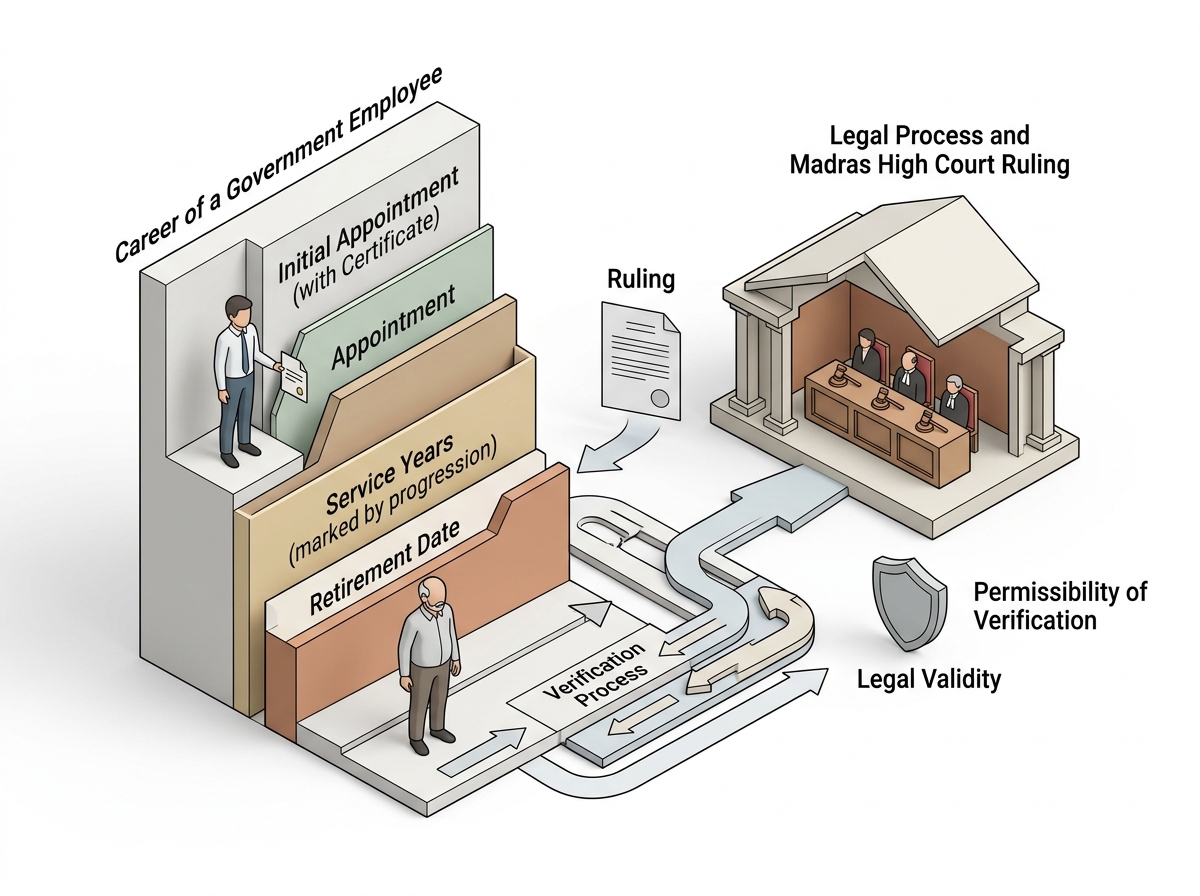
08 Aug Madras HC: Verification of Caste Certificates Permissible Even After Retirement
✎ Verification of community certificates for government employees is legally permissible even after retirement, as fraudulent appointments are *ab initio* void and retiral benefits cannot shield such illegality.
Subject Relevance — Where This Topic Fits
- GS Paper II — Constitutional and Statutory Bodies (Judiciary) | GS Paper IV — Ethics, Integrity and Aptitude (Governance Issues)
- Prelims: Community Certificate, Caste Verification, Kumari Madhuri Patil Case, Article 14, Article 16, SC/ST (Prevention of Atrocities) Act, Government Scrutiny Committees, Retiral Benefits, Ab Initio Void Appointment
- Essay: The tension between constitutional morality and procedural fairness in governance, The role of judicial intervention in upholding meritocracy and social justice
Quick Revision: Verification of community certificates for government employees is legally permissible even after retirement, as fraudulent appointments are *ab initio* void and retiral benefits cannot shield such illegality.
Why is this in the news?
On 30 July 2026, a Full Bench of the Madras High Court ruled that the verification of the genuineness of community certificates or caste status of government employees remains legally permissible even after their retirement. The judgment, delivered by Chief Justice Sushrut Arvind Dharmadhikari and Justices K. Kumaresh Babu and G. Arul Murugan, clarified that retirement does not extinguish the foundational illegality of an appointment secured through fraudulent means, and directed public employers to initiate and complete verification processes within the early years of an employee’s service to prevent systemic backlogs and dilatory tactics.
Background
- The issue arose from conflicting decisions of Division Benches of the Madras High Court on whether post-retirement verification of community certificates is legally tenable.
- The Supreme Court’s landmark judgment in *Kumari Madhuri Patil v. Additional Commissioner, Tribal Development* (1994) established a multi-point verification matrix for caste certificates to prevent fraudulent claims in government appointments.
- The Constitution of India, through Articles 14 (Right to Equality) and 16 (Equality of Opportunity in Public Employment), mandates that appointments to public services must be based on genuine merit and eligibility criteria.
- The Scheduled Castes and Scheduled Tribes (Prevention of Atrocities) Act, 1989, and subsequent judicial interpretations, reinforce the state’s duty to prevent the misuse of caste certificates to secure undue benefits.
- Tamil Nadu, like other states, has established State Level Scrutiny Committees and district-level vigilance committees to verify the authenticity of caste certificates, but systemic delays and backlogs have impeded their efficacy.
- The judgment underscores the principle that fraud has no expiry date and that retiral benefits accruing from a void appointment cannot be shielded from scrutiny.
What is the verification of community certificates and why is it significant?
- A community certificate, issued by competent authorities, certifies an individual’s caste status for the purpose of availing reservations in education, employment, and other welfare schemes under Articles 15(4) and 16(4) of the Constitution.
- Verification of community certificates is a process to ascertain the authenticity of the caste claim made by an individual, particularly in the context of government appointments or promotions where reservations are availed.
- The Supreme Court’s judgment in *Kumari Madhuri Patil* (1994) laid down a rigorous verification mechanism, including scrutiny of documentary evidence, field enquiries, and anthropological verification to prevent fraudulent claims.
- The verification process is conducted by State Level Scrutiny Committees and district-level vigilance committees, which are empowered to cancel fraudulent certificates and recommend disciplinary action against erring officials.
- The Madras High Court’s judgment clarifies that the verification process can be initiated or continued even after an employee’s retirement, as retirement does not absolve the foundational illegality of a fraudulent appointment.
- The court directed public employers to prioritise verification within the initial years of an employee’s service to avoid systemic delays and ensure timely action against fraudulent appointments.
- The judgment reinforces the constitutional principle that appointments secured through fraud are *ab initio* void, meaning they are treated as invalid from the inception and cannot be regularised by subsequent events such as retirement.
- The decision also highlights the state’s obligation to balance constitutional accountability with procedural fairness, ensuring that verification processes are conducted expeditiously without causing undue harassment to genuine claimants.
Key Features
| Feature | Significance |
|---|---|
| Post-retirement verification of community certificates | Affirms that fraud in service entry cannot be insulated by retirement, upholding constitutional accountability. |
| Full Bench ruling on Kumari Madhuri Patil (1994) compliance | Clarifies that procedural mechanics established by the Supreme Court apply irrespective of the year of issuance or employment. |
| Mandatory initiation of verification within initial service years | Ensures timely scrutiny to prevent systemic backlogs and procedural delays. |
| Strengthening of State and district-level scrutiny committees | Institutionalises anthropological expertise to eliminate systemic errors in caste verification. |
| Fast-track inquiries post-retirement | Prevents dilatory tactics while balancing fairness and constitutional integrity. |
Why it Matters
Constitutional Governance
- Reinforces the principle that appointments secured through fraud are void ab initio, irrespective of time elapsed or retirement.
- Upholds the supremacy of constitutional accountability over procedural technicalities.
- Ensures that retiral benefits do not shield foundational illegality in service entry.
Administrative Efficiency
- Mandates timely verification to prevent accumulation of backlogs and delayed justice.
- Directs institutional strengthening to ensure rigorous compliance with verification protocols.
- Balances procedural fairness with the need for expeditious resolution of fraud cases.
Judicial Precedent
- Resolves conflicting Division Bench rulings by providing a definitive interpretation of Kumari Madhuri Patil (1994).
- Clarifies the scope of verification powers of public employers and scrutiny committees.
- Affirms that procedural mechanics are not time-barred, ensuring consistency in judicial interpretation.
Challenges
1. Systemic Backlogs in Verification
- Inadequate manpower and anthropological expertise in scrutiny committees may delay verification processes.
- Risk of procedural delays being exploited to shield fraudulent appointments.
- Need for institutional capacity-building to ensure rigid compliance with verification protocols.
UPSC Link: GS-II: Constitutional & Statutory Bodies
2. Balancing Fairness and Accountability
- Ensuring that post-retirement inquiries do not amount to harassment while maintaining constitutional integrity.
- Preventing dilatory tactics that defeat the purpose of timely verification.
- Balancing the rights of employees with the need for rigorous scrutiny to uphold public trust.
UPSC Link: GS-IV: Ethics and Integrity
3. Interpretational Conflicts in Precedents
- Resolving conflicting Division Bench rulings to ensure uniformity in judicial interpretation.
- Clarifying the scope of verification powers to prevent ambiguity in implementation.
- Ensuring that procedural mechanics are not misinterpreted to grant immunity to fraudulent appointments.
UPSC Link: GS-II: Judiciary
4. Institutional Capacity Constraints
- Limited anthropological expertise available for caste verification may hinder accurate scrutiny.
- Need for targeted manpower augmentation in State and district-level committees.
- Ensuring that institutional strengthening is both timely and effective.
UPSC Link: GS-II: Government Policies
Challenges — UPSC Perspective
| Issue | Concern |
|---|---|
| Inadequate institutional capacity | Risk of delayed verification due to lack of manpower and expertise. |
| Procedural delays | Potential exploitation of delays to shield fraudulent appointments. |
| Balancing fairness and accountability | Ensuring post-retirement inquiries do not amount to harassment. |
| Resolving interpretational conflicts | Need for definitive judicial clarity on verification powers. |
| Ensuring timely implementation | Risk of institutional inertia delaying compliance with court directives. |
Way Forward
- Immediate augmentation of State and district-level scrutiny committees with anthropological experts and administrative staff.
- Mandatory initiation of community certificate verification within the first three years of an employee’s service.
- Fast-tracking of post-retirement inquiries with strict timelines to prevent dilatory tactics.
- Conducting periodic audits of verification processes to ensure compliance with Kumari Madhuri Patil (1994) protocols.
- Capacity-building programs for scrutiny committee members to enhance accuracy in caste verification.
- Establishing a grievance redressal mechanism for employees to address concerns regarding verification processes.
- Ensuring transparency in verification outcomes to uphold public trust and accountability.
- Periodic review of institutional mechanisms to address emerging challenges in verification.
UPSC Value Addition
Keywords for Mains Answer-Writing
Community Certificate verification · Madras High Court Full Bench judgment · Caste status verification post-retirement · Article 16(2) equality of opportunity · Kumari Madhuri Patil case 1994 · State Level Scrutiny Committee · Constitutional accountability · Ab initio void appointments · Retiral benefits · Caste-based reservations · Judicial review of administrative decisions · Procedural fairness in service matters
Constitutional & Policy Linkages
- [‘Article 14: Equality before law and equal protection of laws.’, ‘Ensures non-discrimination in verification processes.’]
- [‘Article 16(4): Reservation and backward class representation.’, ‘Upholds the integrity of reservation policies.’]
- [‘Article 32: Right to constitutional remedies.’, ‘Affirms judicial oversight over administrative actions.’]
Concept Flow
Appointment secured through fraudulent community certificate → Post-retirement verification initiated by public employer → Full Bench ruling affirms legality of post-retirement verification → Verification process completed despite retirement, upholding constitutional accountability → Institutional strengthening of scrutiny committees to ensure rigorous compliance → Timely initiation of verification within initial service years to prevent systemic backlogs → Balancing fairness and accountability in post-retirement inquiries
Prelims Practice Questions
Q1. Consider the following statements regarding the verification of community certificates in India:
1. The Madras High Court has ruled that verification of a government employee’s caste status can be initiated even after retirement.
2. The Supreme Court in Kumari Madhuri Patil (1994) established a multi-point verification matrix for caste certificates.
3. Retiral benefits of an employee cannot be withheld even if their caste certificate is found fraudulent.
4. The verification process must be completed within the first five years of an employee’s service.
How many of the above statements are correct?
- Only one
- Only two
- Only three
- All four
Answer: Only three — Statements 1 and 2 are correct as per the Madras High Court ruling and the Supreme Court’s Kumari Madhuri Patil case. Statement 3 is incorrect because the court held that retiral benefits flowing from a void entry cannot be protected. Statement 4 is incorrect as the court directed verification to be completed within the initial years of service, not strictly five years.
Q2. Assertion (A): The Madras High Court has held that fraud in obtaining a community certificate has no expiry date.
Reason (R): The court ruled that retirement does not absolve the foundational illegality of a void appointment.
Options:
A. Both A and R are true, and R is the correct explanation of A.
B. Both A and R are true, but R is not the correct explanation of A.
C. A is true, but R is false.
D. A is false, but R is true.
Answer: ? — Both Assertion (A) and Reason (R) are true. The court explicitly stated that fraud has no expiry date and that retirement does not wash away the foundational illegality of a void appointment, making R the correct explanation of A.
Q3. Match the following provisions/judgments with their respective contexts:
Column I
1. Article 16(2) of the Constitution
2. Kumari Madhuri Patil case (1994)
3. State Level Scrutiny Committee
4. Ab initio void appointment
Column II
A. Ensures equality of opportunity in matters of public employment
B. Establishes a multi-point verification matrix for caste certificates
C. A committee empowered to verify the genuineness of community certificates
D. An appointment obtained by fraud is legally void from the inception
Options:
A. 1-A, 2-B, 3-C, 4-D
B. 1-B, 2-A, 3-D, 4-C
C. 1-C, 2-D, 3-A, 4-B
D. 1-D, 2-C, 3-B, 4-A
Answer: ? — The correct match is: 1-A (Article 16(2) ensures equality of opportunity), 2-B (Kumari Madhuri Patil case establishes verification norms), 3-C (State Level Scrutiny Committee verifies certificates), 4-D (Ab initio void appointment refers to appointments obtained by fraud).
Mains Practice Question
✍ The Madras High Court has recently ruled that the verification of community certificates can be initiated even after an employee’s retirement, holding that fraud in obtaining such certificates has no expiry date. Critically examine the constitutional and legal implications of this judgment with reference to Articles 14, 15, and 16 of the Constitution. Also, discuss the procedural safeguards required to balance constitutional accountability with fairness in such verifications. (15 Marks)
Approach: MODEL-ANSWER SKELETON:
1. **Constitutional Framework**:
– Article 14 (Right to Equality): Emphasise the principle of equality before law and equal protection of laws, ensuring no discrimination in public employment.
– Article 15(1) (Prohibition of Discrimination): Highlight that reservations must not be misused to secure undue advantages.
– Article 16(2) (Equality of Opportunity): Stress that appointments obtained through fraud subvert the constitutional guarantee of equality in public employment.
2. **Judicial Precedents and Legal Principles**:
– Kumari Madhuri Patil (1994): Cite the Supreme Court’s directive on a multi-point verification matrix for caste certificates.
– Ab initio Void Appointments: Explain the legal principle that appointments obtained by fraud are void from inception and do not confer any legal rights.
– Retiral Benefits: Discuss the court’s reasoning that retiral benefits flowing from a void appointment cannot be protected.
3. **Procedural Safeguards and Fairness**:
– Institutional Strengthening: Reference the Madras High Court’s direction to fortify State Level Scrutiny Committees and district vigilance committees with anthropological experts.
– Timely Verification: Highlight the court’s directive to complete verification within the initial years of service to prevent dilatory tactics.
– Balancing Accountability and Fairness: Discuss the need for a fair inquiry process, avoiding harassment or arbitrary delays.
4. **Contemporary Relevance**:
– Systemic Backlogs: Address the issue of massive backlogs in verification processes and the need for rigid compliance with verification norms.
– Constitutional Integrity: Emphasise that the judgment reinforces constitutional accountability and deters misuse of reservation benefits.
5. **Conclusion**:
– Summarise the judgment’s contribution to upholding constitutional values while ensuring procedural fairness.
– Acknowledge the challenge of balancing speed and justice in such verifications.
Source: The Hindu
Generated by AanyaAi for educational purpose.

- महाराष्ट्र में त्योहार जुलूसों पर बॉम्बे हाईकोर्ट का बड़ा फैसला: पटाखे, लेजर और संगीत पर रोक - September 24, 2026
- Bombay HC Bans Firecrackers, Music in Maharashtra Processions: Key UPSC Analysis - September 24, 2026
- तमिलनाडु में महिला कर्मचारियों के लिए सवैतनिक माहवारी अवकाश नीति पर HC का आदेश - September 24, 2026

No Comments