


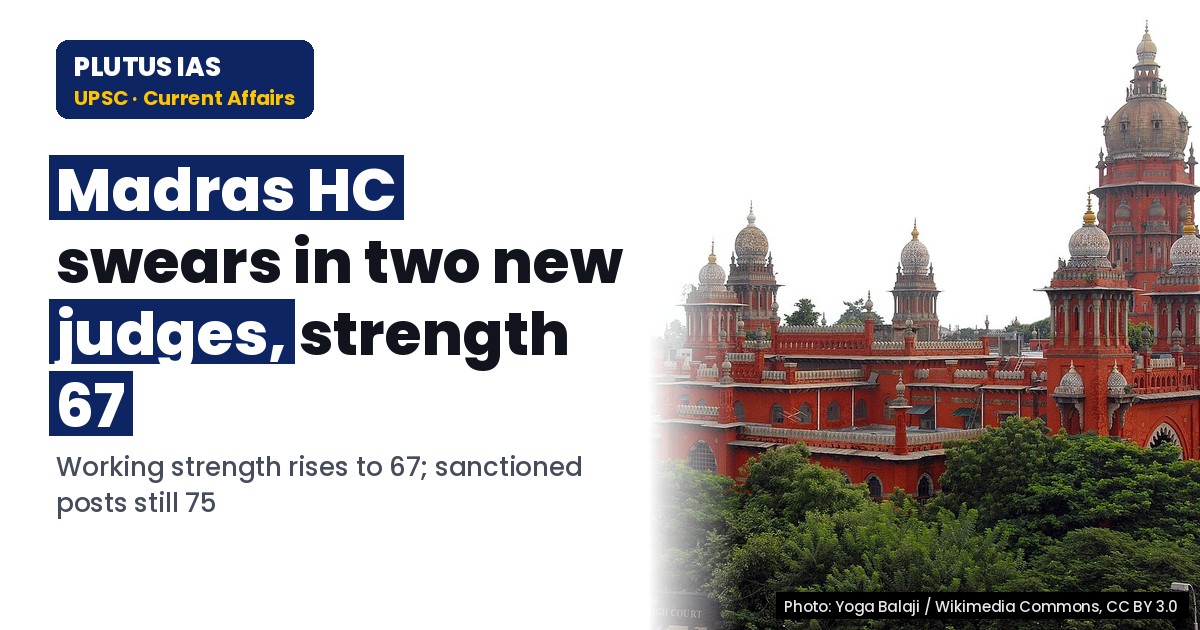
16 Oct Madras High Court strength rises to 67: Key Polity update for UPSC aspirants
✎ The working strength of a high court is determined by the number of judges currently serving, which may be below the sanctioned strength due to vacancies; judicial appointments are governed by the collegium system under the…
Subject Relevance — Where This Topic Fits
- GS Paper II — Polity and Governance — Judiciary and Constitutional Framework | GS Paper IV — Ethics, Integrity and Aptitude — Probity in Governance (Judicial Appointments)
- Prelims: Judicial Appointments Commission, Collegium System, High Court Judges (Conditions of Service) Act, 1954, Madras High Court, Sanctioned vs Working Strength of High Courts, Article 217 of the Constitution, Article 224 of the Constitution, District Judiciary, Oath of Office under Schedule III of the Constitution
- Essay: The role of the judiciary in upholding constitutional democracy, Institutional capacity and judicial efficiency: A case study of the Madras High Court
Quick Revision: The working strength of a high court is determined by the number of judges currently serving, which may be below the sanctioned strength due to vacancies; judicial appointments are governed by the collegium system under the Constitution.
Why is this in the news?
The swearing-in of two additional judges at the Madras High Court, elevating its working strength to 67 against a sanctioned strength of 75, is significant for understanding the dynamics of judicial appointments, the functioning of the collegium system, and the operational capacity of high courts in India. This development highlights the procedural aspects of judicial elevation from the district judiciary and the constitutional framework governing high court judges, which is critical for UPSC Civil Services aspirants preparing for polity and governance-related questions.
Background
- The Madras High Court, established in 1862, is one of the oldest high courts in India and exercises jurisdiction over Tamil Nadu and the Union Territory of Puducherry.
- High courts in India operate under the constitutional framework laid down in Articles 214 to 231 of the Constitution, with their powers and functions delineated by the Constitution and relevant statutes.
- The sanctioned strength of judges in a high court is determined by the President of India in consultation with the Chief Justice of India, as per the High Court Judges (Conditions of Service) Act, 1954.
- The working strength of a high court fluctuates based on appointments, retirements, and transfers, and often falls short of the sanctioned strength due to delays in the judicial appointment process.
- Judicial appointments to high courts are governed by the collegium system, a judicial innovation that emphasizes the primacy of the judiciary in selecting judges, as evolved through Supreme Court judgments.
- The elevation of judges from the district judiciary to high courts is a critical pathway for judicial appointments, ensuring continuity and experience in the higher judiciary.
Judicial Appointments to the Madras High Court: Constitutional and Procedural Framework
- The Madras High Court, like other high courts in India, derives its authority from the Constitution of India, specifically Articles 214 to 231, which establish high courts as the highest courts of appeal and constitutional guardians within their territorial jurisdictions.
- The sanctioned strength of judges in the Madras High Court is 75, as determined by the President of India in consultation with the Chief Justice of India. The current working strength stands at 67, indicating a shortfall of 8 judges.
- Judicial appointments to high courts are governed by the collegium system, a mechanism evolved through judicial pronouncements such as the Second and Third Judges Cases (1993 and 1998), which mandates that the Chief Justice of India and a collegium of senior judges recommend appointments.
- The elevation of judges from the district judiciary to the high court is governed by Article 224 of the Constitution, which empowers the President to appoint additional judges for a fixed tenure or to appoint permanent judges from the district judiciary.
- The oath of office administered to judges of the high court is prescribed under Schedule III of the Constitution, which includes an affirmation to uphold the Constitution and the laws of India without fear or favour.
- The process of judicial elevation involves a rigorous assessment of the candidate’s legal acumen, integrity, and judicial temperament, often through consultations with the Chief Justice of the high court and the collegium.
- The functioning of the Madras High Court, like other high courts, is critical for the dispensation of justice, particularly in matters related to civil, criminal, constitutional, and administrative law within its jurisdiction.
- The appointment of additional judges is a temporary measure to address vacancies, while permanent judges are appointed to ensure stability and continuity in the judicial system.
Key Features
| Feature | Significance |
|---|---|
| Appointment of two additional judges | Increases the High Court’s working strength from 65 to 67, enhancing judicial capacity for case disposal. |
| Elevation from district judiciary | Demonstrates the career progression pathway within the Indian judicial system, ensuring domain expertise in lower-tier courts. |
| Oath administered by Chief Justice | Upholds the constitutional process of judicial appointment under Article 217, ensuring legitimacy and adherence to procedure. |
| Sanctioned strength vs. working strength | Highlights the persistent gap between sanctioned and actual judicial strength, impacting judicial efficiency. |
| Diverse regional representation | The new judges hail from Tirunelveli and Thanjavur districts, reflecting geographical inclusivity in judicial appointments. |
Why it Matters
Judicial Administration
- Strengthens the Madras High Court’s judicial infrastructure, enabling faster disposal of pending cases and reducing backlog.
- Enhances the court’s ability to address constitutional, civil, and criminal matters with greater judicial manpower.
- Promotes career advancement within the judiciary, incentivizing excellence in district-level judicial roles.
Governance and Rule of Law
- Ensures continuity and efficiency in the judicial process, particularly in a high-volume court like the Madras High Court.
- Reinforces the principle of separation of powers by maintaining an independent and adequately staffed judiciary.
- Supports the constitutional mandate of timely justice under Article 21 (Right to Life and Personal Liberty) and Article 39A (Equal Justice).
Human Resource Management in Judiciary
- Demonstrates the structured progression from district judiciary to High Court, ensuring judicial expertise at all levels.
- Highlights the need for balanced regional representation in judicial appointments to ensure equitable access to justice.
- Underscores the importance of career planning and professional development within the judicial services.
Challenges
1. Judicial Vacancy and Backlog
- The sanctioned strength of 75 judges remains unmet, with only 67 judges currently serving, indicating systemic delays in judicial appointments.
- Persistent vacancies contribute to case pendency, undermining the right to speedy justice under Article 21.
- The gap between sanctioned and working strength necessitates urgent measures to expedite appointments and fill vacancies.
UPSC Link: Judicial Appointments and Collegium System
2. Regional Representation and Inclusivity
- Ensuring equitable representation across all regions of Tamil Nadu remains a challenge, particularly for districts with limited judicial representation.
- Balancing meritocracy with regional inclusivity requires careful policy design to avoid compromising judicial efficiency.
- The appointment of judges from Tirunelveli and Thanjavur districts addresses some gaps but highlights the need for broader geographical coverage.
UPSC Link: Judicial Appointments and Federalism
3. Judicial Efficiency and Case Management
- Even with increased strength, the Madras High Court faces challenges in managing its caseload, particularly in complex civil and criminal matters.
- The reliance on additional judges for fixed tenures may not provide long-term solutions to structural inefficiencies.
- Strengthening alternative dispute resolution mechanisms and procedural reforms could complement judicial appointments.
UPSC Link: Judicial Reforms and Case Disposal
Challenges — UPSC Perspective
| Issue | Concern |
|---|---|
| Sanctioned vs. Working Strength | Persistent gap undermines judicial efficiency and delays justice delivery. |
| Regional Representation | Limited geographical diversity in appointments may exclude certain regions from judicial representation. |
| Case Pendency | High volume of pending cases strains judicial resources despite incremental increases in judge strength. |
| Appointment Delays | Systemic bottlenecks in the judicial appointment process contribute to prolonged vacancies. |
| Judicial Career Progression | Ensuring a fair and transparent pathway from district judiciary to High Court remains a challenge. |
Way Forward
- Conduct a comprehensive review of the judicial appointment process to identify and address bottlenecks in the Collegium System.
- Expand the sanctioned strength of the Madras High Court in line with its caseload and regional requirements, with a focus on filling existing vacancies.
- Implement a structured mentorship and training program for judges elevated from the district judiciary to ensure seamless transition to the High Court.
- Strengthen alternative dispute resolution mechanisms, such as mediation and arbitration, to reduce the burden on the judiciary.
- Promote geographical inclusivity in judicial appointments by identifying underrepresented regions and prioritizing candidates from those areas.
- Enhance infrastructure and digitalization in the Madras High Court to improve case management and reduce delays.
- Monitor and publish annual reports on judicial vacancies, appointments, and case disposal rates to ensure transparency and accountability.
UPSC Value Addition
Keywords for Mains Answer-Writing
Judicial Appointments in India · High Court Judges · Madras High Court · Constitutional Provisions for Judicial Appointments · Article 217 of the Constitution · Judicial Strength and Vacancies · Appointment of Additional Judges · Judicial Collegium System · Independence of Judiciary · Judicial Reforms · Appointment Process for High Court Judges · Constitutional Governance of Judiciary
Constitutional & Policy Linkages
- {‘Article 217’: ‘Appointment of High Court judges’}
- {‘Article 219’: ‘Oath of office for High Court judges’}
- {‘Article 224’: ‘Appointment of additional judges’}
- {‘Article 226’: ‘Writ jurisdiction of High Courts’}
- {‘Article 227’: ‘Superintendence over subordinate courts’}
Concept Flow
Constitutional provision for High Court judge appointments (Article 217) → Collegium System for judicial appointments → Vacancy identification and nomination → Presidential warrant of appointment → Oath of office administered by Chief Justice → Judicial strength increases → Enhanced case disposal capacity.
Prelims Practice Questions
Q1. Consider the following statements regarding the appointment of High Court judges in India:
1. The President of India appoints High Court judges after consultation with the Chief Justice of India.
2. The appointment of additional judges in a High Court can be made for a fixed tenure up to two years.
3. The Chief Justice of a High Court is appointed by the President of India after consultation with the Governor of the State and the Chief Justice of India.
How many of the above statements are correct?
- Only one
- Only two
- Only three
- None
Answer: Only three — Statement 1 is correct as per Article 217(1) of the Constitution. Statement 2 is correct as additional judges can be appointed under Article 224(1) for a fixed tenure. Statement 3 is incorrect as the Chief Justice of a High Court is appointed by the President after consultation with the Chief Justice of India and the Governor of the State is not involved in the appointment process.
Q2. Assertion (A): The judicial strength of a High Court cannot exceed its sanctioned strength.
Reason (R): The sanctioned strength of a High Court is determined by the Parliament under Article 224 of the Constitution.
- Both A and R are true, and R is the correct explanation of A
- Both A and R are true, but R is not the correct explanation of A
- A is true but R is false
- A is false but R is true
Answer: A is false but R is true — Assertion (A) is true as the working strength of a High Court cannot exceed its sanctioned strength. However, Reason (R) is false because the sanctioned strength of a High Court is determined by the President in consultation with the Chief Justice of India and not by Parliament.
Q3. Match the following provisions of the Constitution of India with their respective Articles:
Column I (Provision)
A. Appointment of High Court judges
B. Appointment of additional judges in High Courts
C. Original jurisdiction of the Supreme Court
D. Appointment of the Chief Justice of India
Column II (Article)
1. Article 131
2. Article 217
3. Article 124(2)
4. Article 224(1)
- {‘A’: 2, ‘B’: 4, ‘C’: 1, ‘D’: 3}
- {‘A’: 3, ‘B’: 1, ‘C’: 2, ‘D’: 4}
- {‘A’: 2, ‘B’: 4, ‘C’: 3, ‘D’: 1}
- {‘A’: 4, ‘B’: 2, ‘C’: 1, ‘D’: 3}
Answer: {‘A’: 2, ‘B’: 4, ‘C’: 1, ‘D’: 3} — A matches with Article 217 (Appointment of High Court judges), B matches with Article 224(1) (Appointment of additional judges), C matches with Article 131 (Original jurisdiction of the Supreme Court), and D matches with Article 124(2) (Appointment of the Chief Justice of India).
Mains Practice Question
✍ Critically examine the constitutional and institutional framework governing the appointment of judges to the High Courts in India. How does the current process balance judicial independence with accountability? Also, analyse the implications of increasing the working strength of the Madras High Court to 67 judges against its sanctioned strength of 75. (15 Marks)
Approach: MODEL-ANSWER SKELETON:
1. **Constitutional Framework**:
– Article 217: Appointment of High Court judges (President appoints after consultation with CJI and Governor of the State).
– Collegium System: Evolution from the First and Second Judges Cases (1981, 1993) to the present Memorandum of Procedure (MoP).
– Role of the Executive: President’s role in appointment and consultation with the Council of Ministers.
2. **Process of Appointment**:
– Initiation: Proposal from the High Court Collegium to the Supreme Court Collegium.
– Consultation: CJI’s role in recommending names to the President.
– Appointment: President’s formal appointment after clearance from the Intelligence Bureau and the Law Ministry.
3. **Judicial Independence vs. Accountability**:
– Independence: Collegium system aims to insulate judiciary from executive interference.
– Accountability: Transparency concerns, lack of formal criteria for selection, and delays in appointments.
– Recent Reforms: Attempts to introduce a National Judicial Appointments Commission (NJAC) struck down in 2015; ongoing debates on transparency and meritocracy.
4. **Madras High Court Case Study**:
– Sanctioned strength: 75 judges; working strength: 67 judges (as of October 2026).
– Implications of increasing working strength:
– **Judicial Efficiency**: Faster disposal of cases, reduced pendency (e.g., Madras High Court’s pendency of over 6 lakh cases).
– **Constitutional Limits**: Working strength must not exceed sanctioned strength as per Article 224(1).
– **Resource Allocation**: Need for infrastructure, staff, and budgetary support to sustain higher judicial strength.
– **Judicial Quality**: Ensuring that appointments maintain high standards of competence and integrity.
5. **Conclusion**:
– The appointment process must balance judicial independence with mechanisms for transparency and accountability.
– Increasing judicial strength is a step toward reducing pendency but must be accompanied by systemic reforms in judicial governance.
Source: The Hindu
Generated by AanyaAi for educational purpose.
Related guides on our sites
- Best PSIR optional coaching for upsc
- Best PSIR optional teacher for upsc
- Best teacher of PSIR optional for upsc
- Best PSIR optional coaching in delhi for UPSC

- Kerala HC Orders SBI to Refund ₹3.73 Lakh in Cyberfraud Case: Key Judgment for UPSC - October 21, 2026
- मुंबई फ्लेमिंगो अभयारण्य बफर जोन में सड़क निर्माण: 680 मैनग्रोव होंगे प्रभावित - October 21, 2026
- RBI Hikes Repo Rate by 25 bps: MPC Minutes Reveal Inflation Concerns - October 21, 2026

No Comments