


06 Aug MAHA Jal Mission: ANRF & Jal Shakti Ministry’s Joint Initiative for Water Challenges
✎ The Maha Jal Mission integrates mission-oriented research, industry collaboration, and field-ready innovation to address India’s water security challenges through the MAHA Jal Programme under the National Research Foundation…
Subject Relevance — Where This Topic Fits
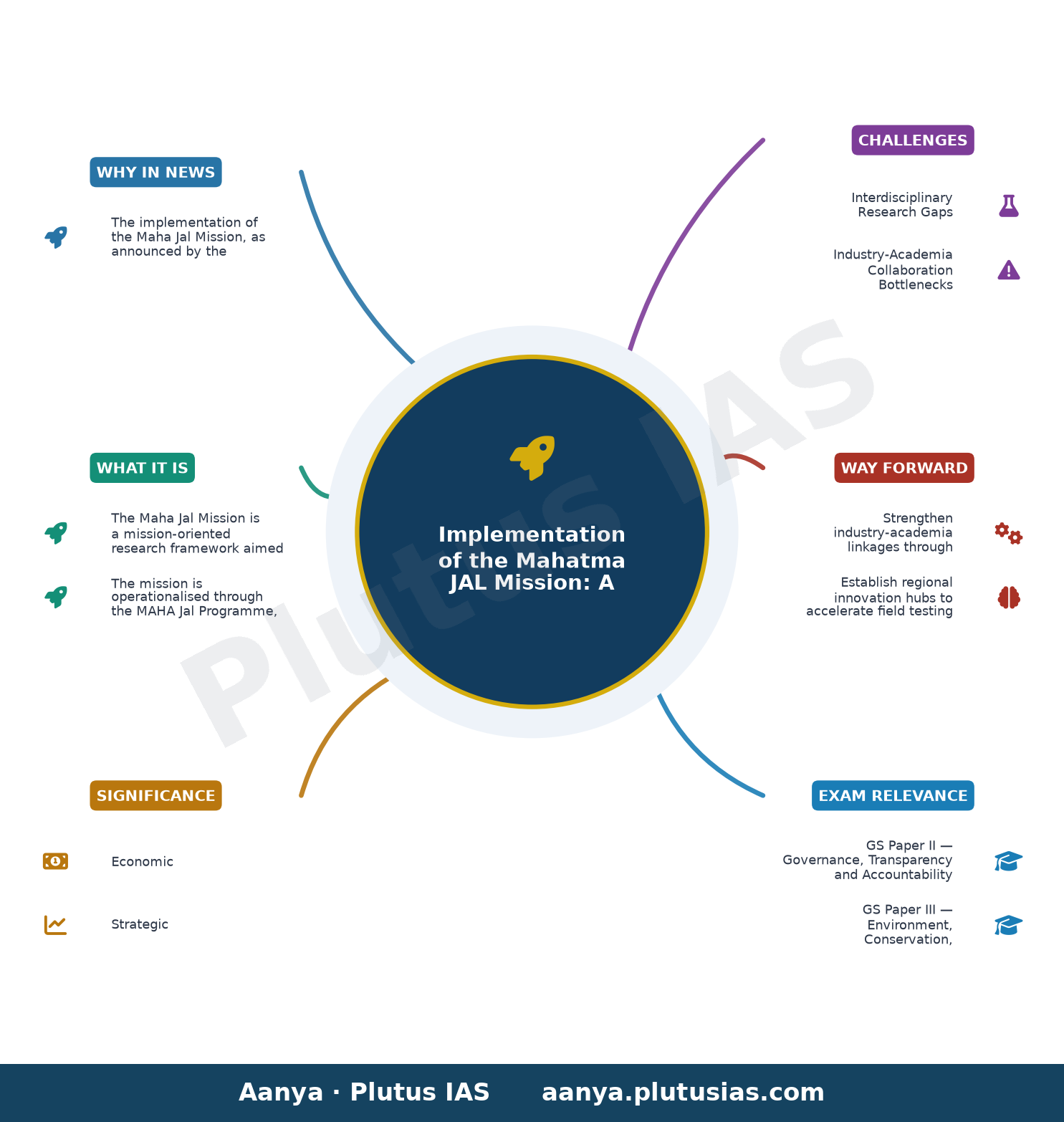
- GS Paper II — Governance, Transparency and Accountability | GS Paper III — Environment, Conservation, Environmental Pollution and Degradation, Environmental Impact Assessment | GS Paper III — Science and Technology — Developments and their Applications and Effects in Everyday Life | GS Paper III — Disaster and Disaster Management
- Prelims: National Research Foundation (NRF), Mission for Advancement in High-Impact Areas (MAHA), Jal Shakti Mission, Circular Economy, Water Quality Index, Sustainable Water Management, Climate Resilience, Hackathon 2025, ANRF Act 2023
- Essay: Water Security as a National Priority: Balancing Development and Sustainability, The Role of Science, Technology, and Industry in Addressing India’s Water Crisis
Quick Revision: The Maha Jal Mission integrates mission-oriented research, industry collaboration, and field-ready innovation to address India’s water security challenges through the MAHA Jal Programme under the National Research Foundation (NRF).
Why is this in the news?
The implementation of the Maha Jal Mission, as announced by the Ministry of Jal Shakti on 06 August 2026, marks a significant shift in India’s approach to water governance by leveraging mission-oriented research through the National Research Foundation (NRF) framework. This initiative underscores the government’s commitment to addressing critical water challenges—such as sustainable management, potable water access, and climate resilience—through multi-disciplinary, multi-institutional, and industry-collaborative research projects. The launch of the MAHA Jal Programme, a joint initiative of the NRF and the Ministry of Jal Shakti, highlights the integration of scientific innovation with policy implementation to achieve tangible outcomes in water security.
Background
- The National Research Foundation (NRF) was established under the NRF Act, 2023, as a statutory body to provide high-level strategic direction for research, innovation, and entrepreneurship in natural sciences, humanities, and social sciences, aligning with the recommendations of the National Education Policy (NEP) 2020.
- The NRF operates through programmes such as the Mission for Advancement in High-Impact Areas (MAHA), which focuses on mission-mode, priority-driven, solution-oriented research in critical sectors, including water.
- The MAHA Jal Programme was launched on 01 June 2026 as a collaborative initiative between the NRF and the Ministry of Jal Shakti to address India’s pressing water challenges through mission-oriented research.
- India faces severe water stress, with over 600 million people experiencing high to extreme water stress, and projections indicating that water demand could exceed supply by 2030 (NITI Aayog Composite Water Management Index).
- The Jal Shakti Abhiyan (2019) and the Jal Jeevan Mission (2019) have laid the groundwork for decentralised water governance, but systemic challenges persist in ensuring equitable access, water quality, and climate resilience.
- The integration of start-ups, MSMEs, and industry partners in research and innovation is a key feature of the MAHA Jal Programme, reflecting the government’s emphasis on leveraging private sector capabilities for public good.
What is the Maha Jal Mission?
- The Maha Jal Mission is a mission-oriented research framework aimed at addressing India’s water security challenges through high-impact, solution-driven research, implemented under the aegis of the National Research Foundation (NRF) and the Ministry of Jal Shakti.
- The mission is operationalised through the MAHA Jal Programme, which focuses on five thematic areas: (1) assessment and sustainable management of water resources, (2) potable water supply, (3) water quality, (4) human and ecological health, and (5) water-use efficiency and circular economy, including climate resilience and adaptation.
- The programme adopts a multi-disciplinary, multi-institutional, and multi-investigator approach, fostering collaboration between academic institutions, research organisations, start-ups, MSMEs, and industry partners to accelerate innovation and deployment of field-ready technologies.
- A key feature of the MAHA Jal Programme is the mandatory participation of at least one start-up/MSME/industry partner, with a minimum 10% cash contribution to the project cost, ensuring industry alignment and scalability of solutions.
- The programme invites proposals through consortia mode, involving principal investigators from eligible organisations such as academic institutions, laboratories, DSIR-registered research organisations, and Section 8 companies, as outlined on the ANRF portal (anrfonline.in).
- The initiative is complemented by the launch of the WIN (Water Innovation) portal to facilitate start-up/MSME participation and expedite the development and deployment of water-related technologies.
- The ‘Jal Shakti Hackathon-2025’ was organised to crowdsource practical, scalable, and field-ready technologies to address critical water challenges, aligning with the mission’s objectives.
- Outcomes of research and development initiatives under the programme are shared with stakeholders—including states, Union Territories, collaborating ministries, and implementing agencies—for adoption and implementation, ensuring policy-relevant impact.
Key Features
| Feature | Significance |
|---|---|
| Statutory body under ANRF Act, 2023 | Provides high-level strategic direction for research, innovation, and entrepreneurship in natural sciences, humanities, and social sciences, aligning with NEP 2020 recommendations. |
| Mission for Advancement in High-Impact Areas (MAHIA) | A mission-mode programme under ANRF designed to focus on critical national needs through multidisciplinary, multi-institutional, and multi-investigator research with industrial partnerships. |
| MAHIA Jal Programme (launched 01 June 2026) | A joint initiative by ANRF and the Ministry of Jal Shakti to address key water sector challenges through mission-oriented, solution-driven research. |
| Five thematic focus areas | Covers water resource assessment, drinking water, water quality, human and ecological health, water-use efficiency, circular economy, and climate resilience. |
| Consortium-based funding model | Requires participation of at least one start-up/MSME/industry partner with a 10% cash contribution to accelerate technology development and deployment. |
| WIN Portal and Jal Shakti Hackathon-2025 | Facilitates start-up/MSME participation and promotes field-ready technologies to address water sector challenges at scale. |
Why it Matters
Economic
- Stimulates innovation and entrepreneurship in water technologies, fostering start-up growth and job creation in the water sector.
- Encourages private sector investment through mandatory industry participation, reducing public expenditure burden.
- Promotes circular economy principles in water management, enhancing resource efficiency and cost savings.
Strategic
- Aligns with India’s commitment to achieving Sustainable Development Goals (SDG 6: Clean Water and Sanitation) and climate resilience targets.
- Strengthens India’s self-reliance in critical water technologies, reducing dependence on foreign imports.
- Enhances inter-ministerial and inter-state coordination for integrated water resource management.
Scientific
- Promotes multidisciplinary research integrating natural sciences, social sciences, and engineering to address complex water challenges.
- Facilitates high-impact, solution-driven research with measurable outcomes and scalability potential.
- Leverages ANRF’s statutory framework to ensure high-quality, peer-reviewed research with strategic oversight.
Governance
- Demonstrates a model of collaborative governance between statutory bodies (ANRF), ministries (Jal Shakti), and industry stakeholders.
- Ensures transparency and accountability through structured funding mechanisms and consortium-based project execution.
- Facilitates rapid adoption of research outcomes by states and Union Territories through stakeholder engagement.
Challenges
1. Interdisciplinary Research Gaps
- Bridging the divide between natural sciences, social sciences, and engineering remains a persistent challenge in water research.
- Need for standardized methodologies to integrate qualitative and quantitative data across disciplines.
UPSC Link: GS3: Science & Technology
2. Industry-Academia Collaboration Bottlenecks
- Limited participation of start-ups/MSMEs due to high capital requirements and risk aversion in water technology ventures.
- Lack of awareness among industry players about funding opportunities and regulatory frameworks.
UPSC Link: GS3: Industrial Policy
3. Scalability and Field Readiness of Technologies
- Many water technologies fail to transition from lab-scale to field deployment due to infrastructure and operational constraints.
- Regulatory hurdles and bureaucratic delays in approving and implementing new technologies.
UPSC Link: GS3: Technology & Innovation
4. Climate Resilience Integration
- Incorporating climate change projections into water resource planning remains underdeveloped in many regions.
- Need for localized climate adaptation strategies tailored to regional hydrological and socio-economic contexts.
UPSC Link: GS3: Disaster Management
5. Funding and Resource Allocation
- Limited public funding for high-risk, high-reward research in water technologies.
- Competition for resources among multiple priority sectors (e.g., health, energy, agriculture).
UPSC Link: GS3: Resource Mobilization
Challenges — UPSC Perspective
| Issue | Concern |
|---|---|
| Disciplinary silos | Limited integration of natural and social sciences in water research. |
| Industry reluctance | Low participation of start-ups/MSMEs due to perceived risks and lack of incentives. |
| Technology transfer gaps | Failure to scale lab-based solutions to field conditions. |
| Climate adaptation lag | Insufficient incorporation of climate projections in water management plans. |
| Funding constraints | Inadequate public and private investment in high-impact water research. |
Way Forward
- Strengthen industry-academia linkages through targeted outreach programmes and simplified funding mechanisms.
- Establish regional innovation hubs to accelerate field testing and deployment of water technologies.
- Develop standardized protocols for interdisciplinary research to ensure methodological rigor and comparability.
- Expand the WIN Portal to include mentorship programmes and regulatory guidance for start-ups/MSMEs.
- Integrate climate resilience metrics into all water resource management projects under the MAHIA Jal Programme.
- Enhance state-level capacity building to facilitate rapid adoption of research outcomes and technologies.
- Promote public-private partnerships for large-scale water infrastructure projects with embedded R&D components.
UPSC Value Addition
Keywords for Mains Answer-Writing
National Research Foundation (NRF), ANRF Act 2023, Mission for Advancement in High-Impact Areas (MAHIA), MAHIA Jal Programme, Mission-mode research, water sector challenges, multi-disciplinary research, start-up/industry participation, circular economy in water management, climate resilience in water resources, Jal Shakti Hackathon 2025, National Water Mission · water governance, sustainable water management, potable water, water quality, ecological health, water-use efficiency, field-ready technologies, academic-industry collaboration, research funding mechanisms, statutory bodies in India
Concept Flow
National Research Foundation (ANRF) Act, 2023 → Establishes ANRF as a statutory body for strategic research oversight. → Mission for Advancement in High-Impact Areas (MAHIA) → Mission-mode programme under ANRF for priority-focused research. → MAHIA Jal Programme (01 June 2026) → Joint initiative by ANRF and Ministry of Jal Shakti for water sector challenges. → Five thematic focus areas → Aligns with SDG 6 and climate resilience goals through multidisciplinary research. → Consortium-based funding model → Mandates industry participation to accelerate technology development and deployment. → WIN Portal and Jal Shakti Hackathon-2025 → Facilitates start-up/MSME engagement and field-ready solutions. → Stakeholder adoption → Ensures research outcomes are implemented by states, ministries, and agencies.
Prelims Practice Questions
Q1. Consider the following statements regarding the National Research Foundation (NRF) established under the ANRF Act, 2023:
1. NRF is a statutory body mandated to promote research and innovation across natural sciences, humanities, and social sciences.
2. NRF operates under the Ministry of Education and is governed by a Governing Board chaired by the Prime Minister.
3. The Mission for Advancement in High-Impact Areas (MAHIA) is a programme of NRF focused on mission-mode research in priority sectors.
4. MAHIA Jal Programme is a joint initiative of NRF and the Ministry of Jal Shakti to address water sector challenges.
How many of the above statements are correct?
- Only one
- Only two
- Only three
- All four
Answer: All four — Statements 1, 3, and 4 are correct. Statement 2 is incorrect as NRF is not governed by a Governing Board chaired by the Prime Minister; its governance structure is specified in the ANRF Act, 2023.
Q2. Which of the following is NOT a thematic focus area under the MAHIA Jal Programme?
A. Water resource assessment and sustainable management
B. Drinking water and water quality
C. Industrial water pollution control
D. Water-use efficiency and circular economy
- A
- B
- C
- D
Answer: C — The thematic focus areas under the MAHIA Jal Programme include water resource assessment and sustainable management, drinking water and water quality, ecological and human health, water-use efficiency and circular economy, and climate resilience and adaptation. Industrial water pollution control is not listed as a thematic area.
Q3. Assertion (A): The MAHIA Jal Programme mandates a minimum 10% cash contribution from project costs and requires the participation of at least one start-up/MSME/industry partner.
Reason (R): This requirement is intended to facilitate the development and deployment of field-ready technologies in the water sector.
In the context of the above two statements, which one of the following is correct?
- Both A and R are true, and R is the correct explanation of A
- Both A and R are true, but R is NOT the correct explanation of A
- A is true, but R is false
- A is false, but R is true
Answer: Both A and R are true, but R is NOT the correct explanation of A — Both the Assertion (A) and Reason (R) are true, and the Reason (R) correctly explains the Assertion (A). The mandate for a 10% cash contribution and industry participation is designed to accelerate the development and deployment of practical, field-ready technologies in the water sector.
Mains Practice Question
✍ The National Research Foundation (NRF), established under the ANRF Act, 2023, has been tasked with promoting mission-mode research through programmes like the Mission for Advancement in High-Impact Areas (MAHIA). In this context, critically examine the role of the MAHIA Jal Programme in addressing India’s water sector challenges. Also, analyse the significance of multi-disciplinary, multi-institutional, and multi-investigator approaches in ensuring the success of such mission-mode initiatives. (15 Marks)
Approach: MODEL-ANSWER SKELETON:
1. **Introduction (2 Marks)**: Define NRF and MAHIA Jal Programme; state the context of India’s water sector challenges (e.g., depleting groundwater, water scarcity, pollution, climate change impacts).
2. **Thematic Focus Areas (3 Marks)**: List and briefly explain the five thematic areas of MAHIA Jal Programme:
– Water resource assessment and sustainable management
– Drinking water and water quality
– Ecological and human health
– Water-use efficiency and circular economy
– Climate resilience and adaptation
3. **Mission-Mode Research (3 Marks)**: Explain the concept of mission-mode research and its advantages in addressing complex, multi-dimensional challenges like water scarcity. Cite examples of successful mission-mode initiatives (e.g., National Mission for Clean Ganga).
4. **Multi-Disciplinary Approach (3 Marks)**: Discuss the necessity of integrating natural sciences, social sciences, and humanities in water research. Highlight how this approach addresses socio-economic, ecological, and technological dimensions of water management.
5. **Multi-Institutional and Multi-Investigator Collaboration (2 Marks)**: Explain the role of academic institutions, research organizations, start-ups, and industry partners in ensuring innovation, scalability, and field-level applicability. Reference the requirement for industry participation and cash contribution.
6. **Challenges and Way Forward (2 Marks)**: Identify potential challenges (e.g., bureaucratic hurdles, funding constraints, inter-state coordination) and suggest measures to enhance the effectiveness of such programmes (e.g., streamlined governance, public-private partnerships, technology transfer mechanisms).
**Key Points to Include**:
– ANRF Act, 2023 and its objectives.
– MAHIA Jal Programme as a joint initiative of NRF and Ministry of Jal Shakti.
– Role of Jal Shakti Hackathon 2025 and WIN portal in fostering innovation.
– Importance of circular economy and climate resilience in water management.
Source: PIB (Press Information Bureau)
Generated by AanyaAi for educational purpose.

- तमिलनाडु के लिए क्या है ‘एल नीनो’ और उत्तर-पूर्वी मानसून का खतरा? - September 23, 2026
- El Nino & Northeast Monsoon: Impact on Tamil Nadu for UPSC 2026 - September 23, 2026
- हिमाचल में डिजिटल भुगतान क्रांति: बिलासपुर अव्वल, महिलाओं की भागीदारी 93% तक पहुंची - September 23, 2026

No Comments