


06 Aug MAHA Jal Mission: ANRF & Jal Shakti’s Mission-Mode Water Solutions
✎ The एमएएचए जल कार्यक्रम is a mission-mode research initiative under the अनुसंधान नेशनल रिसर्च फाउंडेशन ( एएनआरएफ ) to address India’s water challenges through multidisciplinary, industry-partnered, and solution-driven research…
Subject Relevance — Where This Topic Fits
- GS Paper III — Environment and Ecology | GS Paper III — Science and Technology | GS Paper III — Economic Development
- Prelims: National Research Foundation (NRF), ANRF Act 2023, Mission for Advancement in High-Impact Areas (MAHIA), Jal Shakti Mission, Circular Economy in Water Management, Water Quality Monitoring, Climate Resilience in Water Sector
- Essay: Water Security as a Catalyst for Sustainable Development, Bridging Science, Policy, and Industry for National Priorities
Quick Revision: The एमएएचए जल कार्यक्रम is a mission-mode research initiative under the अनुसंधान नेशनल रिसर्च फाउंडेशन ( एएनआरएफ ) to address India’s water challenges through multidisciplinary, industry-partnered, and solution-driven research across six key thematic areas.
Why is this in the news?
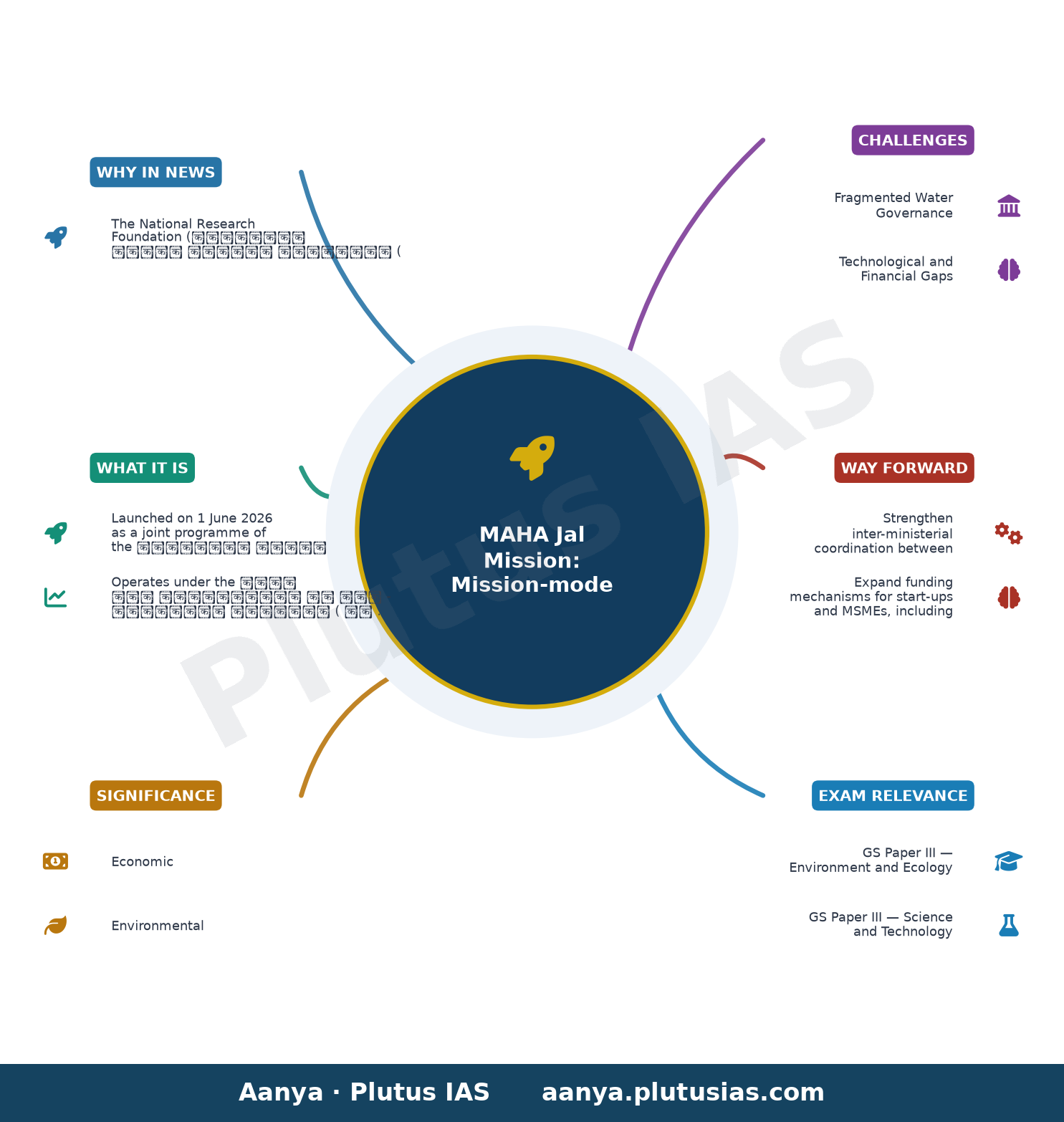
The National Research Foundation (अनुसंधान नेशनल रिसर्च फाउंडेशन ( एएनआरएफ )), under the ANRF Act 2023, has launched the एमएएचए जल कार्यक्रम—a joint initiative with the Ministry of Jal Shakti—to address critical water challenges through mission-oriented, solution-driven research. The initiative, operationalised on 1 June 2026, seeks to foster multidisciplinary, multi-institutional collaborations, including industry partnerships, to develop scalable technologies for sustainable water management. This aligns with the broader objectives of the National Education Policy 2020 and represents a structured response to India’s pressing water security concerns.
Background
- The National Research Foundation (अनुसंधान नेशनल रिसर्च फाउंडेशन ( एएनआरएफ )) was established under the ANRF Act, 2023, as a statutory body to provide strategic direction for research, innovation, and entrepreneurship in natural sciences, humanities, and social sciences.
- Industry participation, including start-ups and MSMEs, is mandatory, with a 10% cash contribution required to ensure practical applicability of research outcomes.
- The initiative builds on prior efforts such as the ‘Jal Shakti Hackathon-2025’ and the ‘WIN Portal’ to accelerate technology development and deployment in the water sector.
What is the एमएएचए जल कार्यक्रम?
- Launched on 1 June 2026 as a joint programme of the अनुसंधान नेशनल रिसर्च फाउंडेशन ( एएनआरएफ ) and the Ministry of Jal Shakti, with a focus on sustainable water management.
- Operates under the मिशन फॉर एडवांसमेंट इन हाई – इम्पैक्ट एरियाज़ ( एम . ए . एच . ए ) framework, which prioritises multidisciplinary, multi-institutional, and multi-investigator projects to tackle national priorities.
- Encompasses six key thematic areas: water resource assessment and sustainable management, potable water, water quality, human and ecological health, water-use efficiency and circular economy, and climate resilience.
- Mandates industry participation (start-ups, MSMEs, and large industries) with a 10% cash contribution to ensure practical applicability and scalability of research outcomes.
- Utilises the ‘WIN Portal’ to facilitate collaboration between academia, industry, and government agencies for rapid technology development.
- Includes mechanisms for stakeholder engagement, such as sharing research outcomes with states, Union Territories, and implementing agencies for adoption and implementation.
- Aims to bridge the gap between scientific research and field-level deployment through mission-oriented, field-ready technologies.
Key Features
| Feature | Significance |
|---|---|
| Statutory establishment under ANRF Act, 2023 | Ensures high-level strategic direction for research, innovation, and entrepreneurship in natural, humanities, and social sciences, aligning with National Education Policy 2020. |
| Mission for Advancement in High-Impact Areas (MAHIA) | A program under ANRF to focus on mission-mode, priority-driven, solution-oriented research addressing critical national needs. |
| MAHIA Jal Programme (launched 01 June 2026) | A joint initiative by ANRF and Ministry of Jal Shakti to address key water sector challenges through mission-oriented and solution-based research. |
| Five thematic focus areas | Covers sustainable water resource management, potable water, water quality, human and ecological health, water-use efficiency, circular economy, and climate resilience. |
| Consortium-based project execution | Involves Principal Investigators, academic institutions, research organizations, and industry partners (including start-ups/MSMEs) for collaborative research and innovation. |
| Mandatory industry partnership (10% cash contribution) | Ensures practical application of research outcomes by engaging start-ups, MSMEs, and industry partners for scalable solutions. |
| WIN Portal for start-ups/MSMEs | Facilitates rapid development and deployment of water-related technologies by streamlining partnerships and reducing bureaucratic delays. |
| Jal Shakti Hackathon 2025 | Promotes field-ready, scalable technologies to address critical water sector challenges through practical problem-solving approaches. |
Why it Matters
Economic
- Stimulates innovation-driven growth in the water sector, fostering entrepreneurship and job creation in start-ups and MSMEs.
- Reduces long-term economic losses from water scarcity, pollution, and inefficient resource use through sustainable solutions.
- Enhances industrial competitiveness by developing indigenous technologies for water treatment, conservation, and circular economy practices.
Environmental
- Promotes sustainable water resource management to mitigate the impacts of climate change and groundwater depletion.
- Ensures equitable access to clean water and sanitation, aligning with SDG 6 (Clean Water and Sanitation) targets.
- Supports circular economy principles to minimize water waste and maximize reuse in industrial and agricultural sectors.
Scientific and Technological
- Advances interdisciplinary research by integrating natural sciences, humanities, and social sciences for holistic water solutions.
- Encourages mission-mode research with measurable outcomes, bridging the gap between laboratory innovations and field applications.
- Strengthens India’s position as a global leader in water technology and research through collaborative international partnerships.
Policy and Governance
- Aligns with the Jal Jeevan Mission and National Water Policy by addressing critical gaps in water governance and infrastructure.
- Facilitates data-driven policymaking through systematic assessment of water resources and quality metrics.
- Enhances inter-ministerial coordination by integrating research outcomes into national and state-level water management strategies.
Social
- Improves public health outcomes by ensuring access to safe drinking water and reducing waterborne diseases.
- Supports marginalized communities by prioritizing equitable water distribution and sustainable livelihoods in water-scarce regions.
- Empowers local stakeholders through participatory research and technology adoption in water management.
Challenges
1. Fragmented Water Governance
- Overlapping jurisdictions among central, state, and local bodies hinder cohesive policy implementation and resource allocation.
- Lack of standardized data across regions complicates evidence-based decision-making in water management.
UPSC Link: GS-II (Governance)
2. Technological and Financial Gaps
- Limited adoption of advanced water technologies due to high costs, inadequate infrastructure, and risk-averse investment environments.
- Insufficient funding for research and development in water sector, particularly for start-ups and MSMEs in rural areas.
UPSC Link: GS-III (Technology & Economy)
3. Climate Change and Water Scarcity
- Increasing frequency of droughts and erratic rainfall patterns exacerbate water stress, particularly in arid and semi-arid regions.
- Groundwater depletion and contamination pose existential threats to agriculture and rural livelihoods.
UPSC Link: GS-III (Environment)
4. Public Participation and Awareness
- Low community engagement in water conservation efforts due to lack of awareness and incentive structures.
- Resistance to behavioral changes in water usage habits, particularly in urban and industrial sectors.
UPSC Link: GS-II (Social Justice)
5. Regulatory and Compliance Bottlenecks
- Cumbersome approval processes for water projects delay implementation and increase costs.
- Inadequate enforcement of water quality standards and pollution control measures.
UPSC Link: GS-II (Governance)
Challenges — UPSC Perspective
| Issue | Concern |
|---|---|
| Data fragmentation | Lack of standardized, interoperable water data across states hinders evidence-based policymaking. |
| High capital costs for R&D | Start-ups and MSMEs face financial constraints in adopting and scaling water technologies. |
| Groundwater overexploitation | Unregulated extraction in agriculture and urban areas depletes aquifers beyond recharge capacity. |
| Low public awareness | Limited understanding of water conservation practices among rural and urban populations. |
| Policy-implementation gap | Delays in translating research outcomes into actionable policies and ground-level projects. |
| Climate-induced variability | Increased unpredictability in monsoon patterns disrupts traditional water management systems. |
Way Forward
- Strengthen inter-ministerial coordination between ANRF, Jal Shakti Ministry, and state governments to ensure seamless implementation of MAHIA Jal Programme.
- Expand funding mechanisms for start-ups and MSMEs, including grants, low-interest loans, and tax incentives for water technology development.
- Develop a national water data repository with standardized metrics to facilitate real-time monitoring and decision-making.
- Launch nationwide awareness campaigns on water conservation, leveraging digital platforms and community-based initiatives.
- Accelerate the adoption of circular economy models in water-intensive industries through regulatory incentives and pilot projects.
- Enhance capacity-building programs for local governments and communities to manage water resources sustainably.
- Establish a dedicated grievance redressal mechanism for water-related issues to improve public participation and trust.
- Promote international collaborations for technology transfer and joint research in water management, particularly with water-stressed nations.
UPSC Value Addition
Keywords for Mains Answer-Writing
National Research Foundation (NRF) Act, 2023 · Mission for Advancement in High-Impact Areas (MAHIA) · MAHIA JAL Programme · Mission-mode research in water sector · Public-Private Partnership (PPP) in R&D · Circular economy in water management · Water resilience and climate adaptation · Water quality and human health · National Research Foundation (NRF) · Water-use efficiency · Sustainable water resource management · Startup and MSME participation in R&D
Constitutional & Policy Linkages
- Article 21 (Right to Life) – Ensures access to clean water as part of the fundamental right to a healthy environment.
- Article 47 (DPSP) – Directs the State to improve public health and nutrition, including water supply and sanitation.
- Seventh Schedule – Distribution of powers between Union and States for water resources management (Entry 17: Water, Entry 56: Regulation and development of inter-state rivers).
Concept Flow
National Education Policy 2020 recommends high-level strategic research in science and humanities → Enactment of ANRF Act, 2023 → Establishment of ANRF as statutory body → Launch of MAHIA Programme → MAHIA Jal Programme (01 June 2026) → Focus on five thematic areas → Consortium-based research with industry partnerships → Development of scalable technologies → Field deployment via WIN Portal and Jal Shakti Hackathon → Adoption by states and stakeholders → Impact on water governance, public health, and climate resilience.
Prelims Practice Questions
Q1. Consider the following statements regarding the National Research Foundation (NRF):
1. NRF was established under the NRF Act, 2023.
2. NRF operates under the administrative control of the Ministry of Education.
3. NRF promotes research and innovation in natural sciences, humanities, and social sciences.
4. NRF is mandated to provide high-level strategic direction for scientific and technological interfaces.
How many of the above statements are correct?
- Only one
- Only two
- Only three
- All
Answer: All — Statements 1, 3, and 4 are correct. Statement 2 is incorrect as NRF is not under the Ministry of Education; it functions as an autonomous statutory body under the Government of India.
Q2. Assertion (A): The MAHIA JAL Programme under NRF is a mission-mode initiative focusing on water sector challenges.
Reason (R): The programme mandates a minimum 10% cash contribution from project partners and includes at least one startup/MSME/industry partner.
Options:
A. Both A and R are true, and R is the correct explanation of A.
B. Both A and R are true, but R is not the correct explanation of A.
C. A is true, but R is false.
D. A is false, but R is true.
Answer: ? — Both Assertion (A) and Reason (R) are true. The MAHIA JAL Programme is indeed a mission-mode initiative addressing water sector challenges, and it mandates a 10% cash contribution with mandatory participation from startups/MSMEs/industry partners, making R the correct explanation of A.
Q3. Match the following initiatives with their respective objectives:
Column I (Initiative) | Column II (Objective)
———————|———————-
A. MAHIA JAL Programme | 1. Promote mission-mode research in water sector
B. WIN Portal | 2. Facilitate participation of startups/MSMEs in water technology
C. Jal Shakti Hackathon-2025 | 3. Showcase field-ready water technologies
D. NRF | 4. Provide strategic direction for scientific research
Options:
A-1, B-2, C-3, D-4
A-2, B-1, C-4, D-3
A-3, B-4, C-1, D-2
A-4, B-3, C-2, D-1
- A-1, B-2, C-3, D-4
- A-2, B-1, C-4, D-3
- A-3, B-4, C-1, D-2
- A-4, B-3, C-2, D-1
Answer: A-1, B-2, C-3, D-4 — The correct matching is: A (MAHIA JAL Programme) – 1 (mission-mode research in water sector), B (WIN Portal) – 2 (facilitate startup/MSME participation), C (Jal Shakti Hackathon-2025) – 3 (showcase field-ready technologies), D (NRF) – 4 (provide strategic direction for scientific research).
Mains Practice Question
✍ The National Research Foundation (NRF), established under the NRF Act, 2023, is envisaged as a transformative institution for fostering high-impact research in India. In this context, critically examine the role of NRF in addressing India’s water sector challenges through the MAHIA JAL Programme. Also, analyse the significance of public-private partnerships (PPPs) in achieving the objectives of the programme. (15 Marks)
Approach: MODEL-ANSWER SKELETON:
1. Introduction (2 marks): Briefly define NRF and the MAHIA JAL Programme, highlighting their statutory basis and mission-oriented nature.
2. NRF’s Role in Addressing Water Sector Challenges (6 marks):
– Discuss the five thematic areas of the MAHIA JAL Programme: water resource assessment, drinking water, water quality, human and ecological health, water-use efficiency and circular economy, and climate resilience.
– Explain how NRF’s mandate under the NRF Act, 2023, enables it to provide high-level strategic direction and support mission-mode research.
– Reference the collaborative framework involving academic institutions, research organisations, and industry partners.
3. Significance of Public-Private Partnerships (PPPs) (5 marks):
– Highlight the mandatory 10% cash contribution and inclusion of startups/MSMEs/industry partners as a key feature of the MAHIA JAL Programme.
– Discuss how PPPs accelerate innovation, technology transfer, and scalability of solutions in the water sector.
– Cite examples of initiatives like the WIN Portal and Jal Shakti Hackathon-2025 as enablers of PPPs.
4. Challenges and Way Forward (2 marks):
– Briefly mention potential challenges such as ensuring equitable participation, balancing academic rigour with industry needs, and sustaining long-term funding.
– Conclude with the need for robust governance mechanisms to realise the full potential of NRF and PPPs in transforming India’s water sector.
Source: PIB (Press Information Bureau)
Generated by AanyaAi for educational purpose.

- तमिलनाडु के लिए क्या है ‘एल नीनो’ और उत्तर-पूर्वी मानसून का खतरा? - September 23, 2026
- El Nino & Northeast Monsoon: Impact on Tamil Nadu for UPSC 2026 - September 23, 2026
- हिमाचल में डिजिटल भुगतान क्रांति: बिलासपुर अव्वल, महिलाओं की भागीदारी 93% तक पहुंची - September 23, 2026

No Comments