


06 Aug MAHA Jal Mission: ANRF’s Mission-Mode Water Solutions for UPSC 2026
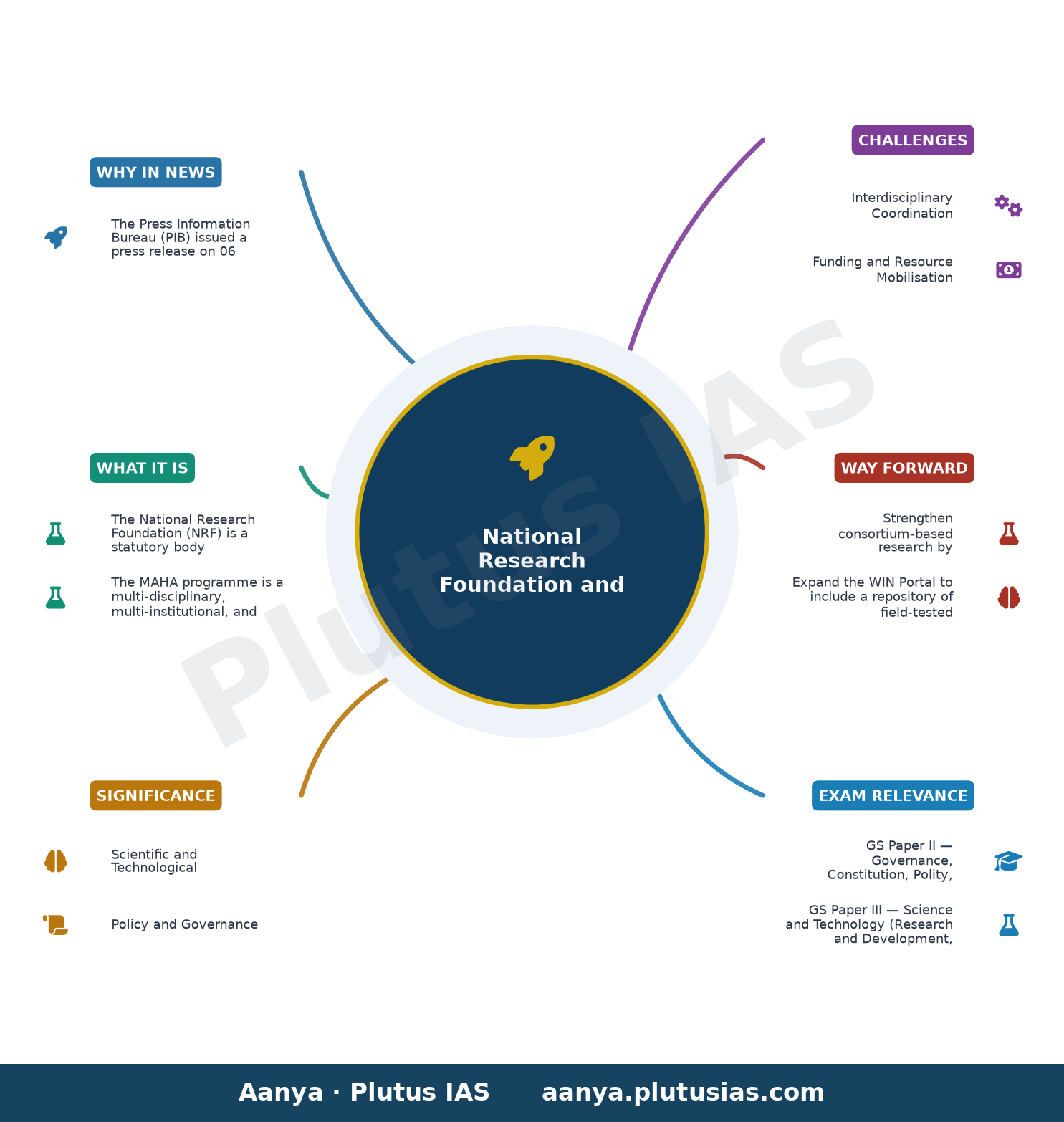
✎ The National Research Foundation (NRF), established under the ANRF Act, 2023, drives mission-oriented research through programmes like MAHA, with the MAHA Jal Programme—a joint initiative of the NRF and Ministry of Jal…
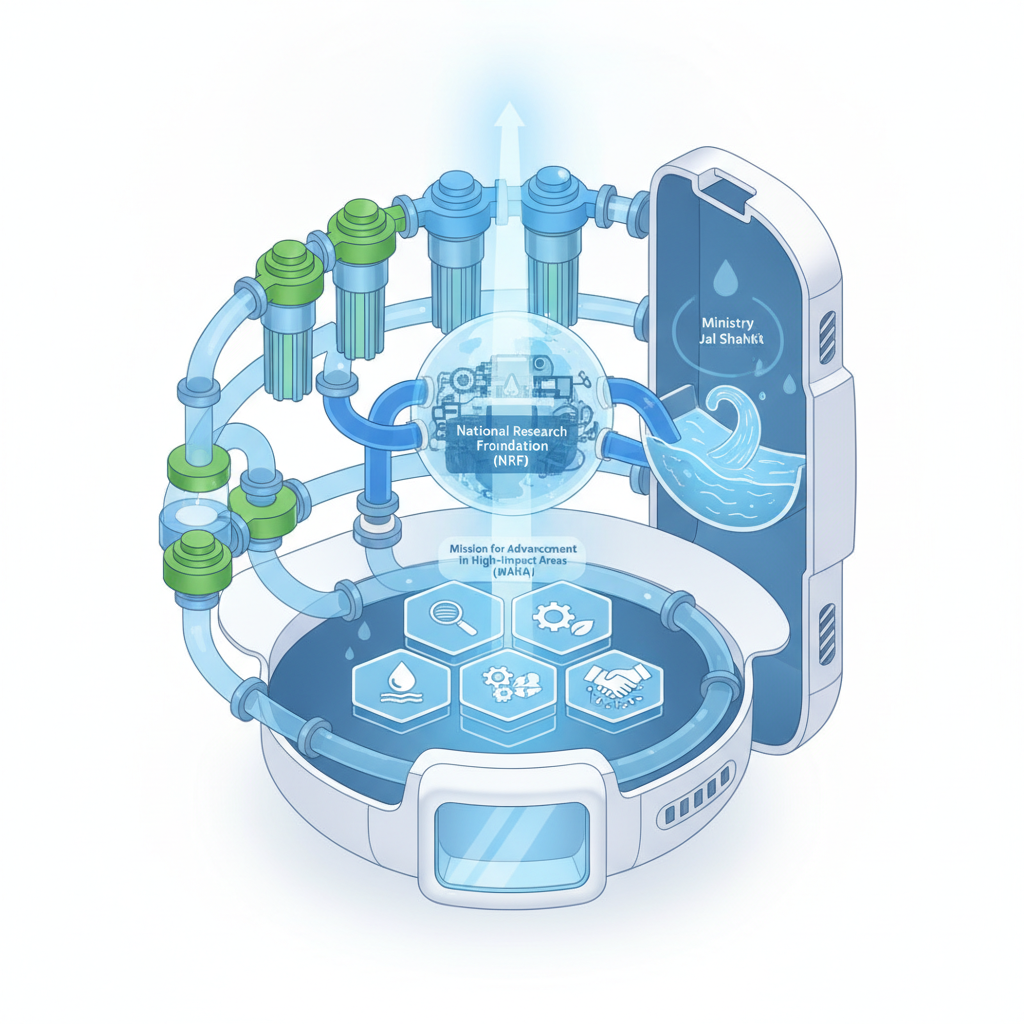 National Research FoundationMinistry of Jal ShaktiMission for Advancement in High-ImIndustry partnerships
Subject Relevance — Where This Topic Fits
- GS Paper II — Governance, Constitution, Polity, Social Justice and International Relations (Role of statutory bodies and policy frameworks) | GS Paper III — Science and Technology (Research and Development, Innovation Ecosystems), Environment and Ecology (Water Resources Management, Climate Resilience)
- Prelims: National Research Foundation (NRF), ANRF Act 2023, Mission for Advancement in High-Impact Areas (MAHA), MAHA Jal Programme, Mission Mode Research, Start-up/Industry Partnership in R&D, WIWIN Portal, Jal Shakti Hackathon 2025
- Essay: The Role of Mission-Oriented Research in Addressing India’s Water Crisis: A Case Study of the MAHA Jal Programme, Institutional Synergy in Public Policy: Aligning Statutory Bodies, Academia, and Industry for Sustainable Development
Quick Revision: The National Research Foundation (NRF), established under the ANRF Act, 2023, drives mission-oriented research through programmes like MAHA, with the MAHA Jal Programme—a joint initiative of the NRF and Ministry of Jal Shakti—focusing on five critical water themes to address India’s water security challenges.
Why is this in the news?
The Press Information Bureau (PIB) issued a press release on 06 August 2026 detailing the operationalisation of the ‘MAHA Jal Programme’ under the aegis of the National Research Foundation (NRF) and the Ministry of Jal Shakti. This initiative, launched on 01 June 2026 as part of the Mission for Advancement in High-Impact Areas (MAHA), seeks to address India’s critical water challenges through mission-oriented, solution-driven research in a multi-disciplinary, multi-institutional framework. The announcement underscores the government’s commitment to leveraging statutory bodies, academic institutions, and industry partnerships to foster innovation and scalable technologies in water resource management.
Background
- The National Research Foundation (NRF) was established under the ANRF Act, 2023, to provide high-level strategic direction for research, innovation, and entrepreneurship in the interface of natural sciences, humanities, and social sciences, aligning with the National Education Policy 2020.
- The ANRF Act, 2023, empowers the NRF to promote, monitor, and support research in areas of national priority, including mission-mode initiatives with industrial collaborations.
- The MAHA programme, a flagship initiative of the NRF, is designed to focus on high-impact domains through priority-centric, solution-oriented research, integrating multi-disciplinary and multi-institutional efforts.
- Water security has emerged as a critical national priority, with challenges such as depleting groundwater levels, deteriorating water quality, and increasing climate variability necessitating innovative and scalable solutions.
- The Ministry of Jal Shakti, through its programmes like the Jal Jeevan Mission and Atal Mission for Rejuvenation and Urban Transformation (AMRUT), has highlighted the need for research-driven interventions to achieve sustainable water management.
- The MAHA Jal Programme was launched on 01 June 2026 as a joint initiative of the NRF and the Ministry of Jal Shakti to address key water challenges through mission-oriented research.
What is the National Research Foundation (NRF) and the MAHA Jal Programme?
- The National Research Foundation (NRF) is a statutory body established under the ANRF Act, 2023, to provide strategic direction for research and innovation in India, particularly in the interface of natural sciences, humanities, and social sciences.
- The MAHA programme is a multi-disciplinary, multi-institutional, and multi-investigator initiative aimed at addressing India’s most pressing challenges through priority-centric, solution-oriented research, including industrial partnerships.
- The MAHA Jal Programme, launched on 01 June 2026, is a joint initiative of the NRF and the Ministry of Jal Shakti to address critical water challenges in India through mission-oriented research.
- The MAHA Jal Programme focuses on five key thematic areas: (1) Water resource assessment and sustainable management, (2) Drinking water, (3) Water quality, (4) Human and ecological health, and (5) Water-use efficiency and circular economy, including climate resilience and adaptation.
- Proposals under the MAHA Jal Programme are invited in a consortium mode, involving Principal Investigators, academic institutions, research organisations, and eligible companies registered under Section 8 of the Companies Act, 2013, with mandatory participation from at least one start-up/MSME/industry partner contributing 10% of the project cost in cash.
- The programme leverages digital platforms such as the WIWIN Portal to facilitate start-up/MSME participation and accelerate the development and deployment of water-related technologies.
- The ‘Jal Shakti Hackathon-2025’ was organised to promote practical, scalable, and field-ready technologies to address critical water challenges, aligning with the objectives of the MAHA Jal Programme.
Key Features
| Feature | Significance |
|---|---|
| Statutory establishment of ANRF (2023) | Provides high-level strategic direction for scientific and technical interface research in natural sciences, humanities, and social sciences, aligning with National Education Policy 2020. |
| Mission for Advancement in High-Impact Areas (MAHIA) | A mission-mode programme under ANRF to focus on priority sectors through multidisciplinary, multi-institutional, and multi-investigator research projects. |
| MAHIA Jal Programme (launched 01 June 2026) | Joint initiative by ANRF and Ministry of Jal Shakti to address critical water-sector challenges through mission-oriented, solution-driven research. |
| Five thematic focus areas of MAHIA Jal | Covers water resource assessment, potable water, water quality, human and ecological health, water-use efficiency, circular economy, and climate resilience. |
| Consortium-based project implementation | Encourages collaboration among Principal Investigators, academic institutions, research labs, industry partners, and startups/MSMEs for scalable solutions. |
| 10% cash contribution requirement | Ensures industry/startup/ MSME participation, fostering public-private partnerships and accelerating technology deployment. |
| WIN Portal and Jal Shakti Hackathon-2025 | Facilitates rapid development and adoption of field-ready, scalable technologies to address water-sector challenges. |
Why it Matters
Scientific and Technological
- Promotes high-impact research in water science and technology, bridging gaps between academia, industry, and policy through mission-mode projects.
- Encourages interdisciplinary collaboration among natural sciences, social sciences, and engineering to develop holistic water solutions.
- Accelerates the transition from laboratory research to field deployment via consortium-based and industry-partnered projects.
Policy and Governance
- Aligns with the National Education Policy 2020 by fostering research, innovation, and entrepreneurship in priority sectors.
- Strengthens the institutional framework for water governance by integrating research outcomes with policy implementation at central and state levels.
- Enhances inter-ministerial coordination (e.g., Ministry of Jal Shakti, ANRF) to address cross-sectoral water challenges.
Economic
- Stimulates innovation-driven entrepreneurship in water technologies, particularly for startups and MSMEs, through structured funding and industry partnerships.
- Reduces long-term economic costs by promoting sustainable water management, circular economy practices, and climate-resilient infrastructure.
- Creates opportunities for job creation in research, technology development, and implementation sectors.
Environmental
- Advances solutions for water quality degradation, ecological health, and climate resilience, addressing pressing environmental challenges.
- Supports the transition to a circular economy in water use, reducing waste and enhancing resource efficiency.
- Contributes to achieving Sustainable Development Goals (SDGs) 6 (Clean Water and Sanitation) and 13 (Climate Action).
Challenges
1. Interdisciplinary Coordination
- Ensuring seamless collaboration among diverse stakeholders (academia, industry, government, and communities) remains a critical challenge.
- Balancing academic research priorities with industry-driven innovation and scalability demands.
UPSC Link: GS-III: Science & Tech
2. Funding and Resource Mobilisation
- Securing sustained funding for long-term research projects, particularly for high-risk, high-reward innovations.
- Ensuring equitable distribution of resources across regions and institutions to prevent concentration in urban/elite centres.
UPSC Link: GS-III: Economic Development
3. Technology Adoption and Scalability
- Overcoming barriers to the adoption of new technologies by state governments and local bodies due to bureaucratic inertia or resource constraints.
- Ensuring field-ready solutions are affordable, culturally acceptable, and adaptable to diverse hydro-climatic conditions.
UPSC Link: GS-III: Environment & Disaster Management
4. Regulatory and Legal Framework
- Addressing gaps in regulatory frameworks for water technology deployment, intellectual property rights, and public-private partnerships.
- Harmonising state-level water policies with central research initiatives to avoid conflicts or duplication.
UPSC Link: GS-II: Governance
5. Public Awareness and Behavioural Change
- Generating public buy-in for water conservation practices, circular economy models, and acceptance of new technologies.
- Overcoming resistance to change in traditional water-use practices, particularly in rural and agrarian communities.
UPSC Link: GS-IV: Ethics & Governance
Challenges — UPSC Perspective
| Issue | Concern |
|---|---|
| Stakeholder fragmentation | Lack of unified vision among academia, industry, and policymakers hinders cohesive project execution. |
| High upfront costs | 10% cash contribution requirement may deter smaller startups/MSMEs from participation despite long-term benefits. |
| Regulatory delays | Slow approval processes for field trials and technology deployment due to overlapping jurisdictions. |
| Data gaps | Inadequate baseline data on water resources, quality, and usage patterns limits evidence-based decision-making. |
| Climate variability | Unpredictable climatic shifts complicate the design of climate-resilient water infrastructure. |
| Equity concerns | Risk of technological solutions being skewed towards urban or industrial needs, neglecting rural or marginalised communities. |
Government Initiatives — Must-Memorise for Prelims
- Jal Shakti Hackathon-2025
Way Forward
- Strengthen consortium-based research by incentivising participation from state governments, local bodies, and international partners.
- Expand the WIN Portal to include a repository of field-tested technologies and best practices for rapid dissemination.
- Establish dedicated funds for rural and tribal water challenges to ensure equitable technological solutions.
- Integrate MAHIA Jal outcomes with existing schemes like AMRUT 2.0 and Jal Jeevan Mission for seamless implementation.
- Launch awareness campaigns in regional languages to promote behavioural change in water conservation and circular economy practices.
- Develop a national framework for technology transfer and intellectual property rights to facilitate industry adoption.
- Conduct periodic reviews of project progress with multi-stakeholder feedback to address bottlenecks proactively.
- Collaborate with international agencies (e.g., UN-Water, World Bank) to leverage global expertise and funding for water innovations.
UPSC Value Addition
Keywords for Mains Answer-Writing
National Research Foundation (NRF) · Mission for Advancement in High-Impact Areas (MAHIA) · MAHIA Jal Programme · ANRF Act, 2023 · Jal Shakti Mission · Water resource management · Circular economy in water sector · Climate resilience in water resources · Interdisciplinary research · Public-private partnerships in R&D · Water quality and health · Sustainable water governance
Concept Flow
National Education Policy 2020 recommends strengthening research and innovation ecosystems in priority sectors. → ANRF Act 2023 establishes a statutory body to provide strategic direction for high-impact research across disciplines. → MAHIA programme under ANRF identifies water sector as a high-impact area requiring mission-mode focus. → MAHIA Jal Programme (June 2026) is launched as a joint initiative by ANRF and Ministry of Jal Shakti. → Five thematic areas are defined to guide research: water assessment, potable water, quality, health, efficiency, and climate resilience. → Consortium-based projects with industry/startup participation are invited to develop scalable, field-ready solutions. → Research outcomes are shared with states, ministries, and implementing agencies for adoption and policy integration.
Prelims Practice Questions
Q1. Consider the following statements regarding the National Research Foundation (NRF):
1. NRF is a statutory body established under the NRF Act, 2023.
2. NRF operates under the Ministry of Education.
3. NRF promotes research and innovation in natural sciences, humanities, and social sciences.
4. NRF’s MAHIA programme focuses exclusively on agricultural research.
How many of the above statements are correct?
- Only one
- Only two
- Only three
- All
Answer: Only three — Statements 1 and 3 are correct. Statement 2 is incorrect as NRF is not under the Ministry of Education; it is an independent statutory body. Statement 4 is incorrect as MAHIA focuses on high-impact areas, including water resources, not exclusively agriculture.
Q2. Assertion (A): The MAHIA Jal Programme is a joint initiative of the National Research Foundation and the Ministry of Jal Shakti.
Reason (R): The programme aims to address critical water challenges through mission-oriented, solution-driven research.
In the context of the above two statements, which one of the following is correct?
- Both A and R are true, and R is the correct explanation of A
- Both A and R are true, but R is not the correct explanation of A
- A is true, but R is false
- A is false, but R is true
Answer: Both A and R are true, and R is the correct explanation of A — Both Assertion (A) and Reason (R) are true, and Reason (R) correctly explains Assertion (A). The MAHIA Jal Programme is indeed a joint initiative of NRF and the Ministry of Jal Shakti, and its objective is to address water challenges through mission-driven research.
Q3. Match the following areas of focus under the MAHIA Jal Programme with their respective descriptions:
Column I (Area of Focus) | Column II (Description)
————————–|————————
1. Water Resource Assessment and Sustainable Management | A. Enhancing efficiency in water use and promoting circular economy principles in water management
2. Drinking Water | B. Ensuring safe and accessible drinking water for all, including rural and urban populations
3. Water Quality | C. Monitoring and improving the chemical, biological, and ecological quality of water resources
4. Climate Resilience and Adaptation | D. Developing strategies to mitigate and adapt to climate change impacts on water resources
Select the correct match:
- 1-B, 2-A, 3-C, 4-D
- 1-A, 2-B, 3-C, 4-D
- 1-D, 2-C, 3-B, 4-A
- 1-C, 2-D, 3-A, 4-B
Answer: 1-A, 2-B, 3-C, 4-D — The correct matches are: 1-A (Water Resource Assessment and Sustainable Management aligns with enhancing efficiency and circular economy), 2-B (Drinking Water focuses on safe and accessible water), 3-C (Water Quality involves monitoring and improving water quality), and 4-D (Climate Resilience and Adaptation addresses climate change impacts).
Mains Practice Question
✍ The National Research Foundation (NRF), established under the NRF Act, 2023, has been tasked with fostering high-impact research through its Mission for Advancement in High-Impact Areas (MAHIA) programme. In this context, critically analyse the significance of the MAHIA Jal Programme for India’s water security and sustainable development. (15 Marks)
Approach: MODEL-ANSWER SKELETON:
1. **Introduction (2 marks)**
– Briefly define NRF and its statutory mandate under the NRF Act, 2023.
– Introduce the MAHIA programme as a mission-driven initiative to address India’s critical needs.
– State the joint implementation of the MAHIA Jal Programme by NRF and the Ministry of Jal Shakti.
2. **Objectives and Focus Areas of MAHIA Jal Programme (4 marks)**
– List and explain the five key focus areas:
a. Water resource assessment and sustainable management
b. Drinking water accessibility and quality
c. Water quality monitoring and improvement
d. Human and ecological health linkages
e. Water-use efficiency and circular economy
f. Climate resilience and adaptation
– Emphasise the interdisciplinary and multi-institutional nature of the programme.
3. **Strategic Importance for Water Security (4 marks)**
– Discuss how the programme addresses India’s water challenges, including depleting groundwater, urban-rural disparities, and climate-induced water stress.
– Highlight the role of public-private partnerships (PPP) and start-up/industry involvement in accelerating technology adoption.
– Reference the ‘Jal Shakti Hackathon-2025’ and the ‘WIN Portal’ as enabling mechanisms for innovation and field-ready solutions.
4. **Institutional and Governance Framework (3 marks)**
– Explain the role of ANRF as a high-level strategic body providing direction, monitoring, and support.
– Discuss the collaborative governance model involving central ministries, state governments, research institutions, and industry.
– Mention the requirement of at least one industry/start-up/ MSME partner and a 10% cash contribution for project approvals.
5. **Challenges and Way Forward (2 marks)**
– Acknowledge potential challenges such as inter-state coordination, data gaps, and technology transfer barriers.
– Suggest measures for effective implementation, including capacity building, decentralised governance, and leveraging indigenous knowledge systems.
**Balanced View Required:**
– Acknowledge the programme’s potential to revolutionise water management through mission-mode research.
– Critically note the need for robust monitoring, evaluation, and stakeholder engagement to ensure real-world impact.
Source: PIB (Press Information Bureau)
Generated by AanyaAi for educational purpose.

- तमिलनाडु के लिए क्या है ‘एल नीनो’ और उत्तर-पूर्वी मानसून का खतरा? - September 23, 2026
- El Nino & Northeast Monsoon: Impact on Tamil Nadu for UPSC 2026 - September 23, 2026
- हिमाचल में डिजिटल भुगतान क्रांति: बिलासपुर अव्वल, महिलाओं की भागीदारी 93% तक पहुंची - September 23, 2026

No Comments