


06 Aug MAHA Jal Mission: UPSC Focused Policy Initiative for Water Challenges
✎ The MAHA Jal Programme is a collaborative initiative by ANRF and the Ministry of Jal Shakti, launched in 2026, to drive mission-oriented research and innovation for addressing critical water sector challenges across five key…
Subject Relevance — Where This Topic Fits
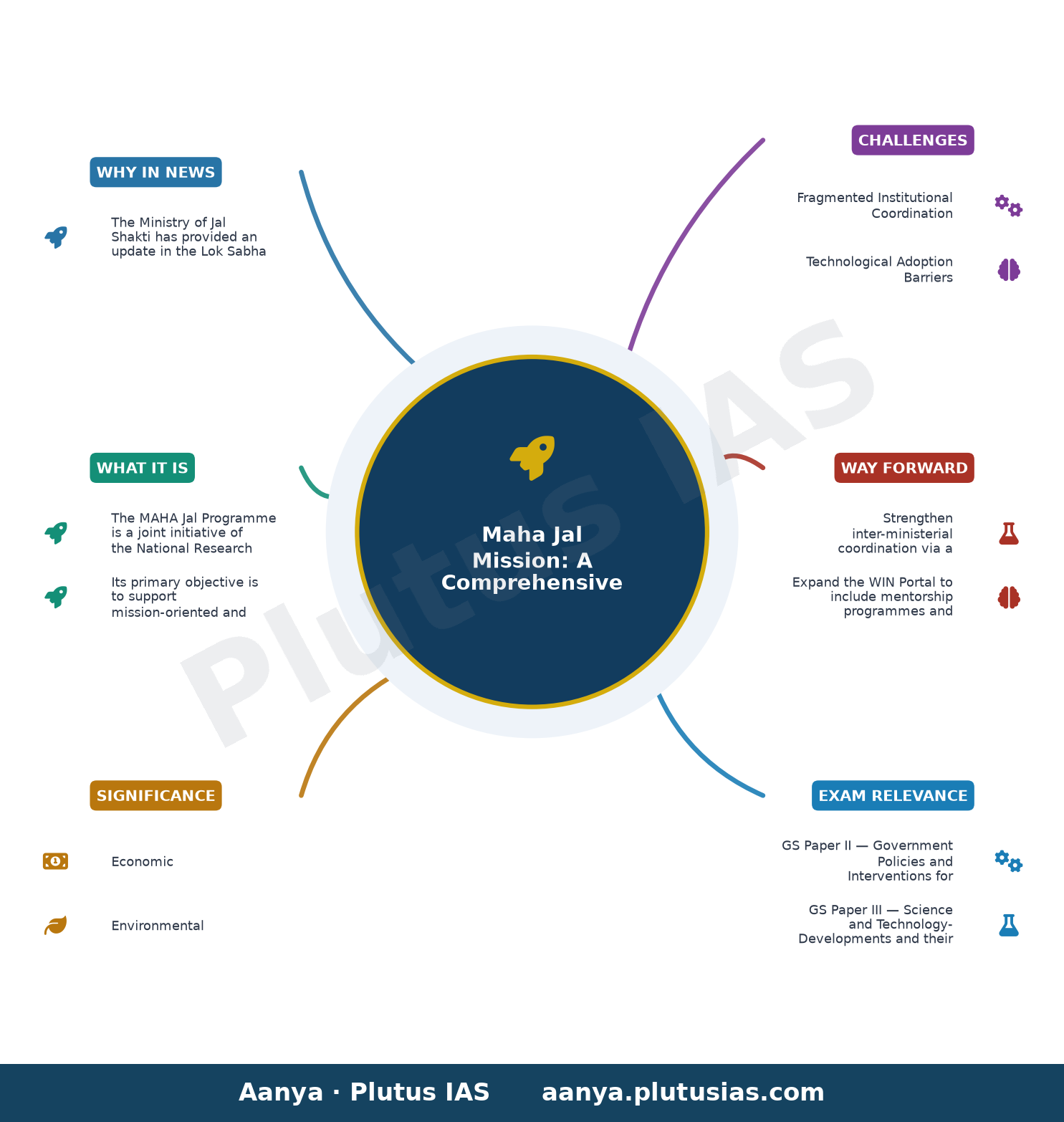
- GS Paper II — Government Policies and Interventions for Development in various sectors and Issues arising out of their Design and Implementation. | GS Paper III — Science and Technology- Developments and their Applications and Effects in Everyday Life; Conservation, Environmental Pollution and Degradation, Environmental Impact Assessment.
- Prelims: Maha Jal Mission, ANRF Act, 2023, National Education Policy, Mission for Advancement in High-Impact Areas (MAHA), Ministry of Jal Shakti, Water Innovation Network (WIN) Portal, Jal Shakti Hackathon-2025
- Essay: Water Security and Sustainable Development in India, The Role of Research and Innovation in Addressing National Challenges
Quick Revision: The MAHA Jal Programme is a collaborative initiative by ANRF and the Ministry of Jal Shakti, launched in 2026, to drive mission-oriented research and innovation for addressing critical water sector challenges across five key thematic areas, emphasizing industry-academia partnerships.
Why is this in the news?
The Ministry of Jal Shakti has provided an update in the Lok Sabha regarding the implementation of the ‘MAHA Jal Programme’. This programme, a joint initiative with the National Research Foundation (ANRF), aims to foster mission-oriented and solution-based research to address critical challenges within the water sector, aligning with national priorities and promoting collaborative innovation.
Background
- The National Research Foundation (ANRF) is a statutory body established under the ANRF Act, 2023, based on the recommendations of the National Education Policy.
- ANRF’s mandate includes providing high-level strategic direction, promotion, monitoring, and support for research, innovation, and entrepreneurship across natural sciences, humanities, and social sciences, particularly at their scientific and technical interfaces.
- The Mission for Advancement in High-Impact Areas (MAHA) is a flagship programme under ANRF, designed to promote priority-focused, solution-based research in a mission mode, addressing key national requirements.
- The MAHA Jal Programme, launched on June 1, 2026, is a collaborative endeavour between ANRF and the Ministry of Jal Shakti, specifically targeting the resolution of major water sector challenges through research.
- The programme emphasizes a multidisciplinary, multi-institutional, and multi-investigator approach, including industrial partnerships, to tackle high-priority concerns.
- Key initiatives like the Water Innovation Network (WIN) Portal and ‘Jal Shakti Hackathon-2025’ have been launched to facilitate start-up/MSME participation and accelerate the development and application of new water-related technologies.
What is the MAHA Jal Programme?
- The MAHA Jal Programme is a joint initiative of the National Research Foundation (ANRF) and the Ministry of Jal Shakti, launched on June 1, 2026.
- Its primary objective is to support mission-oriented and solution-based research to address the significant challenges prevalent in India’s water sector.
- The programme operates under the broader framework of the Mission for Advancement in High-Impact Areas (MAHA), an ANRF initiative.
- It focuses on five principal thematic areas: Water Resource Assessment and Sustainable Management; Drinking Water; Water Quality; Human and Ecological Health; Water Use Efficiency and Circular Economy; and Climate Resilience and Adaptation.
- Proposals are invited in a consortium mode, requiring participation from multiple principal investigators, academic institutions, research organizations, DSIR-SIRO registered research organizations, and eligible Section 8 companies.
- Mandatory involvement of at least one start-up/MSME/Industry partner is stipulated, with a cash contribution of 10% of the total project cost, fostering industry-academia collaboration.
- The programme aims to generate practical, scalable, and field-ready technologies and research outcomes, which are subsequently shared with stakeholders for adoption and implementation.
Key Features
| Feature | Significance |
|---|---|
| Statutory establishment of ANRF (2023) | Provides high-level strategic direction for research, innovation, and entrepreneurship across natural, human, and social sciences, aligning with NEP 2020 recommendations. |
| Mission for Advancement in High-Impact Areas (MAHIA) | A mission-mode programme under ANRF focusing on priority sectors through multidisciplinary, multi-institutional, and multi-investigator projects. |
| MAHIA Jal Programme (launched 01 June 2026) | Joint initiative of ANRF and Ministry of Jal Shakti to address critical water-sector challenges via solution-driven, mission-oriented research. |
| Five thematic focus areas | Covers water resource assessment, potable water, water quality, ecological health, and climate resilience—directly addressing Sustainable Development Goal 6. |
| Consortium-based project proposals | Encourages collaboration among academia, research labs, and industry (including start-ups/MSMEs) for scalable, field-ready technologies. |
| WIN Portal and Jal Shakti Hackathon-2025 | Facilitates rapid development and deployment of water technologies through start-up/MSME engagement and practical problem-solving. |
Why it Matters
Economic
- Promotes public-private partnerships (PPP) in water sector, fostering innovation-driven economic growth through start-ups and MSMEs.
- Reduces long-term fiscal burden by developing cost-effective, scalable water technologies for national adoption.
- Enhances industrial competitiveness via adoption of advanced water management solutions in sectors like agriculture, manufacturing, and energy.
Environmental
- Supports India’s commitments under SDG 6 (Clean Water and Sanitation) and National Water Mission by addressing critical water scarcity and quality issues.
- Advances circular economy principles through water-use efficiency and sustainable resource management.
- Strengthens climate resilience by integrating adaptation strategies into water infrastructure planning.
Institutional
- Establishes ANRF as a statutory body, enhancing governance and strategic oversight for interdisciplinary research.
- Bridges gaps between academia, industry, and government for coordinated, mission-driven water solutions.
- Standardises research frameworks and dissemination mechanisms for equitable adoption across states and UTs.
Technological
- Accelerates R&D in indigenous water technologies, reducing dependence on imported solutions.
- Leverages hackathons and portals to crowdsource innovative, field-tested solutions for real-world challenges.
- Facilitates technology transfer from labs to field applications through structured stakeholder engagement.
Challenges
1. Fragmented Institutional Coordination
- Multiple agencies (central, state, and local) often operate in silos, leading to duplication of efforts and inefficiencies in water management.
- Lack of unified data-sharing platforms hampers evidence-based policymaking and resource allocation.
UPSC Link: GS3: Water Resources; Governance
2. Technological Adoption Barriers
- High upfront costs and limited awareness deter start-ups/MSMEs from participating in R&D despite financial incentives.
- Regulatory hurdles and bureaucratic delays slow down the deployment of pilot technologies.
UPSC Link: GS3: Science & Technology; Innovation
3. Climate Change Vulnerabilities
- Increased frequency of extreme weather events (droughts, floods) exacerbates water stress, requiring adaptive infrastructure.
- Groundwater depletion and salinization threaten long-term water security, necessitating integrated basin management.
UPSC Link: GS3: Disaster Management; Climate Change
4. Equitable Access and Quality Gaps
- Rural-urban disparities in water supply and sanitation persist, with marginalised communities disproportionately affected.
- Contamination of water sources (e.g., fluoride, arsenic, microplastics) remains a critical public health challenge.
UPSC Link: GS2: Social Justice; Health
5. Funding and Sustainability
- Dependence on government funding for R&D projects risks discontinuity if budget allocations are inconsistent.
- Limited post-project scaling mechanisms hinder the transition from lab to market for innovative solutions.
UPSC Link: GS3: Resource Mobilisation; Economy
Challenges — UPSC Perspective
| Issue | Concern |
|---|---|
| Data Fragmentation | Lack of integrated databases across states hinders holistic water resource planning. |
| Regulatory Delays | Bureaucratic approvals for pilot projects slow down technological adoption. |
| Groundwater Depletion | Unsustainable extraction rates threaten aquifer recharge and long-term availability. |
| Urban-Rural Divide | Disparities in infrastructure and service delivery exacerbate water insecurity. |
| Technological Mismatch | Solutions developed in labs often fail to address ground-level operational challenges. |
| Climate Uncertainty | Projected shifts in monsoon patterns require adaptive, flexible water management strategies. |
Way Forward
- Strengthen inter-ministerial coordination via a dedicated ANRF-Jal Shakti task force to align research priorities with national water policies.
- Expand the WIN Portal to include mentorship programmes and incubation support for start-ups/MSMEs in water technologies.
- Establish state-level innovation hubs to bridge the gap between R&D and field implementation, ensuring localised solutions.
- Integrate climate resilience metrics into all MAHIA Jal projects, with mandatory vulnerability assessments for proposed interventions.
- Streamline regulatory frameworks for pilot projects by introducing fast-track approvals and single-window clearances.
- Launch a national water data repository, integrating satellite, IoT, and ground-based monitoring systems for real-time analytics.
- Incentivise private sector participation through tax breaks, viability gap funding, and guaranteed procurement for proven technologies.
- Conduct periodic reviews of ANRF’s funding mechanisms to ensure sustained support for high-impact, scalable projects.
UPSC Value Addition
Keywords for Mains Answer-Writing
Maha Jal Mission · National Research Foundation (ANRF) · Mission for Advancement in High-Impact Areas (MAHA) · Water resource management · Circular economy in water sector · Water quality and human health · Multi-stakeholder research collaboration · ANRF Act 2023 · Jal Shakti Ministry · Climate-resilient water infrastructure · Mission-mode research · Start-up and MSME participation in R&D · Water Hackathon 2025 · Sustainable water governance · Interdisciplinary water research
Concept Flow
National Education Policy 2020 → Recommendations for interdisciplinary research → Establishment of ANRF (2023 Act) → ANRF’s MAHIA framework → Mission-mode focus on high-impact sectors → MAHIA Jal Programme (2026) → Thematic research priorities (water assessment, quality, resilience) → Consortium-based project proposals → Technology development → WIN Portal & Hackathon-2025 → Start-up/MSME engagement → Field-ready solutions → Stakeholder adoption (states, ministries, agencies) → Scalable implementation → Impact on SDG 6 and climate resilience
Prelims Practice Questions
Q1. Consider the following statements regarding the National Research Foundation (ANRF):
1. ANRF was established under the ANRF Act, 2023.
2. It functions under the Ministry of Education.
3. It promotes research, innovation, and entrepreneurship in natural sciences, humanities, and social sciences.
4. The Mission for Advancement in High-Impact Areas (MAHA) is a programme under ANRF.
How many of the above statements are correct?
- Only one
- Only two
- Only three
- All
Answer: All — Statements 1, 3, and 4 are correct. Statement 2 is incorrect as ANRF is not under the Ministry of Education; it is an autonomous statutory body under the Government of India.
Q2. Assertion (A): The Maha Jal Mission aims to address water sector challenges through mission-oriented, solution-driven research.
Reason (R): The mission is jointly initiated by ANRF and the Jal Shakti Ministry with a focus on sustainable water management and climate resilience.
Code:
- Both A and R are true, and R is the correct explanation of A
- Both A and R are true, but R is not the correct explanation of A
- A is true but R is false
- A is false but R is true
Answer: Both A and R are true, but R is not the correct explanation of A — Both the assertion and reason are correct, and the reason accurately explains the assertion. The mission is indeed a joint initiative aimed at addressing water challenges through research and innovation.
Q3. Match the following programmes with their respective initiating bodies:
Column I (Programme) | Column II (Initiating Body)
———————|————————–
1. Maha Jal Mission | A. Ministry of Education
2. MAHA Programme | B. Ministry of Jal Shakti
3. Water Hackathon | C. ANRF
4. ANRF Act | D. Jal Shakti Ministry
Select the correct match:
- 1-B, 2-C, 3-D, 4-A
- 1-D, 2-C, 3-B, 4-A
- 1-B, 2-A, 3-D, 3-C
- 1-C, 2-B, 3-A, 4-D
Answer: 1-D, 2-C, 3-B, 4-A — The correct matches are: Maha Jal Mission (1-B) is a joint initiative of ANRF and the Ministry of Jal Shakti; MAHA Programme (2-C) is under ANRF; Water Hackathon (3-D) is organised by the Ministry of Jal Shakti; and the ANRF Act (4-A) is under the Ministry of Education.
Mains Practice Question
✍ The Maha Jal Mission represents a paradigm shift in India’s approach to water resource management by integrating mission-mode research with multi-stakeholder collaboration. Critically analyse the significance of this initiative in addressing India’s water challenges, with reference to its objectives, institutional framework, and potential limitations. (15 Marks)
Approach: MODEL-ANSWER SKELETON:
1. **Introduction (2 marks)**: Define the Maha Jal Mission and its genesis under the ANRF Act, 2023, and its alignment with the National Education Policy. State its primary objective: addressing India’s water challenges through mission-oriented, solution-driven research.
2. **Objectives and Thematic Areas (3 marks)**:
– List the five key thematic areas: water resource assessment and sustainable management; drinking water; water quality; human and ecological health; water-use efficiency and circular economy; climate resilience and adaptation.
– Emphasise the mission’s focus on priority areas aligned with contemporary needs (e.g., climate change impacts, urbanisation, industrial water demand).
3. **Institutional Framework and Collaboration (4 marks)**:
– ANRF as a statutory body under the Government of India, established to provide strategic direction for research and innovation.
– Role of the Jal Shakti Ministry in policy implementation and stakeholder coordination.
– Multi-disciplinary, multi-institutional, and multi-investigator approach, involving academic institutions, research organisations, start-ups, MSMEs, and industry partners.
– Mandatory 10% cash contribution and participation of at least one start-up/MSME/industry partner to foster innovation and scalability.
4. **Mechanisms for Implementation and Innovation (3 marks)**:
– Mission-mode execution with a focus on practical, field-ready technologies.
– Initiatives like the Water Hackathon 2025 and the WIN (Wastewater Innovation Network) portal to accelerate technology development and adoption.
– Dissemination of R&D outcomes to stakeholders (states, union territories, ministries, and implementing agencies) for adoption and implementation.
5. **Potential Limitations and Challenges (2 marks)**:
– Inter-ministerial coordination challenges and bureaucratic hurdles in a multi-stakeholder model.
– Ensuring equitable participation of start-ups and MSMEs, especially in tier-2 and tier-3 cities.
– Balancing short-term deliverables with long-term research goals.
– Addressing regional disparities in water stress and resource allocation.
6. **Conclusion (1 mark)**: Summarise the transformative potential of the Maha Jal Mission in addressing India’s water challenges while acknowledging the need for robust implementation mechanisms and sustained political will.
Source: PIB (Press Information Bureau)
Generated by AanyaAi for educational purpose.

- तमिलनाडु के लिए क्या है ‘एल नीनो’ और उत्तर-पूर्वी मानसून का खतरा? - September 23, 2026
- El Nino & Northeast Monsoon: Impact on Tamil Nadu for UPSC 2026 - September 23, 2026
- हिमाचल में डिजिटल भुगतान क्रांति: बिलासपुर अव्वल, महिलाओं की भागीदारी 93% तक पहुंची - September 23, 2026

No Comments