


17 Jul Maharashtra Adopts NeVA: Towards Paperless State Legislature
Subject Relevance — Where This Topic Fits
- GS Paper II — Governance, e-governance, transparency and accountability, citizens’ charters | GS Paper III — Digital India, IT applications in governance
- Prelims: NeVA, Digital India, Ministry of Parliamentary Affairs, Paperless Legislature, Mission Mode Project, MOU, State Legislatures, e-governance initiatives
- Essay: Digital Transformation as a Catalyst for Democratic Deepening and Good Governance, The Role of Technology in Enhancing Transparency and Accountability in Public Institutions
Quick Revision: NeVA is a Ministry of Parliamentary Affairs’ Mission Mode Project under Digital India, aiming for paperless, transparent, and efficient legislative functioning across all State/UT Legislatures, embodying the ‘One Nation, One Application’ vision.
Why is this in the news?
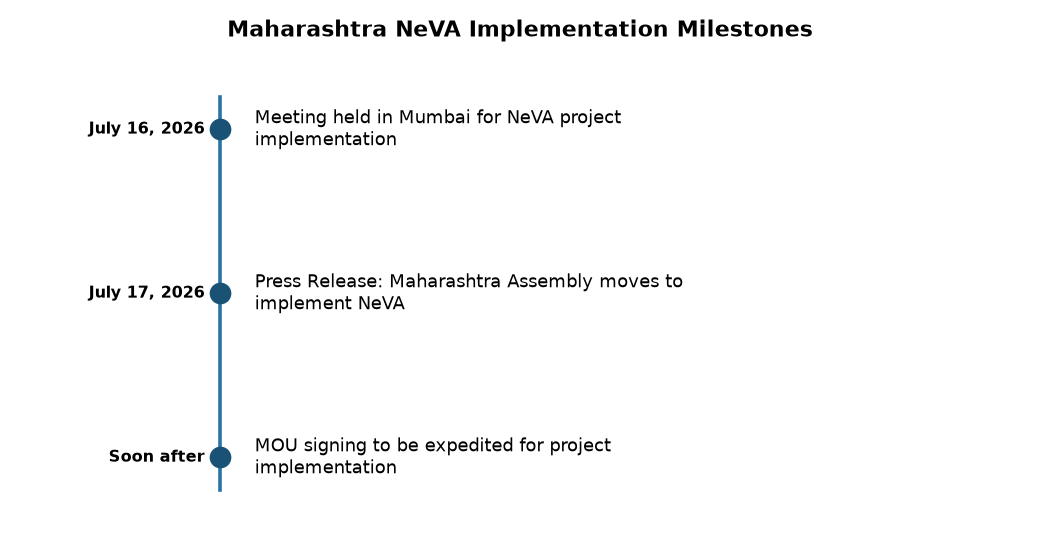
Maharashtra Assembly has taken a significant stride towards implementing the National e-Vidhan Application (NeVA), expressing its commitment to adopt the ‘One Nation, One Application’ vision under the Digital India programme. A crucial meeting was held on July 16, 2026, involving the Ministry of Parliamentary Affairs, Government of India, Maharashtra’s Parliamentary Affairs Department, and the Maharashtra Assembly Secretariat, culminating in an agreement to expedite the signing of a Memorandum of Understanding (MoU) for the project’s swift implementation in the state.
Background
- The Digital India programme, launched in 2015, aims to transform India into a digitally empowered society and knowledge economy.
- e-governance initiatives are a cornerstone of Digital India, focusing on making government services accessible electronically to citizens.
- The concept of ‘One Nation, One Application’ seeks to standardize and integrate digital platforms across various governmental functions.
- Legislatures across India, both at the Union and State levels, have traditionally relied on paper-intensive processes for their functioning.
- The Ministry of Parliamentary Affairs, Government of India, is the nodal ministry for the implementation of NeVA.
- Prior to Maharashtra, 33 State/UT Assemblies have already signed MoUs, and 21 have fully transitioned to digital houses, signifying a broader national movement towards e-legislatures.
What is the National e-Vidhan Application (NeVA)?
- NeVA is a Mission Mode Project (MMP) under the Digital India programme, spearheaded by the Ministry of Parliamentary Affairs, Government of India.
- Its primary objective is to digitize all 37 State and Union Territory Legislatures by providing an integrated digital platform for conducting legislative business.
- The project aims to facilitate a paperless, transparent, efficient, and citizen-centric legislative environment.
- It enables Members of Parliament (MPs) and Members of Legislative Assemblies (MLAs) to access legislative business electronically, including questions, bills, committee reports, and other documents.
- With an approved outlay of ₹673.94 crore, NeVA provides financial assistance for the implementation of the project in state legislatures.
- The project promotes a ‘paperless assembly’ concept, reducing the environmental footprint and operational costs associated with traditional paper-based processes.
- It enhances public access to legislative proceedings and information, thereby strengthening transparency and public participation in democratic processes.
- The NeVA platform is designed to be a single, unified application accessible across all legislative bodies, embodying the ‘One Nation, One Application’ vision.
Key Features
| Feature | Significance |
|---|---|
| Integrated Digital Platform | Provides a unified interface for all legislative functions, streamlining operations and data management across 37 legislatures. |
| Paperless Operations | Reduces reliance on physical documents, leading to significant cost savings, environmental benefits, and increased efficiency. |
| Real-time Information Access | Enables legislators and citizens to access legislative documents, proceedings, and information instantly, fostering informed decision-making. |
| Capacity Building & Training | Includes provisions for training legislators and staff, ensuring smooth adoption and effective utilization of the digital platform. |
| Citizen-Centric Approach | Enhances public access to legislative activities, promoting transparency, accountability, and greater citizen engagement in governance. |
| Financial Assistance | Offers central funding support to states for infrastructure development and implementation, facilitating widespread adoption. |
Why it Matters
Enhancing Democratic Functioning
- Promotes transparency and accountability by making legislative proceedings and documents readily available to the public and legislators.
- Facilitates more informed decision-making by legislators through instant access to relevant information and data.
- Strengthens public participation by providing easier access to legislative actions, fostering a more engaged citizenry.
Governance and Efficiency
- Achieves significant operational efficiencies by digitizing processes, reducing manual effort and processing time.
- Reduces administrative costs associated with printing, storing, and distributing vast quantities of paper documents.
- Aligns with the ‘Minimum Government, Maximum Governance’ principle by leveraging technology for improved public service delivery.
Environmental and Economic Impact
- Contributes to environmental sustainability by drastically reducing paper consumption in legislative bodies.
- Frees up resources that can be reallocated to other developmental initiatives, contributing to economic efficiency.
- Boosts digital literacy and adoption of technology among legislators and legislative staff, fostering a digitally empowered workforce.
National Integration and Standardization
- Fosters a ‘One Nation, One Application’ approach, standardizing legislative processes and digital infrastructure across states.
- Promotes inter-state learning and best practices in legislative functioning through a common digital platform.
- Strengthens the federal structure by enabling seamless digital interaction and information exchange between state legislatures and central bodies.
Challenges
1. Digital Divide and Infrastructure
- Uneven access to reliable internet connectivity and digital infrastructure, especially in remote areas.
- Disparities in technological readiness and digital literacy among legislators and staff across different states.
UPSC Link: GS Paper II — e-governance challenges; GS Paper III — IT infrastructure
2. Data Security and Privacy Concerns
- Ensuring robust cybersecurity measures to protect sensitive legislative data from breaches and cyber threats.
- Addressing concerns related to data privacy and compliance with evolving data protection regulations.
UPSC Link: GS Paper III — Cybersecurity, internal security
3. Capacity Building and Training
- Overcoming resistance to change among traditional users and ensuring effective adoption of new digital tools.
- Providing continuous and comprehensive training to a diverse group of legislators and staff with varying technical proficiencies.
UPSC Link: GS Paper II — Human resource development, administrative reforms
4. Interoperability and Integration
- Ensuring seamless integration of NeVA with existing legacy systems and other e-governance platforms.
- Standardizing data formats and protocols to ensure interoperability across different state legislatures.
UPSC Link: GS Paper III — IT applications, system integration
5. Financial Sustainability
- Securing adequate and sustained funding for ongoing maintenance, upgrades, and expansion of the NeVA platform.
- Managing the long-term operational costs beyond the initial project outlay.
UPSC Link: GS Paper III — Government budgeting, public finance
Challenges — UPSC Perspective
| Issue | Concern |
|---|---|
| Digital Literacy Gap | Varying levels of technological proficiency among legislators and legislative staff, hindering uniform adoption. |
| Cybersecurity Risks | Potential for data breaches and cyber-attacks on sensitive legislative information, requiring robust protective measures. |
| Resistance to Change | Inertia within traditional bureaucratic structures and among individuals accustomed to paper-based workflows. |
| Infrastructure Disparities | Uneven availability of high-speed internet and reliable hardware across different states and legislative premises. |
| Maintenance and Upgrades | Ensuring continuous technical support, software updates, and hardware maintenance for optimal system performance. |
| Language Barriers | Accommodating multiple official languages used in legislative proceedings across different states within the digital platform. |
Government Initiatives — Must-Memorise for Prelims
- Digital India Programme
- National e-Governance Plan (NeGP)
- BharatNet Project
- PM-WANI (Wi-Fi Access Network Interface)
- UMANG (Unified Mobile Application for New-age Governance)
- DigiLocker
- e-Kranti (National e-Governance Plan 2.0)
- MyGov Platform
- National Optical Fibre Network (NOFN)
- Smart Cities Mission
Way Forward
- Prioritize robust cybersecurity frameworks and data protection protocols to safeguard sensitive legislative information.
- Implement comprehensive and continuous capacity-building programs for all stakeholders, including legislators and legislative staff, to enhance digital literacy and adoption.
- Ensure adequate and sustained financial allocation for the long-term maintenance, upgrades, and technological advancements of the NeVA platform.
- Foster a culture of digital adoption through incentives, awareness campaigns, and showcasing successful case studies from fully digitalized legislatures.
- Develop a standardized, user-friendly interface that is accessible in multiple regional languages to cater to linguistic diversity.
- Promote inter-state collaboration and knowledge sharing on best practices and challenges in implementing e-legislature initiatives.
- Regularly evaluate the effectiveness of NeVA in achieving its objectives and incorporate feedback for continuous improvement and innovation.
- Explore integration with other e-governance platforms to create a seamless digital ecosystem for citizens and government.
UPSC Value Addition
Keywords for Mains Answer-Writing
e-governance · Digital India · Legislative Reforms · Transparency · Accountability · Citizen-Centric Governance · Paperless Administration · Democratic Deepening · Digital Transformation · Capacity Building · Cybersecurity · Federalism
Constitutional & Policy Linkages
- Article 168-212: Organization and functioning of State Legislatures
- Seventh Schedule: Division of powers, including legislative matters
- Preamble: Justice, Liberty, Equality, Fraternity (enhanced by transparent governance)
- Article 19(1)(a): Freedom of speech and expression (includes right to information)
- Right to Information Act, 2005: Promotes transparency in government functioning
- Digital India Act (Proposed): Framework for digital governance
Concept Flow
Digital India Vision (‘One Nation, One Application’) → NeVA as a Mission Mode Project → Digitization of State Legislatures → Paperless, Transparent, Efficient Functioning → Enhanced Citizen Participation and Accountability → Strengthened Democratic Governance → Socio-Economic and Environmental Benefits
Prelims Practice Questions
Q1. Which of the following statements about the National e-Vidhan Application (NeVA) is/are correct?
1. It is a Mission Mode Project under the Ministry of Electronics and Information Technology.
2. Its objective is to digitize all State and Union Territory Legislatures.
3. It aims to promote a paperless, transparent, and efficient legislative work methodology.
- A. 1 and 2 only
- B. 2 and 3 only
- C. 1 and 3 only
- D. 1, 2 and 3
Answer: B. 2 and 3 only — Statement 1 is incorrect because NeVA is a Mission Mode Project under the Ministry of Parliamentary Affairs, not MEITY. Statements 2 and 3 are correct, accurately describing NeVA’s objectives to digitize all legislatures and promote paperless, transparent, and efficient legislative work.
Q2. Consider the following benefits of implementing the National e-Vidhan Application (NeVA):
1. Reduction in paper consumption and associated costs.
2. Enhanced public access to legislative proceedings.
3. Standardization of legislative processes across states.
4. Elimination of the need for physical legislative sessions.
- A. 1, 2 and 3 only
- B. 2, 3 and 4 only
- C. 1, 3 and 4 only
- D. 1, 2, 3 and 4
Answer: A. 1, 2 and 3 only — Statements 1, 2, and 3 correctly identify key benefits of NeVA, including cost reduction, increased public access, and standardization. Statement 4 is incorrect; NeVA digitizes processes but does not eliminate the need for physical legislative sessions, which are fundamental to democratic functioning.
Mains Practice Question
✍ The National e-Vidhan Application (NeVA) represents a significant leap towards digital governance and democratic deepening in India. Critically analyze the potential of NeVA to transform legislative functioning and enhance citizen participation, while also discussing the key challenges in its nationwide implementation. (250 words)
Approach: Begin by introducing NeVA as a flagship e-governance initiative under Digital India, highlighting its ‘One Nation, One Application’ vision. Discuss its potential to transform legislative functioning by enabling paperless operations, real-time information access, and greater efficiency. Elaborate on how it can enhance citizen participation through increased transparency and accessibility of legislative proceedings. Subsequently, delve into the significant challenges to its nationwide implementation, such as the digital divide, cybersecurity risks, capacity building requirements, and financial sustainability. Conclude by suggesting a way forward that emphasizes robust infrastructure, continuous training, and strong political will for successful and inclusive implementation.
Source: PIB (Press Information Bureau)
Generated by AanyaAi for educational purpose.

- कर्नाटक में कमजोर मानसून: मुख्यमंत्री शिवकुमार ने चेताया जल एवं बिजली संकट - September 14, 2026
- Karnataka Faces Severe Water & Power Shortage Due to Weak Monsoon 2026 - September 14, 2026
- झारखंड का 1.36 लाख करोड़ का बकाया खत्म! केंद्र बनाम राज्य अब सुप्रीम कोर्ट में - September 14, 2026

No Comments