


20 Aug Maharashtra Freedom of Religion Act 2026: Enforcement Delayed to August 28
✎ The Maharashtra Freedom of Religion Act, 2026, exemplifies the constitutional tension between state legislative competence under the State List and fundamental rights under Articles 25-28, with its validity hinging on the nexus…
Subject Relevance — Where This Topic Fits
- GS Paper II — Fundamental Rights and Directive Principles of State Policy | GS Paper II — Functions and Responsibilities of the Union and the States | GS Paper III — Role of Judiciary, Executive, and Legislature in Governance
- Prelims: Freedom of Religion (Article 25-28), State Subject List (List II, Seventh Schedule), Judicial Review and Constitutional Validity of State Laws, Anti-Conversion Laws, Procedural Law: Commencement of Statutes (Section 5 of General Clauses Act, 1897), Right to Privacy (Puttaswamy Judgment), Protection of Children from Sexual Offences Act (POCSO), Overseas Citizenship of India (OCI) Cardholders
- Essay: The delicate balance between individual liberty and state regulation in matters of personal faith, Constitutional morality and the limits of legislative competence in regulating religious practices
Quick Revision: The Maharashtra Freedom of Religion Act, 2026, exemplifies the constitutional tension between state legislative competence under the State List and fundamental rights under Articles 25-28, with its validity hinging on the nexus between ‘public order’ and religious freedom.
Why is this in the news?
The Maharashtra Freedom of Religion Act, 2026, has entered public discourse following its delayed notification of enforcement, leading to procedural adjustments by the Pune Police in two registered cases. The incident highlights critical constitutional questions regarding the legislative competence of states to regulate religious conversions, the procedural validity of statutory commencement, and the interplay between anti-conversion laws and existing criminal statutes such as the Protection of Children from Sexual Offences Act and the Immigration and Foreigners Act, 2025.
Background
- The regulation of religious conversions has been a contentious issue in India, with several states enacting ‘Freedom of Religion’ or ‘Anti-Conversion’ laws since the 1960s, including Odisha (1967), Madhya Pradesh (1968), and Arunachal Pradesh (1978).
- The Supreme Court, in *Rev. Stanislaus v. State of Madhya Pradesh* (1977), upheld the constitutional validity of state anti-conversion laws, affirming that religious freedom under Article 25 is subject to public order, morality, and health.
- The 2017 judgment in *K.S. Puttaswamy v. Union of India* expanded the scope of privacy as a fundamental right, raising subsequent legal challenges to anti-conversion laws on grounds of privacy and personal autonomy.
- The Maharashtra government introduced the Freedom of Religion Act, 2026, to address concerns over forced conversions, particularly in cases involving minors, women, and vulnerable sections of society.
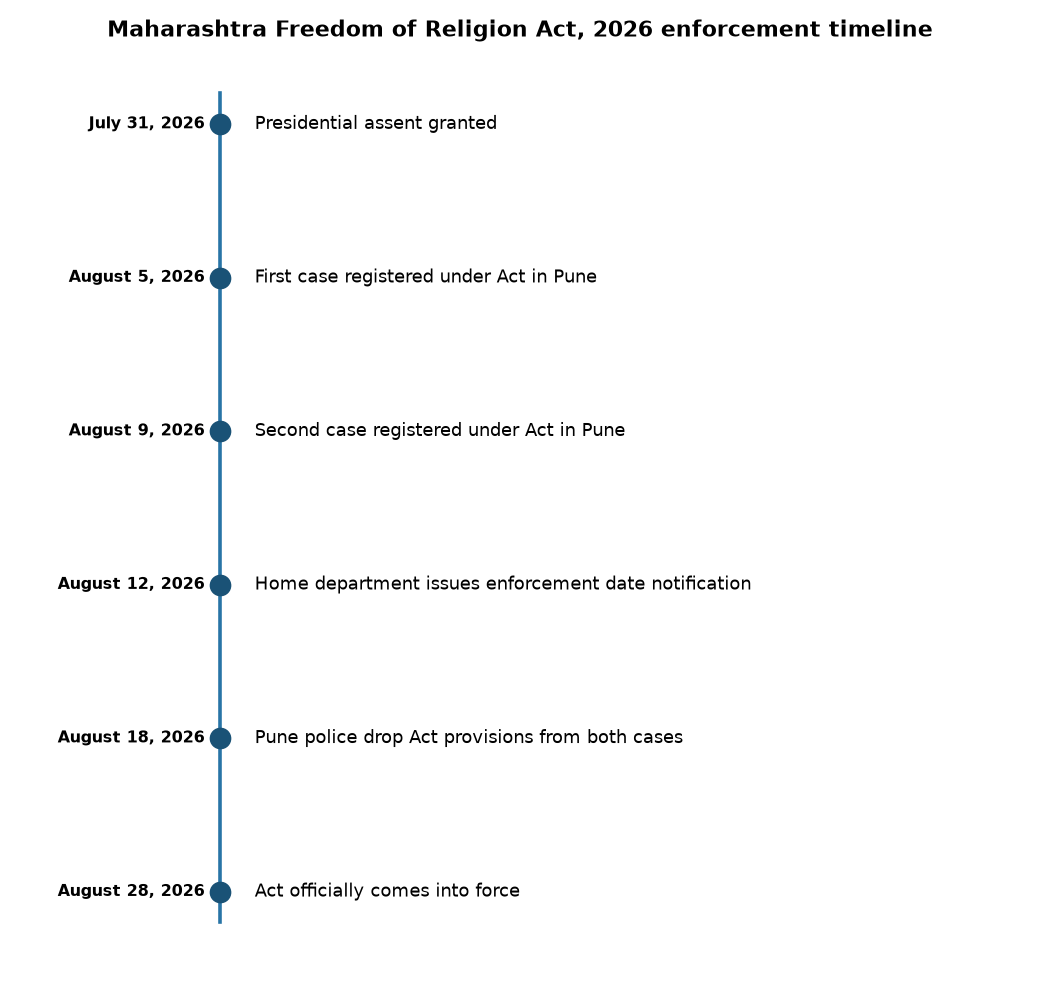
- The Act was granted Presidential assent on July 31, 2026, but its enforcement date was not initially notified, leading to confusion among law enforcement agencies and judicial bodies.
- The Pune Police registered two cases under the Act before its enforcement date, necessitating procedural rectification upon the issuance of the notification fixing August 28, 2026, as the commencement date.
What is the Maharashtra Freedom of Religion Act, 2026?
- The Maharashtra Freedom of Religion Act, 2026, is a state legislation aimed at regulating religious conversions to prevent coercion, fraud, force, threats, misrepresentation, inducement, or undue influence.
- The Act criminalises conversions obtained through deceptive practices, including those linked to marriage or promises of marriage, thereby addressing concerns over ‘love jihad’ narratives while ensuring constitutional compliance.
- It places the evidentiary burden on the person facilitating the conversion to prove that it was voluntary, shifting the onus from the complainant to the accused in legal proceedings.
- The Act prescribes stricter penalties for conversions involving minors, women, or members of Scheduled Castes or Scheduled Tribes, reflecting a protective approach toward vulnerable groups.
- The legislation includes provisions for prior notice to district authorities before any religious conversion, enabling oversight and preventing clandestine conversions.
- The Act is grounded in the state’s legislative competence under Entry 1 of List II (State List) of the Seventh Schedule, which empowers states to legislate on ‘public order’ and ‘police’, though its validity may be tested against fundamental rights.
- The Act’s enforcement mechanism involves police investigation, judicial scrutiny, and potential prosecution, with the state government empowered to frame rules for its implementation.
- The Act’s delayed notification of enforcement (August 28, 2026) underscores the procedural importance of statutory commencement dates, as outlined in Section 5 of the General Clauses Act, 1897.
Key Features
| Feature | Significance |
|---|---|
| Criminalisation of forced conversions | Establishes legal deterrence against coercive religious conversions, aligning with constitutional provisions on religious freedom and public order (Article 25). |
| Onus of proof on facilitator | Shifts burden to the individual or organisation facilitating conversion to prove it was voluntary, reducing evidentiary challenges for prosecutors. |
| Stricter penalties for minors/women | Enhanced punishment for conversions involving vulnerable groups, reflecting the state’s protective mandate under Directive Principles (Article 39(f)). |
| Inclusion of marriage-linked conversions | Covers conversions allegedly linked to marriage or promises thereof, addressing concerns of fraudulent conversions under the guise of matrimony. |
| Enforcement date notification | Clarifies the operational timeline of the Act, ensuring legal certainty for law enforcement and citizens regarding its applicability. |
Why it Matters
Legal and Governance
- The Act operationalises the state’s constitutional authority under Article 25(2)(b) to regulate religious practices in the interest of public order, morality, and health.
- Introduces a statutory framework to address allegations of forced conversions, reducing reliance on general criminal laws (e.g., IPC Sections 295A, 376).
- Establishes a precedent for state-level legislation on religious conversions, complementing the central-level regulation under the Uttar Pradesh Prohibition of Unlawful Conversion of Religion Act, 2021.
Societal Impact
- Aims to protect vulnerable individuals, particularly women and minors, from coercive religious practices, aligning with the state’s duty under Article 39(f) of the Constitution.
- May reduce inter-community tensions by providing a legal recourse for alleged forced conversions, though its impact on social harmony remains contingent on implementation.
- Raises questions about the balance between religious freedom (Article 25) and state intervention in personal beliefs, a recurring theme in constitutional jurisprudence.
Institutional
- Demonstrates the role of police and judicial systems in interpreting and enforcing new legislation, highlighting the need for capacity-building in handling religious-conversion cases.
- Sets a precedent for inter-departmental coordination (Home, Law, Social Justice) in notifying enforcement dates and clarifying legal provisions.
Challenges
1. Implementation and Enforcement
- Risk of selective or politically motivated enforcement, which could undermine public trust in the law.
- Challenges in proving coercion or fraud, given the subjective nature of intent and consent in conversion cases.
- Potential for misuse of the law to harass individuals or organisations engaged in legitimate religious or social activities.
UPSC Link: GS-II: Fundamental Rights (Article 25), Directive Principles (Article 39)
2. Constitutional Validity
- Likelihood of judicial scrutiny regarding the Act’s compatibility with Article 25(1), which guarantees the freedom of conscience and free profession, practice, and propagation of religion.
- Potential conflict with the right to privacy (Article 21) in cases involving personal choices of conversion or marriage.
UPSC Link: GS-II: Fundamental Rights (Articles 25, 21)
3. Social Harmony
- Risk of exacerbating communal tensions if the law is perceived as targeting specific communities or practices.
- Need for community-level awareness campaigns to prevent misinterpretation of the law and its objectives.
UPSC Link: GS-II: Secularism, Communal Harmony
4. Legal Precedents
- The Act must align with prior judicial interpretations, such as the Supreme Court’s rulings in *S.R. Bommai v. Union of India* (1994) on secularism and *Hadiya case* (2017) on personal liberty in conversion matters.
- Potential for conflicting interpretations with other state laws, necessitating harmonisation.
UPSC Link: GS-II: Judicial Review, Secularism
Challenges — UPSC Perspective
| Issue | Concern |
|---|---|
| Burden of Proof | Placing the onus on the facilitator may lead to false accusations or misuse, particularly in cases involving marriage or inter-community relationships. |
| Subjective Elements | Proving coercion, fraud, or inducement requires subjective assessments, which can be contentious in court. |
| Enforcement Discretion | Police and prosecutors may exercise discretion in registering or pursuing cases, leading to inconsistencies. |
| Judicial Scrutiny | The Act may face constitutional challenges, delaying its implementation or leading to partial invalidation. |
| Community Impact | The law could be perceived as targeting specific groups, potentially fueling social divisions. |
Way Forward
- Clarify guidelines for law enforcement agencies on interpreting key terms like ‘coercion,’ ‘fraud,’ and ‘undue influence’ to ensure uniform application.
- Conduct awareness programmes for religious leaders, civil society, and legal practitioners to educate stakeholders on the Act’s provisions and safeguards.
- Establish a dedicated grievance redressal mechanism for individuals accused of forced conversions to address potential misuse of the law.
- Monitor implementation through data collection on cases registered, prosecuted, and acquitted to assess the law’s impact on religious freedom and social harmony.
- Ensure judicial capacity-building in lower courts to handle religious-conversion cases, given their sensitivity and constitutional implications.
- Collaborate with state human rights commissions to investigate allegations of misuse and recommend corrective measures.
- Review the Act periodically in consultation with legal experts, civil society, and religious organisations to address emerging challenges.
UPSC Value Addition
Keywords for Mains Answer-Writing
Freedom of Religion · Constitutional morality · Right to propagate religion · Anti-conversion laws · Coercion and inducement in religious conversion · Protection of Children from Sexual Offences (POCSO) Act · Overseas Citizenship of India (OCI) provisions · Executive notification and enforcement of laws · Judicial scrutiny of legislation · Secularism and religious freedom in India
Constitutional & Policy Linkages
- Article 25: Freedom of conscience and free profession, practice, and propagation of religion.
- Article 21: Right to life and personal liberty, including privacy in personal choices.
- Article 39(f): Directive Principle on the protection of children and youth from exploitation.
- Article 25(2)(b): State’s power to regulate religious practices in the interest of public order, morality, and health.
Concept Flow
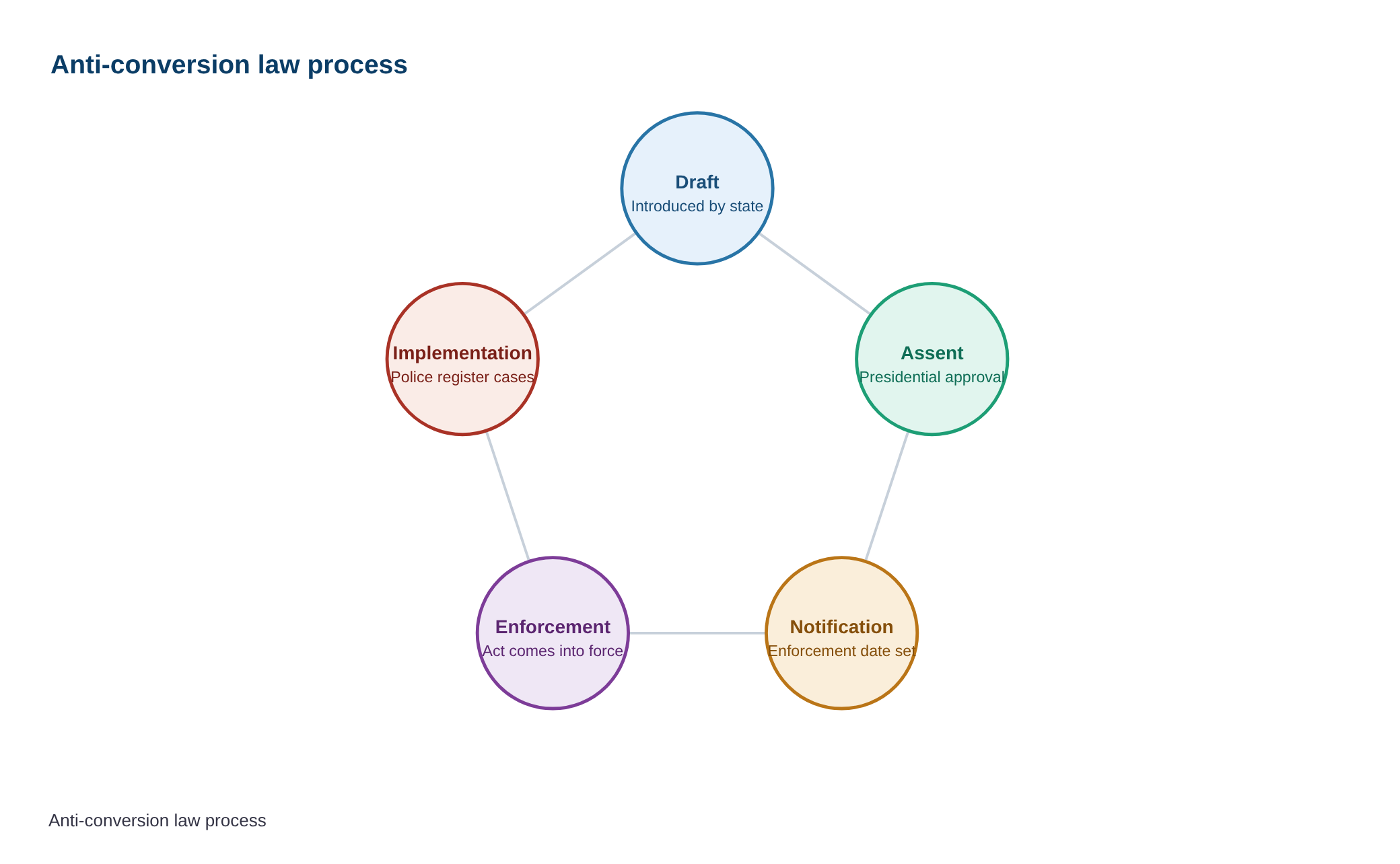
Constitutional mandate for secular governance (Article 25) → State’s authority to regulate religious practices (Article 25(2)(b)) → Enactment of Maharashtra Freedom of Religion Act, 2026 → Notification of enforcement date (August 28) → Registration of cases under the Act → Legal scrutiny of cases (e.g., onus of proof, coercion) → Potential judicial review for constitutional validity → Implementation challenges and societal impact.
Prelims Practice Questions
Q1. Consider the following statements regarding the Maharashtra Freedom of Religion Act, 2026:
1. The law criminalises religious conversion brought about through coercion, fraud, force, or misrepresentation.
2. The Act places the onus on the person facilitating the conversion to prove that it was voluntary.
3. The law prescribes stricter punishment when the conversion involves a minor or a woman.
4. The Act is applicable only to conversions linked to marriage or a promise of marriage.
How many of the above statements are correct?
- Only one
- Only two
- Only three
- All four
Answer: All four — Statements 1, 2, and 3 are correct as per the provisions of the Maharashtra Freedom of Religion Act, 2026. Statement 4 is incorrect because the Act covers all forms of religious conversion, not solely those linked to marriage.
Q2. Assertion (A): The Maharashtra Freedom of Religion Act, 2026, requires the state government to notify the date of its enforcement.
Reason (R): The Act cannot come into force without a formal notification by the state government, even if Presidential assent has been granted.
Options:
A. Both A and R are true, and R is the correct explanation of A.
B. Both A and R are true, but R is not the correct explanation of A.
C. A is true, but R is false.
D. A is false, but R is true.
Answer: ? — Both the Assertion and Reason are true. The Act requires a formal notification by the state government to come into force, as explicitly stated in the news report where the enforcement date was notified on August 18, 2026, for August 28, 2026.
Q3. Match the following provisions of the Maharashtra Freedom of Religion Act, 2026 with their correct descriptions:
Column I (Provision)
1. Section on coercion and inducement
2. Onus of proof
3. Stricter punishment for minors and women
4. Applicability to conversions linked to marriage
Column II (Description)
a. The person facilitating the conversion must prove it was voluntary.
b. Criminalises conversion through force, fraud, or misrepresentation.
c. Enhanced penalties when the conversion involves a minor or woman.
d. Covers conversions allegedly linked to marriage or a promise of marriage.
e. The law does not apply to conversions linked to marriage.
- 1-b, 2-a, 3-c, 4-d; 1-b, 2-a, 3-c, 4-e; 1-a, 2-b, 3-c, 4-d; 1-d, 2-c, 3-b, 4-a
Answer: 1-b, 2-a, 3-c, 4-d; 1-b, 2-a, 3-c, 4-e; 1-a, 2-b, 3-c, 4-d; 1-d, 2-c, 3-b, 4-a — The correct match is: 1-b (Section on coercion and inducement), 2-a (Onus of proof), 3-c (Stricter punishment for minors and women), and 4-d (Applicability to conversions linked to marriage).
Mains Practice Question
✍ The Maharashtra Freedom of Religion Act, 2026, seeks to regulate religious conversions by criminalising coercive or induced conversions. Critically examine the constitutional validity of such anti-conversion laws in India, with reference to the right to propagate one’s religion under Article 25 of the Constitution. Also, analyse the implications of placing the onus of proof on the person facilitating the conversion. (15 Marks)
Approach: MODEL-ANSWER SKELETON:
1. **Constitutional Framework (Article 25)**:
– Article 25(1) guarantees the right to freely profess, practise, and propagate religion, subject to public order, morality, and health.
– The Supreme Court in *Rev. Stanislaus v. State of M.P.* (1977) upheld anti-conversion laws, distinguishing between ‘propagation’ (allowed) and ‘conversion by force’ (prohibited).
– Recent judgments like *K.S. Puttaswamy v. Union of India* (2017) reinforce the need for laws to be proportionate and not arbitrary.
2. **Legitimate Aims and Proportionality**:
– Anti-conversion laws aim to prevent coercion, fraud, or inducement, which aligns with the state’s duty to protect individuals from undue influence.
– However, the laws must not infringe upon the core right to propagate religion or target specific communities disproportionately.
3. **Onus of Proof**:
– Placing the onus on the person facilitating the conversion to prove voluntariness shifts the burden of proof, which may be constitutionally suspect if it becomes an instrument of harassment.
– The Supreme Court in *State of Punjab v. Ramdev Singh* (2019) cautioned against laws that create a presumption of guilt without safeguards.
4. **Judicial Scrutiny and Safeguards**:
– Courts have struck down provisions that are vague or overbroad (e.g., *Shreya Singhal v. Union of India*, 2015).
– The Maharashtra Act must include clear definitions of ‘coercion,’ ‘fraud,’ and ‘inducement’ to avoid misuse.
5. **Balancing Rights and Concerns**:
– While protecting individuals from forced conversion is legitimate, the law must not become a tool to stifle inter-faith marriages or voluntary conversions.
– The role of the executive in notifying enforcement dates (as seen in the Maharashtra case) highlights the need for procedural fairness.
6. **Conclusion**:
– The Maharashtra Freedom of Religion Act, 2026, is constitutionally valid if it adheres to the principles of proportionality, clarity, and non-discrimination. However, its implementation must be monitored to prevent misuse and ensure it does not infringe upon fundamental rights.
Source: The Indian Express
Generated by AanyaAi for educational purpose.


No Comments