


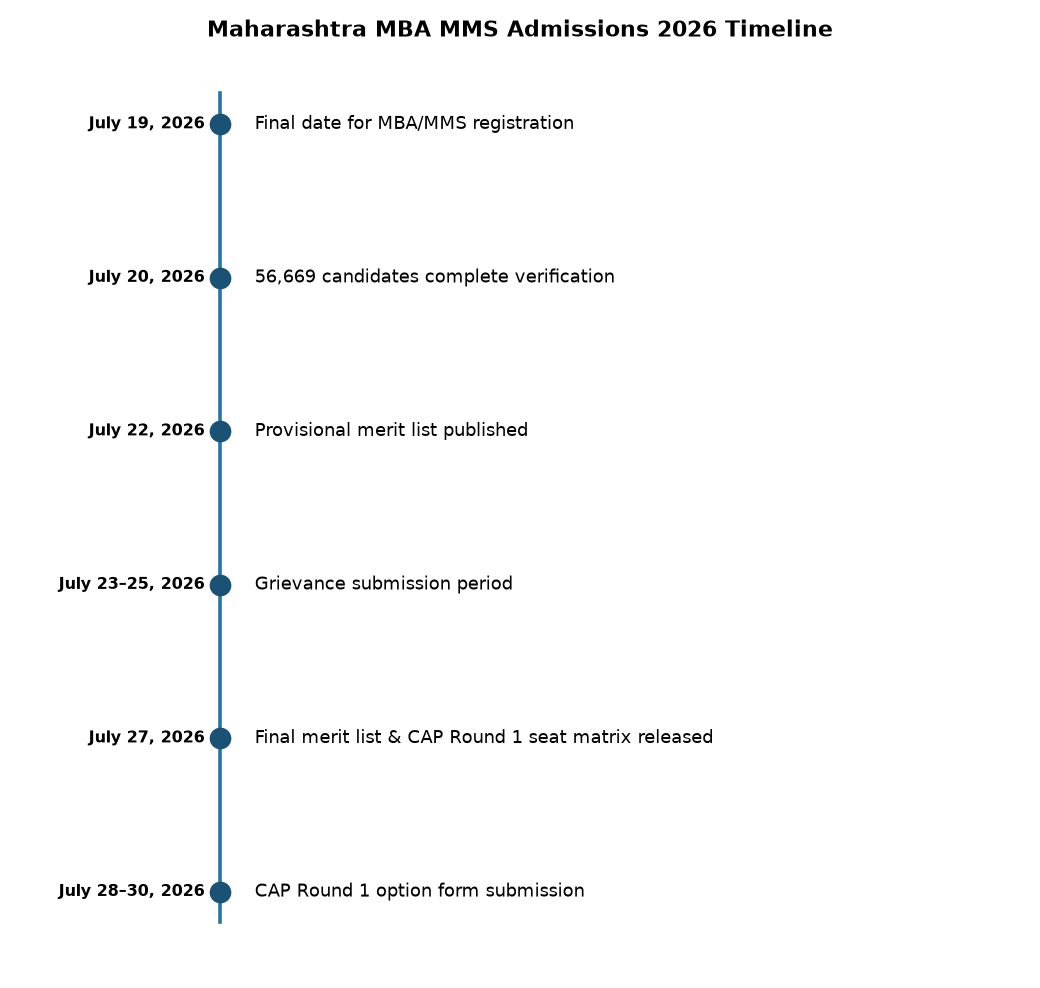
21 Jul Maharashtra MBA MMS CAP Round 1: Key Dates & Merit List for 2026-27 Admissions
Subject Relevance — Where This Topic Fits
- GS Paper II — Governance, Transparency and Accountability in Public Institutions | GS Paper III — Issues Relating to Direct and Indirect Farm Subsidies and Minimum Support Prices
- Prelims: Centralised Admission Process (CAP), State Common Entrance Test (CET) Cell, Maharashtra State Entrance Test (MAH-MBA/MMS-CET), Document Verification, Merit List, Seat Allotment Rounds, Institute-Level Admissions
- Essay: The Role of Standardised Testing in Higher Education Governance: A Case Study of Maharashtra’s CAP System, Balancing Access and Excellence: Evaluating the Efficacy of Centralised Admission Processes in Professional Education
Quick Revision: The Maharashtra MBA MMS CAP 2026 process is a four-round, merit-based admission system conducted by the State CET Cell, with document verification completed for 56,669 candidates; the provisional merit list is scheduled for July 22, 2026.
Why is this in the news?
The Centralised Admission Process (CAP) for MBA and MMS programmes in Maharashtra for the academic year 2026–27 has commenced with the verification of 56,669 candidates, marking the beginning of a structured four-round admission cycle. This initiative by the State CET Cell exemplifies the application of standardised, transparent, and merit-based admission protocols in professional higher education, a critical governance mechanism for ensuring equitable access to quality management education in India.
Background
- The Maharashtra State Common Entrance Test (CET) Cell, established under the Directorate of Technical Education (DTE), Maharashtra, administers the MAH-MBA/MMS-CET for admission to postgraduate management programmes across the state.
- The Centralised Admission Process (CAP) was introduced to streamline admissions, reduce malpractices, and ensure a level playing field for candidates from diverse backgrounds.
- Prior to CAP, admissions were conducted separately by individual institutes, leading to inefficiencies, delays, and opacity in the process.
- The CAP system aligns with national initiatives such as the National Education Policy (NEP) 2020, which advocates for standardised, transparent, and technology-driven admission processes in higher education.
- Maharashtra’s CAP model has been cited as a best practice for other states, particularly in professional education admissions.
- The process involves multiple rounds of seat allotment, document verification, and grievance redressal to ensure fairness and accuracy in merit formation.
What is the Centralised Admission Process (CAP) for Maharashtra MBA MMS Admissions?
- The CAP is a standardised, merit-based admission mechanism for MBA and MMS programmes in Maharashtra, conducted by the State CET Cell under the DTE.
- It replaces institute-level admissions with a centralised system, reducing administrative burden and enhancing transparency.
- The process includes registration, document verification, merit list preparation, option entry, seat allotment, and final reporting to institutes.
- CAP operates in multiple rounds (typically four) to optimise seat utilisation and provide candidates with opportunities to secure preferred seats.
- Document verification ensures the authenticity of academic credentials, work experience, and reservation claims, minimising fraud and misrepresentation.
- The merit list is prepared based on the MAH-MBA/MMS-CET score, academic performance, and reservation categories as per state norms.
- Candidates can modify their preferences across rounds, allowing for dynamic seat allocation based on evolving choices and merit.
- The final phase includes institute-level admissions for any remaining vacant seats, ensuring maximum utilisation of available capacity.
Key Features
| Feature | Significance |
|---|---|
| Centralised Admission Process (CAP) | Ensures transparency and uniformity in admissions across all MBA/MMS institutes in Maharashtra, reducing scope for malpractice. |
| Verification of candidates | Prevents fraudulent applications by confirming eligibility through document scrutiny, maintaining the integrity of the admissions process. |
| Merit list publication | Provides a transparent ranking system based on CET scores, enabling candidates to make informed choices during option filling. |
| Option form submission | Allows candidates to prioritise institutes and courses, aligning with their preferences and CET rankings. |
| Seat allotment and reporting | Facilitates the finalisation of admissions through a structured timeline, ensuring timely completion of the process. |
Why it Matters
Administrative Efficiency
- The CAP system streamlines admissions by centralising the process, reducing administrative burden on individual institutes.
- Standardised timelines ensure predictability and reduce delays in the academic calendar for institutions.
Transparency and Equity
- Verification of candidates ensures only eligible applicants participate, enhancing fairness in the selection process.
- Merit-based allotment prevents discretionary admissions, aligning with constitutional principles of equality (Article 14).
Economic Implications
- Timely admissions enable students to commence academic sessions without delays, reducing opportunity costs.
- Efficient allocation of seats maximises utilisation of educational infrastructure and resources.
Candidates’ Perspective
- Structured CAP rounds provide multiple opportunities for seat allotment, reducing anxiety and uncertainty.
- Clear timelines allow candidates to plan finances and accommodation in advance.
Challenges
1. Document Verification Bottlenecks
- Delays in verification may arise due to discrepancies in submitted documents, affecting candidates’ participation in CAP rounds.
- Candidates from remote areas may face challenges in timely document submission due to logistical constraints.
UPSC Link: GS2: Governance, transparency
2. Merit List Discrepancies
- Errors in provisional merit lists can lead to grievances, necessitating a robust grievance redressal mechanism.
- Candidates may face difficulties in rectifying discrepancies within the limited grievance submission window.
UPSC Link: GS2: Administrative reforms
3. Seat Allotment Mismatch
- High demand for premier institutes may result in candidates securing lower preferences, necessitating multiple CAP rounds.
- Institutes with lower rankings may face under-enrolment, impacting their financial sustainability.
UPSC Link: GS3: Resource allocation
4. Institutional Coordination
- Ensuring synchronised reporting and seat acceptance across institutes requires meticulous planning and inter-institutional coordination.
- Delays in reporting by candidates may disrupt the academic schedule of institutes.
UPSC Link: GS2: Inter-state coordination
Challenges — UPSC Perspective
| Issue | Concern |
|---|---|
| Verification delays | Risk of candidates missing CAP rounds due to pending document scrutiny. |
| Merit list errors | Potential for incorrect rankings, leading to grievances and legal disputes. |
| Seat allotment volatility | High competition may result in candidates accepting sub-optimal choices, affecting career trajectories. |
| Institutional preparedness | Inadequate infrastructure or faculty in some institutes may deter candidates from opting for them. |
| Grievance redressal | Limited time for resolving discrepancies may leave candidates dissatisfied. |
| Financial planning | Uncertainty in seat allotment may hinder candidates’ ability to secure loans or accommodation. |
Way Forward
- Strengthen pre-verification processes to reduce last-minute discrepancies in documents.
- Expand grievance redressal timelines or introduce a preliminary verification phase for high-risk documents.
- Enhance digital infrastructure for seamless option form submission and seat allotment tracking.
- Conduct mock CAP rounds to familiarise candidates with the process and reduce errors in option filling.
- Publish institute-wise seat availability and historical allotment trends to aid candidates in informed decision-making.
- Establish a dedicated helpline for candidates facing verification or merit list-related issues.
- Encourage institutes to offer pre-admission counselling sessions to address candidates’ concerns.
- Monitor CAP round outcomes to identify systemic issues and implement corrective measures for subsequent sessions.
UPSC Value Addition
Keywords for Mains Answer-Writing
Centralised Admission Process (CAP) · State Common Entrance Test (CET) Cell · MBA and MMS admissions · merit list preparation · document verification in admissions · collegiate education policy · higher education governance · admission counselling rounds · seat allotment mechanism · institution-level admissions
Concept Flow
Registration for MBA/MMS admissions opens → Candidates submit applications and documents → Document verification by CET Cell → Provisional merit list published → Candidates submit grievances → Final merit list released → CAP Round 1 option form submission → Seat allotment based on merit and preferences → Seat acceptance and reporting to institutes → Subsequent CAP rounds for unfilled seats → Institution-level admissions for remaining seats → Academic session commences.
Prelims Practice Questions
Q1. Which constitutional or statutory body is responsible for conducting the Centralised Admission Process (CAP) for MBA and MMS programmes in Maharashtra?
- A. University Grants Commission (UGC)
- B. All India Council for Technical Education (AICTE)
- C. Maharashtra State Common Entrance Test (CET) Cell
- D. Directorate of Technical Education (DTE), Maharashtra
Answer: D. Directorate of Technical Education (DTE), Maharashtra — The Maharashtra State Common Entrance Test (CET) Cell, functioning under the Directorate of Technical Education (DTE), Maharashtra, is the designated authority for conducting CAP for MBA and MMS admissions in the state.
Q2. In the context of CAP for MBA/MMS admissions, what is the primary purpose of the ‘option form’ in Round 1?
- A. To verify candidate eligibility documents
- B. To select preferred colleges and courses in order of preference
- C. To confirm acceptance of the allotted seat
- D. To submit grievances regarding the merit list
Answer: B. To select preferred colleges and courses in order of preference — The ‘option form’ in Round 1 of CAP allows candidates to express their preference for colleges and courses in a ranked order, which is used for seat allotment based on merit and availability.
Q3. Which of the following is a mandatory step for a candidate to become eligible for participation in the CAP rounds for MBA/MMS admissions in Maharashtra?
- A. Submission of income certificate
- B. Completion of document verification and application confirmation
- C. Passing a qualifying entrance test conducted by a private agency
- D. Obtaining a No Objection Certificate (NOC) from the previous institution
Answer: B. Completion of document verification and application confirmation — Candidates must complete the document verification and application confirmation process to be deemed eligible for participation in the CAP rounds, as per the CET Cell’s guidelines.
Mains Practice Question
✍ Critically examine the role of the Centralised Admission Process (CAP) in ensuring transparency and merit-based allocation of seats in professional higher education programmes such as MBA and MMS. How does the CAP mechanism address challenges like seat hoarding, multiple admissions, and sub-optimal utilisation of institutional capacity?
Approach: Begin by defining CAP and its objectives in the context of professional education admissions. Analyse how CAP promotes transparency through centralised merit lists, document verification, and grievance redressal mechanisms. Discuss the challenges of seat hoarding and multiple admissions, and explain how CAP mitigates these through staggered rounds, option forms, and strict deadlines. Conclude by evaluating the effectiveness of CAP in optimising seat utilisation and ensuring equitable access, while acknowledging limitations such as administrative delays or technical glitches.
Source: Times of India
Generated by AanyaAi for educational purpose.

- महाराष्ट्र में त्योहार जुलूसों पर बॉम्बे हाईकोर्ट का बड़ा फैसला: पटाखे, लेजर और संगीत पर रोक - September 24, 2026
- Bombay HC Bans Firecrackers, Music in Maharashtra Processions: Key UPSC Analysis - September 24, 2026
- तमिलनाडु में महिला कर्मचारियों के लिए सवैतनिक माहवारी अवकाश नीति पर HC का आदेश - September 24, 2026

No Comments