


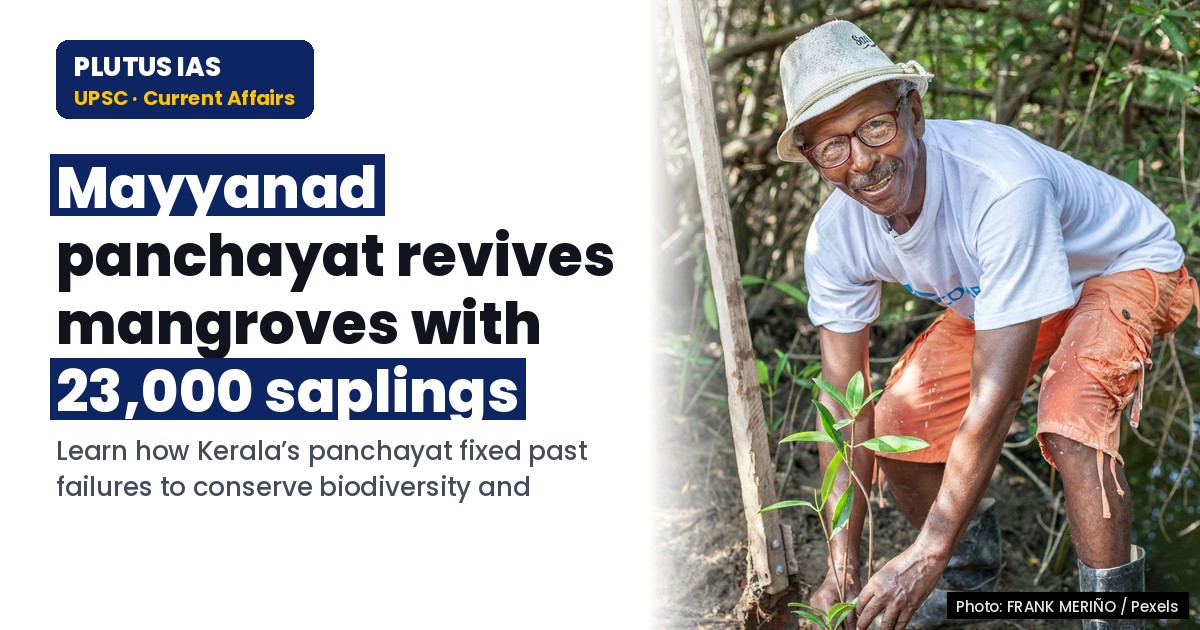
03 Oct Mangrove Revival Mission in Keralam’s Mayyanad: Lessons from Past Failures
✎ Mangrove restoration in Mayyanad exemplifies a community-driven, ecologically informed approach to coastal resilience, integrating long-term monitoring, specialised training, and convergence with MGNREGA and CSR initiatives to…
Subject Relevance — Where This Topic Fits
- GS Paper III — Environment, Ecology and Biodiversity | GS Paper III — Disaster Management | GS Paper II — Local Governance and Panchayati Raj Institutions
- Prelims: mangrove ecosystems, coastal erosion, biodiversity conservation, Community-Based Natural Resource Management (CBNRM), MGNREGA convergence, Eco-Clubs, Ramsar Convention, Panchayati Raj Act, 1993, Village Green Army (VGRA) scheme, Corporate Social Responsibility (CSR), Kollam district geography
- Essay: Sustainable development and ecological restoration: Balancing human needs with environmental conservation, The role of local governance in achieving national and global environmental targets
Quick Revision: Mangrove restoration in Mayyanad exemplifies a community-driven, ecologically informed approach to coastal resilience, integrating long-term monitoring, specialised training, and convergence with MGNREGA and CSR initiatives to ensure sustainable outcomes.
Why is this in the news?
The Mayyanad grama panchayat in Kollam district, Kerala, in collaboration with the HELP Foundation, has launched a renewed mangrove restoration initiative along the coastal fringe, drawing lessons from a previous failed attempt a decade ago. The project integrates community participation, specialised training, and long-term monitoring to ensure ecological resilience and coastal protection, aligning with national and global biodiversity conservation goals.
Background
- Mangroves are critical coastal ecosystems that provide habitat for diverse flora and fauna, act as natural barriers against cyclones and tsunamis, and mitigate coastal erosion by stabilising sediments.
- Kerala’s coastline, spanning approximately 590 km, is highly vulnerable to erosion, with nearly 40% of its shoreline experiencing varying degrees of degradation due to natural and anthropogenic pressures.
- The Ramsar Convention on Wetlands of International Importance (1971) recognises mangroves as vital ecosystems, and India has designated several mangrove sites, including the Vembanad-Kol Wetlands in Kerala, as Ramsar sites.
- The Mayyanad lake, a brackish waterbody in Kollam district, supports rich biodiversity, including migratory birds and aquatic species.
- Past mangrove restoration efforts in India have often failed due to inadequate post-planting care, lack of community engagement, and insufficient monitoring mechanisms.
What is Mangrove Restoration and Why is it Significant?
- Mangrove restoration refers to the deliberate re-establishment of mangrove forests in degraded or deforested coastal areas to restore ecological functions and services such as carbon sequestration, shoreline protection, and biodiversity support.
- Mangroves act as natural barriers against storm surges, cyclones, and tsunamis by reducing wave energy and preventing coastal inundation, thereby safeguarding human settlements and infrastructure.
- They play a pivotal role in mitigating coastal erosion by trapping sediments and stabilising shorelines, which is critical for regions like Kerala where erosion threatens livelihoods and coastal communities.
- Mangrove ecosystems support a wide range of biodiversity, including fish, crustaceans, birds, and mammals, many of which are economically important for local fisheries and tourism.
- Mangroves are highly efficient carbon sinks, sequestering up to four times more carbon per hectare than tropical rainforests, thereby contributing to climate change mitigation.
- Community-led mangrove restoration, as seen in Mayyanad, enhances local ownership, ensures long-term sustainability, and integrates traditional ecological knowledge with modern scientific practices.
- The success of mangrove restoration hinges on post-planting care, including protection from human interference, regular monitoring, and adaptive management to address ecological and socio-economic challenges.
Key Features
| Feature | Significance |
|---|---|
| Renewed plantation drive with 23,000 mangrove saplings | Addresses past failures by scaling up nursery capacity and ensuring species diversity (70 varieties) for ecological resilience. |
| Specialised training for 160 VB-G RAM G workers | Enhances technical capacity for planting and long-term maintenance, reducing survival rate risks of saplings. |
| Community participation (students, Eco Club) | Fosters environmental stewardship among youth, integrating textbook knowledge with practical ecosystem engagement. |
| Two-year post-plantation monitoring commitment | Shifts success metric from sapling count to survival and maturation, ensuring sustained ecological benefits. |
| Corporate CSR funding (Tryzens India) | Demonstrates multi-stakeholder collaboration, leveraging private sector resources for public ecological projects. |
Why it Matters
Ecological
- Mangroves act as natural coastal barriers, mitigating soil erosion and storm surges while preserving biodiversity in estuarine ecosystems.
- Restoration of mangrove habitats supports endangered species, including avifauna and aquatic organisms dependent on these ecosystems.
- Improves water quality by trapping sediments and pollutants, enhancing the health of adjacent waterbodies like the Mayyanad Lake.
Economic
- Sustainable coastal protection reduces expenditure on artificial structures (e.g., breakwaters, groynes) for erosion control.
- Potential for eco-tourism and livelihood generation through mangrove-based activities (e.g., guided nature trails, fisheries support).
Social
- Community involvement (students, local workers) strengthens environmental awareness and civic responsibility.
- Long-term employment through VB-G RAM G workers’ post-plantation care ensures local economic benefits beyond initial planting.
Governance
- Demonstrates adaptive governance through iterative learning from past failures, improving project design and implementation.
- Showcases convergence of local governance (panchayat), NGOs (HELP Foundation), and private sector (CSR) for sustainable development.
Challenges
1. Survival Rate of Saplings
- Historical failure due to inadequate post-plantation care necessitates rigorous monitoring and maintenance protocols.
- Climate variability (e.g., cyclones, salinity changes) may impact sapling establishment despite improved techniques.
UPSC Link: Environmental degradation causes
2. Community Engagement Sustainability
- Maintaining long-term interest among students and local workers requires continuous motivation and awareness campaigns.
- Risk of attrition in participation if immediate benefits (e.g., livelihoods) are not tangible.
UPSC Link: Environmental conservation challenges
3. Funding and Resource Allocation
- Dependence on external CSR funding may limit scalability; reliance on government budgets poses fiscal constraints.
- Ensuring consistent allocation for two-year monitoring requires robust financial planning.
UPSC Link: Public-private partnerships
4. Ecological Adaptability
- Selecting appropriate mangrove species for varying salinity and soil conditions is critical to project success.
- Invasive species or pest outbreaks could threaten the restored ecosystem.
UPSC Link: Biodiversity conservation
5. Policy and Regulatory Compliance
- Navigating land-use regulations and coastal zone management policies may delay or complicate project execution.
- Ensuring compliance with environmental impact assessment norms for large-scale restoration.
UPSC Link: Environmental law and policy
Challenges — UPSC Perspective
| Issue | Concern |
|---|---|
| Survival rate of saplings | Risk of high mortality despite improved techniques due to environmental and care-related factors. |
| Long-term community engagement | Sustaining participation beyond initial enthusiasm requires continuous motivation and tangible benefits. |
| Financial sustainability | Dependence on CSR or government funds may not guarantee long-term resource availability. |
| Species selection and adaptability | Choosing wrong species for local conditions could lead to project failure despite efforts. |
| Regulatory and policy hurdles | Delays in approvals or non-compliance with coastal zone norms may stall implementation. |
Government Initiatives — Must-Memorise for Prelims
- Mahatma Gandhi National Rural Employment Guarantee Scheme (MGNREGS) – for employment under VB-G RAM G workers
Way Forward
- Conduct soil-salinity mapping to select species most suited to local conditions for higher survival rates.
- Establish a dedicated monitoring cell within the panchayat to track sapling growth and ecosystem health bi-annually.
- Expand partnerships with academic institutions for long-term ecological research on restored mangroves.
- Develop a community-based eco-tourism model to generate local livelihoods and sustain interest in conservation.
- Integrate the project with state-level coastal zone management plans to ensure policy alignment and funding support.
- Organise periodic workshops for VB-G RAM G workers and students to reinforce technical and ecological knowledge.
- Explore carbon credit mechanisms under international frameworks to attract additional funding for scaling the project.
UPSC Value Addition
Keywords for Mains Answer-Writing
Mangrove ecosystems · Coastal erosion control · Community-based conservation · Biodiversity restoration · Ecosystem services · Participatory governance · Sustainable livelihoods · Environmental governance · Panchayati Raj Institutions · Corporate Social Responsibility · Eco-club initiatives · Climate change adaptation
Constitutional & Policy Linkages
- [‘Article 48A – Duty of State to protect environment’, ‘Directive Principle of State Policy guiding ecological conservation.’]
- [‘Article 51A(g) – Fundamental Duty to protect environment’, ‘Citizen’s responsibility towards environmental preservation.’]
Concept Flow
Historical failure of mangrove plantation → Identification of gaps (lack of post-plantation care) → Renewed project design with scaled nursery and training → Community and institutional participation → Implementation with monitoring protocols → Long-term ecological and socio-economic benefits.
Prelims Practice Questions
Q1. Consider the following statements regarding mangroves and their ecological significance:
1. Mangroves act as natural barriers against coastal erosion and storm surges.
2. They are highly saline-tolerant plants that thrive in brackish water ecosystems.
3. Mangroves sequester carbon at rates higher than most terrestrial forests.
4. The Mayyanad mangrove restoration project in Kerala is primarily funded by the Union Ministry of Environment, Forest and Climate Change.
How many of the above statements are correct?
- Only one
- Only two
- Only three
- All four
Answer: All four — Statements 1, 2, and 3 are correct. Statement 4 is incorrect as the project is funded through corporate social responsibility (CSR) by Tryzens India and local panchayat resources.
Q2. Assertion (A): Mangrove restoration projects often fail due to lack of post-plantation monitoring and community involvement.
Reason (R): The Mayyanad mangrove restoration project in Kerala addresses this by providing employment for long-term care and involving local students and Eco Clubs.
Options:
A. Both A and R are true, and R is the correct explanation of A.
B. Both A and R are true, but R is not the correct explanation of A.
C. A is true, but R is false.
D. A is false, but R is true.
- A
- B
- C
- D
Answer: B — The assertion (A) is true as past failures in mangrove restoration were due to inadequate monitoring and community engagement. The reason (R) correctly explains how the Mayyanad project mitigates this by ensuring long-term care and involving local stakeholders.
Q3. Match the following terms related to mangrove ecosystems with their correct descriptions:
Column I
1. Viviparity
2. Pneumatophores
3. Halophytes
4. Groynes
Column II
A. Plants adapted to grow in saline soils
B. Structures built perpendicular to the shore to reduce coastal erosion
C. Seedlings germinate while still attached to the parent tree
D. Specialized aerial roots that facilitate gas exchange in waterlogged soils
Options:
A. 1-C, 2-D, 3-A, 4-B
B. 1-A, 2-B, 3-C, 4-D
C. 1-D, 2-C, 3-B, 4-A
D. 1-B, 2-A, 3-D, 4-C
- A
- B
- C
- D
Answer: A — 1-C (Viviparity: seedlings germinate while attached to the parent tree), 2-D (Pneumatophores: aerial roots for gas exchange), 3-A (Halophytes: saline-tolerant plants), 4-B (Groynes: structures to reduce coastal erosion).
Mains Practice Question
✍ The restoration of degraded mangrove ecosystems is increasingly being recognised as a critical strategy for climate change adaptation and biodiversity conservation. In this context, critically analyse the role of community-based participatory models in ensuring the long-term success of mangrove restoration projects. Substantiate your arguments with reference to the Mayyanad mangrove restoration initiative in Kerala. (15 Marks)
Approach: MODEL-ANSWER SKELETON:
1. **Introduction (2 Marks)**
– Define mangrove ecosystems and their ecological significance (carbon sequestration, coastal protection, biodiversity hotspots).
– State the global decline of mangroves and the need for restoration.
2. **Community-Based Participatory Models (5 Marks)**
– Define participatory governance in environmental conservation (reference: UN Sustainable Development Goals, National Biodiversity Action Plan).
– Explain why top-down approaches often fail (citation: past failures in Mayyanad project due to lack of post-plantation care).
– Highlight the role of local institutions (Panchayati Raj Institutions) and community engagement in ensuring sustainability.
– Reference the Mayyanad model: partnership between Mayyanad Grama Panchayat, HELP Foundation, VB-G RAM G workers, students, and Eco Clubs.
3. **Key Components of the Mayyanad Initiative (4 Marks)**
– Specialised training for workers and students in planting and long-term care.
– Financial backing through Corporate Social Responsibility (CSR) initiatives (Tryzens India).
– Employment generation for local communities to ensure continuous monitoring.
– Educational outreach via Eco Clubs to foster long-term stewardship.
4. **Challenges and Limitations (3 Marks)**
– Time lag between planting and visible success (ecological patience).
– Need for sustained funding and political will beyond electoral cycles.
– Balancing conservation with local livelihood needs (e.g., fishing, tourism).
5. **Conclusion (1 Mark)**
– Reiterate the importance of community-based models in mangrove restoration for climate resilience and biodiversity conservation.
Source: The Hindu
Generated by AanyaAi for educational purpose.
Related guides on our sites
- Best PSIR optional coaching for upsc
- Best PSIR optional teacher for upsc
- Best teacher of PSIR optional for upsc
- Best PSIR optional coaching in delhi for UPSC

- Mangrove Revival Mission in Keralam’s Mayyanad: Lessons from Past Failures - October 3, 2026
- एल नीनो से निपटने के लिए पारिस्थितिकी तंत्र निगरानी जरूरी क्यों? - October 3, 2026
- Gujarat UCC Bill: Key Features for UPSC & State PCS Exam - October 3, 2026

No Comments