


06 Aug Maruti Suzuki Demands Amnesty Scheme for Past Indirect Tax Disputes: Key Implications for UPSC
✎ Amnesty schemes aim to resolve past indirect tax disputes, easing business compliance and reducing litigation.
Relevance for UPSC & State PCS: Polity & Governance
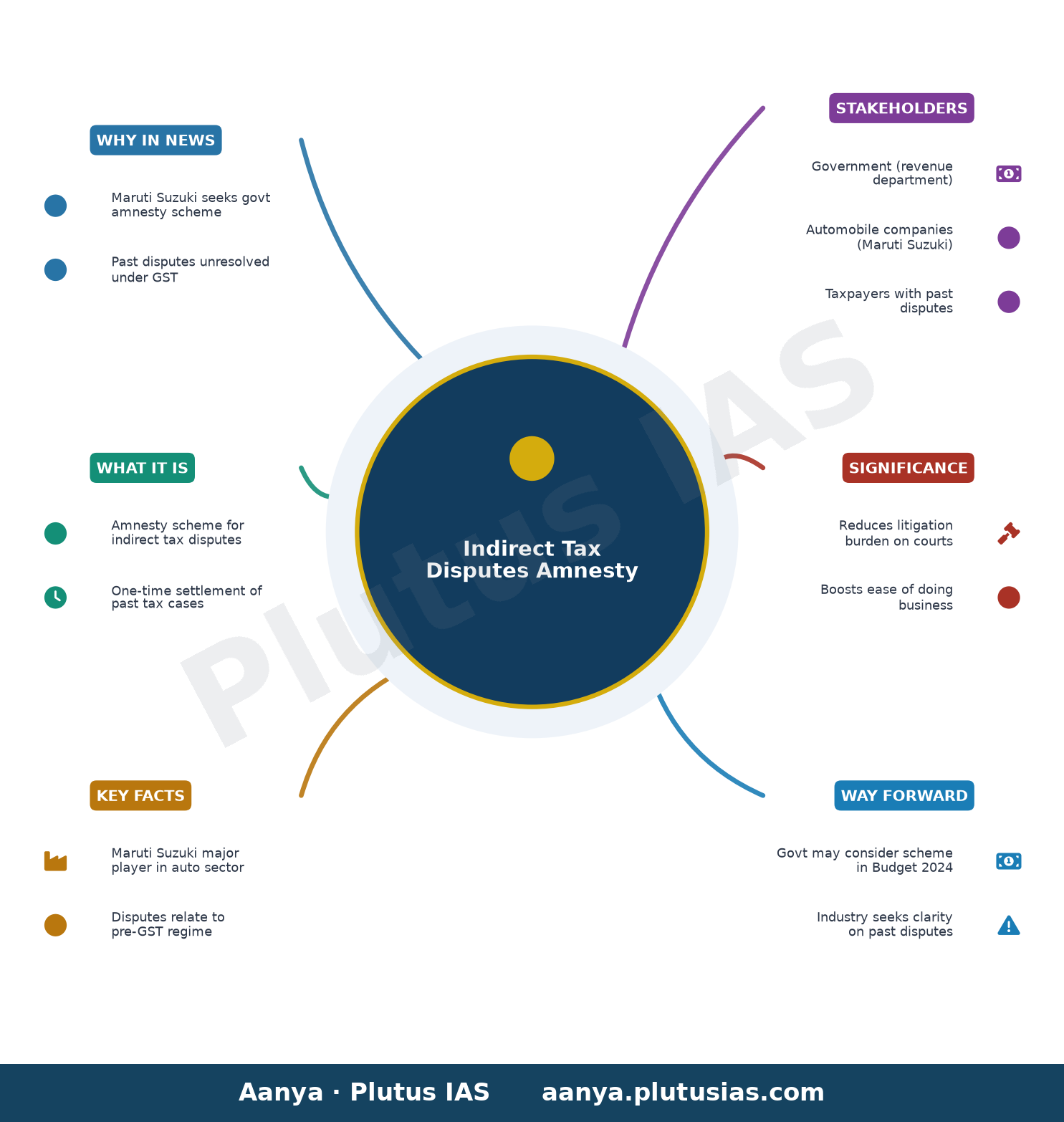
Maruti Suzuki India Ltd has urged the central government to introduce an amnesty scheme to resolve past indirect tax disputes, citing the need for a one-time settlement mechanism to clear long-pending cases under the erstwhile excise and service tax regimes. The company’s appeal aligns with broader industry demands for tax certainty, as businesses continue to grapple with disputes stemming from ambiguous interpretations of tax laws, frequent changes in regulations, and conflicting circulars issued by authorities. Such disputes often lead to prolonged litigation, tying up capital and managerial resources, which hampers investment and operational efficiency. For UPSC and State PCS aspirants, this issue underscores the importance of tax reforms in fostering a business-friendly environment, a key aspect of governance that intersects with economic policies and ease of doing business rankings.
The demand for an amnesty scheme reflects deeper concerns about India’s indirect tax architecture, particularly the transition from the pre-GST regime to the Goods and Services Tax (GST) framework. Many disputes relate to legacy issues like classification of goods, valuation methods, and input tax credit claims under the old tax laws, which were subsumed into GST but remain unresolved. An amnesty scheme, as suggested by Maruti, could provide a structured pathway for taxpayers to settle these disputes without prolonged legal battles, thereby reducing the burden on dispute resolution forums like the GST Appellate Tribunal. For civil service aspirants, this highlights the challenges in policy implementation and the need for mechanisms that balance revenue protection with taxpayer relief, a recurring theme in governance reforms.
From a constitutional and administrative perspective, the issue also touches upon the division of powers between the Centre and states in indirect tax administration. While GST is a cooperative federal structure, disputes often arise due to differing interpretations by state and central authorities, leading to multi-layered litigation. Maruti’s plea for an amnesty scheme could serve as a case study for aspirants to analyze how federalism shapes economic policies and the role of the judiciary in resolving tax disputes. Additionally, the proposal raises questions about the government’s approach to retrospective taxation—a contentious issue that has previously drawn international criticism—and whether an amnesty could be a pragmatic solution to restore investor confidence in India’s tax regime.
For UPSC and State PCS aspirants, this development is relevant not only for its economic implications but also for its governance dimensions. It offers a practical example of how corporate entities engage with policymakers to address systemic inefficiencies, and how the government balances fiscal imperatives with industry demands. The broader lesson lies in understanding the interplay between taxation, economic growth, and administrative reforms—a critical area for both prelims and mains examinations. Aspirants should also consider how such schemes could be designed to prevent future disputes, ensuring that tax policies are transparent, predictable, and aligned with global best practices.
Source: Business Standard
Practice Questions
Q1. What is the primary demand made by Maruti Suzuki to the Indian government regarding past indirect tax disputes?
- A complete waiver of all indirect taxes for the automotive sector
- A one-time amnesty scheme to resolve past indirect tax disputes
- A 50% reduction in GST rates for all automobile manufacturers
- An immediate refund of all previously paid indirect taxes
Answer
A one-time amnesty scheme to resolve past indirect tax disputes — Maruti Suzuki has urged the government to introduce a one-time amnesty scheme to settle past indirect tax disputes, which would provide relief to companies facing unresolved tax issues.
Q2. Which of the following is NOT a likely benefit of an amnesty scheme for past indirect tax disputes?
- Reduction in litigation burden on tax authorities
- Immediate financial relief to companies with pending disputes
- Permanent exemption from future indirect tax obligations
- Improved ease of doing business in the country
Answer
Permanent exemption from future indirect tax obligations — An amnesty scheme typically provides temporary relief by resolving past disputes but does not permanently exempt companies from future tax obligations.
Generated by AanyaAi for educational purpose.

- Karnataka HC rules against insurance condition on tractor-trailers for hire/reward use - October 3, 2026
- युवा संगम: सिक्किम-राजस्थान सांस्कृतिक आदान-प्रदान से सीखें विरासत - October 3, 2026
- Karnataka Launches Praja Seva Legal Aid Centre for Court Case Resolution - October 3, 2026

No Comments