


08 Aug MEA Clarifies: No India-Israel Defence Pact Amid Pak-Saudi-Turkey Pact
✎ The MEA’s dismissal of disinformation regarding India-Israel defence cooperation underscores India’s commitment to strategic autonomy and the need for vigilance against AI-driven fake narratives in foreign policy.
Subject Relevance — Where This Topic Fits
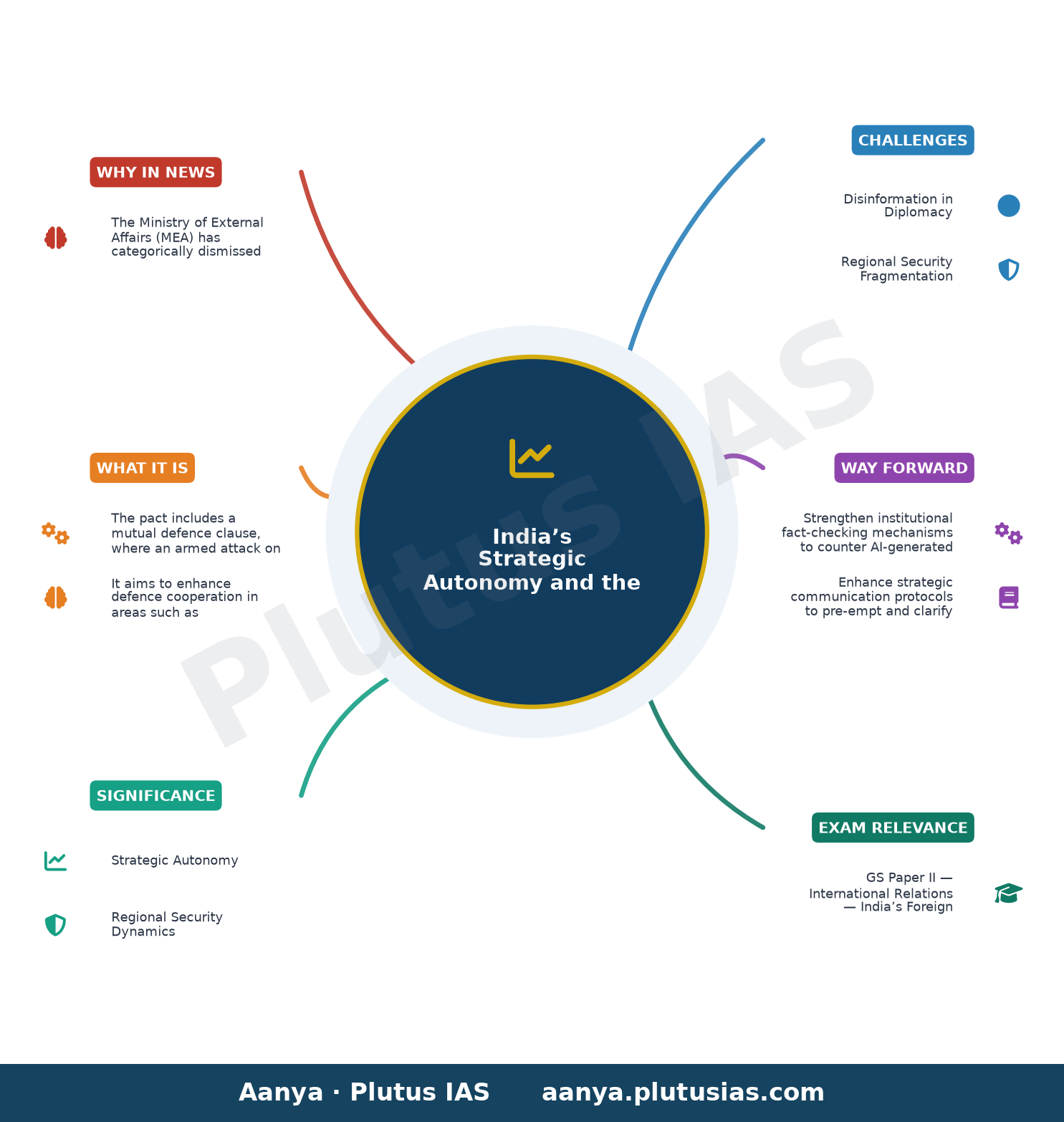
- GS Paper II — International Relations — India’s Foreign Policy, Strategic Alliances, and Countering Disinformation
- Prelims: MEA, Strategic Autonomy, Disinformation, FACT Check Unit, India-Israel Defence Cooperation, Pakistan-Saudi-Turkey Defence Pact, Makkah Defence Agreement
- Essay: The Role of Strategic Autonomy in India’s Foreign Policy, Disinformation and its Impact on National Security
Quick Revision: The MEA’s dismissal of disinformation regarding India-Israel defence cooperation underscores India’s commitment to strategic autonomy and the need for vigilance against AI-driven fake narratives in foreign policy.
Why is this in the news?
The Ministry of External Affairs (MEA) has categorically dismissed as ‘fake news’ reports alleging that India is negotiating a defence pact with Israel in response to the recently signed Pakistan-Saudi Arabia-Turkey defence pact. The MEA’s rebuttal underscores the importance of countering disinformation, particularly when amplified by artificial intelligence-generated content, and highlights India’s vigilance in monitoring geopolitical developments without succumbing to external pressures.
Background
- India’s foreign policy is anchored in the principle of strategic autonomy, which enables it to engage with multiple partners without aligning rigidly with any bloc.
- The pact includes provisions for mutual defence, stipulating that an armed attack on any member shall be considered an attack on all, akin to Article 5 of the NATO treaty.
- India has historically maintained a balanced approach in West Asia, engaging with both Israel and Arab states while avoiding entanglement in regional rivalries.
- The rise of disinformation, particularly through AI-generated content, poses a significant challenge to national security and diplomatic narratives.
- The MEA’s proactive stance in debunking false narratives aligns with India’s broader efforts to safeguard its strategic interests and maintain credibility on the global stage.
What is the Pakistan-Saudi-Turkey Defence Pact?
- The pact includes a mutual defence clause, where an armed attack on any member is deemed an attack on all, ensuring collective response mechanisms.
- It aims to enhance defence cooperation in areas such as counter-terrorism, intelligence-sharing, and joint military exercises.
- The agreement reflects the growing convergence of strategic interests among the three nations, particularly in countering perceived threats from non-state actors and regional rivalries.
- The pact has been interpreted as a counterbalance to other regional alliances, including India’s strategic partnerships with Israel and the West.
- Turkey’s role in the pact is significant, given its historical ties with Pakistan and its evolving defence relationships with Gulf states.
- The agreement has sparked discussions on its implications for regional stability and the potential for further alliances in West Asia.
- India has not officially commented on the pact’s strategic implications but has reiterated its commitment to monitoring developments without being drawn into external pressures.
Key Features
| Feature | Significance |
|---|---|
| India-Israel Defence Narrative | Dispels disinformation regarding a purported India-Israel defence pact, safeguarding India’s strategic autonomy and credibility in global forums. |
| MEA Fact-Check Mechanism | Demonstrates proactive use of institutional fact-checking to counter AI-generated disinformation, reinforcing trust in official communications. |
| Pakistan-Saudi-Turkey Tripartite Defence Pact | Signals a potential shift in regional security architecture, necessitating calibrated Indian responses without overreaction. |
| India’s Strategic Watchfulness | Highlights India’s policy of monitoring geopolitical developments while avoiding premature commitments or alliances. |
| AI-Driven Disinformation | Underscores the growing challenge of synthetic media in shaping international narratives, requiring robust countermeasures. |
Why it Matters
Strategic Autonomy
- India’s rejection of the rumoured defence pact with Israel underscores its commitment to strategic autonomy, avoiding entanglement in perceived regional rivalries.
- The MEA’s clarification reaffirms India’s non-aligned tradition, even amid shifting global power dynamics.
Regional Security Dynamics
- The Pakistan-Saudi-Turkey tripartite defence pact introduces a new variable in South-West Asian security, potentially altering India’s calculus in West Asia.
- India’s measured response indicates a preference for dialogue and diplomacy over reactive security postures.
Counter-Disinformation Framework
- The MEA’s fact-checking mechanism sets a precedent for institutional responses to disinformation, aligning with India’s broader digital governance strategy.
- AI-generated content poses a unique threat to diplomatic narratives, necessitating pre-emptive and transparent countermeasures.
India’s Global Standing
- India’s calibrated approach to the tripartite pact and rumoured defence deals reinforces its image as a responsible stakeholder in global security architecture.
- The episode demonstrates India’s ability to navigate complex geopolitical narratives without compromising its core interests.
Challenges
1. Disinformation in Diplomacy
- AI-generated fake news can distort international perceptions, leading to misinformed policy responses or diplomatic missteps.
- Institutional mechanisms to counter disinformation must evolve to match the sophistication of synthetic media.
UPSC Link: GS II: Role of Social Media
2. Regional Security Fragmentation
- The Pakistan-Saudi-Turkey pact may exacerbate existing rivalries, complicating India’s engagement in West Asia.
- India must balance strategic partnerships without being drawn into zero-sum regional conflicts.
UPSC Link: GS II: India’s Foreign Policy
3. Strategic Ambiguity vs. Clarity
- Rumours of defence pacts can create unnecessary strategic ambiguity, undermining India’s diplomatic leverage.
- Clear, timely communication is essential to prevent misinterpretation of India’s foreign policy intentions.
UPSC Link: GS II: Strategic Partnerships
4. Balancing Alliances in West Asia
- India’s multi-alignment strategy in West Asia faces new pressures with the emergence of rival blocs.
- Maintaining equidistant relations with Gulf states and Israel requires nuanced diplomacy.
UPSC Link: GS II: West Asia Policy
5. Institutional Preparedness for Geopolitical Shifts
- India’s diplomatic institutions must anticipate and adapt to rapid geopolitical realignments in its neighbourhood.
- Proactive monitoring and scenario planning are critical to avoid reactive policy failures.
UPSC Link: GS II: MEA’s Role
Challenges — UPSC Perspective
| Issue | Concern |
|---|---|
| AI-Generated Disinformation | Threatens to distort India’s strategic narratives and provoke misinformed policy responses. |
| Emergence of Rival Security Blocs | May fragment regional security architecture, complicating India’s engagement in West Asia. |
| Strategic Ambiguity in Diplomacy | Rumours of defence pacts can undermine India’s diplomatic clarity and leverage. |
| Balancing Alliances in West Asia | Requires precise calibration to avoid alienating key partners like Gulf states or Israel. |
| Institutional Adaptability | Diplomatic institutions must evolve to address rapid geopolitical shifts and disinformation challenges. |
Way Forward
- Strengthen institutional fact-checking mechanisms to counter AI-generated disinformation in real time.
- Enhance strategic communication protocols to pre-empt and clarify rumours about defence partnerships.
- Conduct scenario-based assessments of the Pakistan-Saudi-Turkey pact’s implications for India’s West Asia policy.
- Foster deeper diplomatic engagement with Gulf states to mitigate the impact of rival security blocs.
- Invest in AI-driven threat detection tools to monitor and counter synthetic media campaigns targeting India’s foreign policy narratives.
- Promote public awareness campaigns on disinformation to build societal resilience against foreign influence operations.
- Develop contingency plans for potential disruptions in India’s defence and energy supply chains due to regional security fragmentation.
UPSC Value Addition
Keywords for Mains Answer-Writing
India-Israel defence cooperation · Pakistan-Saudi-Turkey trilateral defence pact · Makka Defence Agreement · Ministry of External Affairs (MEA) statement · AI-generated fake news · India’s strategic autonomy · Collective defence mechanisms · Foreign policy misinformation · India’s defence diplomacy · Global strategic partnerships
Concept Flow
Rumours of India-Israel defence pact emerge → Pakistan-Saudi-Turkey tripartite pact announced → MEA dismisses rumours as ‘fake news’ → AI-generated disinformation amplifies narrative → India’s strategic watchfulness is reinforced → Regional security dynamics shift → India’s global standing is tested → Institutional countermeasures are strengthened
Prelims Practice Questions
Q1. Consider the following statements regarding the trilateral defence pact signed by Pakistan, Saudi Arabia, and Turkey:
1. The pact is known as the ‘Makka Defence Agreement’.
2. The agreement includes a provision that an armed attack on any one of the three countries shall be considered an attack on all.
3. The pact focuses solely on economic cooperation and does not include military or defence provisions.
How many of the above statements are correct?
- Only one
- Only two
- All three
- None
Answer: Only two — Statement 1 is correct as the pact is referred to as the ‘Makka Defence Agreement’. Statement 2 is correct as the agreement includes a collective defence clause. Statement 3 is incorrect as the pact explicitly includes military and defence cooperation provisions.
Q2. Assertion (A): The Ministry of External Affairs (MEA) of India has dismissed reports of India seeking a defence pact with Israel as fake news.
Reason (R): The reports were based on AI-generated fake content and lacked factual basis.
- Both A and R are true, and R is the correct explanation of A.
- Both A and R are true, but R is NOT the correct explanation of A.
- A is true, but R is false.
- A is false, but R is true.
Answer: Both A and R are true, and R is the correct explanation of A. — The MEA has explicitly stated that reports of India seeking a defence pact with Israel are fake news. The reason provided aligns with the assertion, as the MEA also highlighted the role of AI-generated fake content in spreading these reports.
Q3. Match the following countries with their respective defence or strategic agreements:
Column I (Country) | Column II (Agreement)
— | —
A. India | 1. Makka Defence Agreement
B. Pakistan | 2. India-Israel Strategic Partnership
C. Saudi Arabia | 3. Collective defence pact with Turkey
D. Turkey | 4. India-Russia defence cooperation
Options:
A-2, B-1, C-3, D-4
A-2, B-3, C-1, D-4
A-4, B-3, C-1, D-2
A-1, B-4, C-2, D-3
- A-2, B-1, C-3, D-4
- A-2, B-3, C-1, D-4
- A-4, B-3, C-1, D-2
- A-1, B-4, C-2, D-3
Answer: A-2, B-3, C-1, D-4 — India is part of the India-Israel Strategic Partnership (A-2). Pakistan is involved in the Makka Defence Agreement with Saudi Arabia and Turkey (B-3). Saudi Arabia is a signatory to the Makka Defence Agreement (C-1). Turkey is also a signatory to the Makka Defence Agreement (D-4).
Mains Practice Question
✍ Critically examine India’s strategic response to the Pakistan-Saudi-Turkey trilateral defence pact, particularly in the context of India’s foreign policy stance on defence cooperation with Israel. Substantiate your analysis with reference to India’s principle of strategic autonomy and the role of misinformation in shaping contemporary foreign policy narratives. (15 Marks)
Approach: MODEL-ANSWER SKELETON:
1. **Introduction**: Briefly outline the Pakistan-Saudi-Turkey trilateral defence pact (Makka Defence Agreement) and its collective defence clause. Highlight India’s official response via the MEA dismissing reports of a proposed India-Israel defence pact as fake news.
2. **India’s Strategic Autonomy**:
– Define strategic autonomy in India’s foreign policy context (non-alignment 2.0, multi-alignment).
– Discuss India’s defence diplomacy with Israel (e.g., joint military exercises, defence procurement like Barak missiles, Phalcon AWACS) while maintaining ties with Palestine and Arab states.
– Cite the 2017 India-Israel Joint Statement on ‘Strategic Partnership in Innovation and Technology’ to illustrate balanced engagement.
3. **Misinformation and Foreign Policy**:
– Analyse the role of AI-generated fake news in distorting strategic narratives (e.g., the viral claim linking the trilateral pact to India-Israel defence talks).
– Reference the MEA’s fact-checking unit and its emphasis on countering disinformation as a tool of foreign policy manipulation.
– Discuss the potential impact of such misinformation on India’s diplomatic credibility and strategic messaging.
4. **Balancing Act**:
– Evaluate how India navigates the Pakistan-Saudi-Turkey pact without compromising its defence partnerships (e.g., with Israel or Russia).
– Highlight India’s engagement with Gulf states (e.g., UAE, Saudi Arabia) through the I2U2 framework and the Chabahar port project to diversify strategic partnerships.
5. **Conclusion**:
– Reiterate India’s commitment to strategic autonomy amid evolving regional security architectures.
– Emphasise the need for robust mechanisms to counter disinformation in shaping foreign policy narratives.
Source: amarujala.com
Generated by AanyaAi for educational purpose.

- Exercise Tarang Shakti 2026: India’s Mega Multi-Nation Air Power Showcase - September 27, 2026
- रबी अभियान 2026: राष्ट्रीय सम्मेलन में केंद्र-राज्य तालमेल पर होगा जोर - September 27, 2026
- Himachal CM Sukhu: All Doctor Vacancies to be Filled by March - September 27, 2026

No Comments