


08 Aug Mecca Defence Pact: Will Saudi & Turkey Back Pakistan vs India?
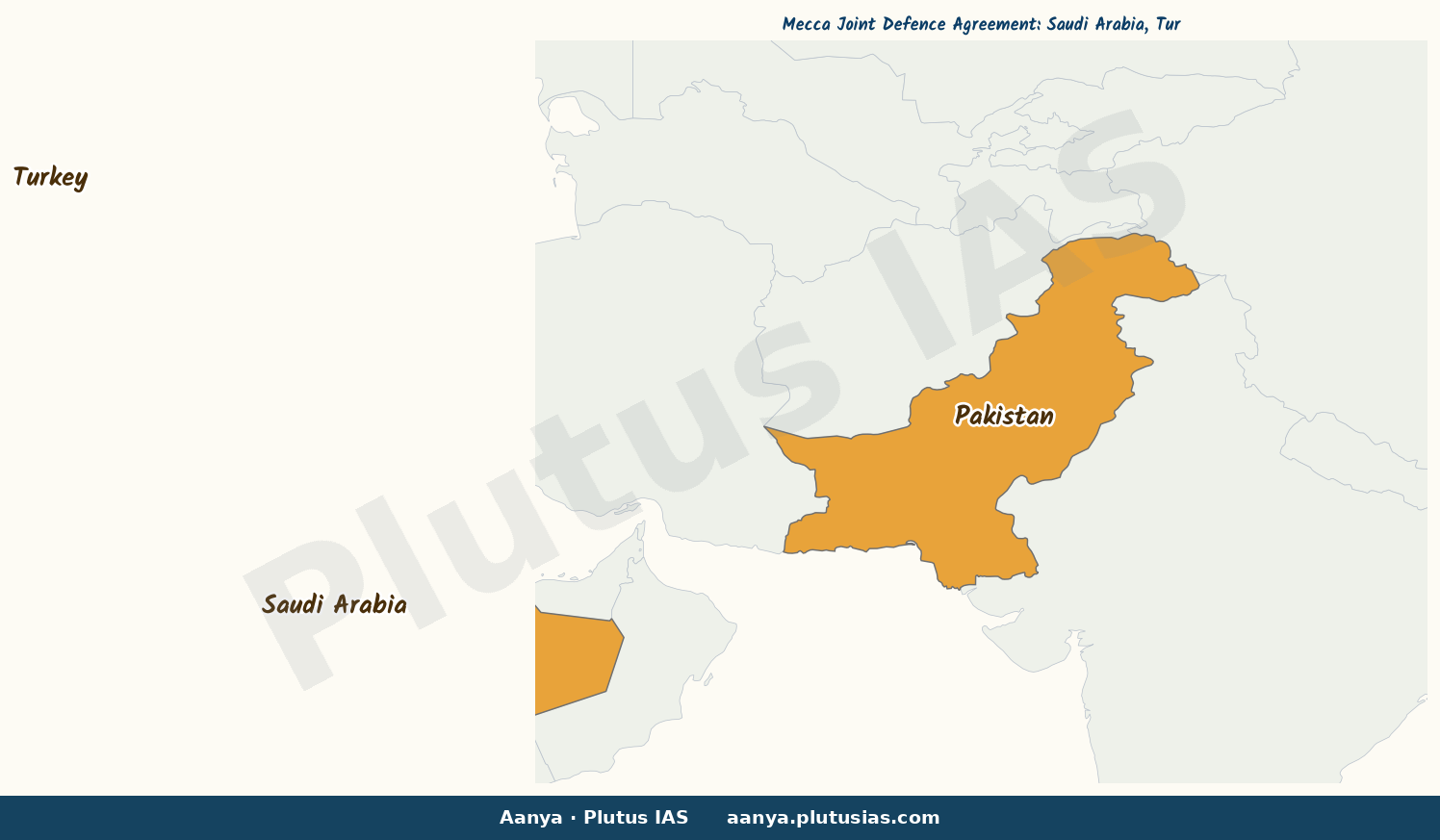
✎ The Mecca Joint Defence Agreement introduces a collective defence clause but does not mandate direct military intervention; its operational ambiguity and 'purely defensive' framing limit its immediate strategic impact on…
Subject Relevance — Where This Topic Fits
- GS Paper II — International Relations — Bilateral, Regional and Global Groupings and Agreements involving India and/or affecting India’s interests | GS Paper II — International Relations — India and its Neighbourhood- Relations | GS Paper II — International Relations — Effect of Policies and Politics of Developed and Developing Countries on India’s interests
- Prelims: Operation Sindoor, Mecca Joint Defence Agreement, Collective Defence Clause, NATO Membership of Turkey, SAARC, Regional Security Alliances
- Essay: The evolving dynamics of collective defence pacts in the contemporary geopolitical landscape, The role of religious and strategic alliances in shaping regional security paradigms
Quick Revision: The Mecca Joint Defence Agreement introduces a collective defence clause but does not mandate direct military intervention; its operational ambiguity and ‘purely defensive’ framing limit its immediate strategic impact on India-Pakistan dynamics.
Why is this in the news?
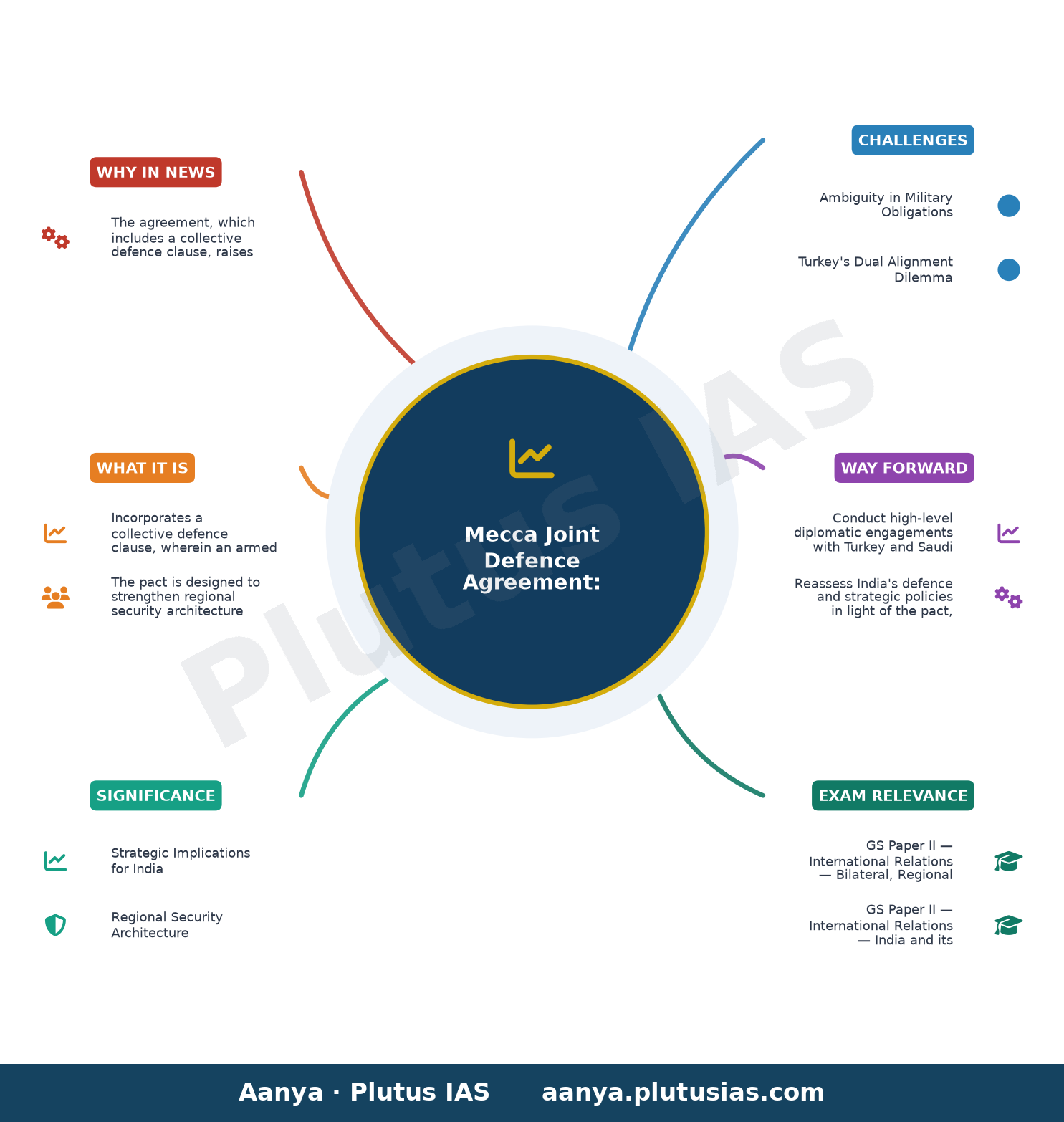
The agreement, which includes a collective defence clause, raises critical questions about potential responses to future military escalations between India and Pakistan, particularly in the context of India’s past cross-border operations such as Operation Sindoor. The ambiguity surrounding the pact’s operationalisation and its implications for India’s strategic calculus has necessitated a rigorous analysis of its provisions and regional ramifications.
Background
- The agreement includes a clause stating that an armed attack against any one of the three signatory states shall be considered an attack against all, invoking the principle of collective defence akin to Article 5 of the NATO treaty.
- During Operation Sindoor (a hypothetical or past operation analogous to India’s 2019 Balakot airstrikes), Pakistan received military and diplomatic support from Turkey and China, highlighting the existing defence partnerships in the region.
- Turkey, as a NATO member, maintains extensive defence and economic ties with both Pakistan and Gulf states, complicating its potential role in any India-Pakistan conflict.
- Saudi Arabia and Pakistan share deep security ties, including bilateral defence agreements and counter-terrorism cooperation, which the new pact seeks to institutionalise.
- The agreement is framed as ‘purely defensive’ and is open to other regional states, suggesting it aims to strengthen regional deterrence rather than target a specific country.
What is the Mecca Joint Defence Agreement?
- Incorporates a collective defence clause, wherein an armed attack against any signatory is deemed an attack against all, invoking the principle of mutual defence.
- The pact is designed to strengthen regional security architecture and deter aggression, though its precise military obligations remain unspecified in public declarations.
- Described by Turkish officials as ‘purely defensive’ and not directed against any particular country, the agreement is open to other regional states, indicating a potential expansion of the security framework.
- The agreement builds upon existing bilateral and multilateral defence arrangements between the signatories, such as Saudi-Pakistan security ties and Turkey-Pakistan defence cooperation.
- Analysts interpret the pact as a mechanism to institutionalise existing defence relationships rather than as a catalyst for new military alliances.
- The agreement does not automatically imply direct military intervention by signatories in conflicts involving one of the parties, leaving room for political and diplomatic responses.
- The pact’s operationalisation, including the form of assistance and decision-making processes, remains ambiguous, which could influence its effectiveness in deterring or responding to conflicts.
Key Features
| Feature | Significance |
|---|---|
| Collective Defence Clause | The pact invokes the principle of collective defence, where an armed attack against one signatory is deemed an attack against all, as per customary international law under Article 51 of the UN Charter. |
| Regional Deterrence Mechanism | The agreement aims to institutionalise security cooperation among Saudi Arabia, Turkey, and Pakistan, enhancing deterrence against perceived external threats. |
| Defensive Orientation | Both Turkey and Saudi Arabia have clarified that the pact is defensive in nature, not directed against any specific country, reducing the likelihood of automatic military confrontation with India. |
| Open to Expansion | The treaty remains open to other regional states, indicating potential for broader security architecture in West Asia without immediate implications for India. |
| Precedent of Support | Turkey’s past diplomatic and material support to Pakistan during Operation Sindoor (2025) suggests structured, though not necessarily military, backing in future conflicts. |
Why it Matters
Strategic Implications for India
- The pact introduces a new variable in India-Pakistan military dynamics, as Turkey and Saudi Arabia may provide structured support to Pakistan, though not necessarily direct military intervention.
- India must reassess its strategic calculus in cross-border operations, considering potential diplomatic and logistical responses from Turkey and Saudi Arabia.
- The agreement could lead to a more consolidated anti-India bloc in West Asia, complicating India’s regional diplomacy and defence planning.
- The absence of clear military obligations in the pact limits its immediate operational impact, but its symbolic and deterrent value remains significant.
Regional Security Architecture
- The Mecca pact reflects growing security cooperation among Muslim-majority nations, potentially reshaping West Asian geopolitics.
- It may contribute to a more cohesive regional security framework, though its effectiveness depends on the commitment of signatories.
- The pact could influence other nations to form similar defence pacts, altering the balance of power in the region.
- Turkey’s dual role as a NATO member and signatory to this pact adds complexity to its regional and global strategic posture.
Diplomatic and Military Posturing
- Turkey’s historical ties with Pakistan and its vocal support during Operation Sindoor suggest a higher likelihood of diplomatic and material assistance to Pakistan in future conflicts.
- Saudi Arabia’s deep security ties with Pakistan indicate potential for increased military cooperation, though its direct involvement in a conflict with India remains unlikely.
- The pact’s defensive framing may mitigate immediate escalation risks, but its long-term implications for regional stability are uncertain.
Challenges
1. Ambiguity in Military Obligations
- The pact’s lack of clarity on the nature and extent of military support creates uncertainty about how Turkey and Saudi Arabia would respond to an Indian strike on Pakistan.
- This ambiguity could lead to miscalculations in crisis situations, potentially escalating tensions between India and Pakistan.
- India may need to engage in diplomatic dialogue with Turkey and Saudi Arabia to clarify the pact’s provisions and reduce the risk of unintended escalation.
UPSC Link: Collective Defence Clauses in International Law
2. Turkey’s Dual Alignment Dilemma
- Turkey’s membership in NATO and its participation in the Mecca pact create a conflict of interests, particularly if the pact is invoked against a NATO ally like India.
- Ankara’s strategic autonomy may lead to a balancing act between its commitments to NATO and the Mecca pact, complicating its regional role.
- India must monitor Turkey’s actions closely to anticipate its responses in a potential India-Pakistan conflict.
UPSC Link: Turkey’s Foreign Policy in West Asia
3. Regional Polarisation Risks
- The Mecca pact could deepen regional polarisation, with Muslim-majority nations aligning more closely against perceived external threats, including India.
- This polarisation may undermine India’s efforts to build strategic partnerships in West Asia, particularly with Gulf states.
- India’s diplomacy must focus on de-escalating tensions and promoting inclusive regional security frameworks.
UPSC Link: Regional Security Alliances in West Asia
4. Impact on India-Pakistan Relations
- The pact may embolden Pakistan to adopt a more aggressive stance in future conflicts with India, relying on structured support from Turkey and Saudi Arabia.
- India’s cross-border operations may face increased diplomatic and logistical challenges, requiring a reassessment of its military and strategic options.
- The agreement could lead to a prolonged standoff between India and Pakistan, with regional powers playing a more active role in mediating or exacerbating the conflict.
UPSC Link: India-Pakistan Bilateral Relations
5. Economic and Strategic Fallout
- The pact may lead to economic and strategic realignments in West Asia, with India potentially facing challenges in maintaining its influence in the region.
- India’s energy security could be impacted if Saudi Arabia and other Gulf states prioritise Pakistan in their strategic partnerships.
- The agreement may also affect India’s defence procurement and military cooperation with West Asian nations.
UPSC Link: India’s Energy Security and Strategic Partnerships
Challenges — UPSC Perspective
| Issue | Concern |
|---|---|
| Ambiguity in Pact Provisions | Lack of clarity on military obligations could lead to miscalculations and unintended escalation in a crisis. |
| Turkey’s NATO Membership | Conflict between Turkey’s commitments to NATO and the Mecca pact may create strategic dilemmas. |
| Regional Polarisation | The pact could deepen divides among Muslim-majority nations, complicating India’s regional diplomacy. |
| Impact on India-Pakistan Dynamics | Structured support for Pakistan may embolden Islamabad to adopt a more aggressive stance against India. |
| Economic and Strategic Realignment | The pact may lead to shifts in energy and defence partnerships, affecting India’s regional interests. |
Way Forward
- Conduct high-level diplomatic engagements with Turkey and Saudi Arabia to clarify the scope and intent of the Mecca pact, ensuring India’s strategic concerns are addressed.
- Reassess India’s defence and strategic policies in light of the pact, particularly regarding cross-border operations and regional security alliances.
- Strengthen India’s diplomatic and economic ties with West Asian nations not party to the pact, such as the UAE and Qatar, to counterbalance the Mecca pact’s influence.
- Enhance India’s defence preparedness and deterrence capabilities to mitigate the risks posed by the pact, including strengthening indigenous defence manufacturing.
- Promote regional security frameworks that are inclusive and non-aligned, reducing the likelihood of polarisation and conflict escalation in West Asia.
- Monitor Turkey’s actions closely, particularly its balancing act between NATO and the Mecca pact, to anticipate its responses in potential crises.
- Engage in Track-II diplomacy with regional stakeholders to foster dialogue and reduce tensions, ensuring that the pact does not escalate into a broader conflict.
UPSC Value Addition
Keywords for Mains Answer-Writing
Mecca Joint Defence Agreement · Operation Sindoor · collective defence clauses · India-Pakistan military dynamics · Saudi Arabia-Turkey-Pakistan defence pact · regional security architecture · Article 51 of the UN Charter · collective self-defence · NATO Article 5 · geopolitical deterrence · military obligations under treaties · India’s strategic autonomy
Concept Flow
Operation Sindoor (2025) → Diplomatic and material support from Turkey to Pakistan → Escalation of tensions in India-Pakistan relations. → Mecca Joint Defence Agreement signed by Saudi Arabia, Turkey, and Pakistan → Collective defence clause invoked → Potential for structured support to Pakistan in future conflicts. → Ambiguity in pact provisions → Uncertainty about military obligations → Risk of miscalculations and unintended escalation. → Turkey’s dual alignment (NATO membership and Mecca pact) → Strategic dilemmas → Potential conflict of interests in a crisis. → Regional polarisation → Deepening divides among Muslim-majority nations → Impact on India’s regional diplomacy and strategic partnerships. → India’s reassessment of defence policies → Enhanced deterrence capabilities → Mitigation of risks posed by the pact.
Prelims Practice Questions
Q1. Consider the following statements regarding the Mecca Joint Defence Agreement signed by Saudi Arabia, Turkey, and Pakistan:
1. The agreement explicitly mandates military intervention by signatory states in case of an armed attack on any one of them.
2. Turkey is a signatory to the agreement and is also a member of NATO.
3. The agreement is primarily aimed at countering India’s military actions against Pakistan.
How many of the above statements are correct?
- Only one
- Only two
- All three
- None
Answer: Only two — Statement 1 is incorrect because the agreement does not explicitly mandate military intervention; it only states that an attack on one shall be considered an attack on all. Statement 2 is correct as Turkey is a NATO member. Statement 3 is incorrect as the agreement is framed as a regional deterrence measure and is not directed against any specific country.
Q2. Assertion (A): The Mecca Joint Defence Agreement between Saudi Arabia, Turkey, and Pakistan is modelled on Article 51 of the UN Charter, which recognises the right of collective self-defence.
Reason (R): The agreement pledges that an armed attack against any one of the three countries will be regarded as an attack against all three, thereby invoking collective defence mechanisms.
Options:
A. Both A and R are true, and R is the correct explanation of A.
B. Both A and R are true, but R is not the correct explanation of A.
C. A is true, but R is false.
D. A is false, but R is true.
- A
- B
- C
- D
Answer: A — Both the assertion and reason are true. The agreement’s structure aligns with Article 51 of the UN Charter, which recognises collective self-defence. However, the reason does not fully explain the assertion as the agreement’s precise military obligations remain unspecified.
Q3. Match the following military alliances with their respective collective defence clauses:
Column I
1. NATO
2. Mecca Joint Defence Agreement
3. Rio Treaty
4. ASEAN Defence Ministers Meeting Plus
Column II
A. Article 5
B. Article 51 of the UN Charter
C. Mutual Defence Treaty
D. Collective Defence Understanding
Options:
1. 1-A, 2-D, 3-C, 4-B
2. 1-B, 2-A, 3-D, 4-C
3. 1-A, 2-C, 3-B, 4-D
4. 1-D, 2-A, 3-C, 4-B
- 1
- 2
- 3
- 4
Answer: 1 — 1-A: NATO’s collective defence is governed by Article 5. 2-D: The Mecca Joint Defence Agreement is a collective defence understanding. 3-C: The Rio Treaty is a Mutual Defence Treaty. 4-B: ASEAN Defence Ministers Meeting Plus operates under the framework of Article 51 of the UN Charter.
Mains Practice Question
✍ The Mecca Joint Defence Agreement signed by Saudi Arabia, Turkey, and Pakistan introduces a new dimension to regional security dynamics in South Asia. Critically analyse the implications of this agreement for India’s strategic calculus, particularly in the context of potential future military engagements with Pakistan. (15 Marks)
Approach: MODEL-ANSWER SKELETON:
1. **Introduction (2 Marks)**:
– Briefly define the Mecca Joint Defence Agreement and its core provision: collective defence clause.
– Contextualise with Operation Sindoor and India’s historical military engagements with Pakistan.
2. **Strategic Implications for India (5 Marks)**:
– **Deterrence and Escalation**: Assess how the agreement may alter Pakistan’s perceived security umbrella and India’s deterrence calculus.
– **Regional Balances**: Discuss the potential shift in regional power dynamics, including China’s role as a counterweight.
– **Diplomatic and Military Responses**: Evaluate India’s options—diplomatic reassurance, military preparedness, or strategic partnerships with other regional actors.
3. **Legal and Normative Framework (4 Marks)**:
– Compare the agreement’s collective defence clause with Article 51 of the UN Charter and NATO’s Article 5.
– Analyse the ambiguity in the agreement’s military obligations and its implications for India.
4. **Counterarguments and Limitations (3 Marks)**:
– Highlight the agreement’s defensive posture and its openness to other regional states.
– Discuss the constraints on Turkey and Saudi Arabia (e.g., NATO membership, economic interests) that may limit direct military intervention.
5. **Conclusion (1 Mark)**:
– Summarise the agreement’s likely impact on India’s strategic autonomy and regional security architecture.
Source: Mint
Generated by AanyaAi for educational purpose.

- युवा संगम: सिक्किम-राजस्थान सांस्कृतिक आदान-प्रदान से सीखें विरासत - October 3, 2026
- Karnataka Launches Praja Seva Legal Aid Centre for Court Case Resolution - October 3, 2026
- महाराष्ट्र में मानसून की असामयिक वापसी: 21 जिलों में बारिश की कमी - October 3, 2026

No Comments