


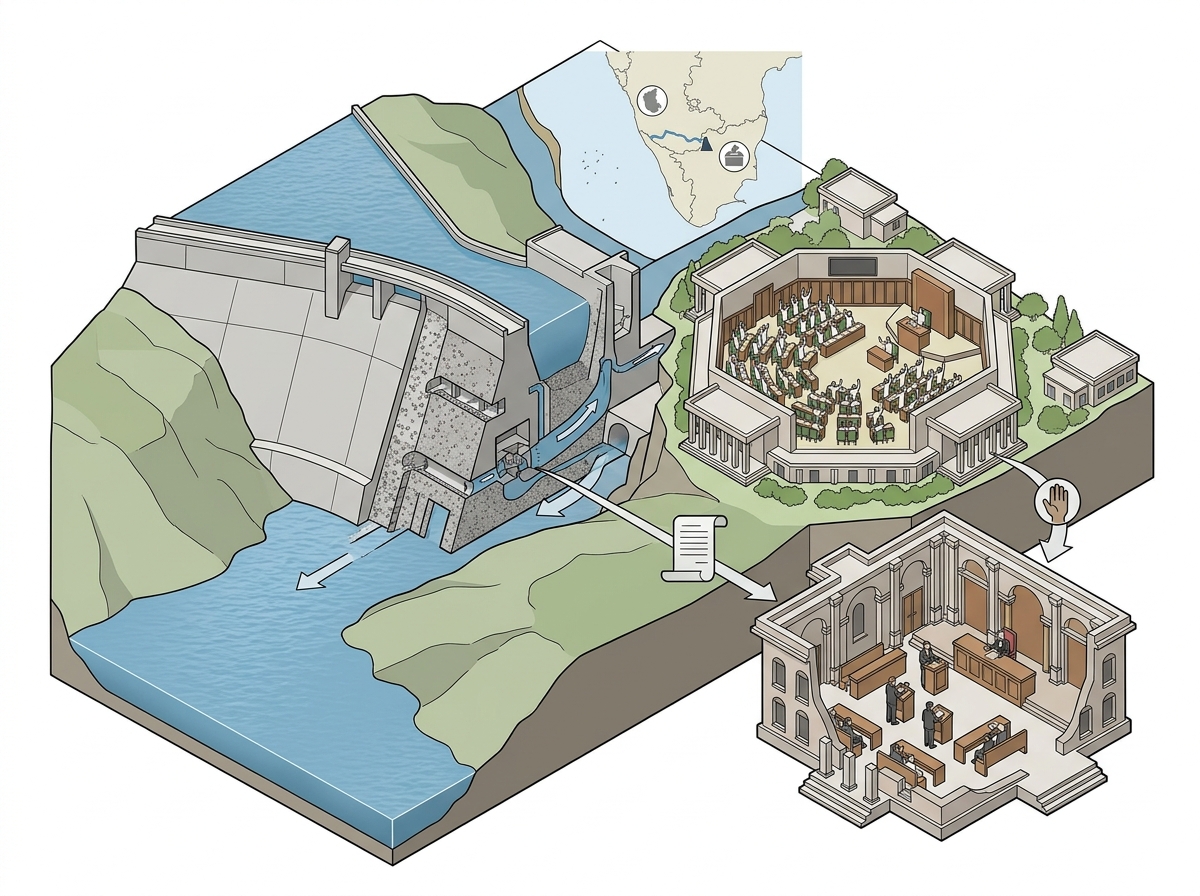
08 Aug Mekedatu Dam: Tamil Nadu Assembly Passes Unanimous Resolution Seeking Centre’s Intervention
Legislative AssemblyAmended resolutionMekedatu DamInter-State tribunalRiver CauveryChief Minister✎ The Inter-State River Water Disputes Act, 1956, read with Article 262 of the Constitution, vests exclusive jurisdiction in tribunals for adjudicating inter-state river water disputes, rendering civil courts incompetent to…
Subject Relevance — Where This Topic Fits
- GS Paper II — Polity and Governance (Inter-State Relations) | GS Paper III — Environment, Ecology, Biodiversity and Climate Change (Water Resources Management)
- Prelims: Inter-State River Water Disputes Act, 1956, Article 262 of the Constitution, Cauvery Water Disputes Tribunal, Special Tribunal under Section 4, Tamil Nadu Legislative Assembly, Madras High Court, Jal Shakti Ministry, AIADMK, Karnataka-Kerala-Tamil Nadu River Water Disputes
- Essay: Federalism and Centre-State Relations in Water Resource Governance, Legal and Political Dimensions of Inter-State River Water Disputes in India
Quick Revision: The Inter-State River Water Disputes Act, 1956, read with Article 262 of the Constitution, vests exclusive jurisdiction in tribunals for adjudicating inter-state river water disputes, rendering civil courts incompetent to entertain such matters.
Why is this in the news?
The Madras High Court is currently adjudicating a writ petition challenging the procedural validity of an amended resolution passed unanimously by the Tamil Nadu Legislative Assembly on June 19, 2026. The resolution, moved by the Chief Minister, urges the Union Government to constitute a special tribunal under Section 4 of the Inter-State River Water Disputes Act, 1956 to resolve the Mekedatu Dam dispute between Tamil Nadu and Karnataka. The case raises critical questions regarding the procedural validity of legislative amendments, the role of the judiciary in inter-state disputes, and the governance framework for river water sharing in India.
Background
- The Mekedatu Dam project, proposed by Karnataka across the River Cauvery, has been a longstanding source of contention between Karnataka and Tamil Nadu, both riparian states under the Cauvery basin.
- The Cauvery Water Disputes Tribunal (CWDT), constituted under the Inter-State River Water Disputes Act, 1956, delivered its final award in 2007, allocating water shares among the basin states. However, Karnataka’s proposal to construct the Mekedatu Dam has been contested by Tamil Nadu on grounds of reduced downstream water availability and violation of the CWDT award.
- Tamil Nadu has consistently opposed the Mekedatu project, with the Chief Minister moving a resolution urging the Union Government to constitute a special tribunal under Section 4 of the Inter-State River Water Disputes Act, 1956.
- The Inter-State River Water Disputes Act, 1956, provides the legal framework for resolving disputes over inter-state rivers, including the constitution of tribunals under Section 4 for adjudicating specific disputes.
- The present case emerges from a writ petition filed by the AIADMK whip in the Madras High Court, challenging the procedural validity of the amended resolution passed by the Tamil Nadu Legislative Assembly.
- The Union Ministry of Jal Shakti, as the nodal authority for inter-state water disputes, plays a pivotal role in constituting tribunals and implementing tribunal awards under the Act.
What is the Mekedatu Dam Dispute?
- The Mekedatu Dam is a proposed reservoir project by Karnataka across the River Cauvery, located near the border with Tamil Nadu, aimed at supplying drinking water to Bengaluru and generating hydroelectric power.
- Tamil Nadu opposes the project, arguing that it violates the Cauvery Water Disputes Tribunal (CWDT) award of 2007, which allocated specific water shares to each basin state and prohibited unilateral construction of projects that alter downstream flows.
- Karnataka contends that the project is essential for meeting Bengaluru’s water needs and is being developed within its constitutional rights under Entry 17 of the State List (Water), subject to the provisions of the Inter-State River Water Disputes Act, 1956.
- The dispute exemplifies the broader challenge of balancing developmental needs with inter-state water-sharing obligations under India’s federal structure.
- The Inter-State River Water Disputes Act, 1956, empowers the Union Government to constitute tribunals for resolving inter-state river water disputes, with the CWDT being the tribunal for the Cauvery basin.
- Article 262 of the Constitution provides for the adjudication of inter-state river water disputes by tribunals constituted by Parliament.
- The Mekedatu dispute highlights the procedural and substantive complexities in the governance of inter-state rivers, including the role of legislative assemblies, executive actions, and judicial oversight.
Key Features
| Feature | Significance |
|---|---|
| Unanimous Legislative Assembly Resolution | Demonstrates Tamil Nadu’s unified political stance on the Mekedatu Dam issue, strengthening its negotiating position vis-à-vis Karnataka and the Centre. |
| Amendment to Resolution | Expands the scope to include a demand for a special tribunal under Section 4 of the Inter-State River Water Disputes Act, 1956, addressing procedural gaps in dispute resolution. |
| Advocate General’s Submission | Provides legal validation of the Assembly’s procedural compliance, crucial for the judiciary’s assessment of the resolution’s legitimacy. |
| Madras High Court’s Notice | Initiates judicial scrutiny of the resolution’s validity, ensuring constitutional and procedural checks on legislative actions. |
| Consultation with Legal Experts | Indicates a structured approach to legal strategy, aligning executive action with constitutional and statutory frameworks. |
Why it Matters
Inter-State Water Disputes
- Reinforces the constitutional principle of cooperative federalism in water resource management, as enshrined in Article 262 of the Constitution.
- Highlights the procedural rigidity in resolving inter-state river disputes, necessitating institutional reforms in the Inter-State River Water Disputes Act, 1956.
- Underscores the role of the judiciary in adjudicating disputes arising from unilateral state actions in transboundary river basins.
Federalism and Centre-State Relations
- Exemplifies the tension between state autonomy in water resource development and the Centre’s constitutional obligation to mediate inter-state disputes.
- Demonstrates the political and legal strategies employed by states to influence Centre-state negotiations on contentious issues.
- Illustrates the Centre’s role as an arbitrator in disputes where states seek constitutional remedies beyond administrative negotiations.
Judicial Review of Legislative Actions
- Showcases the judiciary’s role in ensuring that legislative resolutions comply with constitutional and procedural norms.
- Emphasises the need for judicial oversight in matters involving public interest and inter-state implications.
- Highlights the balance between legislative sovereignty and judicial scrutiny in matters of governance.
Challenges
1. Procedural Legitimacy of Amended Resolution
- The AIADMK’s contention that the amendment was not debated raises questions about the procedural validity of the resolution.
- The judiciary’s scrutiny of the Assembly’s conduct may set a precedent for future legislative amendments in contentious matters.
- Ensuring transparency in legislative processes while addressing urgent public concerns remains a challenge.
UPSC Link: GS-II: Centre-State Relations
2. Constitutional and Statutory Gaps in Dispute Resolution
- The demand for a special tribunal under Section 4 of the Inter-State River Water Disputes Act, 1956, reflects inadequacies in the existing dispute resolution mechanism.
- The Act’s reliance on ad-hoc tribunals and prolonged adjudication processes exacerbates inter-state tensions.
- The need for a permanent, empowered tribunal to address inter-state water disputes is underscored.
UPSC Link: GS-II: Constitutional Provisions
3. Centre-State Coordination Failures
- The Centre’s role in mediating the dispute is constrained by the absence of a clear constitutional framework for intervention.
- Delays in constituting tribunals or providing interim reliefs fuel state-level unilateral actions, as seen in Karnataka’s Mekedatu Dam proposal.
- The lack of a structured mechanism for Centre-state consultations on inter-state projects exacerbates conflicts.
UPSC Link: GS-II: Federalism
4. Judicial Overreach vs. Legislative Sovereignty
- The judiciary’s intervention in scrutinising legislative resolutions may be perceived as judicial overreach by some stakeholders.
- Balancing judicial review with respect for legislative sovereignty is a persistent challenge in constitutional governance.
- The case may set a precedent for the judiciary’s role in adjudicating the procedural validity of legislative actions.
UPSC Link: GS-II: Judicial Review
Challenges — UPSC Perspective
| Issue | Concern |
|---|---|
| Procedural Validity of Amended Resolution | Potential violation of legislative norms due to lack of prior debate on the amendment. |
| Constitutional Framework for Water Disputes | Inadequacies in the Inter-State River Water Disputes Act, 1956, leading to prolonged conflicts. |
| Centre-State Coordination | Absence of a structured mechanism for Centre-state negotiations on inter-state projects. |
| Judicial Role in Legislative Matters | Risk of judicial overreach in scrutinising legislative actions. |
| Political Polarisation | Partisan politics influencing the resolution’s framing and passage in the Assembly. |
Way Forward
- The Centre must expedite the constitution of a special tribunal under Section 4 of the Inter-State River Water Disputes Act, 1956, to address the Mekedatu Dam dispute.
- Tamil Nadu and Karnataka should engage in structured negotiations under the aegis of the Centre to explore mutually acceptable solutions.
- The Madras High Court should clarify the procedural standards for legislative amendments in contentious matters to prevent future disputes.
- Parliament should consider amending the Inter-State River Water Disputes Act, 1956, to establish a permanent tribunal with binding powers.
- States must adopt a consultative approach in planning inter-state river projects to avoid unilateral actions that escalate conflicts.
- The judiciary should delineate the boundaries of judicial review in legislative matters to ensure a balance between constitutional governance and judicial oversight.
- Political parties should depoliticise inter-state water disputes to foster cooperative federalism and long-term solutions.
UPSC Value Addition
Keywords for Mains Answer-Writing
Inter-State River Water Disputes Act, 1956 · Mekedatu Dam dispute · Special tribunal under Section 4 · Cauvery River water sharing · Tamil Nadu Legislative Assembly · Madras High Court · Inter-State River Water Disputes (Amendment) Act, 2019 · Constitutional provisions on water disputes · Federalism in water governance · Judicial review of legislative resolutions · Karnataka-Tamil Nadu water dispute · Article 262 of the Constitution · Inter-State Water Disputes Tribunal · Federal disputes resolution mechanisms
Constitutional & Policy Linkages
- Article 262: Adjudication of inter-state water disputes
Concept Flow
Karnataka’s proposal for Mekedatu Dam → Tamil Nadu’s political and legal opposition → Tamil Nadu Legislative Assembly passes unanimous resolution → Amendment to include demand for special tribunal → AIADMK challenges resolution in Madras High Court → Advocate General submits Assembly’s compliance → Judiciary orders notices to respondents → Judicial scrutiny of procedural validity and constitutional framework.
Prelims Practice Questions
Q1. Consider the following statements regarding the Inter-State River Water Disputes Act, 1956: 1. It empowers the Central Government to constitute a tribunal for resolving inter-state river water disputes. 2. The Act was amended in 2019 to introduce a single permanent tribunal for all water disputes. 3. Section 4 of the Act allows the Central Government to constitute a tribunal on a state’s request. How many of the above statements are correct?
- Only one
- Only two
- All three
- None
Answer: All three — Statements 1 and 2 are correct. Statement 3 is incorrect as Section 4 empowers the Central Government to constitute a tribunal suo motu or on a state’s request, but the 2019 amendment introduced a permanent tribunal system, not a single tribunal for all disputes.
Q2. Assertion (A): The Mekedatu Dam dispute between Karnataka and Tamil Nadu is a matter of inter-state river water sharing under the Inter-State River Water Disputes Act, 1956. Reason (R): The Act empowers the Central Government to constitute a tribunal to adjudicate disputes arising from the use, distribution, or control of inter-state river waters.
- A. Both A and R are true, and R is the correct explanation of A
- B. Both A and R are true, but R is NOT the correct explanation of A
- C. A is true, but R is false
- D. A is false, but R is true
Answer: A. Both A and R are true, and R is the correct explanation of A — Both Assertion (A) and Reason (R) are true, and R correctly explains A as the Mekedatu Dam dispute falls under the purview of inter-state river water sharing, enabling the Central Government to constitute a tribunal under the Act.
Q3. Match the following provisions of the Inter-State River Water Disputes Act, 1956 with their correct descriptions: Column I: 1. Section 3 2. Section 4 3. Section 5 4. Section 6. Column II: A. Power of Central Government to constitute a tribunal B. Reference of disputes to tribunals C. Constitution of tribunals D. Procedure for tribunals
- 1-C, 2-A, 3-B, 4-D
- 1-B, 2-A, 3-D, 4-C
- 1-A, 2-B, 3-C, 4-D
- 1-D, 2-C, 3-A, 4-B
Answer: 1-C, 2-A, 3-B, 4-D — Correct match: 1-C (Section 3: Constitution of tribunals), 2-A (Section 4: Power of Central Government to constitute a tribunal), 3-B (Section 5: Reference of disputes to tribunals), 4-D (Section 6: Procedure for tribunals).
Mains Practice Question
✍ The constitutional and legal framework governing inter-state river water disputes in India has evolved significantly, yet disputes persist. Critically analyse the efficacy of the Inter-State River Water Disputes Act, 1956, and the mechanisms it provides for resolving disputes such as the Mekedatu Dam controversy. Also, examine the role of the judiciary in adjudicating such disputes. (15 Marks)
Approach: MODEL-ANSWER SKELETON:
1. **Introduction**: Define inter-state river water disputes and their constitutional basis (Article 262 of the Constitution).
2. **Inter-State River Water Disputes Act, 1956**:
– Key provisions: Sections 3, 4, 5, and 6 (constitution of tribunals, reference of disputes, procedure).
– Amendments: 2019 amendment introducing a permanent tribunal system (single tribunal for all disputes).
– Limitations: Delays in tribunal formation, lack of enforceability, and absence of time-bound resolution.
3. **Mekedatu Dam Dispute**:
– Background: Karnataka’s proposal to construct the dam on the Cauvery River and Tamil Nadu’s opposition.
– Tamil Nadu’s resolution: Unanimous passage of an amended resolution urging the Centre to constitute a special tribunal under Section 4.
– Legal and political dimensions: Federalism, state autonomy, and Centre’s role in dispute resolution.
4. **Judicial Role**:
– Jurisdiction of the Supreme Court and High Courts in water disputes (e.g., Cauvery Water Disputes Tribunal’s recommendations).
– Judicial review of legislative resolutions (Madras High Court’s role in the Mekedatu case).
– Limitations: Judicial intervention often comes late, and tribunals lack enforcement powers.
5. **Comparative Analysis**:
– Contrast with international mechanisms (e.g., Indus Waters Treaty between India and Pakistan).
– Efficacy of tribunals vs. alternative dispute resolution mechanisms (mediation, negotiation).
6. **Conclusion**:
– Need for structural reforms: Time-bound resolution, enforceable awards, and greater Centre-State coordination.
– Role of cooperative federalism and political will in resolving disputes.
Key thinkers/cases: Article 262, Inter-State River Water Disputes Act, 1956, Cauvery Water Disputes Tribunal, Madras High Court’s order in the Mekedatu case.
Source: The Hindu
Generated by AanyaAi for educational purpose.

- महाराष्ट्र में त्योहार जुलूसों पर बॉम्बे हाईकोर्ट का बड़ा फैसला: पटाखे, लेजर और संगीत पर रोक - September 24, 2026
- Bombay HC Bans Firecrackers, Music in Maharashtra Processions: Key UPSC Analysis - September 24, 2026
- तमिलनाडु में महिला कर्मचारियों के लिए सवैतनिक माहवारी अवकाश नीति पर HC का आदेश - September 24, 2026

No Comments