


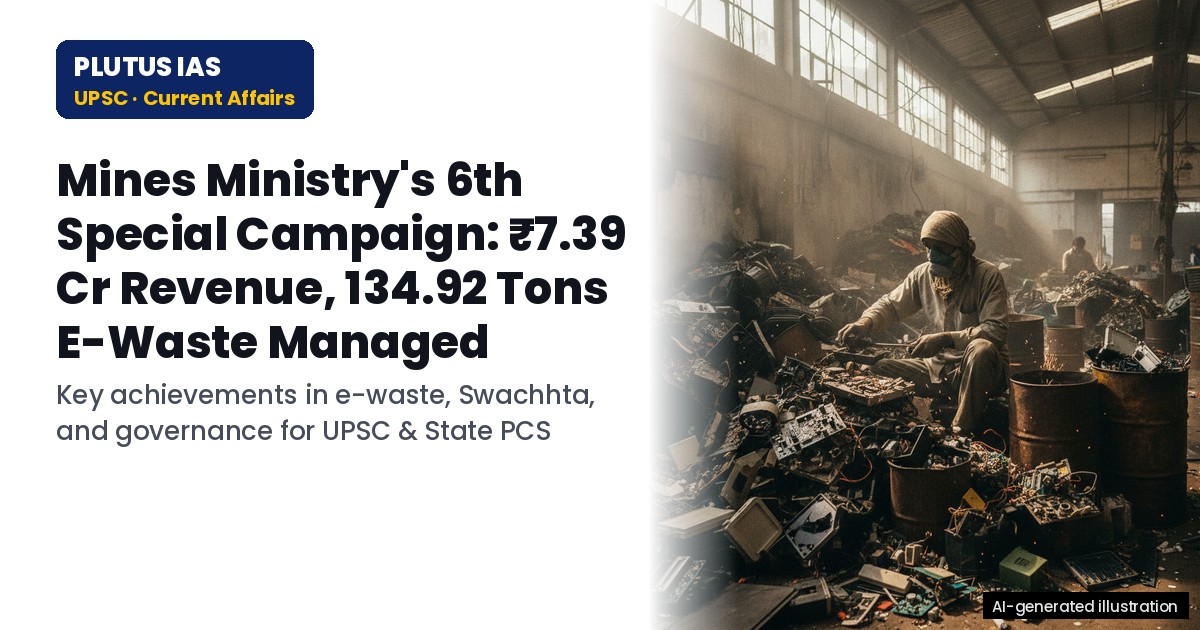
02 Nov Mines Ministry’s Special Campaign: E-Waste, Governance & Swachhta
✎ The Ministry of Mines' Sixth Special Campaign successfully integrated e-waste management, sanitation, and administrative reforms, demonstrating a commitment to environmental sustainability and good governance.
Subject Relevance — Where This Topic Fits
- GS Paper II — Governance, Transparency and Accountability, Citizens’ Charters | GS Paper III — Environment and Ecology, Waste Management, Conservation
- Prelims: E-waste management, Swachhta Abhiyan, Good Governance, Resource recovery, Circular economy, Ministry of Mines, Hindustan Copper Limited, NALCO, Indian Bureau of Mines
- Essay: Sustainable Development and Environmental Stewardship in Public Administration, The Imperative of Good Governance in Achieving National Development Goals
Quick Revision: The Ministry of Mines’ Sixth Special Campaign successfully integrated e-waste management, sanitation, and administrative reforms, demonstrating a commitment to environmental sustainability and good governance.
Why is this in the news?
The Ministry of Mines, along with its associated and subordinate offices, Central Public Sector Enterprises, and autonomous bodies, successfully concluded its Sixth Special Campaign. This initiative primarily focused on the effective collection, segregation, and disposal of e-waste, alongside significant efforts in sanitation, efficient record management, resolution of pending references, addressing public grievances, and enhancing administrative efficiency. The campaign’s achievements underscore the Ministry’s commitment to sustainable development and good governance principles.
Background
- The Government of India periodically launches special campaigns across ministries and departments to enhance administrative efficiency, promote cleanliness, and address specific governance challenges.
- These campaigns often align with broader national initiatives such as the Swachh Bharat Abhiyan, emphasizing cleanliness and waste management.
- E-waste generation is a growing concern globally and in India, necessitating structured approaches for its responsible management and disposal.
- Good governance principles, including transparency, accountability, and citizen-centric administration, are integral to the functioning of government bodies.
- The Ministry of Mines, as a key governmental entity, is responsible for policy formulation and administration of the mining sector, which includes environmental sustainability aspects.
- Systematic record management and timely resolution of public grievances are fundamental to improving public service delivery and administrative efficacy.
Key Aspects of the Sixth Special Campaign by the Ministry of Mines
- The campaign was a comprehensive initiative undertaken by the Ministry of Mines and its affiliated entities, including PSUs and autonomous bodies.
- A primary focus was on e-waste management, involving the collection, segregation, and responsible disposal of electronic waste across 96 locations.
- Significant revenue generation of approximately ₹1.2 crore was achieved through the disposal of 134.92 tonnes of e-waste.
- Extensive sanitation drives were conducted, with 465 Swachhta campaigns leading to the disposal of scrap and e-waste, generating a total revenue of approximately ₹6.19 crore.
- Office space optimization was a notable outcome, with approximately 47,881 square feet of office area reclaimed through scrap disposal.
- Record management initiatives included the review of 13,067 physical files and 3,270 e-files, resulting in the closure or weeding out of 11,282 files to streamline documentation.
- The campaign also addressed public grievances and references from various sources, including Members of Parliament and the Prime Minister’s Office, meeting set disposal targets.
- Efforts to enhance administrative efficiency included the simplification of 7 rules/procedures, promoting ease of governance.
Key Features
| Feature | Significance |
|---|---|
| E-waste Collection and Disposal | Systematic collection and responsible disposal of 134.92 tonnes of e-waste across 96 locations, generating revenue and promoting resource recovery. |
| Swachhta Campaigns | Execution of 465 cleanliness drives, leading to the clearing of approximately 47,881 square feet of office space and revenue generation from scrap disposal. |
| Document Management | Review of 13,067 physical files and 3,270 e-files, resulting in the closure or weeding out of 11,282 files to enhance administrative efficiency. |
| Grievance Redressal and Administrative Simplification | Achievement of targets for public grievance resolution and simplification of 7 rules/procedures to improve governance and administrative ease. |
| Innovative Best Practices | Implementation of initiatives such as rainwater harvesting, tree plantation drives, promotion of biodegradable bags, and ‘waste-to-wealth’ activities by associated organisations. |
Why it Matters
Environmental Sustainability
- The campaign directly addresses the growing challenge of electronic waste, a significant environmental concern due to hazardous materials and non-biodegradable components.
- Promotes responsible resource management through the recovery of valuable materials from e-waste, reducing the demand for virgin resources.
- Encourages eco-friendly practices within government offices, setting a precedent for broader societal adoption of sustainable waste management.
Economic Implications
- Revenue generation from the disposal of e-waste and scrap materials demonstrates the economic potential inherent in effective waste management.
- Optimisation of office space through cleanliness drives and scrap disposal leads to more efficient utilisation of government infrastructure.
Governance and Administrative Efficiency
- Streamlining of document management processes, both physical and electronic, contributes to enhanced administrative efficiency and quicker decision-making.
- Focus on public grievance redressal reinforces the principles of citizen-centric governance and accountability in public administration.
- Simplification of rules and procedures reduces bureaucratic hurdles, fostering an environment of ease of doing business and improved public service delivery.
Social Impact
- Promotes a culture of cleanliness and environmental consciousness among government employees, which can have a ripple effect on public awareness and participation.
- Innovative ‘waste-to-wealth’ initiatives demonstrate the potential for creative solutions to waste problems, inspiring similar community-level projects.
Challenges
1. Volume and Complexity of E-waste
- The increasing generation of e-waste, driven by rapid technological advancements and consumerism, poses a continuous challenge for collection and processing.
- E-waste often contains a complex mix of hazardous and valuable materials, requiring specialised and environmentally sound recycling infrastructure.
UPSC Link: Environment and Ecology: Pollution and Degradation
2. Infrastructure and Technology Gaps
- Adequate infrastructure for the scientific collection, segregation, and recycling of e-waste is still developing in many regions.
- Lack of advanced recycling technologies can lead to inefficient recovery of resources and potential environmental damage during processing.
UPSC Link: Science and Technology: Indigenisation of Technology
3. Awareness and Behavioural Change
- Despite campaigns, a lack of widespread public awareness regarding proper e-waste disposal methods often leads to informal recycling or improper dumping.
- Sustaining behavioural change towards responsible waste management requires continuous educational efforts and incentives.
UPSC Link: Social Issues: Role of NGOs and Civil Society
4. Regulatory Enforcement and Compliance
- Ensuring strict compliance with e-waste management rules across all stakeholders, including manufacturers, consumers, and recyclers, remains a challenge.
- Monitoring and preventing illegal e-waste trade and informal recycling practices are crucial for environmental protection.
UPSC Link: Governance: Government Policies and Interventions
Challenges — UPSC Perspective
| Issue | Concern |
|---|---|
| Informal E-waste Recycling | Unregulated practices lead to environmental pollution and health hazards due to the release of toxic substances. |
| Data Security in E-waste | Improper disposal of electronic devices can compromise sensitive personal and organisational data. |
| Logistics of Collection | Efficient collection networks for e-waste, especially from remote areas and individual households, are often insufficient. |
| Financial Viability of Recycling | High costs associated with scientific e-waste recycling can deter formal sector participation, favouring cheaper, informal methods. |
| Lifespan of Electronic Products | Rapid obsolescence of electronic goods contributes to the ever-increasing volume of e-waste, straining management systems. |
Government Initiatives — Must-Memorise for Prelims
- E-Waste (Management) Rules, 2022
Way Forward
- Strengthen Extended Producer Responsibility (EPR) mechanisms to ensure manufacturers take greater responsibility for the end-of-life management of their products.
- Invest in advanced e-waste recycling technologies and infrastructure to enhance resource recovery and minimise environmental impact.
- Launch comprehensive public awareness campaigns to educate citizens on the importance of proper e-waste disposal and the associated environmental and health risks.
- Promote the circular economy model by encouraging product longevity, repair, reuse, and refurbishment of electronic goods.
- Develop robust digital platforms for tracking e-waste generation, collection, and processing to ensure transparency and accountability.
- Incentivise formal sector participation in e-waste recycling through financial support, tax benefits, and simplified regulatory processes.
- Integrate e-waste management into urban planning and smart city initiatives, ensuring dedicated collection points and processing facilities.
- Foster international collaborations for knowledge sharing and technology transfer in e-waste management best practices.
UPSC Value Addition
Keywords for Mains Answer-Writing
E-waste management · Swachh Bharat Abhiyan · Good Governance · Sustainable Development Goals · Circular Economy · Resource Conservation · Administrative Efficiency · Public Grievance Redressal · Digital India · Waste-to-Wealth
Constitutional & Policy Linkages
- {‘article’: ‘Article 48A’, ‘note’: ‘Protection and improvement of environment’}
- {‘article’: ‘Article 51A(g)’, ‘note’: ‘Duty to protect natural environment’}
Concept Flow
Rapid technological advancement and consumption → Increased generation of electronic waste (e-waste) → Environmental pollution and resource depletion → Government initiatives for e-waste management and Swachhta → Responsible disposal, resource recovery, and administrative efficiency → Promotion of sustainable development and good governance
Prelims Practice Questions
Q1. Consider the following statements regarding e-waste management in India:
1. The E-Waste (Management) Rules, 2022, replaced the earlier 2016 rules.
2. These rules introduce a market-based mechanism for Extended Producer Responsibility (EPR) through a credit system.
3. Informal sector workers are explicitly excluded from the ambit of these rules.
How many of the above statements are correct?
- Only one
- Only two
- Only three
- None
Answer: Only two — Statement 1 is correct; the E-Waste (Management) Rules, 2022, indeed superseded the 2016 rules. Statement 2 is correct; the 2022 rules incorporate a credit-based system for EPR. Statement 3 is incorrect; the rules aim to formalize and integrate the informal sector into the e-waste management framework.
Q2. Which of the following initiatives is NOT directly associated with the promotion of environmental sustainability and resource conservation by the Ministry of Mines, as per recent reports?
- Rainwater harvesting centres by Hindustan Copper Limited.
- Promotion of biodegradable bags in townships by NALCO.
- Development of green parks on barren land by Indian Bureau of Mines.
- Establishment of a National Centre for Coastal Research (NCCR).
Answer: Establishment of a National Centre for Coastal Research (NCCR). — The establishment of a National Centre for Coastal Research (NCCR) is primarily under the Ministry of Earth Sciences, focusing on coastal zone management and research, not directly an initiative of the Ministry of Mines as per the provided context. The other options are explicitly mentioned as initiatives by entities under the Ministry of Mines.
Mains Practice Question
✍ Examine the significance of special campaigns like the one conducted by the Ministry of Mines in fostering good governance and sustainable development. Discuss the challenges in implementing such initiatives across various government departments. (15 Marks)
Approach: Introduction: Define special campaigns in the context of government functioning and their objectives (e.g., efficiency, accountability, sustainability).
Significance (Good Governance): Detail how these campaigns contribute to administrative efficiency (file management, grievance redressal), transparency, accountability, and citizen-centric services. Refer to specific examples from the news (e.g., simplified rules, public grievance disposal).
Significance (Sustainable Development): Explain their role in environmental protection (e-waste management, waste-to-wealth), resource conservation (rainwater harvesting, green parks), and promoting a circular economy. Cite specific organizational initiatives (Hindustan Copper Limited, NALCO, IBM).
Challenges in Implementation: Discuss hurdles such as inter-departmental coordination, resource allocation, behavioral change resistance, monitoring and evaluation mechanisms, technological integration, and ensuring sustained impact beyond campaign periods.
Conclusion: Summarize the dual benefits of such campaigns and suggest measures for long-term institutionalization and overcoming identified challenges for broader impact.
Source: PIB (Press Information Bureau)
Generated by AanyaAi for educational purpose.
Related guides on our sites
- Anthropology VS PSIR
- Best PSIR optional coaching
- Best PSIR optional coaching online
- Best PSIR optional teacher

- Mines Ministry’s Special Campaign: E-Waste, Governance & Swachhta - November 2, 2026
- हॉर्नबिल महोत्सव: नागालैंड PAP नियम वापसी की मांग क्यों कर रहा है? - November 2, 2026
- PM Inaugurates Bharat Renewable Energy Summit & Expo - November 2, 2026

No Comments