


15 Sep Mission LiFE Campaign: UPSC Focus on Single-Use Plastics Ban Drive
✎ Mission LiFE’s 3R framework—Reduce, Reuse, Recycle—is the cornerstone of India’s strategy to phase out single-use plastics, supported by scientific tools like the Mahanadi Litter Detection Dashboard and governed by the Plastic…
Subject Relevance — Where This Topic Fits
- GS Paper III — Environment and Ecology (Environmental Pollution, Waste Management, Sustainable Development)
- Prelims: Single-use plastics, Mission LiFE, EIACP, Mahanadi Litter Detection Dashboard, Plastic Waste Management Rules 2022, Reduce-Reuse-Recycle (3R), Marine Pollution, Bio-based alternatives, Waste Segregation
- Essay: Environmental Sustainability and Human Responsibility, Technology and Conservation: Balancing Innovation with Ecological Integrity
Quick Revision: Mission LiFE’s 3R framework—Reduce, Reuse, Recycle—is the cornerstone of India’s strategy to phase out single-use plastics, supported by scientific tools like the Mahanadi Litter Detection Dashboard and governed by the Plastic Waste Management Rules, 2022.
Why is this in the news?
The Mission LiFE campaign, in collaboration with the Ministry of Environment, Forest and Climate Change, the Environment Information, Awareness, Capacity Building and Livelihood Programme (EIACP), and WWF-India, conducted a multi-location awareness campaign in Odisha to galvanise public action against single-use plastics. The initiative, held across Puri, Baripada, Kendrapada, and Koraput, engaged over 25,000 participants and highlighted scientific tools such as the Mahanadi Litter Detection Dashboard to monitor plastic pollution, underscoring the campaign’s role in advancing India’s commitments under Mission LiFE and the Plastic Waste Management Rules, 2022.
Background
- The global proliferation of single-use plastics has emerged as a critical environmental challenge, with an estimated 400 million tonnes of plastic waste generated annually, of which a significant portion enters marine ecosystems, harming biodiversity and human health.
- Mission LiFE, launched in 2022 by the Prime Minister of India, is a people-driven, mass movement to promote sustainable lifestyles aligned with the principles of ‘Reduce, Reuse, Recycle’ (3R) and circular economy models.
- The Environment Information, Awareness, Capacity Building and Livelihood Programme (EIACP) operates under the Ministry of Environment, Forest and Climate Change to enhance environmental awareness, capacity building, and community engagement across India.
- The Mahanadi River system, a major river basin in eastern India, is a critical ecological corridor that drains into the Bay of Bengal, with plastic pollution from its basin contributing significantly to marine litter along the Odisha coast.
What is Mission LiFE and its Role in Addressing Single-Use Plastics?
- Mission LiFE (Lifestyle for Environment) is a national campaign launched in 2022 to foster sustainable consumption and production patterns through individual and collective behavioural change, aligning with the United Nations Sustainable Development Goals (SDGs), particularly SDG 12 (Responsible Consumption and Production) and SDG 14 (Life Below Water).
- The campaign’s core principles are encapsulated in the ‘Reduce, Reuse, Recycle’ (3R) framework, which advocates minimising waste generation, extending the lifecycle of products, and ensuring responsible disposal and recycling of materials.
- Single-use plastics, defined as plastic items intended for one-time use, include items such as carry bags, cutlery, straws, and packaging materials, which contribute disproportionately to environmental degradation due to their short lifespan and high persistence in ecosystems.
- Mission LiFE emphasises the adoption of alternatives to single-use plastics, such as bio-based or compostable materials, reusable containers, and bulk packaging, to reduce reliance on conventional plastics.
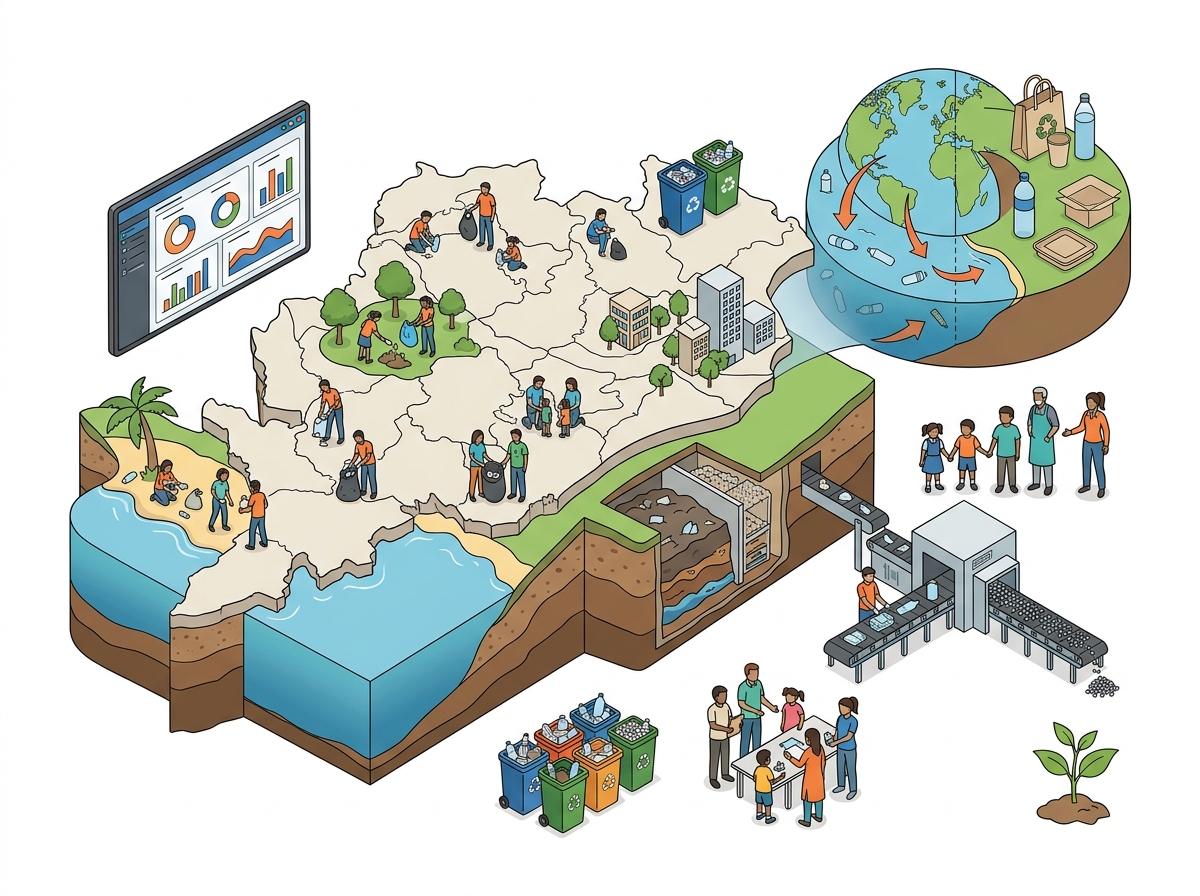
- The campaign integrates scientific and technological tools to monitor and mitigate plastic pollution, including the Mahanadi Litter Detection Dashboard, which utilises satellite remote sensing, machine learning, and Web GIS to identify litter accumulation zones and seasonal hotspots in the Mahanadi River basin and Odisha coastline.
- Mission LiFE operates through multi-stakeholder partnerships involving government agencies (e.g., Ministry of Environment, Forest and Climate Change), civil society organisations (e.g., WWF-India), academic institutions, and community groups to amplify outreach and impact.
- The campaign’s governance model is decentralised, with state-level hubs such as the EIACP Hub in Odisha coordinating local awareness programmes, capacity-building initiatives, and community engagement activities to ensure contextual relevance and effectiveness.
Key Features
| Feature | Significance |
|---|---|
| Mission LiFE campaign | A national initiative promoting sustainable lifestyles under the Ministry of Environment, Forest and Climate Change to foster collective action against environmental degradation. |
| Single-use plastic phase-out | Targets the elimination of non-essential plastic items (bottles, wrappers, carry bags) to mitigate marine and terrestrial pollution. |
| Mahanadi Litter Detection Dashboard | Uses satellite remote sensing, machine learning, and Web GIS to monitor floating litter in the Mahanadi basin and Odisha coastline, enabling data-driven waste management. |
| Community engagement programmes | Awareness drives, pledge-taking, and competitions involving tourists, students, and local residents to promote behavioural change and waste segregation. |
| Inter-agency collaboration | Involves the EIACP Hub, Centre for Environmental Studies, Forest Department, WWF-India, and local authorities for coordinated implementation and outreach. |
Why it Matters
Environmental Conservation
- Reduces plastic leakage into marine ecosystems, protecting biodiversity in the Mahanadi delta and coastal Odisha.
- Mitigates microplastic contamination in water bodies and soil, preserving ecosystem health.
- Supports India’s commitments under international agreements (e.g., UN Sustainable Development Goals, Basel Convention) on plastic waste management.
Public Health
- Limits human exposure to toxic additives in plastics (e.g., phthalates, bisphenol A) through reduced consumption and disposal.
- Decreases vector-borne diseases linked to plastic waste accumulation in urban and rural areas.
Policy Implementation
- Demonstrates the integration of scientific tools (remote sensing, AI) with grassroots awareness for effective environmental governance.
- Provides a replicable model for state-level plastic waste management, aligning with the Plastic Waste Management Rules (2016) and amendments.
Economic Implications
- Encourages the adoption of bio-based alternatives, fostering innovation in sustainable packaging and waste-to-wealth initiatives.
- Reduces healthcare and sanitation costs associated with plastic pollution management.
Institutional Strengthening
- Enhances inter-departmental coordination between environmental agencies, municipalities, and civil society for cohesive action.
- Builds capacity among local authorities for data-driven decision-making in waste management.
Challenges
1. Behavioural Resistance
- Public reluctance to adopt alternatives due to convenience, cost, or lack of awareness about long-term benefits.
- Cultural and economic dependence on single-use plastics in informal sectors (e.g., street vendors, tourism).
UPSC Link: GS3: Environmental Pollution and Degradation
2. Enforcement Gaps
- Inadequate monitoring and penalties for violations of plastic waste management rules in urban and rural areas.
- Limited resources for municipal authorities to enforce bans and conduct regular inspections.
UPSC Link: GS2: Governance, Transparency and Accountability
3. Technological and Logistical Constraints
- Scalability challenges in waste collection, segregation, and recycling infrastructure, particularly in coastal and remote regions.
- High costs associated with advanced waste management technologies (e.g., pyrolysis, chemical recycling).
UPSC Link: GS3: Science and Technology in Governance
4. Data and Monitoring Deficiencies
- Incomplete baseline data on plastic waste generation, leakage pathways, and accumulation hotspots in riverine and marine systems.
- Limited integration of citizen science and community-based monitoring in existing waste management frameworks.
UPSC Link: GS3: Conservation, Environmental Pollution and Degradation
5. Socio-Economic Disparities
- Unequal access to alternatives among marginalised communities, exacerbating environmental justice concerns.
- Informal waste pickers face livelihood disruptions due to reduced plastic waste collection under phase-out policies.
UPSC Link: GS1: Social Empowerment
Challenges — UPSC Perspective
| Issue | Concern |
|---|---|
| Public Behavioural Change | Low adoption of alternatives due to convenience and lack of awareness. |
| Regulatory Enforcement | Inadequate penalties and monitoring for violations of plastic waste rules. |
| Waste Management Infrastructure | Limited capacity for collection, segregation, and recycling in coastal regions. |
| Data Gaps | Incomplete tracking of plastic waste pathways and accumulation zones. |
| Livelihood Impacts | Disruption of informal waste economies without alternative income sources. |
Government Initiatives — Must-Memorise for Prelims
- Mission LiFE (Lifestyle for Environment)
Way Forward
- Strengthen inter-departmental coordination between environmental agencies, municipalities, and civil society for cohesive implementation of plastic waste policies.
- Expand the Mahanadi Litter Detection Dashboard to other river basins for real-time monitoring of plastic pollution hotspots.
- Launch targeted awareness campaigns in high-footfall areas (e.g., pilgrim sites, tourist hubs) to normalise the use of bio-based alternatives.
- Incentivise local governments and businesses to adopt Extended Producer Responsibility (EPR) frameworks for plastic waste management.
- Integrate plastic waste reduction into school and college curricula to foster long-term behavioural change among youth.
- Develop low-cost, scalable waste segregation and recycling units in coastal and rural areas to address infrastructure gaps.
- Conduct periodic audits of plastic waste generation and leakage to refine policy interventions and track progress.
- Partner with informal waste sectors to formalise their roles in collection and recycling, ensuring livelihood continuity.
UPSC Value Addition
Keywords for Mains Answer-Writing
Mission LiFE · Lifestyle for Environment · single-use plastics · plastic pollution · circular economy · waste management hierarchy · Extended Producer Responsibility (EPR) · polluter pays principle · marine litter · river basin management · sustainable consumption · Environment Protection Act, 1986 · National Green Tribunal (NGT) · UN Sustainable Development Goals (SDG 12, 14) · plastic waste management rules · WWF-India · EIACP Hub · Mahatma Gandhi’s trusteeship model · circular economy transition · source-to-sea plastic leakage
Concept Flow
Single-use plastic consumption → Environmental degradation (marine/terrestrial pollution) → Mission LiFE campaign launch → Awareness programmes and community engagement → Behavioural change (Reduce, Reuse, Recycle) → Waste segregation and responsible disposal → Satellite remote sensing and AI monitoring → Mahanadi Litter Detection Dashboard → Data on plastic accumulation zones → Policy enforcement (Plastic Waste Management Rules) → Municipal and state-level actions → Reduction in plastic leakage → Ecosystem protection (Mahanadi delta, Odisha coastline) → Biodiversity conservation and public health benefits → Replicability of model → Scaling to other river basins and coastal regions → National-level plastic waste reduction
Prelims Practice Questions
Q1. Consider the following statements regarding Mission LiFE (Lifestyle for Environment):
1. Mission LiFE is a government of India initiative launched under the Ministry of Environment, Forest and Climate Change.
2. The campaign explicitly mandates the complete elimination of all plastic use across India by 2030.
3. Mission LiFE promotes the principles of Reduce, Reuse and Recycle as part of its sustainable lifestyle framework.
4. The campaign includes a component of satellite remote sensing and machine learning to monitor plastic pollution in river basins.
How many of the above statements are correct?
- Only one
- Only two
- Only three
- All four
Answer: All four — Statements 1, 3, and 4 are correct. Statement 2 is incorrect as Mission LiFE promotes reduction and responsible use of single-use plastics, not a blanket elimination of all plastic use. The campaign aligns with the waste management hierarchy and does not impose a statutory deadline for total plastic elimination.
Q2. Assertion (A): The Extended Producer Responsibility (EPR) framework under the Plastic Waste Management Rules, 2022, places the onus of managing post-consumer plastic waste on producers, importers, and brand owners.
Reason (R): The EPR framework is grounded in the polluter pays principle, which seeks to internalise the environmental costs of plastic pollution into the economic decisions of producers.
In the context of the above two statements, which one of the following is correct?
- Both A and R are true, and R is the correct explanation of A
- Both A and R are true, but R is not the correct explanation of A
- A is true, but R is false
- A is false, but R is true
Answer: Both A and R are true, but R is not the correct explanation of A — Both the assertion and reason are true. The EPR framework under the Plastic Waste Management Rules, 2022, indeed places the responsibility of post-consumer plastic waste management on producers, importers, and brand owners (A). This responsibility is rooted in the polluter pays principle, which internalises environmental costs (R), making R the correct explanation of A.
Q3. Match the following initiatives with their respective objectives:
Column I (Initiative) | Column II (Objective)
— | —
A. Mission LiFE | 1. Monitor floating litter in river basins using satellite remote sensing and machine learning
B. EPR under PWM Rules, 2022 | 2. Promote sustainable lifestyles and collective action against plastic pollution
C. WWF-India’s Tech for Conservation | 3. Internalise environmental costs of plastic waste through producer responsibility
D. National Green Tribunal (NGT) | 4. Adjudicate disputes related to environmental protection and pollution control
Select the correct match:
- A-2, B-3, C-1, D-4
- A-1, B-2, C-3, D-4
- A-3, B-1, C-2, D-4
- A-4, B-3, C-1, D-2
Answer: A-2, B-3, C-1, D-4 — The correct matches are: A-2 (Mission LiFE promotes sustainable lifestyles), B-3 (EPR under PWM Rules, 2022 internalises environmental costs), C-1 (WWF-India’s Tech for Conservation monitors floating litter), and D-4 (NGT adjudicates environmental disputes).
Mains Practice Question
✍ Critically assess the role of Mission LiFE (Lifestyle for Environment) in addressing the challenge of single-use plastic pollution in India. How far does the campaign align with the principles of circular economy and sustainable consumption? Also, examine the governance mechanisms required to ensure its effective implementation at the grassroots level. (15 Marks)
Approach: A structured answer should cover the following dimensions:
1. **Introduction**: Briefly define Mission LiFE, its objectives, and its launch context under the Ministry of Environment, Forest and Climate Change. Link it to India’s commitments under the UN Sustainable Development Goals (SDG 12: Responsible Consumption and Production, SDG 14: Life Below Water).
2. **Mission LiFE’s Approach to Single-Use Plastics**:
– Explain the campaign’s focus on reducing single-use plastics through awareness, behavioural change, and the adoption of alternatives (e.g., bio-based materials).
– Highlight the principles of Reduce, Reuse, and Recycle (3R) as core to Mission LiFE’s framework.
– Discuss the inclusion of community-led initiatives such as the ‘Mission LiFE Green Pledge’ and waste segregation practices.
3. **Alignment with Circular Economy Principles**:
– Define circular economy and its relevance to plastic pollution management.
– Explain how Mission LiFE promotes circularity by encouraging the reduction of plastic consumption, reuse of materials, and recycling of waste.
– Discuss the role of Extended Producer Responsibility (EPR) under the Plastic Waste Management Rules, 2022, in complementing Mission LiFE’s objectives.
4. **Governance Mechanisms for Effective Implementation**:
– Discuss the institutional framework: Role of the Ministry of Environment, Forest and Climate Change, State Pollution Control Boards, and local bodies (municipalities, panchayats).
– Highlight the importance of multi-stakeholder collaboration involving NGOs (e.g., WWF-India), private sector, and civil society.
– Explain the use of technology (e.g., satellite remote sensing, machine learning) for monitoring plastic pollution and identifying hotspots, as demonstrated in the Mahanadi Litter Detection Dashboard.
– Discuss the role of the National Green Tribunal (NGT) in enforcing compliance with environmental regulations.
5. **Challenges and Way Forward**:
– Identify challenges such as low public awareness, lack of infrastructure for recycling, and resistance to behavioural change.
– Suggest measures such as strengthening EPR compliance, enhancing waste management infrastructure, and leveraging community-based initiatives for sustained impact.
6. **Conclusion**: Summarise the potential of Mission LiFE to drive systemic change in plastic pollution management while emphasising the need for robust governance and stakeholder engagement.
Source: orissapost.com
Generated by AanyaAi for educational purpose.
Related guides on our sites
- Best PSIR optional coaching for upsc
- Best PSIR optional teacher for upsc
- Best teacher of PSIR optional for upsc
- Best PSIR optional coaching in delhi for UPSC

- Mission LiFE Campaign: UPSC Focus on Single-Use Plastics Ban Drive - September 15, 2026
- श्रेयस योजना: अनुसूचित जाति एवं ओबीसी विद्यार्थियों के लिए उच्च शिक्षा का मार्ग प्रशस्त - September 15, 2026
- SHREYAS Scheme Boosts SC/OBC Higher Education Opportunities for UPSC Aspirants - September 15, 2026

No Comments