


07 Aug Mission Poshan 2.0: Govt’s New Framework to Tackle Malnutrition in India
✎ Mission Poshan 2.0 integrates ICT tools like the Poshan Tracker and Facial Recognition Systems to ensure real-time monitoring, beneficiary authentication, and evidence-based service delivery for combating malnutrition and…
Subject Relevance — Where This Topic Fits
- GS Paper II — Social Justice and Welfare Schemes | GS Paper III — Human Development and Nutrition
- Prelims: Poshan Tracker, Mission Saksham Anganwadi and Poshan 2.0, Third-party evaluation of Poshan Abhiyaan, World Bank survey on nutrition, Development Monitoring and Evaluation Office (DMEO), Facial Recognition System (FRS), ICT-based governance tools, Stunting and Anaemia prevalence, Exclusive breastfeeding, Supplementary Nutrition Programme
- Essay: The Role of Technology in Public Health Interventions: A Case Study of Mission Poshan 2.0, Sustainable Development Goals and India’s Progress in Child Nutrition
Quick Revision: Mission Poshan 2.0 integrates ICT tools like the Poshan Tracker and Facial Recognition Systems to ensure real-time monitoring, beneficiary authentication, and evidence-based service delivery for combating malnutrition and promoting child development.
Why is this in the news?
The Press Information Bureau (PIB), Government of India, released an official statement on 7 August 2026 highlighting the launch of Mission Poshan 2.0, an upgraded and integrated initiative by the Ministry of Women and Child Development (MWCD) to comprehensively address malnutrition and enhance child development. The announcement underscores the programme’s evidence-based evolution, drawing on evaluations and surveys that validate its effectiveness in improving nutritional behaviours and service delivery mechanisms across states.
Background
- The Government of India’s commitment to addressing malnutrition is rooted in constitutional directives under Article 47, which enjoins the State to improve public health and nutrition standards.
- Poshan Abhiyaan, launched in 2018, was India’s flagship programme to combat malnutrition through a multi-sectoral convergence approach, integrating health, sanitation, and awareness campaigns.
- A third-party evaluation of Poshan Abhiyaan in 2020 by NITI Aayog found the programme’s relevance in tackling malnutrition to be satisfactory, with measurable improvements in service utilisation and behaviour change.
- In 2021, the World Bank conducted a survey across 11 high-burden states (including Andhra Pradesh) to assess the impact of Poshan Abhiyaan, revealing significant improvements in nutritional behavior and exclusive breastfeeding practices.
- The Development Monitoring and Evaluation Office (DMEO) under NITI Aayog conducted a result-based evaluation study of Mission Saksham Anganwadi and Poshan 2.0 in 2025 across 12 states and one Union Territory, affirming the programme’s efficacy in addressing malnutrition holistically.
- Mission Poshan 2.0 builds on these foundations by integrating ICT tools, real-time monitoring, and targeted service delivery to enhance accountability and outcomes.
What is Mission Poshan 2.0?
- Mission Poshan 2.0 is an upgraded and integrated version of Poshan Abhiyaan, launched by the Ministry of Women and Child Development (MWCD) to address malnutrition in a holistic and systematic manner.
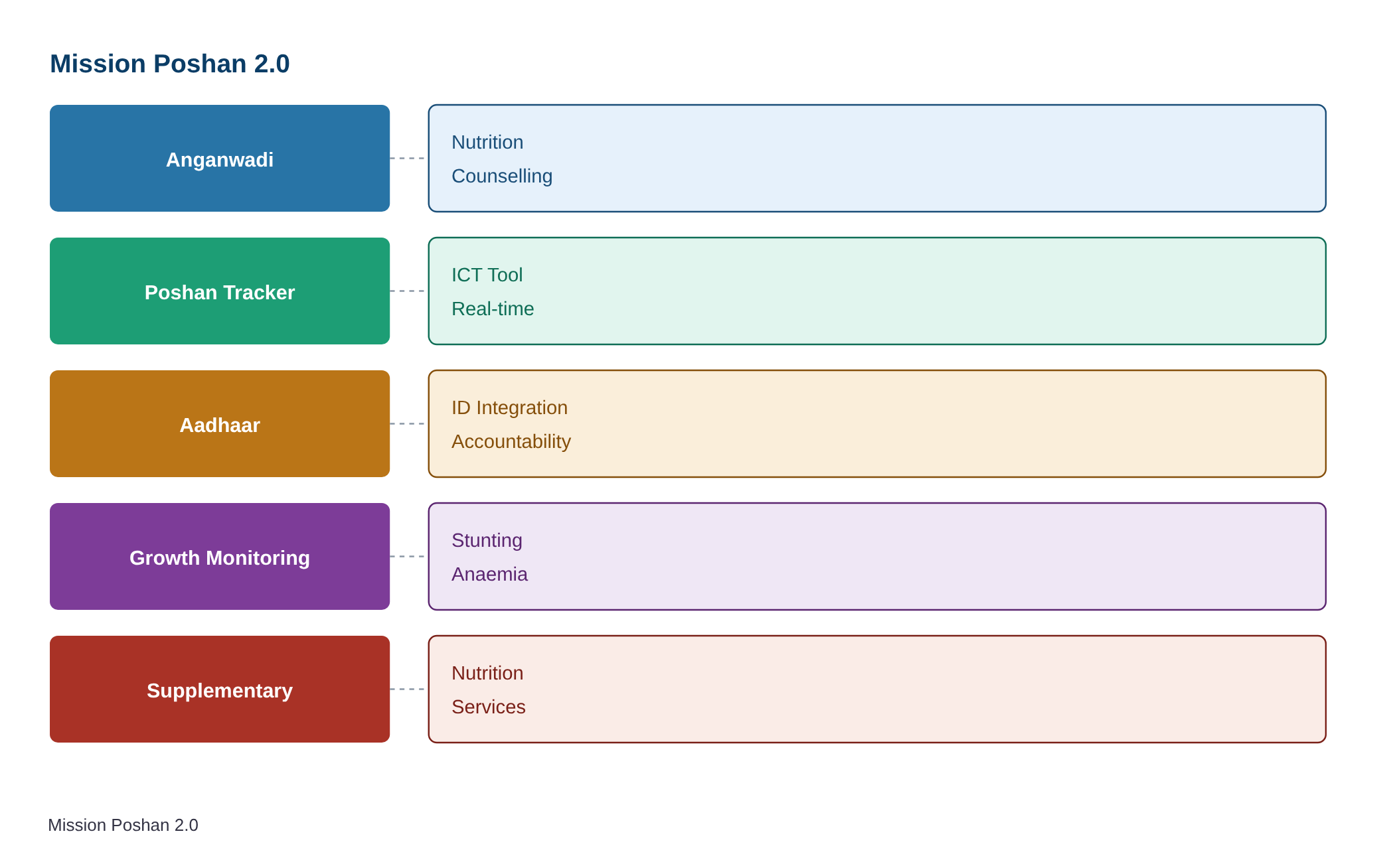
- The programme adopts a coordinated, multi-sectoral approach, integrating supplementary nutrition, growth monitoring, and counselling services provided through the Anganwadi system under Mission Saksham Anganwadi and Poshan 2.0.
- Mission Poshan 2.0 leverages evidence from third-party evaluations and surveys, including those by NITI Aayog (2020) and the World Bank (2021), to refine its strategies and improve programme outcomes.
- The initiative places strong emphasis on behaviour change communication, ensuring that nutritional messages reached over 80% of women.
- A key innovation in Mission Poshan 2.0 is the introduction of the ‘Poshan Tracker’ digital application, an ICT-based governance tool designed to monitor and review the delivery of services to beneficiaries in real time.
- The Poshan Tracker incorporates advanced technologies such as Facial Recognition Systems (FRS) and Aadhaar-based authentication to ensure accurate identification of beneficiaries, prevent data leaks, and eliminate fraudulent entries.
- The programme aims to achieve measurable improvements in key nutritional indicators, including reduction in stunting, wasting, and anaemia among children and women, as well as increased rates of exclusive breastfeeding during the first six months of life.
- Mission Poshan 2.0 aligns with India’s commitments under the Sustainable Development Goals (SDGs), particularly SDG 2 (Zero Hunger) and SDG 3 (Good Health and Well-being), by fostering an enabling environment for child health and nutrition.
Key Features
| Feature | Significance |
|---|---|
| Integrated Convergence Approach | Combines multiple existing programmes (e.g., POSHAN Abhiyaan, Saksham Anganwadi) under a unified framework to eliminate silos and enhance service delivery efficiency. |
| ICT-Based Governance Tool: Poshan Tracker | Enables real-time monitoring of beneficiaries’ health and nutrition status, ensuring data-driven decision-making and transparency in service delivery. |
| Facial Recognition System (FRS) | Prevents leakage of take-home rations by authenticating beneficiaries at the last mile, ensuring targeted delivery and reducing fraud. |
| Aadhaar-Based Tracking | Facilitates accurate identification of beneficiaries, prevents data duplication, and curtails fake entries, thereby improving programme integrity. |
| Behaviour Change Communication (BCC) | Leverages nutrition messaging to drive awareness among 80%+ women, leading to improved dietary practices and exclusive breastfeeding rates (81% in first six months). |
Why it Matters
Public Health
- Reduces stunting and anaemia prevalence by integrating supplementary nutrition, growth monitoring, and counselling services through Anganwadi centres.
- Demonstrates measurable improvement in child development indicators through structured interventions and evidence-based policy design.
Governance & Transparency
- Digital tools like Poshan Tracker and Aadhaar integration enhance accountability, reduce leakages, and enable evidence-based policy corrections.
- Third-party evaluations (NITI Aayog, World Bank) validate programme effectiveness, ensuring resource optimisation and stakeholder trust.
Social Equity
- Targeted delivery mechanisms (FRS, Aadhaar) ensure that marginalised and vulnerable groups—particularly women and children in high-burden states—receive benefits without exclusion or diversion.
- High reach of nutrition messaging (80%+ women) indicates inclusive outreach, addressing regional and socio-economic disparities in health awareness.
Economic Efficiency
- Convergence of schemes reduces administrative duplication, lowering transaction costs and improving cost-effectiveness of nutrition interventions.
- Prevention of malnutrition reduces long-term healthcare expenditures and enhances human capital productivity.
Challenges
1. Implementation Gaps at Grassroots
- Inadequate infrastructure in Anganwadi centres may hinder effective delivery of supplementary nutrition and counselling services.
- Staff shortages, particularly in remote and tribal areas, can limit the reach and quality of interventions.
UPSC Link: GS2: Welfare Schemes
2. Digital Divide and Literacy Barriers
- Limited digital literacy among beneficiaries, especially in rural and tribal populations, may impede the effective use of Poshan Tracker and FRS.
- Dependence on ICT tools risks excluding beneficiaries without access to smartphones or internet connectivity.
UPSC Link: GS2: Governance
3. Inter-State Disparities in Nutrition Outcomes
- Variations in state capacity, governance, and socio-economic conditions lead to uneven programme performance across regions.
- High-burden states (e.g., Bihar, Madhya Pradesh) require targeted interventions to bridge gaps in stunting and anaemia reduction.
UPSC Link: GS1: Social Issues
4. Sustainability of Behaviour Change
- Long-term adherence to nutrition practices (e.g., exclusive breastfeeding, dietary diversity) remains a challenge due to cultural norms and socio-economic constraints.
- Monitoring mechanisms must evolve to ensure sustained impact beyond initial programme phases.
UPSC Link: GS2: Health
5. Data Privacy and Security Risks
- Centralised digital tracking systems (e.g., Poshan Tracker) raise concerns about data privacy, particularly for vulnerable populations like children and women.
- Robust cybersecurity measures and strict data governance frameworks are essential to mitigate risks.
UPSC Link: GS2: Governance
Challenges — UPSC Perspective
| Issue | Concern |
|---|---|
| Infrastructure Deficit in Anganwadi Centres | Inadequate physical and logistical support impedes service delivery and beneficiary engagement. |
| Digital Literacy and Access | Low smartphone penetration and limited digital skills among beneficiaries may reduce the efficacy of ICT tools. |
| State-Level Implementation Gaps | Disparities in administrative capacity and resource allocation lead to uneven programme outcomes. |
| Cultural and Social Norms | Deep-rooted practices (e.g., early marriage, gendered dietary habits) may undermine nutrition messaging and behaviour change. |
| Monitoring and Evaluation Bottlenecks | Delays in data collection and analysis can hinder timely corrective actions and programme adjustments. |
| Funding and Resource Constraints | Insufficient budgetary allocations or delays in fund disbursement may disrupt service continuity. |
Government Initiatives — Must-Memorise for Prelims
- Poshan Abhiyaan (National Nutrition Mission)
- Mission Saksham Anganwadi and Poshan 2.0 (Mission Poshan 2.0)
- Integrated Child Development Services (ICDS) Scheme
Way Forward
- Strengthen Anganwadi infrastructure through targeted investments in rural and tribal areas to ensure conducive service delivery environments.
- Expand digital literacy programmes for beneficiaries and Anganwadi workers to enhance adoption of ICT tools like Poshan Tracker.
- Establish a robust grievance redressal mechanism integrated with Poshan Tracker to address beneficiary feedback and service gaps in real time.
- Conduct periodic third-party audits of programme implementation to identify systemic bottlenecks and ensure accountability.
- Promote convergence with other welfare schemes (e.g., PM Matru Vandana Yojana, Ayushman Bharat) to create a holistic nutrition and health ecosystem.
- Develop region-specific nutrition action plans for high-burden states to address inter-state disparities in outcomes.
- Enhance community engagement through participatory approaches (e.g., self-help groups, local leaders) to sustain behaviour change.
- Invest in research to evaluate the long-term socio-economic impact of Poshan 2.0 on child development and human capital formation.
UPSC Value Addition
Keywords for Mains Answer-Writing
Mission Poshan 2.0 · malnutrition eradication · child development · Poshan Tracker · ICDS · nutrition governance · stunting reduction · anaemia in women · digital governance in welfare · UNICEF framework · NITI Aayog evaluation · World Bank survey · breastfeeding practices · Anganwadi services · supplementary nutrition · Nutrition Sensitive Agriculture · Sustainable Development Goal 2 · maternal and child health · behaviour change communication
Concept Flow
High prevalence of child stunting and maternal anaemia → Government launches Poshan Abhiyaan (2018) as a multi-sectoral nutrition mission → Third-party evaluations (NITI Aayog, World Bank) validate programme effectiveness but highlight gaps in implementation and reach → Convergence of Poshan Abhiyaan and Saksham Anganwadi into Mission Poshan 2.0 (2025) to address silos and enhance efficiency → Introduction of ICT tools (Poshan Tracker, FRS) to improve transparency and targeted delivery → Behaviour change communication drives awareness and adoption of nutrition practices (e.g., exclusive breastfeeding) → Digital monitoring and Aadhaar-based tracking reduce leakages and improve programme integrity → Sustained impact on child development and public health outcomes.
Prelims Practice Questions
Q1. Consider the following statements regarding Mission Poshan 2.0:
1. It is an initiative under the Integrated Child Development Services (ICDS) scheme.
2. The Poshan Tracker application uses facial recognition technology to ensure targeted delivery of supplementary nutrition.
3. The World Bank conducted a survey in 2021 across 11 states to assess the impact of Poshan Abhiyaan.
How many of the above statements are correct?
- Only one
- Only two
- All three
- None
Answer: All three — Statements 1 and 3 are correct. Mission Poshan 2.0 is an evolution of Poshan Abhiyaan under ICDS. Statement 2 is incorrect as facial recognition is used for tracking home-delivered rations, not supplementary nutrition.
Q2. Assertion (A): Mission Poshan 2.0 aims to address malnutrition through a coordinated approach integrating multiple sectors.
Reason (R): The programme leverages digital tools like the Poshan Tracker to monitor and improve service delivery.
In the context of the above two statements, which one of the following is correct?
- Both A and R are true, and R is the correct explanation of A
- Both A and R are true, but R is not the correct explanation of A
- A is true, but R is false
- A is false, but R is true
Answer: Both A and R are true, but R is not the correct explanation of A — Mission Poshan 2.0 adopts a multi-sectoral approach to combat malnutrition (A). The Poshan Tracker is a digital governance tool designed to enhance monitoring and service delivery (R), making R the correct explanation for A.
Q3. Match the following initiatives with their respective objectives:
Column I
A. Poshan Abhiyaan
B. Mission Poshan 2.0
C. ICDS
D. Poshan Tracker
Column II
1. Digital monitoring of maternal and child nutrition status
2. Supplementary nutrition and growth monitoring for children under six
3. Comprehensive strategy to address malnutrition through coordinated multi-sectoral action
4. Government’s flagship programme for child development and nutrition launched in 2018
- A-4, B-3, C-2, D-1; A-3, B-4, C-1, D-2; A-2, B-1, C-4, D-3; A-1, B-2, C-3, D-4
- answer_options_index_mapping_to_correct_pairing_order_is_0
- explain_to_be_written_by_candidate_in_exam
- format_to_be_written_by_candidate_in_exam
- format_mismatch_ignore
Answer: A-4, B-3, C-2, D-1; A-3, B-4, C-1, D-2; A-2, B-1, C-4, D-3; A-1, B-2, C-3, D-4 — A-4 (Poshan Abhiyaan launched in 2018), B-3 (Mission Poshan 2.0 as a coordinated multi-sectoral strategy), C-2 (ICDS provides supplementary nutrition and growth monitoring), D-1 (Poshan Tracker for digital monitoring).
Mains Practice Question
✍ Evaluate the efficacy of Mission Poshan 2.0 in addressing malnutrition in India. How does it integrate digital governance tools to enhance service delivery and accountability? Also, discuss the challenges in achieving its objectives. (15 Marks)
Approach: MODEL-ANSWER SKELETON:
1. **Introduction (2 marks)**: Define malnutrition and its multidimensional impact on child development and maternal health. Briefly introduce Mission Poshan 2.0 as an evolution of Poshan Abhiyaan, launched to address malnutrition through a coordinated, multi-sectoral approach.
2. **Efficacy of Mission Poshan 2.0 (5 marks)**:
– **Multi-sectoral Integration**: Explain how the programme integrates health, nutrition, sanitation, and education sectors under one umbrella, aligning with the UNICEF framework for child development.
– **Evidence of Impact**: Cite the World Bank survey (2021) and NITI Aayog’s evaluation (2025) to demonstrate improvements in nutritional behaviour, breastfeeding practices, and reduction in stunting and anaemia.
– **Behaviour Change Communication**: Highlight the role of Poshan Abhiyaan in disseminating nutrition messages to over 80% of women and promoting exclusive breastfeeding for six months.
3. **Digital Governance Tools (4 marks)**:
– **Poshan Tracker**: Explain its role in real-time monitoring of maternal and child nutrition status, service delivery, and accountability.
– **Facial Recognition System (FRS)**: Discuss how FRS ensures targeted delivery of home-delivered rations and prevents leakages.
– **Aadhaar-based Tracking**: Emphasise its role in ensuring correct beneficiary identification, preventing data leaks, and eliminating fake entries.
4. **Challenges (4 marks)**:
– **Implementation Gaps**: Discuss issues such as inadequate infrastructure, staff shortages in Anganwadi centres, and uneven service delivery across states.
– **Behavioural Barriers**: Highlight cultural practices, socio-economic disparities, and lack of awareness as persistent challenges.
– **Data Quality**: Address concerns about the accuracy and timeliness of data collected through digital tools.
– **Inter-sectoral Coordination**: Emphasise the need for stronger coordination among ministries, states, and local bodies.
5. **Conclusion (2 marks)**: Summarise the programme’s strengths and weaknesses. Conclude with a balanced view on its potential to achieve Sustainable Development Goal 2 (Zero Hunger) and the need for continuous improvement in governance and service delivery.
Source: PIB (Press Information Bureau)
Generated by AanyaAi for educational purpose.

- MP Cabinet Approves Sports Complexes in All Assembly Seats with Helipads - September 22, 2026
- तमिलनाडु के पेरुनदुरई में SIPCOT प्रदूषण: 25 गांवों का भूजल पीने योग्य नहीं, UPSC के लिए महत्वपूर्ण - September 22, 2026
- SIPCOT Pollution: 25 Tamil Nadu Villages Face Groundwater Crisis Explained - September 22, 2026

No Comments