


07 Aug Mission Poshan 2.0: UPSC’s Guide to Tackling Malnutrition in India
✎ Mission Poshan 2.0 is India’s evidence-based, digitally enabled, multi-sectoral initiative to combat malnutrition, integrating Poshan Tracker and Facial Recognition System for real-time monitoring, transparency, and targeted…
Subject Relevance — Where This Topic Fits
- GS Paper II — Governance, Social Justice and Welfare | GS Paper III — Human Development, Public Health and Nutrition
- Prelims: Poshan Tracker, Mission Poshan 2.0, Anganwadi Services, Supplementary Nutrition Programme, NITI Aayog’s Development Monitoring and Evaluation Office (DMEO), World Bank’s State-level Nutrition Surveys, Stunting and Anaemia in Women and Children, Breastfeeding Practices, Facial Recognition System (FRS) for Beneficiary Identification
- Essay: The Role of Technology in Public Health Delivery: A Case Study of Poshan Tracker, Sustainable Development Goals and India’s Progress in Eradicating Malnutrition
Quick Revision: Mission Poshan 2.0 is India’s evidence-based, digitally enabled, multi-sectoral initiative to combat malnutrition, integrating Poshan Tracker and Facial Recognition System for real-time monitoring, transparency, and targeted service delivery.
Why is this in the news?
The Ministry of Women and Child Development (MWCD) has launched Mission Poshan 2.0 as an upgraded, integrated approach to combat malnutrition and enhance child development, building on the successes and lessons of previous programmes such as the Poshan Abhiyaan. This initiative is significant due to its evidence-based design, digital governance tools like the Poshan Tracker, and the integration of facial recognition technology for beneficiary authentication, reflecting India’s commitment to achieving Sustainable Development Goals (SDGs) 2 and 3.
Background
- Malnutrition remains a critical public health challenge in India, with high prevalence of stunting (35.5% in children under five, NFHS-5, 2019-21) and anaemia (57% in women aged 15-49, NFHS-5, 2019-21).
- The Poshan Abhiyaan (National Nutrition Mission), launched in 2018, was India’s first concerted effort to address malnutrition through a multi-sectoral convergence approach, integrating health, nutrition, and sanitation services.
- Third-party evaluations by NITI Aayog (2020) and the World Bank (2021) validated the relevance and impact of Poshan Abhiyaan, demonstrating measurable improvements in nutritional behaviours, breastfeeding practices, and service utilisation.
- Mission Poshan 2.0 was conceptualised to address gaps in service delivery, enhance convergence among stakeholders, and leverage digital tools for real-time monitoring and accountability.
- The initiative aligns with India’s commitments under the SDGs, particularly SDG 2 (Zero Hunger) and SDG 3 (Good Health and Well-being), as well as national frameworks like the National Nutrition Strategy (2017) and the National Health Policy (2017).
What is Mission Poshan 2.0?
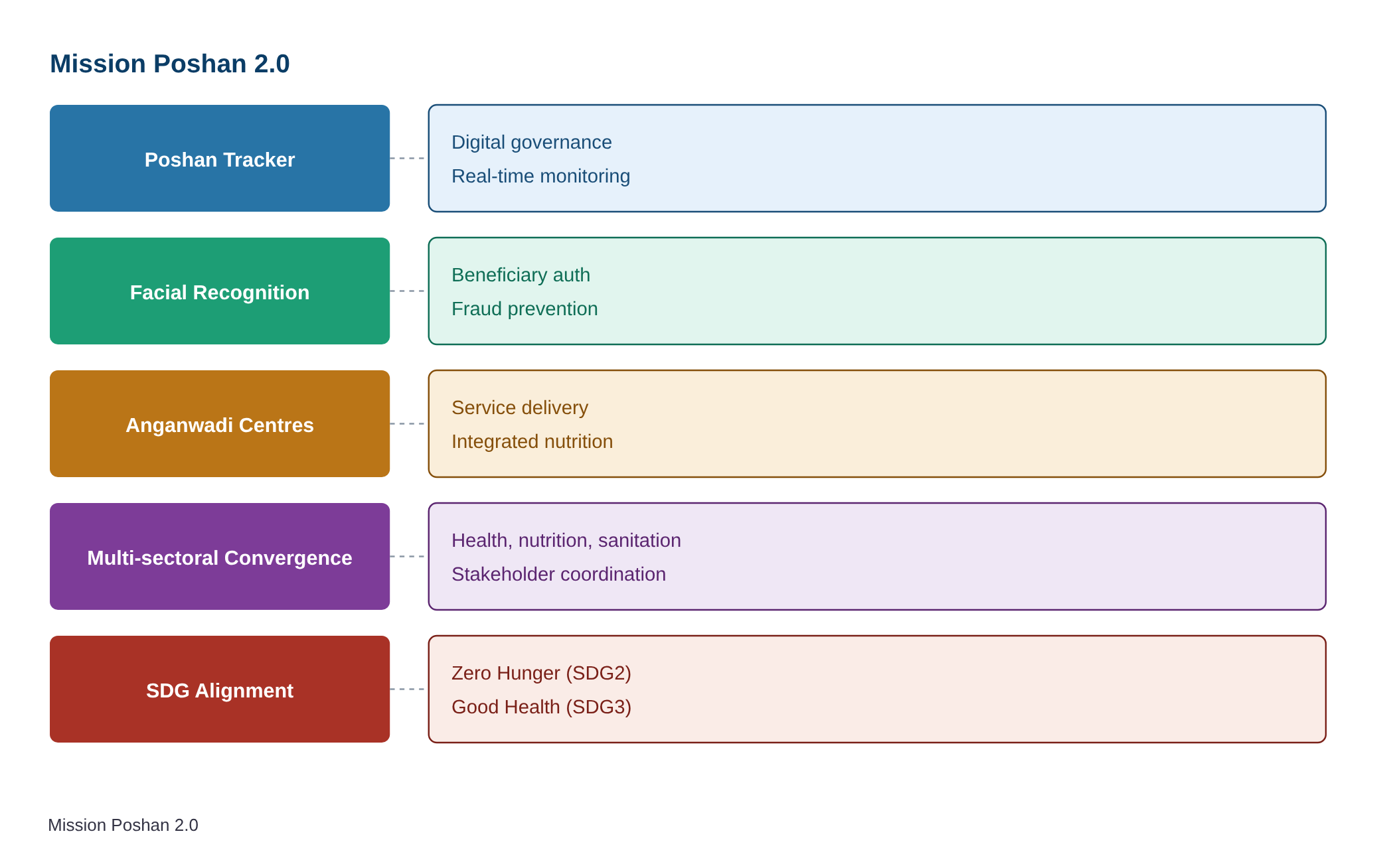
- Mission Poshan 2.0 is an upgraded version of the Poshan Abhiyaan, launched to address malnutrition holistically through a coordinated and robust multi-sectoral approach, integrating health, nutrition, and early childhood development services.
- The programme builds on the evidence and learnings from Poshan Abhiyaan, incorporating digital governance tools such as the Poshan Tracker to enhance real-time monitoring, transparency, and accountability in service delivery.
- Mission Poshan 2.0 expands the scope of Anganwadi services to include supplementary nutrition, growth monitoring, and counselling, ensuring comprehensive care for women and children, particularly in high-burden states.
- The Poshan Tracker, an ICT-based governance tool, enables tracking of beneficiary health and nutrition status, service utilisation, and delivery of take-home rations, ensuring targeted and efficient resource allocation.
- Facial Recognition System (FRS) has been integrated into the Poshan Tracker to authenticate beneficiaries, prevent leakage of rations, and eliminate fraudulent entries, thereby enhancing the integrity of the programme.
- Mission Poshan 2.0 emphasises behaviour change communication, leveraging the success of Poshan Abhiyaan in reaching 80% of target women with nutrition messages and promoting exclusive breastfeeding in 81% of cases during the first six months.
- The programme is aligned with India’s commitment to the Sustainable Development Goals (SDGs), particularly SDG 2 (Zero Hunger) and SDG 3 (Good Health and Well-being), and supports the National Nutrition Strategy (2017) and the National Health Policy (2017).
Key Features
| Feature | Significance |
|---|---|
| Integrated Approach | Combines multiple nutrition programmes under a unified framework to address stunting, wasting, underweight, and anaemia holistically. |
| Anganwadi Services Leveraging | Enhances utilisation of supplementary nutrition, growth monitoring, and counselling services at grassroots level. |
| Nutrition Tracker App | ICT-based monitoring tool for real-time tracking of service delivery, beneficiary identification, and data integrity using facial recognition and Aadhaar linkage. |
| Behaviour Change Communication | Targeted nutrition messaging reaching over 80% of women, leading to improved breastfeeding practices and dietary habits. |
| Third-Party Evaluations | Regular impact assessments by NITI Aayog and World Bank validate programme effectiveness and guide policy refinements. |
Why it Matters
Public Health
- Reduces child mortality and morbidity linked to malnutrition by addressing stunting, wasting, and micronutrient deficiencies.
- Improves maternal health by targeting anaemia through iron-folic acid supplementation and dietary counselling.
Social Equity
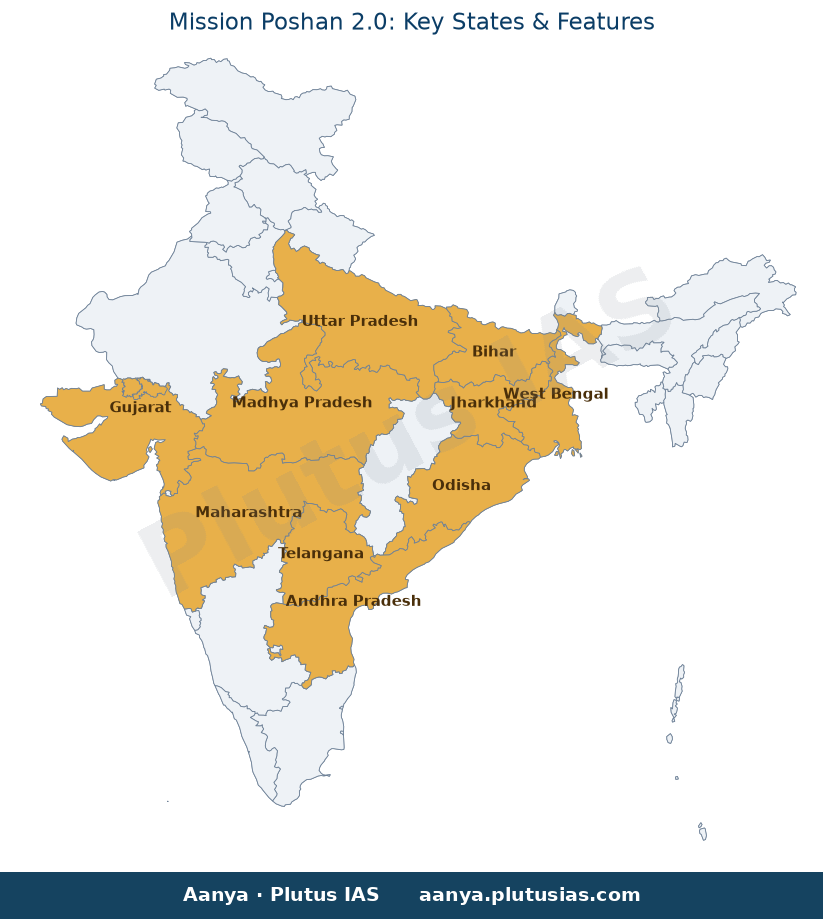
- Ensures targeted delivery of services to marginalised communities, particularly in high-burden states like Andhra Pradesh.
- Promotes inclusive growth by integrating nutrition interventions with early childhood care and education.
Governance Efficiency
- Leverages digital governance tools (Nutrition Tracker) for transparent, accountable, and data-driven programme implementation.
- Facilitates inter-sectoral convergence between health, women and child development, and rural development ministries.
Economic Productivity
- Long-term economic gains through improved cognitive development and reduced healthcare costs associated with malnutrition.
Challenges
1. Implementation Gaps at Grassroots
- Inconsistent service delivery due to inadequate training of Anganwadi workers and limited infrastructure in remote areas.
- High turnover of frontline workers disrupts continuity of counselling and monitoring services.
UPSC Link: GS-II: Social Sector
2. Behavioural Resistance
- Cultural practices such as early introduction of complementary foods undermine exclusive breastfeeding goals.
- Low awareness among adolescent girls and pregnant women about optimal nutrition practices.
UPSC Link: GS-II: Social Sector
3. Data Integrity and Digital Divide
- Risk of exclusion errors in Aadhaar-based tracking due to biometric authentication failures in marginalised groups.
- Limited digital literacy among beneficiaries may hinder effective use of Nutrition Tracker App.
UPSC Link: GS-III: Technology
4. Funding and Resource Constraints
- Dependence on supplementary nutrition supply chains vulnerable to delays and quality issues.
- Inadequate budgetary allocations for scaling up interventions in high-burden states.
UPSC Link: GS-II: Social Sector
5. Monitoring and Evaluation Bottlenecks
- Delayed release of third-party evaluation reports limits timely course corrections.
- Lack of standardised metrics for assessing behavioural change outcomes.
UPSC Link: GS-II: Governance
Challenges — UPSC Perspective
| Issue | Concern |
|---|---|
| Frontline Worker Capacity | Inadequate training and high attrition rates reduce service quality. |
| Cultural Practices | Traditional beliefs hinder adoption of recommended nutrition practices. |
| Digital Literacy | Low smartphone penetration and digital skills among beneficiaries. |
| Supply Chain Disruptions | Delays in provision of supplementary nutrition kits. |
| Evaluation Lag | Slow feedback loops delay programme adjustments. |
Way Forward
- Strengthen capacity-building programmes for Anganwadi workers with focus on behaviour change communication.
- Expand community-based awareness campaigns targeting adolescent girls, pregnant women, and mothers of young children.
- Enhance digital infrastructure in rural areas to improve Nutrition Tracker App accessibility and usability.
- Streamline supply chains for supplementary nutrition with real-time monitoring to prevent stockouts.
- Conduct periodic third-party evaluations with standardised metrics to assess behavioural and health outcomes.
- Promote convergence with Poshan Vatikas and other local nutrition gardens to supplement dietary diversity.
- Integrate nutrition interventions with school health programmes under Ayushman Bharat to ensure continuity.
UPSC Value Addition
Keywords for Mains Answer-Writing
Mission Poshan 2.0 · Poshan Tracker · ICDS · Malnutrition · NITI Aayog · Women and Child Development Ministry · Anganwadi Services · Nutrition-sensitive agriculture · Stunting and Anaemia · Digital Governance in Social Sector · Comprehensive Nutrition Strategy · Behaviour Change Communication · Supplementary Nutrition Programme · Facial Recognition System · Early Childhood Development
Concept Flow
High prevalence of stunting and anaemia among children and women → Government launches integrated nutrition mission (Mission Poshan 2.0) → Mission Poshan 2.0 consolidates multiple schemes under a unified framework → Enhanced service delivery through Anganwadi centres → Behaviour change communication and digital tracking (Nutrition Tracker) improve beneficiary engagement → Improved breastfeeding and dietary practices → Regular third-party evaluations validate programme effectiveness → Evidence-based policy refinements → Long-term outcomes: Reduced malnutrition rates, improved child development, and enhanced maternal health
Prelims Practice Questions
Q1. Consider the following statements about Mission Poshan 2.0:
1. It is an integrated nutrition strategy launched by the Ministry of Women and Child Development.
2. The Poshan Tracker application uses facial recognition to ensure targeted delivery of supplementary nutrition.
3. The programme was evaluated by the World Bank in 2021 across 11 states.
4. Mission Poshan 2.0 subsumes the Integrated Child Development Services (ICDS) scheme entirely.
How many of the above statements are correct?
- Only one
- Only two
- Only three
- All
Answer: Only three — Statements 1, 2, and 3 are correct. Statement 4 is incorrect as Mission Poshan 2.0 builds on existing programmes like ICDS but does not subsume it entirely.
Q2. Assertion (A): The Poshan Tracker application employs facial recognition technology to prevent leakage of supplementary nutrition rations.
Reason (R): Facial recognition ensures that only registered beneficiaries receive the nutrition supplements, enhancing transparency and accountability in service delivery.
Options:
A. Both A and R are true, and R is the correct explanation of A.
B. Both A and R are true, but R is not the correct explanation of A.
C. A is true, but R is false.
D. A is false, but R is true.
Answer: ? — Both the assertion and reason are true, and the reason correctly explains the assertion. Facial recognition in Poshan Tracker is specifically designed to authenticate beneficiaries and prevent diversion of rations.
Q3. Match the following initiatives with their respective implementing agencies:
Column I (Initiative) | Column II (Implementing Agency)
— | —
A. Mission Poshan 2.0 | 1. Ministry of Agriculture and Farmers’ Welfare
B. Poshan Tracker | 2. Ministry of Women and Child Development
C. National Nutrition Mission (Poshan Abhiyaan) | 3. NITI Aayog
D. Nutrition-sensitive agriculture programmes | 4. Ministry of Health and Family Welfare
Options:
A. A-2, B-2, C-3, D-1
B. A-2, B-2, C-4, D-1
C. A-3, B-2, C-4, D-1
D. A-2, B-4, C-3, D-1
Answer: ? — Correct matches: A-2 (Mission Poshan 2.0 is under MWCD), B-2 (Poshan Tracker is launched by MWCD), C-3 (NITI Aayog was involved in evaluating Poshan Abhiyaan), D-1 (Nutrition-sensitive agriculture falls under the Ministry of Agriculture).
Mains Practice Question
✍ Critically examine the efficacy of Mission Poshan 2.0 in addressing malnutrition in India. How does it integrate technology and behavioural change communication to achieve its objectives? Also, analyse the challenges in its implementation and suggest measures to enhance its impact. (15 Marks)
Approach: MODEL-ANSWER SKELETON:
1. **Introduction** (2 marks): Define malnutrition and its prevalence in India (stunting, wasting, anaemia in women and children). Briefly introduce Mission Poshan 2.0 as an evolution of Poshan Abhiyaan, integrating technology and multi-sectoral approaches.
2. **Efficacy of Mission Poshan 2.0** (4 marks):
– **Technology Integration**: Discuss Poshan Tracker, facial recognition, and ICT-based governance for real-time monitoring and transparency.
– **Behavioural Change Communication**: Highlight the role of Anganwadi workers, community engagement, and nutrition messaging in altering dietary practices (e.g., exclusive breastfeeding, complementary feeding).
– **Evidence from Evaluations**: Cite findings from NITI Aayog (2020) and World Bank (2021) surveys showing improvements in nutrition-related behaviours and service utilisation.
3. **Challenges in Implementation** (5 marks):
– **Structural Issues**: Inadequate Anganwadi infrastructure, workforce shortages, and regional disparities in service delivery.
– **Technology Gaps**: Digital divide, limited internet access in rural areas, and data privacy concerns.
– **Behavioural Barriers**: Persistent socio-cultural norms (e.g., early marriage, gender discrimination) affecting nutrition outcomes.
– **Multi-sectoral Coordination**: Weak linkages between health, agriculture, and women and child development sectors.
4. **Measures to Enhance Impact** (4 marks):
– **Strengthening ICDS**: Expand Anganwadi coverage, improve training of workers, and integrate with health systems (e.g., Ayushman Bharat).
– **Technology Optimisation**: Scale up Poshan Tracker with offline capabilities, AI-driven analytics, and grievance redressal mechanisms.
– **Community Mobilisation**: Leverage SHGs, ASHAs, and local leaders to drive behaviour change.
– **Nutrition-sensitive Policies**: Promote agricultural diversification, fortification of food items, and convergence with schemes like PM-KISAN and MGNREGA.
5. **Conclusion** (1 mark): Summarise the transformative potential of Mission Poshan 2.0 while acknowledging the need for sustained political will, resource allocation, and adaptive strategies.
Source: PIB (Press Information Bureau)
Generated by AanyaAi for educational purpose.

- सुप्रीम कोर्ट ने चुनाव आयोग को दिल्ली में ‘यांत्रिक’ SIR नोटिस पर सावधानियां बरतने को कहा - September 22, 2026
- ‘स्वच्छता ही सेवा-2026’ अभियान: सरकारी विभागों में स्वच्छता क्रांति, जानिए मुख्य बिंदु - September 22, 2026
- DFPD Launches ‘Swachhata Hi Seva-2026’ Campaign for Clean India Mission - September 22, 2026

No Comments