


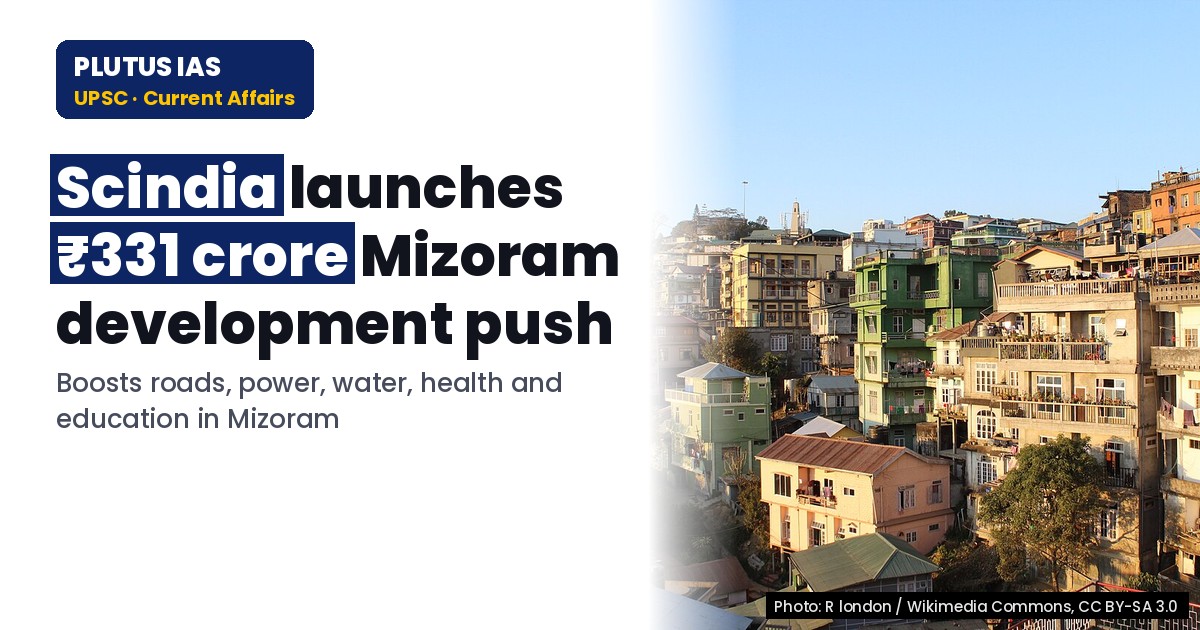
13 Oct Mizoram gets ₹331 crore development push: Key projects launched
✎ Mizoram’s infrastructure development is anchored in the Union Government’s ‘Act East Policy’ and ‘Bharatmala Pariyojana’, with the Bairabi-Sairang railway line serving as a transformative project linking the state to national…
Subject Relevance — Where This Topic Fits
- GS Paper II — Governance, Constitution and Polity (Role of Union and State Governments in Development) | GS Paper III — Infrastructure (Roads, Railways, Power, Water Supply) | GS Paper III — Economic Development (Regional Disparities and Inclusive Growth)
- Prelims: Mizoram, North Eastern Council (NEC), Ministry of Development of North Eastern Region (DoNER), Bharatmala Pariyojana, Sagarmala, PM Gati Shakti, National Infrastructure Pipeline (NIP), Connectivity, Inter-State River Water Disputes Act, 1956, Zonal Councils, North Eastern Region Vision 2020
- Essay: Regional Development and Inclusive Growth: Balancing Infrastructure and Environmental Sustainability, The Role of Connectivity in Transforming Geographical Constraints into Economic Opportunities
Quick Revision: Mizoram’s infrastructure development is anchored in the Union Government’s ‘Act East Policy’ and ‘Bharatmala Pariyojana’, with the Bairabi-Sairang railway line serving as a transformative project linking the state to national markets and reducing logistical bottlenecks.
Why is this in the news?
The Union Minister for Development of North Eastern Region (DoNER) and Communications, Shri Jyotiraditya M. Scindia, inaugurated and laid the foundation stone for development projects worth ₹331 crore in Mizoram on 12 October 2026. These initiatives span critical sectors such as road connectivity, power transmission, water supply, healthcare, education, sports, and cultural infrastructure, reflecting the Union Government’s sustained commitment to the holistic development of the North Eastern Region (NER). The event underscores the strategic importance of Mizoram in India’s broader connectivity and economic integration agenda, particularly in the context of the NER’s emergence as a growth engine.
Background
- Mizoram, a landlocked state in the North Eastern Region, faces unique geographical challenges due to its hilly terrain, which historically impeded connectivity and economic integration with the rest of India.
- The North Eastern Region (NER) comprises eight states (Arunachal Pradesh, Assam, Manipur, Meghalaya, Mizoram, Nagaland, Sikkim, and Tripura) and is home to approximately 4% of India’s population but contributes less than 3% to the national GDP, highlighting regional development disparities.
- The Ministry of Development of North Eastern Region (DoNER), established in 2001, serves as the nodal agency for the planning, coordination, and implementation of development schemes in the NER, with a focus on bridging infrastructure gaps and promoting socio-economic equity.
- The Union Government’s ‘Act East Policy’ (2014) and subsequent initiatives like the ‘North Eastern Region Vision 2020’ aim to enhance connectivity, trade, and cultural ties between India’s NER and Southeast Asian nations, positioning Mizoram as a key gateway.
- The National Infrastructure Pipeline (NIP) 2019-2025 allocated ₹111 lakh crore across sectors, with a significant share earmarked for the NER to address critical gaps in transport, energy, and digital infrastructure.
- The ‘Bharatmala Pariyojana’ (2017) and ‘Sagarmala’ (2015) programmes prioritise multi-modal connectivity, including road, rail, and inland waterways, to reduce logistics costs and integrate peripheral regions like Mizoram with national and international markets.
What are the key infrastructure and connectivity initiatives in Mizoram under the Union Government’s development schemes?
- **Road Connectivity:** Expansion and upgradation of state and national highways aim to improve intra-state and inter-state connectivity, particularly with Assam and Manipur, enhancing trade and tourism potential.
- **Power Transmission:** Development of new substations and transmission lines under the ‘Power for All’ initiative ensures reliable electricity supply to rural and urban areas, supporting industrial growth and household welfare.
- **Water Supply:** Augmentation of piped water supply schemes in urban and rural areas, including the ‘Jal Jeevan Mission’, addresses chronic water scarcity issues and improves public health outcomes.
- **Healthcare Infrastructure:** Establishment of new Primary Health Centres (PHCs), Community Health Centres (CHCs), and district hospitals, aligned with the National Health Mission (NHM), to strengthen healthcare delivery in remote areas.
- **Education and Skill Development:** Construction of new schools, ITIs, and skill development centres under the ‘Samagra Shiksha’ and ‘Skill India Mission’ to enhance human capital and employability in Mizoram.
- **Sports and Cultural Infrastructure:** Development of sports complexes and cultural centres to promote local talent, preserve indigenous traditions, and foster community engagement, aligning with the ‘Khelo India’ and ‘National Culture Fund’ schemes.
- **Tourism Promotion:** Initiatives to boost tourism, such as the development of eco-tourism circuits and heritage trails, leverage Mizoram’s natural beauty and cultural heritage to create livelihood opportunities and preserve ecological balance.
Key Features
| Feature | Significance |
|---|---|
| ₹102 crore (5 projects) inauguration | Immediate enhancement of critical infrastructure in Mizoram, including road connectivity, power transmission, water supply, healthcare, education, sports, and cultural infrastructure. |
| ₹228.54 crore (5 projects) foundation laying | Long-term developmental impact through new initiatives in connectivity, power, and social sectors, aligning with Mizoram’s socio-economic priorities. |
| 51.38 km Bairabi-Sairang railway line | Transformative rail connectivity linking Mizoram to national rail network, facilitating economic integration and reducing logistical constraints. |
| Sairang-Silchar rail service | Strengthened connectivity with Barak Valley, enhancing inter-state mobility and trade linkages. |
| Tourism growth (5 lakh+ tourists in H1 2026) | Economic diversification through increased tourism, leveraging Mizoram’s natural and cultural heritage for sustainable development. |
Why it Matters
Economic Integration
- Mizoram’s integration into national economic corridors via rail, road, and air connectivity, reducing isolation and fostering trade.
- Enhanced connectivity enables agricultural and industrial output expansion, aligning with ‘Act East Policy’ objectives.
- Tourism-driven economic growth diversifies revenue streams beyond traditional sectors.
Strategic Connectivity
- Railway projects (Bairabi-Sairang, Sairang-Silchar) reduce dependence on road transport, ensuring year-round accessibility.
- Improved connectivity strengthens Mizoram’s role in India’s northeastern security and logistics framework.
- Integration with national rail network (Guvahati, Kolkata, Delhi) enhances emergency response and disaster management.
Social Infrastructure Development
- Healthcare and education projects address regional disparities in service delivery, improving human development indices.
- Sports and cultural infrastructure promotes youth engagement and preserves local traditions.
- Water supply and power transmission projects mitigate resource constraints in hilly terrain.
Sustainable Development
- Balancing infrastructure growth with ecological preservation, aligning with Mizoram’s biodiversity and tribal heritage.
- Tourism promotion emphasizes eco-friendly practices to protect fragile ecosystems.
- Long-term planning integrates climate resilience into infrastructure design.
Challenges
1. Geographical Constraints
- Hilly terrain complicates large-scale infrastructure projects, requiring advanced engineering and cost optimization.
- Seasonal monsoons disrupt construction timelines and maintenance schedules.
- Limited land availability necessitates innovative land-use policies and community engagement.
UPSC Link: Geography of North-East India
2. Funding and Resource Mobilization
- High capital expenditure for connectivity projects demands sustained central and state budgetary support.
- Public-Private Partnership (PPP) models face viability challenges in low-density regions.
- Ensuring equitable distribution of funds across Mizoram’s districts and tribal communities.
UPSC Link: Finance-Commerce Static
3. Human Resource Development
- Shortage of skilled labor for specialized infrastructure projects (e.g., rail, power transmission).
- Need for vocational training programs to align local workforce with emerging economic opportunities.
- Retention of trained personnel in remote areas due to limited urban amenities.
UPSC Link: Human Geography
4. Environmental and Cultural Preservation
- Balancing developmental needs with protection of Mizoram’s biodiversity hotspots and tribal lands.
- Mitigating environmental degradation from construction and tourism expansion.
- Ensuring community participation in project design to respect indigenous knowledge systems.
UPSC Link: Environmental Conservation
5. Policy Coordination
- Aligning central schemes (e.g., PM-Gati Shakti, Sagarmala) with state-specific priorities.
- Streamlining approvals for multi-state infrastructure projects to avoid delays.
- Strengthening inter-ministerial and inter-state cooperation for seamless implementation.
UPSC Link: Governance and Administration
Challenges — UPSC Perspective
| Issue | Concern |
|---|---|
| Hilly terrain | Increased construction costs, logistical challenges, and environmental risks. |
| Monsoon disruptions | Project delays, maintenance difficulties, and safety hazards. |
| Funding gaps | Dependence on central allocations, limited private investment in remote areas. |
| Skill shortages | Lack of local expertise for specialized infrastructure projects. |
| Environmental trade-offs | Risk of biodiversity loss and cultural erosion due to unplanned development. |
| Policy fragmentation | Delays in approvals and coordination gaps between agencies. |
Way Forward
- Accelerate completion of Bairabi-Sairang and Sairang-Silchar rail projects to operationalize by 2027.
- Expand vocational training programs in collaboration with ITIs and skill development agencies to address labor shortages.
- Establish a dedicated fund for climate-resilient infrastructure in Mizoram’s hilly regions.
- Strengthen inter-state coordination mechanisms (e.g., North Eastern Council) for multi-modal connectivity projects.
- Promote eco-tourism policies with community participation to balance development and conservation.
- Leverage PM-Gati Shakti National Master Plan for integrated planning of rail, road, and air connectivity.
- Enhance digital infrastructure (e.g., BharatNet) to support remote healthcare, education, and governance.
- Conduct periodic impact assessments of completed projects to ensure sustainability and equity.
UPSC Value Addition
Keywords for Mains Answer-Writing
North Eastern Region Development (DoNER) Ministry · Connectivity infrastructure in Mizoram · Multi-modal transport integration · Sustainable development in ecologically sensitive zones · Central Sector Schemes for North East · Railway connectivity in North East · PM Gati Shakti National Master Plan · Fiscal federalism and Centre-State cooperation · Tourism-led growth in North East · Eco-sensitive development paradigm · Infrastructure financing in hilly terrains · Role of Union Ministries in regional development · Public-Private Partnerships in infrastructure · Environmental safeguards in developmental projects
Constitutional & Policy Linkages
- Article 371G: Special provisions for Mizoram, ensuring autonomy in administration and resource management.
Concept Flow
Geographical isolation → Limited connectivity → Economic stagnation → Policy intervention (Act East Policy) → Infrastructure investment → Enhanced mobility → Trade and tourism growth → Sustainable development → Socio-economic upliftment.
Prelims Practice Questions
Q1. Consider the following statements regarding the North Eastern Region Development (DoNER) Ministry:
1. The DoNER Ministry is mandated to accelerate the pace of socio-economic development in the North Eastern Region.
2. The Ministry implements the North East Special Infrastructure Development Scheme (NESIDS).
3. The Ministry is responsible for the administration of the Border Area Development Programme (BADP) in the North Eastern states.
How many of the above statements are correct?
- Only one
- Only two
- All three
- None
Answer: All three — Statements 1 and 2 are correct. Statement 3 is incorrect as BADP is administered by the Ministry of Home Affairs, not DoNER.
Q2. Assertion (A): The PM Gati Shakti National Master Plan aims to achieve seamless multi-modal connectivity across India.
Reason (R): The Plan integrates infrastructure schemes of various Ministries and State Governments to reduce logistics costs and enhance economic efficiency.
Codes:
A. Both A and R are true and R is the correct explanation of A.
B. Both A and R are true but R is NOT the correct explanation of A.
C. A is true but R is false.
D. A is false but R is true.
Answer: ? — Both A and R are true, and R correctly explains A as PM Gati Shakti integrates multiple infrastructure schemes to ensure seamless connectivity.
Q3. Match the following initiatives with their respective implementing Ministries:
Initiative:
1. North East Special Infrastructure Development Scheme (NESIDS)
2. Border Area Development Programme (BADP)
3. Pradhan Mantri Gram Sadak Yojana (PMGSY)
4. Sagarmala Programme
Ministry:
A. Ministry of Rural Development
B. Ministry of Ports, Shipping and Waterways
C. Ministry of Home Affairs
D. Ministry of Development of North Eastern Region (DoNER)
Choose the correct match:
- 1-D, 2-C, 3-A, 4-B
- 1-A, 2-D, 3-C, 4-B
- 1-B, 2-A, 3-D, 4-C
- 1-D, 2-B, 3-A, 4-C
Answer: 1-D, 2-C, 3-A, 4-B — 1-D (NESIDS is implemented by DoNER), 2-C (BADP is implemented by MHA), 3-A (PMGSY is implemented by Ministry of Rural Development), 4-B (Sagarmala is implemented by Ministry of Ports, Shipping and Waterways).
Mains Practice Question
✍ The inauguration and laying of foundation stones for development projects in Mizoram by the Union Minister for Development of North Eastern Region (DoNER) underscores the significance of multi-modal connectivity and sustainable development in ecologically sensitive regions. Critically examine the role of the DoNER Ministry in accelerating regional development in the North East while ensuring environmental safeguards. (15 Marks)
Approach: MODEL-ANSWER SKELETON:
1. **Contextual Introduction (2 Marks)**:
– Briefly outline the DoNER Ministry’s mandate under the Constitution of India (Article 371C) and its role in the North Eastern Region (NER).
– Reference the PM Gati Shakti National Master Plan and its relevance to Mizoram’s connectivity projects (e.g., Bairabi-Sairang railway line).
2. **Multi-Modal Connectivity as a Catalyst (4 Marks)**:
– Explain how road, rail, and air connectivity projects (e.g., Bairabi-Sairang railway line, Aizawl-Guwahati-Kolkata-Delhi air connectivity) enhance economic integration and reduce logistics costs.
– Cite data from the PIB release (e.g., 51.38 km railway line, 15 lakh passengers) to substantiate claims.
– Link to the PM Gati Shakti framework and its emphasis on integrated planning.
3. **Sustainable Development and Environmental Safeguards (4 Marks)**:
– Discuss the need for balancing development with environmental conservation in Mizoram’s ecologically sensitive terrain (e.g., Mizoram’s biodiversity, forest cover).
– Reference constitutional provisions (Article 48A, Directive Principles of State Policy) and statutory frameworks (Environment Protection Act, 1986; Forest Conservation Act, 1980).
– Highlight the Ministry’s emphasis on eco-sensitive development (e.g., preservation of natural heritage alongside infrastructure).
4. **Challenges and Critiques (3 Marks)**:
– Identify challenges: terrain constraints, funding gaps, land acquisition issues, and coordination between Centre and State.
– Critique the effectiveness of schemes like NESIDS and PMGSY in addressing these challenges.
– Discuss the role of Public-Private Partnerships (PPPs) and their limitations in hilly terrains.
5. **Conclusion and Way Forward (2 Marks)**:
– Summarize the DoNER Ministry’s pivotal role in NER’s development while ensuring sustainability.
– Suggest measures: enhanced inter-ministerial coordination, leveraging technology for environmental monitoring, and community participation in project planning.
Key Provisions/Schemes to Mention:
– North East Special Infrastructure Development Scheme (NESIDS)
– PM Gati Shakti National Master Plan
– Article 371C (Special provisions for NER)
– Environment Protection Act, 1986; Forest Conservation Act, 1980
– Border Area Development Programme (BADP) for border states like Mizoram
Source: PIB (Press Information Bureau)
Generated by AanyaAi for educational purpose.
Related guides on our sites
- Current affairs for upsc 2026
- Best PSIR optional coaching for upsc
- Best PSIR optional teacher for upsc
- Best teacher of PSIR optional for upsc

- Retrospective PF Trust Exemption: Amnesty Scheme 2026 Explained for UPSC - October 13, 2026
- मद्रास उच्च न्यायालय ने तमिलनाडु विधानसभा अध्यक्ष के फैसले को बरकरार रखा: छह एआईएडीएमके विधायकों के इस्तीफे स्वीकार किए गए - October 13, 2026
- India-Czech Republic Bilateral Talks: Key Agreements & Strategic Insights - October 13, 2026

No Comments