


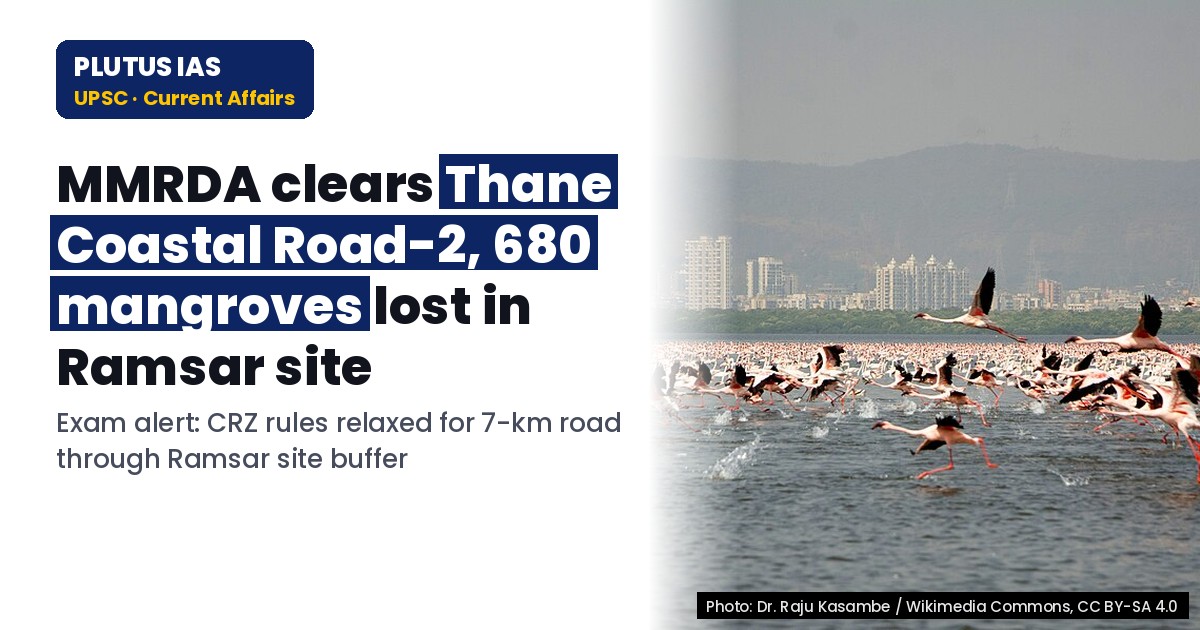
21 Oct MMRDA’s Thane Coastal Road-2 Approved: 680 Mangroves Lost in Ramsar Site
✎ The Thane Coastal Road-2 project exemplifies the tension between developmental imperatives and ecological conservation, governed by the Coastal Regulation Zone (CRZ) 2019 and the Ramsar Convention’s principles of wise use of…
Subject Relevance — Where This Topic Fits
- GS Paper II — Governance, Constitution, Polity, Social Justice and International Relations (Environmental Governance) | GS Paper III — Environment, Economic Development, Infrastructure
- Prelims: Coastal Regulation Zone (CRZ) 2019, Ramsar Convention, Eco-Sensitive Zones (ESZ), Mangrove Conservation, Environmental Impact Assessment (EIA), Mumbai Metropolitan Region Development Authority (MMRDA), Maharashtra Coastal Zone Management Authority (MCZMA)
- Essay: Balancing Development and Environmental Conservation: The Case of Coastal Infrastructure in India, Ecological Governance in the 21st Century: Lessons from Ramsar Sites
Quick Revision: The Thane Coastal Road-2 project exemplifies the tension between developmental imperatives and ecological conservation, governed by the Coastal Regulation Zone (CRZ) 2019 and the Ramsar Convention’s principles of wise use of wetlands.
Why is this in the news?
The clearance granted by the Maharashtra Coastal Zone Management Authority (MCZMA) for the Thane Coastal Road-2 (TCR-2) project, despite its alignment passing through the buffer zone of the Thane Creek Flamingo Sanctuary—a Ramsar site—has reignited debates on the trade-offs between infrastructure development and ecological conservation in India’s coastal regions. The decision, taken on 24 September 2026, permits the loss of 680 mangroves and temporary damage to 1,053 others, raising questions about compliance with Coastal Regulation Zone (CRZ) norms and the efficacy of environmental governance mechanisms.
Background
- The Thane Creek Flamingo Sanctuary (TCFS) was designated as a Ramsar site in 2022, recognising its critical role in supporting biodiversity, including migratory birds such as flamingos, and its ecological functions like storm protection and carbon sequestration.
- The sanctuary lies within an Eco-Sensitive Zone (ESZ), a legally demarcated buffer around protected areas to mitigate anthropogenic pressures.
- The Mumbai Metropolitan Region Development Authority (MMRDA) proposed the Thane Coastal Road-2 (TCR-2) as a 7.129-km greenfield road to decongest Thane city and improve regional connectivity, extending the existing Thane Coastal Road-1.
- In August 2026, the MCZMA initially rejected the project’s alignment, citing significant damage to mangroves and the ESZ, and directed the MMRDA to explore alternative routes.
- The MMRDA argued that no viable alternative alignment existed due to pre-existing urban developments and the creek’s eastern boundary, necessitating the original route.
- The project was ultimately cleared with the original alignment, subject to strict adherence to CRZ rules and compensatory afforestation measures.
What is the Thane Coastal Road-2 (TCR-2) Project?
- The TCR-2 is a 7.129-km greenfield road proposed by the MMRDA, running from Anand Nagar in Mulund East to Balkum in Thane, extending the existing Thane Coastal Road-1.
- The project aims to provide a bypass for regional and through traffic, reducing congestion in Thane city and improving connectivity to the proposed Kopri-Patni bridge and Eastern Express Highway extension.
- The road is envisaged as a four-lane elevated corridor with provisions for pedestrian and cycle tracks, designed to minimise environmental impact through engineering solutions.
- The MMRDA has committed to compensatory afforestation for damaged mangroves and adherence to CRZ norms, including no-go zones within the sanctuary’s core area.
- The project is part of Maharashtra’s broader coastal infrastructure development plan, aligning with the state’s urban transport and regional connectivity goals.
- The alignment passes through the ESZ of the Thane Creek Flamingo Sanctuary, a Ramsar site, raising concerns about ecological sustainability.
- The MMRDA has stated that the road’s route was finalised after public consultations as per the Thane Development Plan, ensuring minimal impact on mangrove areas.
Key Features
| Feature | Significance |
|---|---|
| Thane Creek Flamingo Sanctuary (TCFS) | A Ramsar-designated wetland of international importance, hosting migratory waterbirds including the Greater Flamingo; critical for biodiversity conservation and ecosystem services. |
| Coastal Regulation Zone (CRZ) Notification, 2019 | Regulates development activities in coastal areas to balance ecological protection with economic development, mandating strict environmental safeguards. |
| Mangrove Ecosystem Services | Provides coastal protection, carbon sequestration, fisheries support, and storm surge mitigation; mangroves are among the most productive ecosystems globally. |
| Eco-Sensitive Zone (ESZ) | A buffer zone around protected areas like TCFS, where developmental activities are regulated to minimise ecological disruption. |
| Mumbai Metropolitan Region Development Authority (MMRDA) | Statutory body responsible for planning and implementing regional infrastructure projects in the Mumbai Metropolitan Region. |
Why it Matters
Ecological Significance
- The TCFS is a Ramsar site under the Convention on Wetlands (1971), signifying its global ecological importance and the need for international conservation standards.
- Mangroves in the ESZ act as natural barriers against cyclones and tidal surges, protecting coastal communities and infrastructure.
- The loss of 680 mangroves, though partial, disrupts habitat connectivity and may affect avian migratory patterns and local biodiversity.
- Mangroves contribute to carbon sequestration, mitigating climate change impacts; their degradation releases stored carbon.
Economic and Infrastructure Significance
- The Thane Coastal Road-2 (TCR-2) is designed to decongest Thane city by providing an alternate route for regional and intercity traffic, reducing travel time and operational costs.
- The road is expected to lower vehicular emissions and noise pollution in densely populated areas by diverting traffic from arterial routes.
- Connectivity improvements (e.g., Kopri-Patni bridge) enhance freight movement and economic integration within the Mumbai Metropolitan Region.
- The project aligns with the Thane Development Plan, reflecting long-term urban planning priorities for sustainable infrastructure.
Legal and Governance Significance
- The MCZMA’s clearance of the project under CRZ rules highlights the tension between developmental imperatives and environmental conservation in coastal governance.
- The decision underscores the role of statutory authorities in balancing ecological protection with public infrastructure needs under the CRZ framework.
- Public participation in the Development Plan process (e.g., objections invited by Thane Municipal Corporation) demonstrates procedural safeguards in urban planning.
Challenges
1. Ecological Trade-offs in Infrastructure Development
- Balancing economic development with ecological conservation remains a persistent challenge, particularly in ecologically sensitive coastal zones.
- The irreversible loss of 680 mangroves raises questions about compensatory afforestation and long-term ecological recovery.
- Construction activities may cause short-term disruptions to wetland hydrology and sediment dynamics, affecting mangrove health.
- The project’s alignment through the ESZ necessitates rigorous monitoring to mitigate unintended ecological impacts.
UPSC Link: Environmental Impact Assessment (EIA) 2006
2. Regulatory and Compliance Challenges
- Ensuring strict adherence to CRZ norms amid developmental pressures requires robust enforcement mechanisms and inter-agency coordination.
- The MCZMA’s decision to approve the original alignment despite initial objections highlights the need for transparent and evidence-based decision-making.
- Post-clearance monitoring of compensatory afforestation and mitigation measures is critical to validate the project’s ecological compliance.
UPSC Link: Coastal Regulation Zone (CRZ) Notification 2019
3. Urban Planning and Land Use Dilemmas
- The TCR-2 project exemplifies the challenges of integrating infrastructure development with sustainable urban planning in rapidly growing metropolitan regions.
- Fixed alignments in Development Plans may limit flexibility in responding to ecological or technological advancements, necessitating periodic reviews.
- Balancing the needs of diverse stakeholders—local communities, industries, and environmentalists—requires inclusive and participatory planning.
UPSC Link: Urban Planning and Development
4. Climate Resilience and Adaptation
- Coastal infrastructure projects must account for climate change impacts, including sea-level rise and increased storm frequency, to ensure long-term viability.
- Mangrove degradation exacerbates coastal vulnerability; restoration and conservation efforts must be prioritised alongside developmental projects.
- Integrating climate resilience into infrastructure design (e.g., elevated roads, flood-resistant structures) is essential for sustainable development.
UPSC Link: Climate Change and Coastal Vulnerability
Challenges — UPSC Perspective
| Issue | Concern |
|---|---|
| Loss of Mangroves | Irreversible ecological damage and disruption of ecosystem services such as coastal protection and carbon sequestration. |
| Regulatory Compliance | Ensuring adherence to CRZ norms and mitigating ecological impacts amid developmental pressures. |
| Urban Congestion | Balancing infrastructure needs with environmental conservation in densely populated coastal urban areas. |
| Climate Vulnerability | Increased exposure to coastal hazards due to mangrove loss and inadequate climate-resilient design. |
| Stakeholder Conflicts | Reconciling competing interests of development, conservation, and local communities in project planning. |
| Monitoring and Enforcement | Post-project oversight to ensure compliance with environmental safeguards and mitigation measures. |
Way Forward
- Conduct a comprehensive Environmental Impact Assessment (EIA) post-construction to evaluate actual ecological impacts and validate mitigation measures.
- Implement a robust compensatory afforestation plan with strict timelines and third-party audits to ensure mangrove restoration success.
- Establish a multi-stakeholder monitoring committee comprising ecologists, urban planners, and local communities to oversee project compliance and ecological recovery.
- Integrate climate resilience into the design of TCR-2, including flood-resistant infrastructure and green buffers to mitigate future risks.
- Undertake periodic ecological surveys to assess the health of mangroves and the sanctuary, with data shared publicly for transparency.
- Explore alternative alignments or design modifications (e.g., elevated corridors, underground sections) in future projects to minimise ecological disruption.
- Strengthen inter-agency coordination between MMRDA, MCZMA, and environmental bodies to streamline regulatory compliance and enforcement.
- Promote public awareness campaigns to highlight the ecological significance of TCFS and the importance of sustainable infrastructure development.
UPSC Value Addition
Keywords for Mains Answer-Writing
Coastal Regulation Zone Notification 2019 · Ramsar Convention on Wetlands · Mangrove Conservation · Eco-Sensitive Zones (ESZ) · Environmental Impact Assessment (EIA) 2006 · Coastal Zone Management Authority (CZMA) · Thane Creek Flamingo Sanctuary · Thane Coastal Road-2 · Environmental Compensation · Sustainable Development · Precautionary Principle · Public Interest Litigation (PIL) · Intergenerational Equity · Biodiversity Hotspots · Greenfield Road Projects
Concept Flow
Urban congestion and regional connectivity needs in Thane → Proposal for Thane Coastal Road-2 (TCR-2) → Alignment through ESZ of Thane Creek Flamingo Sanctuary → Initial objections by MCZMA on ecological grounds → MMRDA’s argument for fixed alignment and lack of alternatives → MCZMA’s conditional clearance under CRZ rules → Loss of 680 mangroves and ecological trade-offs → Implementation of compensatory afforestation and mitigation measures → Post-project monitoring and long-term ecological impact assessment
Prelims Practice Questions
Q1. Consider the following statements regarding the Coastal Regulation Zone (CRZ) Notification in India:
1. CRZ Notification 2019 applies to the entire coastal zone of India, including the territorial waters.
2. CRZ-I areas are the most ecologically sensitive and include mangroves, coral reefs, and sand dunes.
3. The notification mandates a minimum 200-meter No Development Zone (NDZ) from the High Tide Line (HTL) in all CRZ areas.
4. Activities such as construction of roads and bridges are permitted in CRZ-I areas with prior environmental clearance.
How many of the above statements are correct?
- Only one
- Only two
- Only three
- All four
Answer: Only two — Statement 1 is correct: CRZ Notification 2019 applies to the entire coastal zone of India, including territorial waters. Statement 2 is correct: CRZ-I areas are indeed the most ecologically sensitive. Statement 3 is incorrect: The NDZ varies—200 meters in CRZ-III, 100 meters in CRZ-II, and no NDZ in CRZ-I. Statement 4 is incorrect: Construction in CRZ-I is highly restricted and requires stringent environmental clearance.
Q2. Assertion (A): The precautionary principle requires that where there are threats of serious or irreversible damage, lack of full scientific certainty shall not be used as a reason for postponing cost-effective measures to prevent environmental degradation.
Reason (R): The principle is enshrined in the Environment (Protection) Act, 1986, and is often invoked in cases involving coastal development projects.
- Both A and R are true, and R is the correct explanation of A
- Both A and R are true, but R is not the correct explanation of A
- A is true, but R is false
- A is false, but R is true
Answer: Both A and R are true, but R is not the correct explanation of A — Assertion (A) correctly states the precautionary principle as articulated in Principle 15 of the Rio Declaration and applied in Indian jurisprudence. Reason (R) is also correct: the principle is embedded in the Environment (Protection) Act, 1986, and frequently invoked in coastal development disputes (e.g., Coastal Road Projects).
Q3. Match the following pairs related to environmental governance in India:
Column I
1. Thane Creek Flamingo Sanctuary
2. Coastal Regulation Zone Notification 2019
3. Environment Impact Assessment Notification 2006
4. Ramsar Convention
Column II
a. International treaty for wetland conservation
b. Designated under the Wildlife (Protection) Act, 1972
c. Regulates development activities in coastal areas
d. Mandates environmental clearance for certain projects
Select the correct match from the options below:
- 1-b, 2-c, 3-d, 4-a
- 1-c, 2-b, 3-d, 4-a
- 1-a, 2-b, 3-c, 4-d
- 1-d, 2-a, 3-b, 4-c
Answer: 1-b, 2-c, 3-d, 4-a — 1-b: Thane Creek Flamingo Sanctuary is a protected area under the Wildlife (Protection) Act, 1972. 2-c: The Coastal Regulation Zone Notification 2019 regulates development in coastal areas. 3-d: The EIA Notification 2006 mandates environmental clearance for specified projects. 4-a: The Ramsar Convention is an international treaty for wetland conservation.
Mains Practice Question
✍ The balance between developmental imperatives and ecological conservation is often tested in coastal infrastructure projects. Critically analyse the legal and institutional framework governing such projects in India, with particular reference to the Thane Coastal Road-2 project and its impact on the Thane Creek Flamingo Sanctuary. Also, examine the role of the precautionary principle in this context. (15 Marks)
Approach: MODEL-ANSWER SKELETON:
1. **Legal Framework**:
– Constitution of India, Article 48A (DPSP on environment) and Article 51A(g) (Fundamental Duty).
– Environment (Protection) Act, 1986: Empowers the central government to take measures for environmental protection.
– Coastal Regulation Zone (CRZ) Notification 2019: Classifies coastal areas into CRZ-I, II, III, IV and regulates development.
– Wildlife (Protection) Act, 1972: Provides for the declaration of sanctuaries and protection of wildlife.
– Environmental Impact Assessment (EIA) Notification 2006: Mandates environmental clearance for projects in coastal zones.
– National Green Tribunal Act, 2010: Provides for expeditious disposal of environmental disputes.
2. **Institutional Framework**:
– Ministry of Environment, Forest and Climate Change (MoEFCC): Formulates policies and notifies regulations.
– State Coastal Zone Management Authorities (e.g., Maharashtra Coastal Zone Management Authority): Implement CRZ notifications and grant clearances.
– National Board for Wildlife (NBWL): Advises on wildlife conservation.
– State Pollution Control Boards: Monitor compliance with environmental norms.
3. **Thane Coastal Road-2 Project**:
– Proposed alignment through the buffer zone of the Thane Creek Flamingo Sanctuary (a Ramsar site).
– MCZMA initially rejected the alignment, citing damage to mangroves and ESZ.
– MMRDA argued no alternative route existed; alignment was finalized in the Thane Development Plan with public consultation.
– MCZMA cleared the project on 24 September 2026, subject to CRZ compliance, despite loss of 680 mangroves.
– Environmental mitigation measures: Restoration of 1,053 damaged mangroves; bridge elevated to minimize impact on core sanctuary area.
4. **Precautionary Principle**:
– Principle 15 of the Rio Declaration: Lack of scientific certainty should not delay cost-effective measures to prevent environmental harm.
– Jurisprudence: Applied in cases like *Vellore Citizens Welfare Forum v. Union of India* (1996), *A.P. Pollution Control Board v. M.V. Nayudu* (1999).
– Relevance to TCR-2: Despite ecological sensitivity, project cleared due to developmental necessity; mitigation measures reflect application of the principle.
5. **Critique and Balance**:
– **Developmental Perspective**: Road reduces congestion, pollution, and travel time; aligns with Thane’s Development Plan and public interest.
– **Ecological Perspective**: Loss of mangroves (680 trees) and potential long-term impact on biodiversity; Ramsar sites are globally significant.
– **Institutional Challenges**: Delay in clearances, balancing stakeholder interests, and ensuring strict compliance with mitigation measures.
6. **Way Forward**:
– Strengthen environmental impact assessments for linear infrastructure projects in ecologically sensitive zones.
– Enhance public participation in development plan finalization.
– Promote green infrastructure (e.g., elevated roads) to minimize ecological footprint.
– Strict monitoring and third-party audits of mitigation commitments.
Source: The Indian Express
Maharashtra PCS (MPSC) — State PCS Practice
Prelims: As per recent reports, approximately how many mangroves were lost due to the construction of a road near a Ramsar site in Thane district?
- 680
- 500
- 1000
- 750
Answer: 680 — The report states that 680 mangroves were lost permanently due to the construction of the road near the Ramsar site in Thane district.
Mains: Analyze the ecological and legal implications of the loss of 680 mangroves near a Ramsar site in Thane district. Discuss the role of state and central authorities in ensuring compliance with environmental laws like the Forest (Conservation) Act, 1980, and the Wildlife (Protection) Act, 1972. Suggest measures to mitigate such losses in the future, with a focus on Maharashtra’s coastal ecosystem.
Generated by AanyaAi for educational purpose.
Related guides on our sites
- Best geography optional coaching
- Best geography optional coaching
- Best geography optional teacher
- Best geography optional teacher

- एससीओ बैठक में भारत का आतंकवाद विरोध: क्षेत्रीय सहयोग पर जोर - October 22, 2026
- SEC Directs Strict SC Order Compliance for Andhra ULB Polls - October 22, 2026
- आंध्र प्रदेश: 100 नगर निकाय चुनाव प्रक्रिया पर रोक, सर्वोच्च न्यायालय के आदेश के बाद SEC ने रोकी प्रक्रिया - October 22, 2026

No Comments