


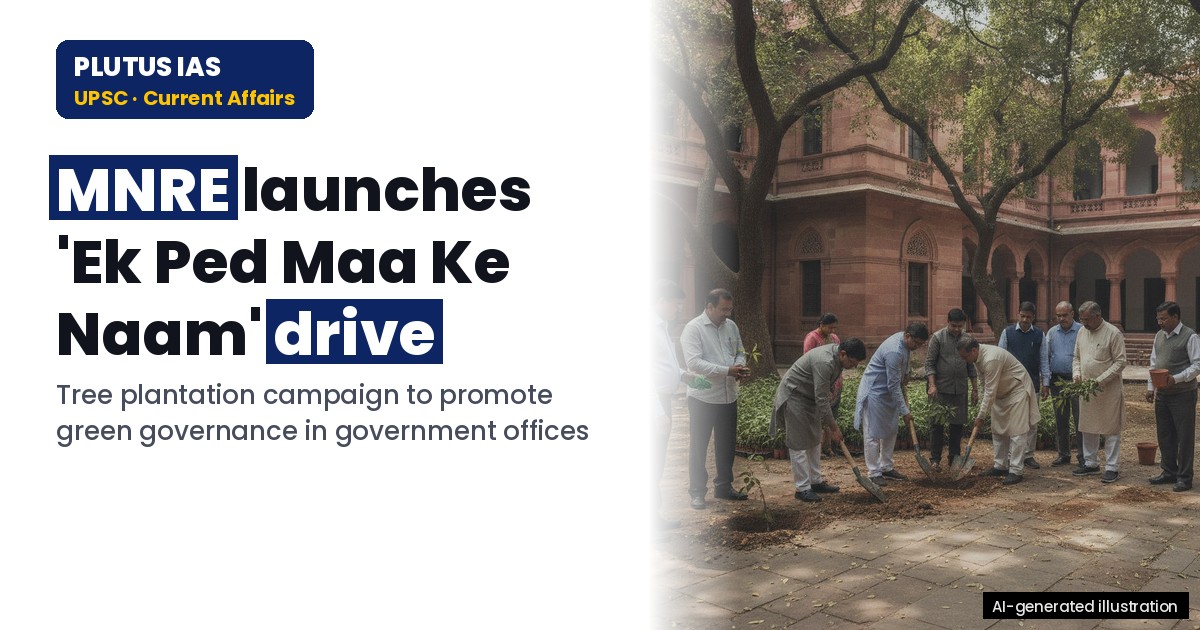
01 Oct MNRE launches ‘Ek Ped Maa Ke Naam’ tree plantation drive for green governance
✎ The ‘One Tree for Mother’ initiative by the MNRE exemplifies institutional leadership in environmental governance by integrating afforestation into administrative practices, aligning with the National Mission for a Green India…
Subject Relevance — Where This Topic Fits
- GS Paper III — Environment and Ecology | GS Paper III — Disaster and Disaster Management
- Prelims: Afforestation, National Action Plan on Climate Change (NAPCC), National Mission for a Green India (GIM), Carbon neutrality, National Green Tribunal (NGT)
- Essay: Climate action as a public good: balancing development and environmental justice, Institutional leadership in environmental governance: the role of ministries in achieving SDGs
Quick Revision: The ‘One Tree for Mother’ initiative by the MNRE exemplifies institutional leadership in environmental governance by integrating afforestation into administrative practices, aligning with the National Mission for a Green India and India’s climate commitments under the Paris Agreement.
Why is this in the news?
The Ministry of New and Renewable Energy (MNRE) organised a tree-plantation drive under the ‘One Tree for Mother’ initiative at the Atal Akshay Urja Bhawan in New Delhi on 30 September 2026. This initiative, led by the MNRE Secretary, underscores the Ministry’s commitment to institutionalising environmental sustainability within its operational premises and aligning with broader national climate goals. The event reflects the integration of afforestation practices into governance frameworks to promote green workplaces and long-term ecological resilience.
Background
- The National Action Plan on Climate Change (NAPCC), launched in 2008, outlines eight national missions to address climate change, including the National Mission for a Green India (GIM), which aims to increase forest cover and enhance ecosystem services.
- India’s Nationally Determined Contributions (NDCs) under the Paris Agreement commit to creating an additional carbon sink of 2.5 to 3 billion tonnes of CO₂ equivalent through afforestation and reforestation by 2030.
- The National Green Tribunal (NGT), established in 2010, provides a legal framework for environmental protection and afforestation, ensuring compliance with environmental laws and policies.
- Institutional sustainability initiatives, such as tree-plantation drives within government premises, are increasingly being adopted to demonstrate leadership in environmental stewardship and to foster a culture of ecological responsibility among public servants.
- The MNRE’s initiative aligns with the broader ‘LiFE’ (Lifestyle for Environment) movement, which emphasises individual and institutional actions to promote sustainable living and environmental conservation.
What is the ‘One Tree for Mother’ Initiative?
- The ‘One Tree for Mother’ initiative is a symbolic afforestation campaign launched by the Ministry of New and Renewable Energy (MNRE) to promote environmental sustainability within its institutional framework.
- The initiative encourages employees and officials to plant trees in the name of their mothers, fostering a personal connection to environmental conservation and encouraging long-term care for planted saplings.
- The campaign is part of a broader effort to create green workplaces, reduce carbon footprints, and enhance biodiversity within government premises.
- The initiative is aligned with the National Mission for a Green India (GIM), which seeks to increase forest cover and improve ecosystem services across the country.
- By integrating afforestation into routine administrative practices, the MNRE demonstrates institutional leadership in environmental governance and sets an example for other ministries and organisations.
- The campaign also contributes to India’s climate commitments, including the creation of additional carbon sinks and the promotion of sustainable development practices.
- The symbolic act of planting a tree in the name of a mother underscores the cultural and emotional value placed on environmental conservation, making it a powerful tool for public engagement.
- The initiative is expected to be replicated in other government departments, thereby institutionalising environmental sustainability as a core value in governance.
Key Features
| Feature | Significance |
|---|---|
| Initiative Name: ‘एक पेड़ माँ के नाम’ | A symbolic campaign linking environmental stewardship with cultural reverence for maternal lineage, enhancing public engagement in afforestation. |
| Leadership: MNRE Secretary Santosh Kumar Sarangi | Demonstrates top-level bureaucratic commitment to sustainability, setting an institutional precedent for green initiatives. |
| Location: Atal Akshay Urja Bhawan, New Delhi | Leverages a high-visibility government complex to amplify the campaign’s reach and institutional legitimacy. |
| Participation: MNRE Officers & Staff | Ensures grassroots involvement in institutional sustainability, fostering a culture of environmental responsibility within governance. |
| Objective: Promote Green Workspaces | Aligns with national sustainability goals by integrating environmental practices into government operations. |
Why it Matters
Environmental Sustainability
- Contributes to India’s Nationally Determined Contributions (NDCs) under the Paris Agreement by increasing forest cover and carbon sequestration.
- Supports the National Mission for a Green India (GIM) by augmenting green spaces in urban and semi-urban administrative hubs.
- Enhances local biodiversity and ecosystem services, particularly in the National Capital Region (NCR), where air quality and green cover are critical concerns.
Governance & Institutional Culture
- Institutionalises environmental responsibility within the MNRE, reinforcing the principle of ‘polluter pays’ and ‘sustainable governance’ in public administration.
- Demonstrates the role of government buildings as models for sustainable practices, aligning with the ‘LiFE’ (Lifestyle for Environment) initiative.
- Encourages inter-departmental collaboration on environmental projects, fostering a whole-of-government approach to sustainability.
Public Engagement & Awareness
- Uses symbolic cultural framing (‘mother’s name’) to deepen public emotional connection with environmental conservation, aiding behaviour change.
- Serves as a scalable model for other ministries and state governments to replicate, amplifying national afforestation efforts.
- Enhances transparency and accountability in government-led environmental initiatives through visible, measurable actions.
Challenges
1. Long-term Maintenance of Planted Saplings
- Risk of sapling mortality due to inadequate post-planting care, watering, and protection from pests or urban stressors.
- Dependence on institutional budgets and staff capacity for ongoing maintenance, which may fluctuate with administrative priorities.
UPSC Link: GS3: Environmental Governance
2. Scalability Across Diverse Geographies
- Variability in soil quality, climate conditions, and water availability across India may limit the success of afforestation efforts.
- Logistical challenges in sourcing native, resilient plant species suitable for specific regional ecosystems.
UPSC Link: GS3: Climate Change & Disaster Management
3. Balancing Urbanisation and Green Cover
- Pressure from infrastructure development and land-use changes in metropolitan areas like Delhi may conflict with afforestation goals.
- Need for integrated urban planning policies that prioritise green spaces without compromising developmental imperatives.
UPSC Link: GS2: Urban Governance
4. Public Participation and Behavioural Change
- Ensuring sustained public engagement beyond symbolic participation to foster long-term environmental stewardship.
- Overcoming apathy or misinformation regarding the ecological and economic benefits of afforestation.
UPSC Link: GS3: Environmental Ethics
5. Monitoring and Impact Assessment
- Lack of standardised metrics to evaluate the success of afforestation campaigns in terms of carbon sequestration, biodiversity, and ecosystem services.
- Need for robust data systems to track survival rates, growth metrics, and socio-economic impacts of planted saplings.
UPSC Link: GS3: Science & Technology in Governance
Challenges — UPSC Perspective
| Issue | Concern |
|---|---|
| Resource Allocation | Insufficient funding or manpower for maintenance and monitoring of planted saplings. |
| Species Selection | Risk of planting non-native or unsuitable species that fail to thrive in local conditions. |
| Urban Constraints | Limited space and competing land-use priorities in densely populated urban areas. |
| Climate Variability | Increased frequency of extreme weather events (droughts, heatwaves) threatening sapling survival. |
| Institutional Coordination | Need for inter-departmental and inter-ministerial collaboration to avoid duplication or gaps in efforts. |
Way Forward
- Develop a standardised ‘Green Office Protocol’ for all government buildings, mandating annual afforestation targets and maintenance budgets.
- Establish a dedicated ‘MNRE Green Fund’ to finance sapling procurement, maintenance, and monitoring across all regional offices.
- Partner with state forest departments and NGOs to train MNRE staff in afforestation techniques and post-planting care.
- Integrate afforestation metrics into the Performance Appraisal System (PAS) for government officers, incentivising participation.
- Launch a public dashboard to track the progress of planted saplings, including survival rates, growth metrics, and carbon sequestration data.
- Collaborate with educational institutions to conduct research on the ecological and socio-economic impacts of urban afforestation.
- Align the campaign with national missions like the National Mission for a Green India (GIM) and the LiFE initiative to amplify its reach.
- Conduct periodic reviews to assess the campaign’s alignment with India’s NDCs and other international commitments.
UPSC Value Addition
Keywords for Mains Answer-Writing
Environmental Sustainability · Renewable Energy Sector · Corporate Social Responsibility (CSR) in Environment · Tree Plantation Initiatives · Green Workplace Practices · Ministry of New and Renewable Energy (MNRE) · Afforestation Campaigns · Environmental Governance · Sustainable Development Goals (SDGs) · Corporate Environmental Responsibility
Concept Flow
MNRE’s afforestation initiative → Symbolic cultural framing (‘mother’s name’) → Institutional commitment to sustainability → Government buildings as models for green practices → Alignment with ‘LiFE’ initiative and NDCs → Grassroots participation (officers/staff) → Institutionalisation of environmental responsibility → Post-planting maintenance and monitoring → Long-term ecological benefits (carbon sequestration, biodiversity) → Scalability across ministries/states → National afforestation targets (e.g., GIM) → Public engagement and behavioural change → Sustainable urban governance
Prelims Practice Questions
Q1. Consider the following statements regarding the ‘One Tree Mother’s Name’ initiative:
1. It is a tree plantation campaign launched by the Ministry of New and Renewable Energy (MNRE).
2. The campaign was inaugurated by the Prime Minister of India.
3. The initiative aims to promote clean and green workplaces and environmental sustainability.
How many of the above statements are correct?
- Only one
- Only two
- All three
- None
Answer: Only two — Statement 1 is correct as the initiative was launched by MNRE. Statement 2 is incorrect as the campaign was led by the Secretary of MNRE, not the Prime Minister. Statement 3 is correct as the initiative aims to promote clean and green workplaces and environmental sustainability.
Q2. Assertion (A): The Ministry of New and Renewable Energy (MNRE) has recently initiated a tree plantation campaign named ‘One Tree Mother’s Name’.
Reason (R): The campaign aims to enhance green cover and promote sustainable practices within the ministry’s premises.
In the context of the above two statements, which one of the following is correct?
- Both A and R are true, and R is the correct explanation of A.
- Both A and R are true, but R is not the correct explanation of A.
- A is true, but R is false.
- A is false, but R is true.
Answer: Both A and R are true, and R is the correct explanation of A. — Both Assertion (A) and Reason (R) are true. The campaign was indeed initiated by MNRE, and its objective is to enhance green cover and promote sustainable practices, making R the correct explanation of A.
Q3. Which of the following best describes the primary objective of the ‘One Tree Mother’s Name’ initiative launched by the Ministry of New and Renewable Energy (MNRE)?
- To promote afforestation and environmental sustainability within the ministry’s premises
- To encourage the use of renewable energy sources in rural areas
- To provide financial incentives for tree plantation in urban areas
- To regulate the carbon footprint of industrial units under MNRE
Answer: To promote afforestation and environmental sustainability within the ministry’s premises — The primary objective of the ‘One Tree Mother’s Name’ initiative is to promote afforestation and environmental sustainability within the ministry’s premises by encouraging tree plantation.
Mains Practice Question
✍ Critically examine the role of government ministries in promoting environmental sustainability through tree plantation initiatives. Substantiate your answer with reference to the ‘One Tree Mother’s Name’ campaign launched by the Ministry of New and Renewable Energy (MNRE). (15 Marks)
Approach: MODEL-ANSWER SKELETON:
1. **Introduction (2 Marks)**
– Define environmental sustainability and its importance in the context of climate change and SDGs (e.g., SDG 13, SDG 15).
– Briefly introduce the concept of corporate/ministerial social responsibility in environmental governance.
2. **Role of Government Ministries in Environmental Sustainability (5 Marks)**
– Discuss the constitutional and statutory framework empowering ministries to undertake environmental initiatives (e.g., Article 48A, National Forest Policy 1988, National Mission for a Green India).
– Highlight the role of ministries as catalysts for behavioral change and institutionalizing sustainable practices.
– Cite examples of other ministries’ initiatives (e.g., Ministry of Railways’ afforestation drives, Ministry of Defence’s eco-friendly practices).
3. **Analysis of the ‘One Tree Mother’s Name’ Initiative (5 Marks)**
– Explain the campaign’s objectives: promoting clean and green workplaces, enhancing green cover, and fostering a culture of environmental responsibility.
– Discuss the leadership and participation (e.g., involvement of the Secretary and senior officials).
– Critically assess its potential impact: symbolic vs. substantive contributions to sustainability.
– Link to broader government policies like the National Clean Air Programme (NCAP) and India’s Nationally Determined Contributions (NDCs).
4. **Challenges and Way Forward (3 Marks)**
– Challenges: Lack of long-term monitoring, limited scalability, and integration with broader urban greening policies.
– Suggest measures: Institutionalizing such initiatives, linking to CSR funds under the Companies Act 2013, and integrating with national missions like the National Mission for Sustainable Agriculture (NMSA).
**Balanced View Required:** Acknowledge the initiative’s symbolic value while critiquing its scalability and long-term impact.
Source: PIB (Press Information Bureau)
Generated by AanyaAi for educational purpose.
Related guides on our sites
- Current affairs for upsc 2026
- Best PSIR optional coaching for upsc
- Best PSIR optional teacher for upsc
- Best teacher of PSIR optional for upsc

- विशेष अभियान-6: कोल इंडिया लिमिटेड की तैयारी पर केंद्र सरकार की निगरानी - October 1, 2026
- ECL’s Action Plan for Special Campaign 6: A UPSC Governance Case Study - October 1, 2026
- विशेष अभियान 6: स्वच्छ कार्यालय एवं कुशल प्रशासन की ओर एक बड़ा कदम - October 1, 2026

No Comments