


24 Aug Monsoon Session Prorogation Delay: BJP vs Congress on Women’s Bill
✎ The Women’s Reservation Bill requires a two-thirds majority in Parliament and ratification by State Legislatures, with implementation contingent upon the delimitation process.
Subject Relevance — Where This Topic Fits
- GS Paper II — Polity and Governance (Parliamentary Procedures, Constitutional Amendments) | GS Paper III — Social Justice (Women Empowerment, Reservation Policies)
- Prelims: Women’s Reservation Bill, Constitutional Amendment Bill, Parliamentary Sessions (Prorogation, Adjournment), Delimitation Commission, Lok Sabha Strength, Two-thirds Majority in Parliament, Article 334 of the Constitution
- Essay: Women’s Empowerment: A Constitutional Imperative for Inclusive Governance, Parliamentary Democracy: Balancing Efficiency and Deliberation in Legislative Processes
Quick Revision: The Women’s Reservation Bill requires a two-thirds majority in Parliament and ratification by State Legislatures, with implementation contingent upon the delimitation process.
Why is this in the news?
The monsoon session of Parliament, concluded on August 13, 2026, remains unprorogued, raising procedural and strategic questions about the potential revival of the Women’s Reservation Bill. The bill, aimed at reserving one-third of seats in the Lok Sabha and State Legislative Assemblies for women, was previously introduced but faced procedural hurdles. The delay in prorogation has sparked speculation about the government’s intent to reconvene Parliament for a special session to advance the bill, particularly given the constitutional requirement of a two-thirds majority for passage. Political exchanges between parties have underscored the procedural and substantive dimensions of the bill’s progression.
Background
- The Women’s Reservation Bill was first introduced in Parliament in 1996 and has been reintroduced in subsequent sessions, including 2008 and 2010, without passage.
- The bill seeks to amend Article 334 of the Constitution to extend reservation for women in Lok Sabha and State Legislative Assemblies for a further period of 15 years, alongside provisions for sub-reservation for SCs and STs.
- The Constitution (108th Amendment) Bill, 2008, proposed reserving one-third of seats for women in the Lok Sabha and State Legislative Assemblies, but it lapsed with the dissolution of the 15th Lok Sabha in 2014.
- The current iteration of the bill, if revived, would require a two-thirds majority in both Houses of Parliament and ratification by at least half of the State Legislatures, as per Article 368 of the Constitution.
- The delimitation process, which determines the number and boundaries of constituencies, is a prerequisite for the implementation of the women’s reservation, as it necessitates a reallocation of seats.
- The monsoon session of Parliament concluded on August 13, 2026, but the session has not been formally prorogued, a procedural step that typically follows the adjournment sine die.
What is the Women’s Reservation Bill?
- The Women’s Reservation Bill is a proposed constitutional amendment aimed at reserving one-third of seats in the Lok Sabha and State Legislative Assemblies for women, including sub-reservation for SCs and STs.
- The bill was first introduced in 1996 and has been reintroduced multiple times, including in 2008 and 2010, but has not been passed due to procedural and political challenges.
- The bill requires a two-thirds majority in both Houses of Parliament and ratification by at least half of the State Legislatures, as per the provisions of Article 368 of the Constitution.
- The implementation of the bill is contingent upon the completion of the delimitation process, which involves redrawing constituency boundaries and increasing the number of seats in the Lok Sabha and State Legislative Assemblies.
- The bill is framed as a measure to enhance women’s political representation and empowerment, aligning with constitutional goals of social justice and equality.
- The procedural delay in prorogation of the monsoon session has raised questions about the government’s strategy to revive the bill, including the possibility of a special session.
Key Features
| Feature | Significance |
|---|---|
| Constitution (108th Amendment) Bill, 2008 (Women’s Reservation Bill) | Proposes 33% reservation for women in the Lok Sabha and State Legislative Assemblies, aiming to enhance political representation of women in governance structures. |
| Parliamentary Session Prorogation | Formal closure of a parliamentary session, enabling the government to convene a new session after a mandatory gap, ensuring legislative continuity and procedural compliance. |
| Two-thirds Majority Requirement | Constitutional amendments necessitate a two-thirds majority in both Houses of Parliament, reflecting the federal and democratic principles embedded in the Constitution. |
| Adjournment vs. Prorogation | Adjournment suspends a sitting temporarily, whereas prorogation ends a session, allowing the government to introduce new legislative agendas in the subsequent session. |
| Delimitation Process | Redrawing of electoral boundaries based on census data, which, if linked to the Women’s Reservation Bill, could alter the number of seats allocated to states. |
Why it Matters
Political
- The Women’s Reservation Bill, if enacted, would significantly alter the gender composition of India’s legislative bodies, potentially influencing policy priorities and governance outcomes.
- The delay in prorogation and the ongoing debate highlight the procedural and political complexities involved in constitutional amendments, particularly those with far-reaching social implications.
- The discourse underscores the role of opposition in scrutinising government proposals, a cornerstone of parliamentary democracy.
- The bill’s revival potential reflects the dynamic nature of legislative agendas, which can be influenced by political bargaining and public discourse.
Constitutional
- The requirement of a two-thirds majority for constitutional amendments ensures that such changes are consensus-driven, safeguarding the foundational principles of the Constitution.
- The process of prorogation and summoning of a new session is governed by Article 85 of the Constitution, which mandates a gap between sessions to maintain legislative discipline.
- The Women’s Reservation Bill, if passed, would necessitate amendments to Articles 330, 332, and 334, which deal with reserved seats for women in legislatures.
Social
- The bill aims to address the historical underrepresentation of women in India’s political institutions, aligning with global commitments to gender parity in governance.
- The debate surrounding the bill reflects broader societal discussions on affirmative action and the role of women in public life, which are critical for inclusive development.
- The discourse also highlights the intersection of gender, politics, and representation, a key theme in contemporary governance and constitutionalism.
Procedural
- The delay in prorogation may indicate strategic considerations by the government, such as the need to secure additional support for the bill or to align with other legislative priorities.
- The parliamentary process, including adjournment and prorogation, is designed to ensure that legislative business is conducted systematically and with adequate deliberation.
- The ongoing debate reflects the importance of inter-party consultations and consensus-building in the legislative process, particularly for constitutionally significant bills.
Challenges
1. Ensuring Two-Thirds Majority
- Securing a two-thirds majority in both Houses of Parliament for constitutional amendments is a significant challenge, requiring broad political consensus.
- The opposition’s stance against the bill, as articulated by the Congress party, underscores the difficulty in achieving such consensus.
- The government may need to engage in extensive negotiations with opposition parties and allies to build support for the bill.
UPSC Link: Polity – Parliament and State Legislatures
2. Procedural Delays in Prorogation
- The delay in prorogation of the monsoon session may lead to procedural complications, including the need to follow a mandatory gap before convening a new session.
- Such delays can disrupt legislative timelines and create uncertainty regarding the government’s legislative agenda.
- The government must balance strategic considerations with procedural compliance to ensure smooth parliamentary functioning.
UPSC Link: Polity – Parliamentary Procedures
3. Balancing Representation and Delimitation
- The Women’s Reservation Bill, if linked to delimitation, could raise concerns about altering electoral boundaries and the potential for political manipulation.
- Ensuring that the delimitation process is fair, transparent, and based on objective criteria is critical to maintaining public trust in the electoral system.
- The government must address these concerns to prevent perceptions of partisan advantage in the delimitation process.
UPSC Link: Polity – Electoral Reforms
4. Addressing Opposition Concerns
- The opposition’s demand to freeze the number of Lok Sabha seats at the existing level presents a challenge to the government’s proposal to increase seats and reserve them for women.
- Balancing the need for gender representation with the concerns of states about seat allocation requires careful negotiation and compromise.
- The government must demonstrate a commitment to inclusive and consultative policymaking to build trust with opposition parties.
UPSC Link: Polity – Role of Opposition
5. Public Perception and Political Narratives
- The framing of the debate by political parties, such as the BJP’s emphasis on women’s empowerment and the Congress’s critique of the government’s motives, can shape public perception of the bill.
- Ensuring that the narrative remains focused on the substantive benefits of the bill, rather than political posturing, is essential for garnering public support.
- The government must communicate the rationale behind the bill clearly to address any misconceptions or scepticism.
UPSC Link: Polity – Role of Media and Public Opinion
Challenges — UPSC Perspective
| Issue | Concern |
|---|---|
| Two-Thirds Majority Requirement | Difficulty in securing broad political consensus for the constitutional amendment. |
| Procedural Delays in Prorogation | Potential disruption to legislative timelines and uncertainty in government’s agenda. |
| Balancing Representation and Delimitation | Risk of political manipulation in the delimitation process and concerns about fairness. |
| Opposition Concerns on Seat Freeze | Challenge of reconciling demand to freeze Lok Sabha seats with the bill’s provisions for increased representation. |
| Public Perception and Political Narratives | Risk of the debate being framed around political posturing rather than the bill’s substantive benefits. |
Way Forward
- The government should engage in proactive consultations with opposition parties and allies to build consensus on the Women’s Reservation Bill, focusing on the substantive benefits of gender representation in governance.
- Parliamentary procedures must be followed diligently to ensure that the prorogation and summoning of a new session are conducted without procedural lapses, maintaining legislative discipline.
- The government should address concerns about the delimitation process by ensuring transparency, objectivity, and fairness in the redrawing of electoral boundaries.
- A clear communication strategy should be adopted to explain the rationale behind the bill and its potential impact on governance, countering any misconceptions or political narratives.
- The government should consider alternative approaches to achieve the goal of women’s representation, such as phased implementation or pilot projects, if consensus on the constitutional amendment remains elusive.
- Parliamentary committees, such as the Standing Committee on Personnel, Public Grievances, Law and Justice, should be tasked with examining the bill in detail and submitting a report to facilitate informed debate.
- Civil society organisations and women’s rights groups should be involved in the discourse to provide expert insights and ensure that the bill aligns with broader goals of gender equality and social justice.
UPSC Value Addition
Keywords for Mains Answer-Writing
Women’s Reservation Bill · Constitutional Amendment · Parliamentary Procedures · Prorogation of Parliament · Lok Sabha Delimitation · Women’s Empowerment · Two-Thirds Majority · Parliamentary Sessions · Constitutional Provisions for Women · Parliamentary Democracy
Constitutional & Policy Linkages
- [‘Article 85 – Sessions of Parliament’, ‘Governed by the gap between prorogation and summoning of a new session.’]
- [‘Article 330 – Reservation of Seats for Scheduled Castes and Scheduled Tribes’, “Potential amendment required for women’s reservation.”]
- [‘Article 332 – Reservation of Seats for Scheduled Castes and Scheduled Tribes in State Legislatures’, “Potential amendment required for women’s reservation.”]
Concept Flow
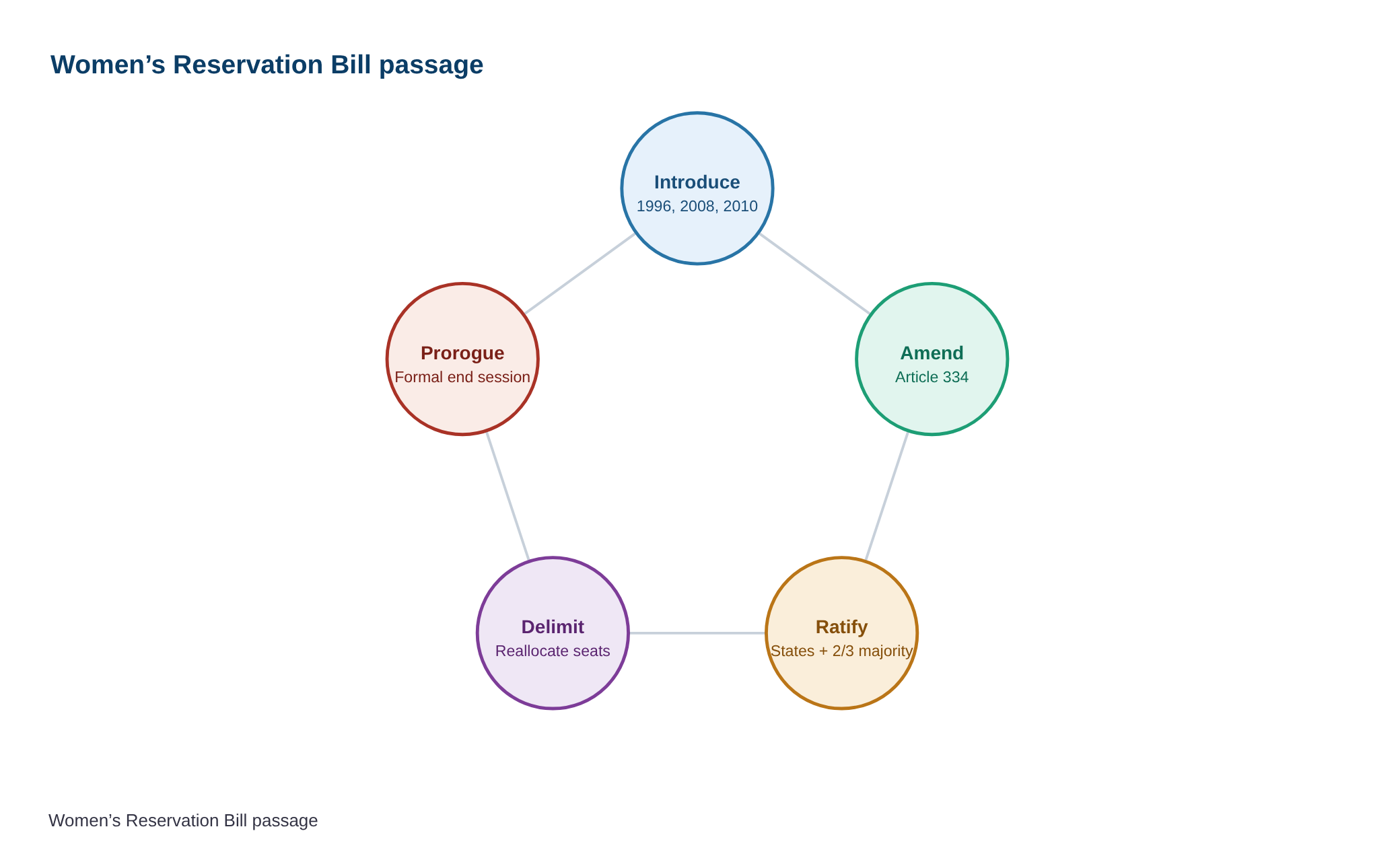
Introduction of Women’s Reservation Bill in Parliament → Debate and scrutiny in Parliamentary Committees → Requirement for two-thirds majority in both Houses for constitutional amendment → Government’s decision to link the bill with delimitation, necessitating census data and electoral boundary redrawing → Opposition’s demand to freeze Lok Sabha seats at existing number → Delay in prorogation of monsoon session, raising procedural and strategic considerations → Ongoing negotiations and consultations to build consensus → Potential revival of the bill in a future session, subject to political and procedural feasibility
Prelims Practice Questions
Q1. Consider the following statements regarding the Women’s Reservation Bill in India:
1. The Bill proposes to reserve one-third of the seats in the Lok Sabha and State Legislative Assemblies for women.
2. The Bill was first introduced in Parliament in 1996.
3. The Bill requires a two-thirds majority in both Houses of Parliament for its passage.
4. The Bill has been passed by both Houses of Parliament and is now a constitutional amendment.
How many of the above statements are correct?
- Only one
- Only two
- Only three
- All four
Answer: Only three — Statements 1, 2, and 3 are correct. The Bill proposes 33% reservation for women in Lok Sabha and State Legislative Assemblies, was first introduced in 1996, and requires a two-thirds majority for passage. Statement 4 is incorrect as the Bill has not yet been passed by both Houses.
Q2. Assertion (A): The Women’s Reservation Bill requires a two-thirds majority in both Houses of Parliament for its passage.
Reason (R): The Bill seeks to amend the Constitution of India, which mandates a special majority for constitutional amendments.
- Both A and R are true, and R is the correct explanation of A.
- Both A and R are true, but R is not the correct explanation of A.
- A is true, but R is false.
- A is false, but R is true.
Answer: Both A and R are true, and R is the correct explanation of A. — Both the Assertion and Reason are true. The Women’s Reservation Bill seeks to amend the Constitution, which requires a two-thirds majority in both Houses of Parliament for passage. The Reason correctly explains the Assertion.
Q3. Which of the following is NOT a step in the legislative process for passing a constitutional amendment bill in India?
A. Introduction of the Bill in either House of Parliament
B. Reference to a Joint Parliamentary Committee for detailed scrutiny
C. Approval by a simple majority in both Houses of Parliament
D. Ratification by the Legislatures of not less than one-half of the States
- A
- B
- C
- D
Answer: C — Approval by a simple majority is not sufficient for a constitutional amendment bill. Such bills require a two-thirds majority in both Houses of Parliament. The other options (A, B, and D) are correct steps in the process.
Mains Practice Question
✍ The Women’s Reservation Bill, aimed at providing one-third reservation for women in the Lok Sabha and State Legislative Assemblies, has been a subject of prolonged debate in Parliament. Critically examine the constitutional and procedural challenges associated with the passage of this Bill. Also, analyse the implications of its potential implementation on India’s representative democracy. (15 Marks)
Approach: MODEL-ANSWER SKELETON:
1. **Constitutional Provisions and Requirements**:
– Article 330A (Lok Sabha) and Article 332A (State Legislative Assemblies) of the Constitution, introduced via the 108th Constitutional Amendment Bill (2008), provide for reservation of seats for women.
– Requires a two-thirds majority in both Houses of Parliament and ratification by at least half of the State Legislatures (Art. 368).
2. **Procedural Challenges**:
– **Delimitation Process**: The Bill mandates fresh delimitation of constituencies, which is constitutionally prohibited until after the first census following 2026 (Art. 82, 170).
– **Subsequent Sessions**: The Bill lapses if not passed in a single session unless reintroduced, highlighting the procedural rigidity of Parliament.
– **Political Consensus**: Lack of bipartisan support due to concerns over sub-categorisation (e.g., OBC women) and potential impact on existing reservation structures.
3. **Implications for Representative Democracy**:
– **Enhanced Representation**: Potential to address gender imbalance in legislative bodies, aligning with global benchmarks (e.g., Rwanda, South Africa).
– **Impact on Electoral Dynamics**: Could alter vote-bank politics, particularly in states with high female voter turnout.
– **Constitutional Precedents**: Compare with the 73rd and 74th Amendments (1992), which reserved seats for women in local bodies.
4. **Balancing Views**:
– **Proponents**: Argue for substantive democracy and gender justice, citing the success of women’s reservation in Panchayati Raj institutions.
– **Opponents**: Cite concerns over dilution of caste-based reservations, logistical challenges in delimitation, and potential marginalisation of other marginalised groups.
5. **Way Forward**:
– Explore alternatives such as dual-member constituencies or rotational reservation to mitigate delimitation challenges.
– Strengthen political consensus through structured deliberations in Parliamentary committees.
Source: Times of India
Generated by AanyaAi for educational purpose.
Related guides on our sites
- Current affairs for upsc 2026
- Best PSIR optional coaching for upsc
- Best PSIR optional teacher for upsc
- Best teacher of PSIR optional for upsc

- सुप्रीम कोर्ट ने सीबीएसई की तीन-भाषा नीति पर उठाए सवाल, ‘नेटिव’ शब्द पर क्या कहा? - August 24, 2026
- Supreme Court Questions CBSE’s Three-Language Policy: ‘Native’ vs ‘Indigenous’ Debate - August 24, 2026
- उच्च न्यायालय ने पूछा: पुलिस मुठभेड़ में एक गोली, आरोपी के घुटने के नीचे क्यों लगी? - August 24, 2026

No Comments