


22 Sep MP Cabinet Approves Sports Complexes in All Assembly Seats with Helipads
✎ Madhya Pradesh will develop sports complexes in all 230 assembly constituencies with integrated helipads for air ambulance services, alongside a phased expansion of public transport to 15,000 buses by 2030-31 under the…
Subject Relevance — Where This Topic Fits
- GS Paper II — Governance, Social Justice and Welfare | GS Paper III — Infrastructure and Economic Development
- Prelims: Sports infrastructure, Public transport, State budget allocation, MP Roadways, Air ambulance services, Sports complexes, Connectivity
- Essay: Sports as a tool for holistic development, The role of state-led infrastructure in inclusive growth
Quick Revision: Madhya Pradesh will develop sports complexes in all 230 assembly constituencies with integrated helipads for air ambulance services, alongside a phased expansion of public transport to 15,000 buses by 2030-31 under the Mukhyamantri Sugam Parivahan Seva.
Why is this in the news?
The Madhya Pradesh Cabinet, in its meeting held on 22 September 2026, approved significant proposals aimed at enhancing sports infrastructure and public transport across the state. These decisions reflect a dual focus on grassroots sporting development and urban-rural connectivity, with substantial budgetary allocations and phased implementation timelines. The initiatives are positioned as part of the state’s broader strategy to leverage infrastructure for socio-economic upliftment.
Background
- Madhya Pradesh, with 230 legislative assembly constituencies, has historically faced disparities in access to sports facilities, particularly in rural and tribal regions.
- The state’s public transport system, primarily managed by Madhya Pradesh State Road Transport Corporation (MPSRTC), has been constrained by aging fleet, limited coverage, and inadequate last-mile connectivity.
- Recent state budgets have prioritised infrastructure development to align with national schemes such as the Khelo India initiative and the PM Gati Shakti National Master Plan for multi-modal connectivity.
- The introduction of helipads within sports complexes aligns with the central government’s push for emergency medical services (EMS) and air ambulance networks under the National Health Mission.
- Transport sector reforms in MP follow a trend observed in several Indian states, where modernisation of public transport is being linked to decarbonisation goals and urban mobility enhancement.
Key Components of the Proposals
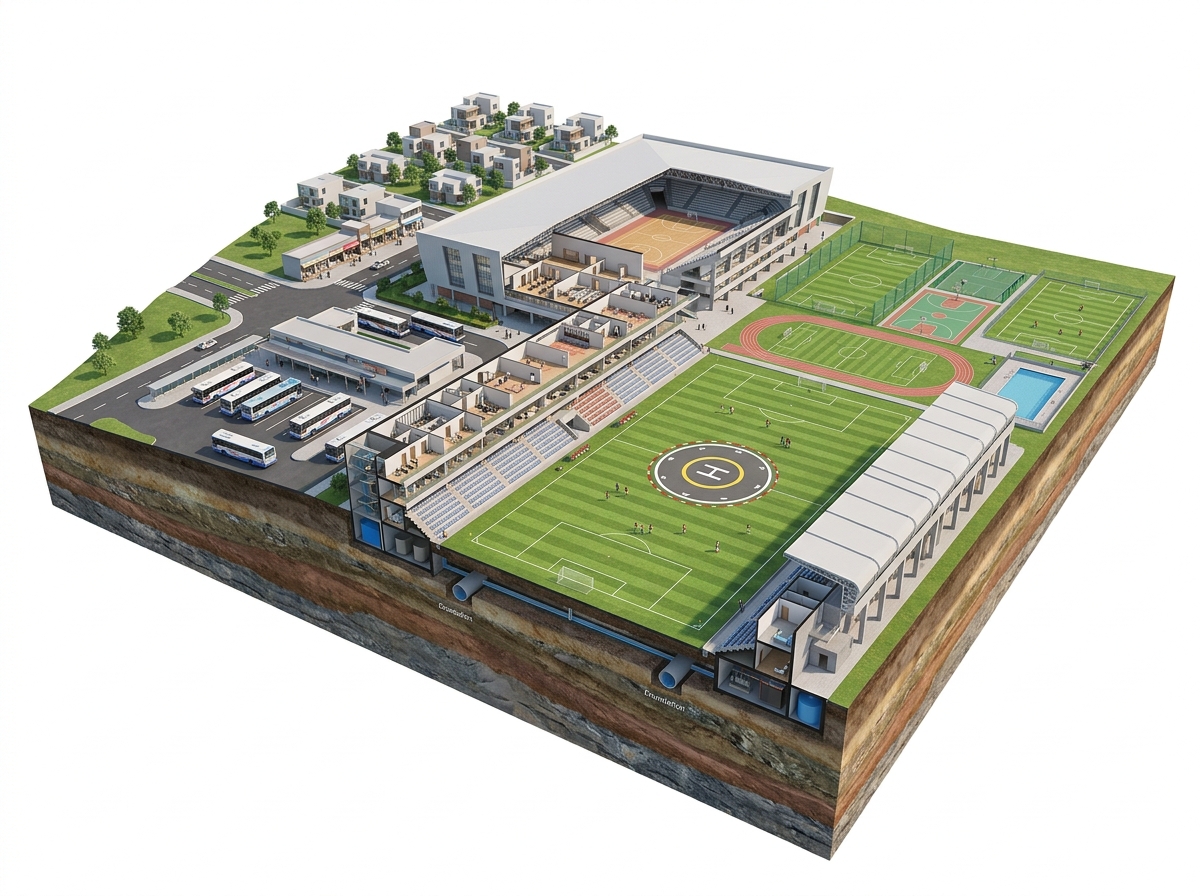
- Establishment of modern sports complexes in every legislative assembly constituency: Each complex will include indoor and outdoor facilities, with a provision of 10 acres of land where available. The total budgetary allocation is ₹940 crore, with an estimated cost of ₹7 crore per complex for standardised amenities such as coaching staff, equipment, and spectator infrastructure.
- Integration of helipads within sports complexes: These will facilitate air ambulance services, ensuring 24×7 accessibility for emergency medical evacuations, particularly in remote and tribal areas lacking dedicated EMS infrastructure.
- Launch of the ‘Mukhyamantri Sugam Parivahan Seva’ (Chief Minister’s Convenient Transport Service): Scheduled to commence on 25 September 2026 in Bhopal, the initiative aims to deploy 15,000 buses by 2030-31.
- Phased deployment and public-private partnership (PPP) model: The transport expansion will leverage PPP frameworks to ensure operational efficiency, route rationalisation, and fleet modernisation, including electric and CNG-powered buses.
- Naming convention and branding: The sports complexes will be designated as ‘Mukhyamantri Sports Complexes’, aligning with the state’s emphasis on leadership-driven developmental branding.
- Focus on inclusivity: The initiatives are designed to cater to diverse demographic segments, including women, children, and persons with disabilities, through accessible infrastructure and gender-sensitive facilities.
Key Features
| Feature | Significance |
|---|---|
| Establishment of sports complexes in every assembly constituency | Ensures equitable access to modern sports infrastructure across all regions, promoting grassroots sports development and talent identification. |
| Indoor and outdoor sports facilities | Provides year-round training and competition opportunities, including coaching support, thereby enhancing athletic performance and participation. |
| Helipad at the centre of sports complexes | Facilitates rapid air-ambulance services for emergency medical evacuations, particularly in rural and remote areas lacking immediate healthcare access. |
| Provision of 940 crore INR for sports complexes | Demonstrates state-level prioritisation of sports infrastructure development, with budgetary allocation reflecting long-term commitment to public welfare. |
| Sugam Parivahan Seva (ease of transport service) | Aims to improve public transport connectivity and reliability, reducing travel time and enhancing mobility for citizens across the state. |
Why it Matters
Sports Development & Public Health
- Promotes physical fitness and mental well-being through structured sports engagement, aligning with the National Sports Policy 2023’s emphasis on grassroots participation.
- Enhances talent scouting and athlete development by providing standardised training facilities, potentially increasing representation in national and international competitions.
- Supports the implementation of the Khelo India initiative by creating a decentralised network of high-quality sports infrastructure at the local level.
Rural & Remote Connectivity
- The integration of helipads in sports complexes addresses critical gaps in emergency medical services, particularly in areas with limited road connectivity or healthcare facilities.
- Improves accessibility to specialised medical care, reducing morbidity and mortality in time-sensitive emergencies such as trauma or obstetric complications.
Urban Mobility & Public Transport
- The Sugam Parivahan Seva initiative seeks to modernise the state’s bus fleet, reducing congestion and pollution while improving last-mile connectivity.
- Expansion of the bus network to 15,000 by 2030-31 aligns with the National Urban Transport Policy’s goals of sustainable and inclusive mobility solutions.
Fiscal & Governance Implications
- Allocation of 940 crore INR signifies a shift towards outcome-based budgeting in social sectors, with measurable deliverables tied to public infrastructure.
- Demonstrates the use of decentralised governance models, where local assembly constituencies receive direct funding for region-specific development.
Challenges
1. Land Acquisition & Utilisation
- Identification and procurement of 10-acre plots for each sports complex may face resistance from local communities or landowners, delaying project timelines.
- Ensuring optimal land utilisation without displacing existing public or private assets requires meticulous planning and stakeholder consultations.
UPSC Link: Land Reforms & RTE Act
2. Operational Sustainability of Helipads
- Maintaining 24/7 operational readiness of helipads demands significant investment in manpower, training, and emergency protocols, posing fiscal and logistical challenges.
- Coordination with state and central agencies (e.g., Airports Authority of India, Ministry of Civil Aviation) is essential to avoid regulatory conflicts or safety lapses.
UPSC Link: Disaster Management Act
3. Public Transport Modernisation
- Achieving the target of 15,000 buses by 2030-31 requires phased procurement, which may strain state finances and supply chains, particularly for electric or CNG buses.
- Ensuring equitable distribution of bus routes and frequency across urban, semi-urban, and rural areas is critical to prevent service disparities.
UPSC Link: NITI Aayog’s Mobility Plan
4. Maintenance & Upkeep of Infrastructure
- Long-term sustainability of sports complexes and helipads depends on dedicated maintenance budgets and skilled personnel, often overlooked in initial planning.
- Establishing a public-private partnership model or state-owned enterprise for operations could mitigate maintenance costs but raises governance concerns.
UPSC Link: PPP in Infrastructure
Challenges — UPSC Perspective
| Issue | Concern |
|---|---|
| Land acquisition delays | Potential resistance from local stakeholders, leading to project postponements. |
| High operational costs of helipads | Sustaining 24/7 readiness requires continuous funding and trained personnel. |
| Supply chain constraints for buses | Procuring 15,000 buses may face delays due to manufacturing or import bottlenecks. |
| Equitable service distribution | Risk of urban-centric focus, leaving rural areas underserved in transport and sports facilities. |
| Maintenance neglect post-completion | Without structured O&M plans, infrastructure may degrade, rendering investments ineffective. |
Government Initiatives — Must-Memorise for Prelims
- Khelo India Scheme (for sports infrastructure alignment)
- National Urban Transport Policy (for bus fleet modernisation)
- Ayushman Bharat Health Infrastructure Mission (for emergency medical services integration)
Way Forward
- Constitute district-level committees for land identification and stakeholder consultations to expedite acquisition.
- Develop a phased rollout plan for sports complexes, prioritising constituencies with existing gaps in facilities.
- Establish a dedicated maintenance fund for sports complexes and helipads, with annual audits for transparency.
- Collaborate with the Ministry of Civil Aviation to standardise helipad protocols and training for emergency services.
- Launch a pilot phase for Sugam Parivahan Seva in select districts, with real-time monitoring of ridership and feedback mechanisms.
- Integrate sports complexes with local schools and colleges to foster talent identification and community engagement.
- Explore PPP models for bus fleet expansion, ensuring compliance with environmental and safety standards.
- Conduct periodic impact assessments to evaluate the scheme’s effectiveness in promoting sports participation and rural connectivity.
UPSC Value Addition
Keywords for Mains Answer-Writing
State-level sports infrastructure policy · Multi-functional sports complexes · Helipads in public facilities · Public health infrastructure · State transport policy · Regional connectivity · Multi-modal transport integration · Decentralised development · Local governance and public goods · Fiscal federalism in India · Sports governance in India · Air ambulance services
Constitutional & Policy Linkages
- Article 21 (Right to Health) – Ensuring timely medical access via helipads.
- Article 48 (DPSP – Organisation of agriculture and animal husbandry) – Aligns with holistic rural development.
- Article 51A (Fundamental Duties – promoting sports and fitness)
Concept Flow
State government identifies gaps in sports infrastructure and emergency medical access → Proposes decentralised sports complexes with helipads → Allocates budget and sets timelines → Land acquisition and construction begin → Operational protocols for helipads and transport services are established → Maintenance and community integration phases follow.
Prelims Practice Questions
Q1. Consider the following statements regarding the proposed Sports Complex in every Assembly constituency of Madhya Pradesh:
1. Each complex will include indoor and outdoor sports facilities.
2. The complexes will have helipads exclusively for air ambulance services.
3. The total financial outlay for all complexes is ₹940 crore.
4. The complexes will be named after the Chief Minister of Madhya Pradesh.
How many of the above statements are correct?
- Only one
- Only two
- Only three
- All four
Answer: All four — Statements 1, 2, and 3 are correct as per the report. Statement 4 is incorrect as the complexes are named ‘Mukhyamantri Sports Complex’ (Chief Minister’s Sports Complex), but the Chief Minister’s name is not specified.
Q2. Assertion (A): The inclusion of helipads in public sports complexes is primarily intended to facilitate air ambulance services.
Reason (R): Rural areas in Madhya Pradesh often lack immediate access to air ambulance facilities.
In the context of the above statements, which one of the following is correct?
- Both A and R are true, and R is the correct explanation of A.
- Both A and R are true, but R is not the correct explanation of A.
- A is true, but R is false.
- A is false, but R is true.
Answer: Both A and R are true, but R is not the correct explanation of A. — The assertion (A) is true as the report explicitly states the helipads are for air ambulance services. The reason (R) is also true and correctly explains (A), as rural areas in Madhya Pradesh face accessibility challenges.
Q3. Match the following columns related to the proposed initiatives in Madhya Pradesh:
Column I (Initiative) | Column II (Objective)
———————|———————-
1. Mukhyamantri Sports Complex | A. Enhance regional connectivity
2. Helipads in sports complexes | B. Provide modern sports infrastructure
3. Sugam Parivahan Seva | C. Facilitate emergency medical services
4. 15,000 buses by 2030-31 | D. Improve public transport system
Select the correct match:
- 1-B, 2-C, 3-A, 4-D
- 1-B, 2-C, 3-D, 4-A
- 1-A, 2-B, 3-C, 4-D
- 1-C, 2-B, 3-A, 4-D
Answer: 1-B, 2-C, 3-D, 4-A — The Mukhyamantri Sports Complex (1) aims to provide modern sports infrastructure (B). Helipads (2) are for emergency medical services (C). Sugam Parivahan Seva (3) enhances regional connectivity (A). The bus initiative (4) improves the public transport system (D).
Mains Practice Question
✍ The Government of Madhya Pradesh has approved the establishment of modern sports complexes in every Assembly constituency, including helipads for air ambulance services. Critically examine the significance of this initiative for public health, sports governance, and regional development. Also, analyse the fiscal and administrative challenges in implementing such a decentralised infrastructure policy. (15 Marks)
Approach: MODEL-ANSWER SKELETON:
1. Public Health Significance (4 marks):
– Helipads enable 24/7 air ambulance access, reducing response time in emergencies, especially in rural areas.
– Integration with local health infrastructure (Primary Health Centres, Community Health Centres) for seamless emergency care.
– Cite examples of states like Kerala or Tamil Nadu where air ambulances have improved maternal and trauma care outcomes.
2. Sports Governance and Development (4 marks):
– Decentralised sports infrastructure promotes grassroots talent identification and training (reference to Khelo India Scheme and National Sports Development Code, 2011).
– Provision of indoor/outdoor facilities addresses the lack of 140+ Assembly constituencies with modern sports complexes.
– Potential to reduce urban-rural disparities in sports opportunities.
3. Regional Development and Connectivity (3 marks):
– Multi-modal transport integration (helipads + buses) enhances last-mile connectivity in remote areas.
– Stimulates local economies through construction, employment, and tourism (e.g., sports tourism).
– Aligns with the National Infrastructure Pipeline (NIP) and Sustainable Development Goals (SDG 3, 9, 11).
4. Fiscal and Administrative Challenges (4 marks):
– Fiscal federalism: Centre-State funding dynamics; potential reliance on devolution from the Finance Commission.
– Land acquisition and environmental clearances for helipads and sports complexes in densely populated or ecologically sensitive areas.
– Maintenance and operational costs post-construction; risk of underutilisation in low-population constituencies.
– Coordination challenges among multiple agencies (State PWD, Sports Authority of India, District Collectors).
Balance of Views:
– Proponents argue it is a transformative step toward inclusive development.
– Critics may highlight the opportunity cost of ₹940 crore in a state with competing priorities (education, healthcare, poverty alleviation).
Source: amarujala.com
Generated by AanyaAi for educational purpose.
Related guides on our sites

- नमस्ते योजना से स्वच्छता कर्मियों को मिली सुरक्षा, गरिमा और आजीविका सहायता - September 22, 2026
- कर्नाटक में ‘वंदे मातरम’ विवाद: राज्यपाल ने सीएम से आदेश वापस लेने को कहा - September 22, 2026
- Karnataka Governor vs CM: Vande Mataram GO row explained for UPSC - September 22, 2026

No Comments