


08 Aug MP Urges Karnataka CM to Extend Crop Insurance Premium Deadline Amid Monsoon Deficit
✎ The Weather-Based Crop Insurance Scheme (WBCIS) is a parametric insurance model under PMFBY, where payouts are triggered by adverse weather parameters, not actual crop loss, to mitigate agricultural risks.
Subject Relevance — Where This Topic Fits
- GS Paper III — Agriculture and Rural Development | GS Paper III — Disaster Management
- Prelims: Pradhan Mantri Fasal Bima Yojana (PMFBY), Weather-Based Crop Insurance Scheme (WBCIS), Monsoon Deficit, Horticultural Crops, Common Service Centres (CSCs), Cooperative Societies
- Essay: Agrarian distress and policy interventions: Balancing fiscal prudence with farmer welfare
Quick Revision: The Weather-Based Crop Insurance Scheme (WBCIS) is a parametric insurance model under PMFBY, where payouts are triggered by adverse weather parameters, not actual crop loss, to mitigate agricultural risks.
Why is this in the news?
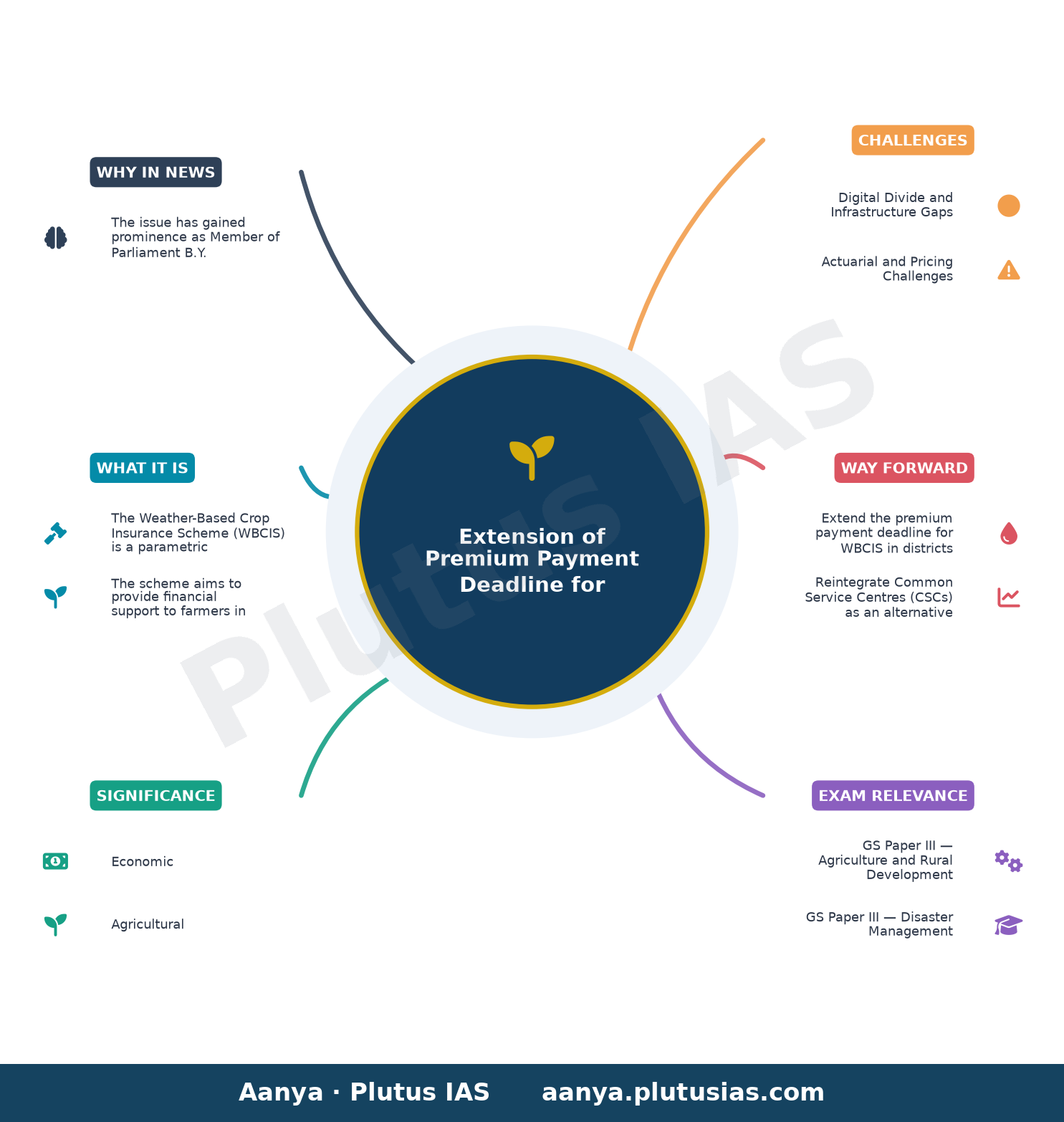
The issue has gained prominence as Member of Parliament B.Y. Raghavendra has urged the Karnataka Chief Minister to extend the deadline for premium payments under the Weather-Based Crop Insurance Scheme (WBCIS) due to a significant monsoon deficit, financial constraints faced by farmers, and technical glitches in payment systems. The request underscores the challenges in implementing agricultural insurance schemes and the need for adaptive policy measures to mitigate farmer distress.
Background
- The Weather-Based Crop Insurance Scheme (WBCIS) is a variant of the Pradhan Mantri Fasal Bima Yojana (PMFBY), designed to provide insurance coverage against weather-related risks such as deficit rainfall, excess rainfall, and unseasonal weather events.
- Karnataka has experienced a substantial monsoon deficit in 2026, with an average deficit of 34% across the state and 44% in Shivamogga district, exacerbating agricultural risks and necessitating timely insurance payouts.
- The premium payment deadline for WBCIS was initially set for July 31, 2026, with horticultural crops such as areca, pepper, ginger, and mango included under the scheme.
- Historically, farmers could pay premiums through Common Service Centres (CSCs), but the 2026 iteration mandated payments exclusively via cooperative societies or banks, leading to technical and logistical challenges.
- The shift in payment modalities, coupled with server issues and financial constraints, has impeded farmers’ ability to comply with the deadline, prompting political and administrative interventions.
- The PMFBY and its variants, including WBCIS, were launched in 2016 to address the vulnerabilities of Indian agriculture to climate variability and market fluctuations.
What is the Weather-Based Crop Insurance Scheme (WBCIS)?
- The Weather-Based Crop Insurance Scheme (WBCIS) is a parametric insurance model under the Pradhan Mantri Fasal Bima Yojana (PMFBY), where payouts are triggered by predefined weather parameters such as rainfall deficit, excess rainfall, or temperature anomalies, rather than actual crop loss.
- The scheme aims to provide financial support to farmers in the event of adverse weather conditions that affect crop yields, thereby reducing the financial burden on cultivators and enhancing agricultural resilience.
- WBCIS covers a wide range of crops, including foodgrains, oilseeds, and horticultural crops such as areca, pepper, ginger, and mango, as seen in the Karnataka context.
- Premiums for WBCIS are shared among the central government, state governments, and farmers in a specified ratio (e.g., 50:40:10 for most states), with the central government bearing the majority of the cost to ensure affordability for farmers.
- The scheme operates on a multi-peril basis, addressing risks such as drought, flood, and unseasonal rainfall, which are increasingly prevalent due to climate change.
- WBCIS employs a technology-driven approach, utilising remote sensing, weather stations, and digital platforms for premium collection, claim processing, and payout disbursal.
- The scheme is implemented in collaboration with insurance companies, state agricultural departments, and financial institutions, with the Agricultural Insurance Company of India Ltd. (AIC) serving as the primary insurer.
- WBCIS is part of a broader strategy to integrate technology and risk management in agriculture, aligning with the goals of doubling farmers’ income and ensuring food security.
Key Features
| Feature | Significance |
|---|---|
| Weather-based Crop Insurance Scheme (WBCIS) | A parametric insurance model where payouts are triggered by predefined weather indices (e.g., rainfall deficit) rather than actual crop loss, reducing moral hazard and administrative delays. |
| Premium Payment Deadline Extension | Provides fiscal relief to farmers facing liquidity constraints due to monsoon deficits, ensuring continuity of insurance coverage for horticultural crops. |
| Digital Payment Channels (Cooperative Societies/Banks) | Enhances transparency and reduces leakages but may exclude farmers without access to banking infrastructure or digital literacy. |
| Common Service Centres (CSCs) | Last-mile delivery mechanism for premium payments, though its exclusion in the current cycle highlights administrative bottlenecks. |
| Horticultural Crop Inclusion | Expands coverage to high-value crops (areca, pepper, ginger, mango), aligning with diversification goals but increasing actuarial complexity. |
Why it Matters
Economic
- Mitigates income volatility for small and marginal farmers dependent on monsoon-dependent horticulture, reducing distress migration and rural indebtedness.
- Prevents cascading financial stress in allied sectors (e.g., agro-processing, logistics) by stabilizing farm incomes.
- Reduces fiscal burden on state exchequers by averting ad-hoc relief packages post-crop failure.
Agricultural
- Encourages adoption of climate-resilient horticultural practices by de-risking investments in water-efficient crops.
- Aligns with the National Mission for Sustainable Agriculture (NMSA) by integrating weather-based risk management into farm planning.
- Supports the Pradhan Mantri Kisan Sampada Yojana (PMKSY) by safeguarding post-harvest infrastructure investments.
Administrative
- Highlights implementation gaps in digital payment ecosystems, particularly in tribal and remote districts like Shivamogga.
- Exposes the need for inter-departmental coordination between the Agriculture, Revenue, and IT departments for seamless scheme delivery.
- Underscores the importance of grievance redressal mechanisms for farmers facing technical barriers.
Social
- Protects livelihoods of marginal farmers, including Scheduled Castes and Scheduled Tribes, who are disproportionately vulnerable to climate shocks.
- Preserves rural social fabric by reducing farmer suicides linked to crop failures and indebtedness.
Challenges
1. Digital Divide and Infrastructure Gaps
- Exclusion of Common Service Centres in the current cycle disproportionately affects farmers in remote areas lacking bank branches or internet connectivity.
- Server and technical issues in cooperative societies/banks exacerbate delays, defeating the purpose of timely premium payments.
- Low digital literacy among smallholders increases dependency on intermediaries, raising risks of misinformation or exploitation.
UPSC Link: GS-III: Agricultural Marketing & Supply Chain
2. Actuarial and Pricing Challenges
- Premium rates for horticultural crops are often misaligned with actual risk profiles, leading to underinsurance or fiscal unsustainability.
- Lack of granular weather data (e.g., micro-climate variations) reduces the accuracy of payout triggers, undermining farmer trust.
- Adverse selection risks where high-risk farmers disproportionately enroll, skewing the risk pool.
UPSC Link: GS-III: Agricultural Finance & Insurance
3. Financial Constraints and Liquidity Bottlenecks
- Monsoon deficits (e.g., 44% in Shivamogga) reduce farm incomes, leaving farmers unable to pay premiums despite scheme benefits.
- Delayed disbursement of crop loans or subsidies further constrains farmers’ ability to meet premium obligations.
- High upfront costs for horticultural crops (e.g., areca, pepper) make premium payments a secondary priority for resource-constrained farmers.
UPSC Link: GS-III: Agricultural Credit & Rural Economy
4. Policy Coordination and Implementation Gaps
- Overlap between state and central schemes (e.g., PMFBY, WBCIS) creates confusion among farmers regarding eligibility and procedures.
- Inadequate awareness campaigns result in low enrollment, particularly among women farmers and tenant cultivators.
- Weak monitoring mechanisms fail to capture ground-level implementation issues, leading to reactive rather than proactive solutions.
UPSC Link: GS-II: Centre-State Relations
Challenges — UPSC Perspective
| Issue | Concern |
|---|---|
| Premium Payment Deadline | Rigid timelines fail to account for monsoon variability and farmer liquidity constraints. |
| Digital Payment Channels | Exclusion of CSCs and technical glitches disproportionately affect marginalized farmers. |
| Actuarial Pricing | Premium rates do not reflect actual risk, leading to underinsurance or fiscal strain. |
| Awareness and Outreach | Low enrollment due to inadequate dissemination of scheme benefits and procedures. |
| Monitoring and Grievance Redressal | Lack of real-time data on implementation gaps hampers corrective action. |
| Inter-departmental Coordination | Silos between Agriculture, Revenue, and IT departments delay scheme rollout. |
Government Initiatives — Must-Memorise for Prelims
- Weather-Based Crop Insurance Scheme (WBCIS)
- Pradhan Mantri Fasal Bima Yojana (PMFBY)
Way Forward
- Extend the premium payment deadline for WBCIS in districts facing monsoon deficits (e.g., Shivamogga) to prevent farmer distress.
- Reintegrate Common Service Centres (CSCs) as an alternative payment channel to bridge the digital divide in rural areas.
- Conduct targeted awareness campaigns in local languages to educate farmers on WBCIS benefits, procedures, and deadlines.
- Strengthen IT infrastructure in cooperative societies and banks to ensure seamless digital transactions and reduce server-related delays.
- Revise actuarial models to reflect micro-climate variations and actual risk profiles for horticultural crops.
- Establish a real-time grievance redressal portal for farmers to report technical or procedural issues during premium payments.
- Enhance inter-departmental coordination through regular review meetings between Agriculture, Revenue, and IT departments.
- Pilot a ‘flexible premium payment’ model where farmers can pay in installments aligned with their cash flows.
UPSC Value Addition
Keywords for Mains Answer-Writing
Weather-based Crop Insurance Scheme · Pradhan Mantri Fasal Bima Yojana (PMFBY) · Agricultural insurance mechanisms · Monsoon rainfall deficit · Farmers’ financial constraints · Agricultural policy implementation · Cooperative societies in agriculture · Digital payment failures in rural India · Agrarian distress mitigation · Union and State government coordination in agriculture
Concept Flow
Monsoon deficit (34% statewide, 44% in Shivamogga) → Reduced farm incomes → Farmers unable to pay WBCIS premiums by July 31 deadline → Exclusion of Common Service Centres → Dependency on banks/cooperatives → Technical/server issues → Delayed payments → Delayed payments → Loss of insurance coverage → Increased vulnerability to future climate shocks → Farmer distress → Risk of indebtedness/migration → Adverse impact on rural economy and allied sectors → State intervention (deadline extension) → Temporary relief but highlights systemic gaps in digital infrastructure and actuarial design → Long-term solution → Integrated weather-data systems + flexible payment models + robust grievance redressal
Prelims Practice Questions
Q1. Consider the following statements regarding the Pradhan Mantri Fasal Bima Yojana (PMFBY):
1. It is a voluntary scheme for all farmers in India.
2. Premium payment under the scheme can be made through Common Service Centres (CSCs).
3. The scheme covers only food crops and excludes horticultural crops.
4. Weather-based insurance is a component of PMFBY.
How many of the above statements are correct?
- Only one
- Only two
- Only three
- All four
Answer: Only three — Statement 1 is correct: PMFBY is voluntary for all farmers. Statement 2 is incorrect: While CSCs were previously used, the scheme now mandates payments through cooperative societies or banks. Statement 3 is incorrect: PMFBY covers both food and horticultural crops. Statement 4 is correct: Weather-based insurance is a key component of PMFBY.
Q2. Assertion (A): The Pradhan Mantri Fasal Bima Yojana (PMFBY) aims to provide financial support to farmers in the event of crop failure due to natural calamities.
Reason (R): The scheme is implemented by the Ministry of Agriculture and Farmers’ Welfare in collaboration with insurance companies.
Options:
A. Both A and R are true, and R is the correct explanation of A.
B. Both A and R are true, but R is NOT the correct explanation of A.
C. A is true, but R is false.
D. A is false, but R is true.
- A
- B
- C
- D
Answer: B — Assertion (A) is true: PMFBY provides financial support for crop failure due to natural calamities. Reason (R) is also true and correctly explains (A), as the Ministry of Agriculture and Farmers’ Welfare is the nodal agency for the scheme’s implementation.
Q3. Match the following components of the Pradhan Mantri Fasal Bima Yojana (PMFBY) with their respective descriptions:
Column I
1. Premium rates for Kharif crops
2. Premium rates for Rabi crops
3. Premium rates for horticultural crops
4. Weather-based insurance
Column II
A. 1.5% of sum insured
B. 2% of sum insured
C. 5% of sum insured
D. Premium based on weather parameters
Options:
A. 1-A, 2-B, 3-C, 4-D
B. 1-B, 2-A, 3-C, 4-D
C. 1-C, 2-B, 3-A, 4-D
D. 1-A, 2-C, 3-B, 4-D
- A
- B
- C
- D
Answer: C — The correct matching is: 1-B (Kharif crops: 2% of sum insured), 2-A (Rabi crops: 1.5% of sum insured), 3-C (Horticultural crops: 5% of sum insured), and 4-D (Weather-based insurance: premium based on weather parameters).
Mains Practice Question
✍ The Pradhan Mantri Fasal Bima Yojana (PMFBY) represents a critical intervention in mitigating agrarian distress through crop insurance. Critically examine the efficacy of PMFBY in addressing the challenges faced by farmers, particularly in the context of recent implementation gaps such as delayed premium payments and digital payment failures. Also, suggest measures to enhance the scheme’s reach and effectiveness. (15 Marks)
Approach: MODEL-ANSWER SKELETON:
1. **Introduction**: Define PMFBY, its objectives (financial protection against crop failure), and statutory basis (launched in 2016, implemented under the Ministry of Agriculture and Farmers’ Welfare).
2. **Efficacy of PMFBY**:
– **Strengths**: Broad coverage (food and horticultural crops), subsidised premiums (2% for Kharif, 1.5% for Rabi, 5% for horticultural crops), and actuarial premium rates. Highlight success in states like Maharashtra and Karnataka.
– **Implementation Gaps**: Delays in premium payments due to digital payment failures (as reported in Shivamogga district), reliance on cooperative societies/banks (excluding CSCs), and financial constraints faced by small farmers.
– **Data**: Reference to monsoon deficits (e.g., 34% average deficit in Karnataka, 44% in Shivamogga) and their impact on farmers’ ability to pay premiums.
3. **Challenges**:
– **Operational**: Technical glitches in payment portals, limited digital literacy among farmers, and exclusion of CSCs in the current iteration.
– **Structural**: Inadequate awareness campaigns, delays in claim settlements, and lack of integration with local agricultural extension services.
4. **Measures to Enhance Effectiveness**:
– **Operational Reforms**: Reintroduce CSCs as payment channels, improve digital infrastructure in rural areas, and streamline claim settlement processes.
– **Financial Inclusion**: Subsidise premiums further for marginal farmers or provide instalment-based payment options.
– **Awareness and Outreach**: Conduct grassroots-level campaigns using local leaders (e.g., MPs like B.Y. Raghavendra) to educate farmers on scheme benefits and payment procedures.
– **Monitoring**: Establish a real-time grievance redressal system and independent audits of payment portals.
5. **Conclusion**: Balance between state-led insurance schemes and market-based solutions, with a focus on last-mile delivery and farmer-centric design.
Source: The Hindu
Generated by AanyaAi for educational purpose.

- दिव्यांगजन विभाग का विशेष अभियान 6.0 : लंबित मामलों से मुक्ति और स्वच्छ कार्यालयों की ओर - September 24, 2026
- DEPwD Launches Special Campaign 6.0 for Swachh Governance & Pending Cases - September 24, 2026
- यूएनजीए81 में भारत: यूनिवर्सल हेल्थ कवरेज और हेपेटाइटिस उन्मूलन की उपलब्धियां - September 24, 2026

No Comments