


08 Aug MP Urges Karnataka CM to Extend Crop Insurance Premium Deadline Amid Monsoon Deficit
✎ The Weather-Based Crop Insurance Scheme (WBCIS) provides insurance against weather anomalies.
Subject Relevance — Where This Topic Fits
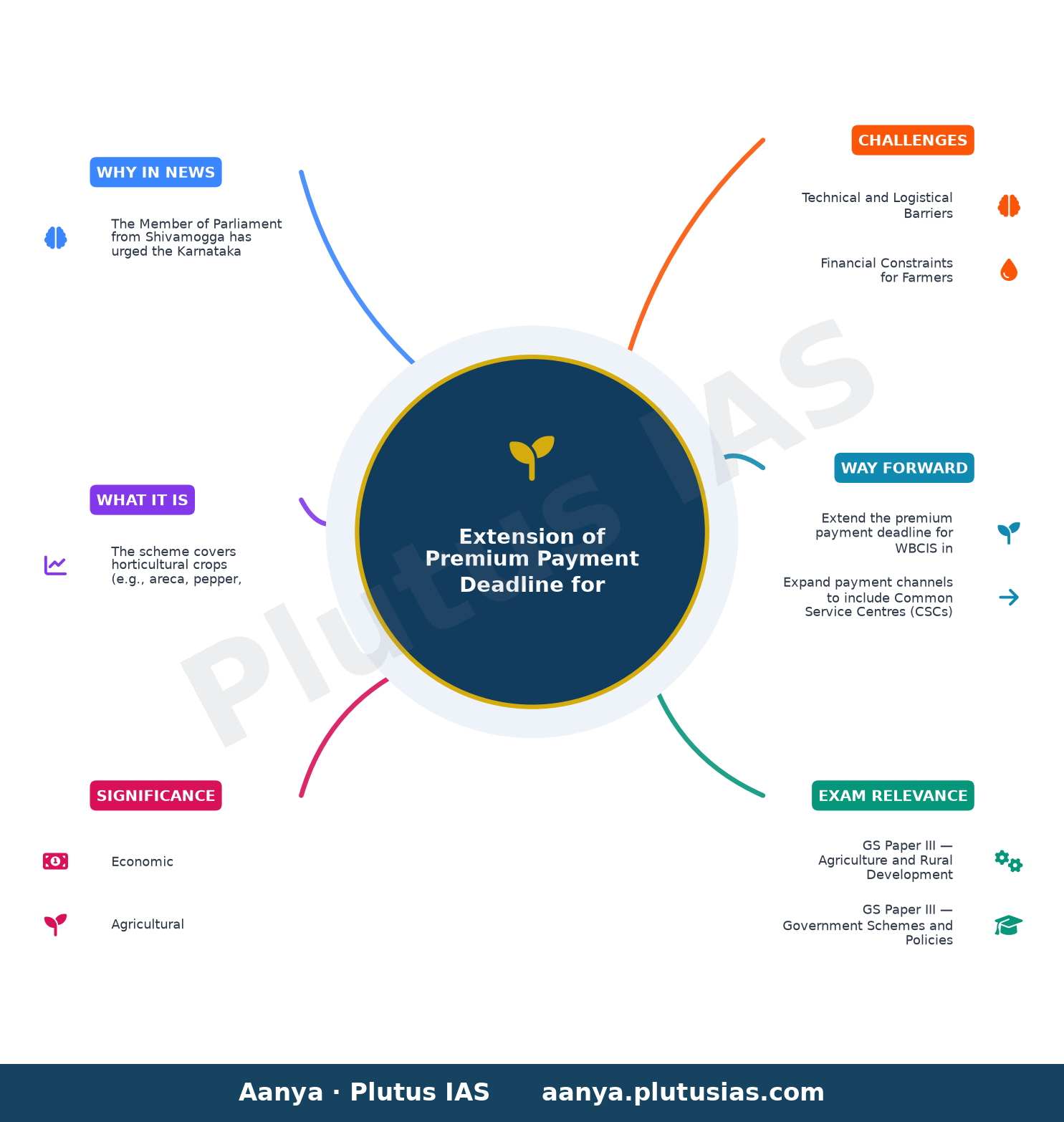
- GS Paper III — Agriculture and Rural Development | GS Paper III — Government Schemes and Policies
- Prelims: Pradhan Mantri Fasal Bima Yojana (PMFBY), Weather-Based Crop Insurance Scheme (WBCIS), Crop Insurance Premium, Monsoon Deficit, Horticultural Crops, Common Service Centres (CSCs), Cooperative Societies, Technical Glitches in Payment Systems
- Essay: Agrarian distress and the role of insurance mechanisms in mitigating farmer vulnerabilities, Technological interventions in agricultural governance: Challenges and opportunities
Quick Revision: The Weather-Based Crop Insurance Scheme (WBCIS) provides insurance against weather anomalies.
Why is this in the news?
The Member of Parliament from Shivamogga has urged the Karnataka Chief Minister to extend the deadline for paying premiums under the Weather-Based Crop Insurance Scheme (WBCIS), citing a significant monsoon rainfall deficit of 34% in the state and 44% in Shivamogga district. The request highlights operational challenges, including the mandatory shift from Common Service Centres to cooperative societies and banks, which reportedly caused technical delays, thereby impeding farmers’ ability to meet the July 31 deadline.
Background
- The WBCIS specifically covers horticultural crops such as areca, pepper, ginger, and mango, which are highly vulnerable to weather anomalies.
- In Karnataka, the premium payment deadline for the current season was July 31, 2026, under the WBCIS.
- Farmers historically had the option to pay premiums through Common Service Centres (CSCs), but this year, the process was restricted to cooperative societies and banks, leading to operational bottlenecks.
- The state has recorded a significant rainfall deficit this monsoon, exacerbating the financial strain on farmers and increasing the urgency for timely insurance coverage.
What is the Weather-Based Crop Insurance Scheme (WBCIS)?
- The scheme covers horticultural crops (e.g., areca, pepper, ginger, mango), with premium rates varying by crop type.
Key Features
| Feature | Significance |
|---|---|
| Weather-based Crop Insurance Scheme (WBCIS) | Provides financial protection to farmers against adverse weather events such as deficit rainfall, excess rainfall, or temperature fluctuations, thereby mitigating income losses. |
| Premium Payment Deadline Extension | Allows farmers additional time to pay premiums, addressing logistical and financial constraints, especially in regions with significant rainfall deficits. |
| Inclusion of Horticultural Crops | Expands coverage to high-value crops like areca, pepper, ginger, and mango, supporting diversification and income stability for farmers. |
| Payment Channels (Cooperative Societies & Banks) | Ensures formal financial inclusion and reduces dependency on informal credit sources, though technical issues may hinder accessibility. |
| Common Service Centres (CSC) Exclusion | Limits payment options, potentially excluding farmers in remote areas without bank access or cooperative society membership. |
Why it Matters
Economic
- Mitigates financial distress for farmers in drought-prone regions, preventing distress sales of assets or migration.
- Supports rural demand and agricultural sector stability, contributing to food security and economic growth.
- Reduces dependency on informal credit, lowering long-term debt burdens on farmers.
Agricultural
- Provides a safety net against climate variability, encouraging sustainable farming practices.
- Incentivizes the adoption of high-value horticultural crops, diversifying agricultural income sources.
- Enhances resilience of small and marginal farmers to weather-related shocks.
Policy Implementation
- Highlights the need for adaptive policy frameworks to address implementation gaps, such as technical failures in payment systems.
- Demonstrates the importance of inclusive financial infrastructure to ensure equitable access to insurance schemes.
Challenges
1. Technical and Logistical Barriers
- Server and connectivity issues in bank/cooperative society portals hinder premium payments.
- Limited access to formal banking channels in remote areas excludes farmers from payment options.
UPSC Link: GS3: Agricultural Marketing & Insurance
2. Financial Constraints for Farmers
- Rainfall deficits (e.g., 44% in Shivamogga) reduce farm incomes, making premium payments unaffordable.
- Delayed payments or high premiums may discourage participation in insurance schemes.
UPSC Link: GS3: Farm Subsidies & Credit
3. Policy Design Flaws
- Exclusion of CSC as a payment channel limits accessibility for farmers without bank access.
- Strict deadlines may not account for regional variations in monsoon patterns or local financial conditions.
UPSC Link: GS2: Centre-State Relations (Agriculture)
4. Climate Vulnerability
- Increasing frequency of extreme weather events (e.g., droughts) strains the financial sustainability of insurance schemes.
- Lack of real-time weather data integration may reduce the scheme’s effectiveness in risk mitigation.
UPSC Link: GS3: Climate Change & Agriculture
Challenges — UPSC Perspective
| Issue | Concern |
|---|---|
| Payment System Failures | Technical glitches in bank/cooperative portals delay premium payments. |
| Limited Financial Inclusion | Farmers in remote areas lack access to formal banking channels. |
| Affordability Constraints | Rainfall deficits reduce farm incomes, making premiums unaffordable. |
| Policy Rigidity | Fixed deadlines do not accommodate regional weather variations or local conditions. |
| Exclusion of Alternative Channels | Removal of CSC option restricts payment flexibility for farmers. |
Way Forward
- Extend the premium payment deadline for WBCIS in drought-affected districts to ensure farmer participation.
- Expand payment channels to include Common Service Centres (CSCs) and digital wallets for broader accessibility.
- Strengthen technical infrastructure for bank and cooperative society portals to prevent payment failures.
- Introduce flexible premium payment options, such as installments or subsidies, for low-income farmers.
- Enhance real-time weather data integration to improve the accuracy and timeliness of insurance payouts.
- Conduct awareness campaigns to educate farmers on the benefits and procedures of the scheme.
- Collaborate with state governments to address regional disparities in monsoon patterns and financial access.
UPSC Value Addition
Keywords for Mains Answer-Writing
Weather-based Crop Insurance Scheme (WBCIS) · Pradhan Mantri Fasal Bima Yojana (PMFBY) · Agricultural insurance mechanisms · Monsoon rainfall deficit · Farmers’ financial constraints · Premium payment deadlines · Institutional delivery of agricultural schemes · Digital payment infrastructure in rural India · Cooperative societies and banks · Agrarian distress and policy gaps
Concept Flow
Monsoon deficit (34% state-wide, 44% in Shivamogga) → Reduced farm incomes → Financial inability to pay premiums → Exclusion from insurance coverage → Increased vulnerability to future shocks → Payment system transition (CSC to banks/cooperatives) → Technical failures → Delayed premium payments → Farmer exclusion → Policy implementation gaps → Inclusion of horticultural crops in WBCIS → Higher premiums → Financial burden on farmers → Low participation → Reduced risk mitigation → State-level appeal for deadline extension → Policy response → Potential resolution → Improved farmer participation → Enhanced agricultural resilience
Prelims Practice Questions
Q1. Consider the following statements regarding the Weather-based Crop Insurance Scheme (WBCIS):
1. It is a component of the Pradhan Mantri Fasal Bima Yojana (PMFBY).
2. The premium payment deadline for farmers is uniformly set across all states.
3. Farmers can pay premiums through Common Service Centres (CSCs) as well as cooperative societies or banks.
4. The scheme covers horticultural crops such as areca, pepper, ginger, and mango.
How many of the above statements are correct?
- Only one
- Only two
- Only three
- All four
Answer: Only three — Statements 1 and 4 are correct. Statement 2 is incorrect as deadlines may vary by state. Statement 3 is incorrect as the article specifies that this year, farmers were required to pay only through cooperative societies or banks, excluding CSCs.
Q2. Assertion (A): The Weather-based Crop Insurance Scheme (WBCIS) aims to mitigate the financial risks faced by farmers due to weather anomalies.
Reason (R): The scheme provides compensation to farmers when rainfall deficits exceed a predefined threshold.
Options:
A. Both A and R are true, and R is the correct explanation of A.
B. Both A and R are true, but R is not the correct explanation of A.
C. A is true, but R is false.
D. A is false, but R is true.
- A
- B
- C
- D
Answer: B — Both the assertion and reason are correct. The WBCIS is designed to protect farmers from weather-related risks, including rainfall deficits, by providing compensation when predefined thresholds are breached. The reason correctly explains the assertion.
Q3. Match the following agricultural schemes with their primary objectives:
Column I (Scheme) | Column II (Objective)
— | —
A. Pradhan Mantri Fasal Bima Yojana (PMFBY) | 1. Provides life insurance cover to farmers
B. Weather-based Crop Insurance Scheme (WBCIS) | 2. Covers crop yield losses due to weather anomalies
C. Pradhan Mantri Kisan Maan-Dhan Yojana (PM-KMY) | 3. Provides financial support to small and marginal farmers in their old age
D. National Agriculture Market (e-NAM) | 4. Creates a unified national market for agricultural commodities
Options:
A. A-2, B-4, C-1, D-3
B. A-2, B-1, C-3, D-4
C. A-4, B-2, C-1, D-3
D. A-2, B-3, C-1, D-4
- A
- B
- C
- D
Answer: B — The correct match is: A-2 (PMFBY covers crop yield losses due to weather anomalies), B-4 (WBCIS covers crop losses due to weather anomalies, not life insurance), C-1 (PM-KMY provides life insurance cover), D-3 (e-NAM creates a unified national market).
Mains Practice Question
✍ The Weather-based Crop Insurance Scheme (WBCIS) represents a critical intervention in India’s agricultural policy framework to address climate-induced risks. Critically examine the efficacy of such insurance schemes in mitigating agrarian distress, with particular reference to recent challenges in their implementation. Also, analyse the structural limitations in the institutional delivery of these schemes that undermine their intended benefits. (15 Marks)
Approach: MODEL-ANSWER SKELETON:
1. **Introduction (2 marks)**: Define WBCIS and its linkage to PMFBY. State its objective: to provide financial protection to farmers against weather-related risks (e.g., rainfall deficit, excess rainfall, temperature anomalies).
2. **Efficacy in Mitigating Agrarian Distress (5 marks)**:
– **Strengths**:
– Provides a safety net for small and marginal farmers vulnerable to climate variability.
– Reduces indebtedness by compensating for yield losses, as seen in states like Karnataka where rainfall deficits have been severe (e.g., 44% in Shivamogga).
– Encourages adoption of modern agricultural practices by reducing risk aversion.
– **Limitations**:
– **Inadequate coverage**: Only a fraction of farmers (approx. 30% under PMFBY in 2023-24) are enrolled due to awareness gaps and exclusion errors.
– **Delayed compensation**: Payouts are often delayed due to complex claim settlement processes and bureaucratic hurdles.
– **Premium affordability**: Financial constraints prevent timely premium payments, as highlighted in the recent case from Karnataka.
– **Data dependency**: Reliance on IMD data for claim triggers can be contentious due to measurement inaccuracies or delays.
3. **Structural Limitations in Institutional Delivery (5 marks)**:
– **Digital divide**: Exclusion of Common Service Centres (CSCs) in the current year’s payment mechanism exacerbates access issues for farmers in remote areas.
– **Technical glitches**: Server failures and lack of digital literacy hinder premium payments, as reported in the article.
– **Over-reliance on cooperatives and banks**: Limited reach of these institutions in tribal and hilly regions, where farmers face higher climate risks.
– **Lack of grievance redressal**: Absence of a robust mechanism for farmers to report issues or seek extensions, as seen in the deadline extension appeal.
– **State-level variability**: Inconsistent implementation across states leads to differential benefits and exclusion of eligible farmers.
4. **Way Forward (3 marks)**:
– **Expanding payment channels**: Reintroduce CSCs and explore mobile-based payment solutions (e.g., UPI, Aadhaar-linked payments) to enhance accessibility.
– **Simplifying processes**: Streamline claim settlement and premium payment deadlines to reduce bureaucratic delays.
– **Enhancing data accuracy**: Invest in real-time weather monitoring systems and transparent data-sharing mechanisms.
– **Awareness campaigns**: Conduct targeted outreach programs in vernacular languages to improve farmer participation.
– **Inclusive design**: Involve local self-governments (Panchayats) in scheme delivery to ensure last-mile connectivity.
Source: The Hindu
Generated by AanyaAi for educational purpose.

- Gujarat UCC Bill: Key Features for UPSC & State PCS Exam - October 3, 2026
- इंदिरा गांधी प्राणी उद्यान में वन्यजीव सप्ताह का शुभारंभ, जानिए मुख्य गतिविधियां - October 3, 2026
- Sharam Samvad: Govt’s PR Campaign for Labour Codes in Delhi-NCR & Uttarakhand - October 2, 2026

No Comments