


08 Aug MP urges Karnataka CM to extend crop insurance premium deadline amid rainfall deficit
✎ Weather-Based Crop Insurance Scheme (WBCIS) under PMFBY provides parametric insurance against adverse weather events, with premiums subsidized by the government and payouts triggered by IMD weather data, ensuring timely…
Subject Relevance — Where This Topic Fits
- GS Paper III — Agriculture and Rural Development | GS Paper III — Disaster Management
- Prelims: Weather-based Crop Insurance Scheme (WBCIS), Pradhan Mantri Fasal Bima Yojana (PMFBY), Crop insurance premium payment deadlines, Monsoon rainfall deficit, Common Service Centres (CSCs), Cooperative societies and banks in agricultural finance, Horticultural crops insurance, Agri-tech and digital payment failures
- Essay: Agrarian distress and policy interventions: Balancing fiscal prudence with farmer welfare, Climate change and its impact on agricultural productivity: The case for adaptive governance
Quick Revision: Weather-Based Crop Insurance Scheme (WBCIS) under PMFBY provides parametric insurance against adverse weather events, with premiums subsidized by the government and payouts triggered by IMD weather data, ensuring timely compensation to farmers for yield losses.
Why is this in the news?
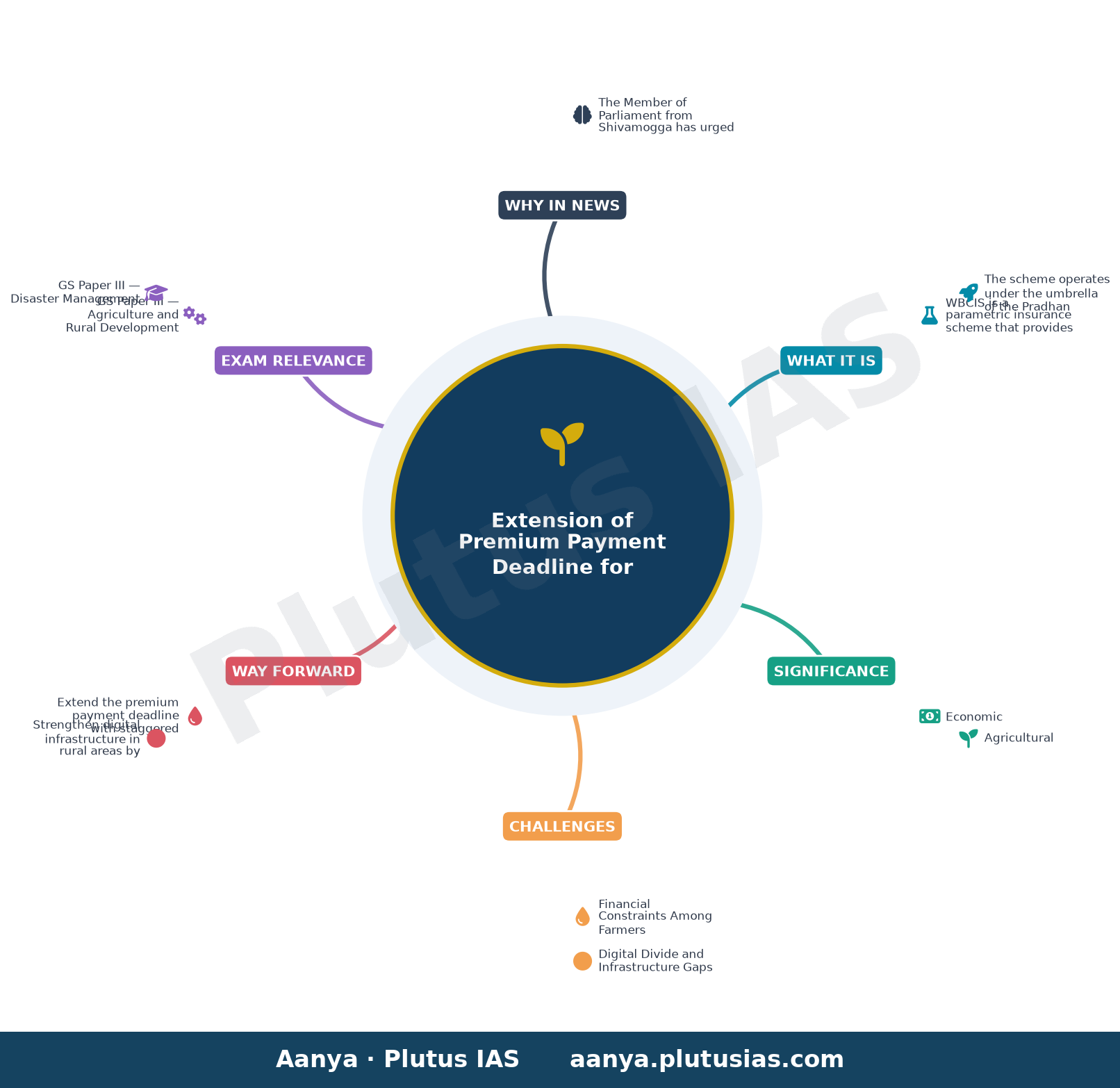
The Member of Parliament from Shivamogga has urged the Karnataka Chief Minister to extend the deadline for farmers to pay premiums under the weather-based crop insurance scheme, citing a significant monsoon rainfall deficit of 34% across the state and 44% in Shivamogga district. The urgency stems from financial constraints faced by farmers, exacerbated by technical glitches in digital payment systems and the exclusion of Common Service Centres as payment channels this year, necessitating a farmer-centric policy response.
Background
- Weather-based Crop Insurance Scheme (WBCIS) is a sub-scheme under the Pradhan Mantri Fasal Bima Yojana (PMFBY), launched in 2016 to provide insurance coverage against adverse weather events such as excess rainfall, drought, or unseasonal rains.
- The scheme aims to stabilize farm incomes by compensating farmers for yield losses due to weather variability, thereby reducing the financial burden on agricultural households.
- In Karnataka, the scheme has been extended to include horticultural crops such as areca, pepper, ginger, and mango, reflecting the state’s diversified agricultural profile and the vulnerability of high-value crops to climatic shocks.
- The premium payment deadline for the current season was set as July 31, 2026, but farmers faced challenges due to a 34% rainfall deficit in the state, with Shivamogga district experiencing a 44% deficit, exacerbating agricultural distress.
- Historically, Common Service Centres (CSCs) have served as accessible payment channels for farmers, but this year, the government mandated payments only through cooperative societies or banks, leading to technical failures and delays.
- The demand for an extension aligns with broader concerns about the accessibility and effectiveness of digital payment infrastructure in rural India, particularly in the context of agri-insurance schemes.
What is the Weather-Based Crop Insurance Scheme (WBCIS)?
- WBCIS is a parametric insurance scheme that provides financial protection to farmers against yield losses caused by adverse weather events, such as excess rainfall, drought, or heatwaves, without requiring on-ground crop cutting experiments.
- The scheme operates under the umbrella of the Pradhan Mantri Fasal Bima Yojana (PMFBY), which was launched in 2016 to replace the erstwhile National Agricultural Insurance Scheme (NAIS) and Modified National Agricultural Insurance Scheme (MNAIS).
- WBCIS uses weather data from India Meteorological Department (IMD) stations to trigger payouts when predefined weather thresholds (e.g., rainfall deficit of 19% or more) are breached, ensuring timely compensation to farmers.
- The scheme covers both food crops (e.g., rice, wheat, millets) and horticultural crops (e.g., areca, coconut, banana, mango), with premium rates varying based on the crop and region, typically ranging from 1.5% to 5% of the sum insured.
- The government subsidizes the premium, with farmers paying only 2% of the sum insured for kharif crops, 1.5% for rabi crops, and 5% for horticultural crops, while the remaining premium is shared equally by the central and state governments.
- Payouts are made directly to farmers’ bank accounts through the Aadhaar-enabled Payment System (AePS), ensuring transparency and reducing leakages in the disbursement process.
- The scheme also includes provisions for post-harvest losses due to cyclonic rains or unseasonal weather, providing a safety net for farmers during critical periods.
- WBCIS is implemented through a network of insurance companies, banks, cooperative societies, and agricultural departments, with the Indian Council of Agricultural Research (ICAR) providing technical support for crop modeling and risk assessment.
Key Features
| Feature | Significance |
|---|---|
| Weather-based crop insurance scheme | Provides financial protection to farmers against weather-related risks such as deficient rainfall, ensuring income stability and reducing vulnerability to climate variability. |
| Premium payment deadline extension | Aims to accommodate farmers facing financial or technical constraints, ensuring broader coverage and preventing exclusion due to procedural hurdles. |
| Inclusion of horticultural crops | Expands the scope of the scheme to cover high-value crops like areca, pepper, ginger, and mango, supporting diversification and rural livelihoods. |
| Payment through cooperative societies or banks | Enhances formal financial inclusion by leveraging existing rural institutional networks, though it may pose challenges for farmers without access. |
| Server and technical issues | Highlights systemic inefficiencies in digital payment infrastructure, which can undermine the scheme’s accessibility and effectiveness. |
Why it Matters
Economic
- Mitigates financial losses for farmers due to climate-induced crop failures, thereby stabilising rural incomes and reducing distress migration.
- Encourages investment in high-value horticultural crops by reducing perceived risk, potentially boosting agricultural productivity and export earnings.
- Prevents debt traps by providing a safety net, reducing the reliance on informal credit sources during crop failures.
Agricultural
- Promotes climate-resilient agriculture by incentivising farmers to adopt weather-dependent crops with insurance coverage.
- Supports crop diversification beyond traditional staples, enhancing farm resilience to market and environmental shocks.
- Aligns with the National Mission for Sustainable Agriculture (NMSA) by integrating risk management into agricultural planning.
Social
- Protects marginalised and smallholder farmers, who are most vulnerable to climate variability, thereby reducing rural poverty.
- Ensures gender-inclusive benefits by covering crops cultivated by women farmers, particularly in horticulture-based livelihoods.
- Reduces farmer suicides linked to crop failures and indebtedness, addressing a critical public health concern.
Administrative
- Demonstrates the need for adaptive governance in implementing welfare schemes, particularly in the face of climate variability.
- Highlights the importance of robust digital infrastructure for financial inclusion and service delivery in rural areas.
- Underscores the role of elected representatives in advocating for timely policy adjustments to address ground realities.
Challenges
1. Financial Constraints Among Farmers
- Small and marginal farmers often lack liquidity to pay premiums, especially during deficit monsoons when income is already constrained.
- High premium rates for horticultural crops may deter participation, despite their economic importance.
UPSC Link: GS 3: Agricultural Finance
2. Digital Divide and Infrastructure Gaps
- Limited internet connectivity and digital literacy in rural areas impede online premium payments, exacerbating exclusion.
- Technical glitches in payment gateways and banking systems create procedural barriers, defeating the scheme’s purpose.
UPSC Link: GS 3: Digital Infrastructure
3. Climate Variability and Data Accuracy
- Deficient rainfall data may not accurately reflect localised climatic variations, leading to under-compensation or disputes.
- Lag in weather forecasting and insurance payout triggers delays financial relief to farmers in need.
UPSC Link: GS 3: Climate Change
4. Institutional Capacity and Awareness
- Cooperative societies and banks may lack the capacity to handle large-scale premium collections, particularly during peak periods.
- Low awareness among farmers about claim processes and eligibility criteria reduces the scheme’s effectiveness.
UPSC Link: GS 2: Governance
5. Policy Implementation Gaps
- Short deadlines for premium payments may not account for regional disparities in monsoon onset and crop cycles.
- Lack of inter-departmental coordination between agriculture, revenue, and financial institutions hampers seamless implementation.
UPSC Link: GS 2: Policy Implementation
Challenges — UPSC Perspective
| Issue | Concern |
|---|---|
| Premium affordability | Financial burden on small farmers during deficit monsoons |
| Digital payment infrastructure | Unreliable internet and banking systems in rural areas |
| Weather data reliability | Inaccuracies in rainfall measurements affecting payouts |
| Institutional bottlenecks | Overburdened cooperative societies and banks |
| Farmer awareness | Low understanding of claim processes and benefits |
| Policy rigidity | Fixed deadlines not aligned with regional agricultural calendars |
Government Initiatives — Must-Memorise for Prelims
- Pradhan Mantri Fasal Bima Yojana (PMFBY)
- Weather-Based Crop Insurance Scheme (WBCIS)
Way Forward
- Extend the premium payment deadline with staggered timelines based on regional monsoon patterns to accommodate local agricultural cycles.
- Strengthen digital infrastructure in rural areas by expanding Common Service Centres (CSCs) and improving banking network coverage.
- Conduct targeted awareness campaigns in local languages to educate farmers on premium payment processes, claim procedures, and benefits.
- Simplify the payment process by reintroducing multiple channels, including CSCs, to reduce dependency on a single system.
- Enhance real-time weather data collection and validation through partnerships with meteorological agencies and local institutions.
- Provide financial literacy programmes to help farmers budget for premium payments and understand risk mitigation strategies.
- Establish grievance redressal mechanisms at the district level to address technical and procedural issues promptly.
- Integrate PMFBY and WBCIS databases to streamline data sharing and reduce duplication in farmer enrolment.
UPSC Value Addition
Keywords for Mains Answer-Writing
Weather-based Crop Insurance Scheme (WBCIS) · Pradhan Mantri Fasal Bima Yojana (PMFBY) · Agricultural insurance mechanisms · Monsoon rainfall deficit · Farmer distress and financial constraints · Crop insurance premium payment deadlines · Institutional delivery of agricultural schemes · Digital governance challenges in rural India · Horticultural crop insurance · Role of cooperative societies and banks in agricultural credit · Climate vulnerability and agricultural risk mitigation · Farmers’ welfare and policy implementation
Concept Flow
Deficient monsoon (34% deficit) → Reduced farm incomes → Inability to pay premiums → Exclusion from insurance coverage → Payment process shift to banks/cooperatives → Digital divide and technical issues → Failed premium payments → MP’s appeal for deadline extension → Government intervention → Potential policy adjustment → Extended deadline → Successful premium payments → Enhanced crop insurance coverage → Increased coverage → Financial protection for farmers → Reduced vulnerability to climate shocks → Strengthened rural financial systems → Improved digital infrastructure → Long-term resilience
Prelims Practice Questions
Q1. Consider the following statements regarding the Weather-based Crop Insurance Scheme (WBCIS) in India:
1. The scheme is implemented under the Pradhan Mantri Fasal Bima Yojana (PMFBY).
2. The premium payment deadline for farmers under the scheme is uniformly set across all states.
3. The scheme covers horticultural crops such as areca, pepper, ginger, and mango.
4. Farmers can pay the premium through Common Service Centres (CSCs) as well as cooperative societies or banks.
How many of the above statements are correct?
- Only one
- Only two
- Only three
- All
Answer: Only three — Statements 1 and 3 are correct. Statement 2 is incorrect because deadlines may vary by state and district. Statement 4 is incorrect as the news specifies that this year, premiums could only be paid through cooperative societies or banks, not CSCs.
Q2. Assertion (A): The Weather-based Crop Insurance Scheme (WBCIS) is designed to mitigate the financial risks faced by farmers due to unpredictable weather events.
Reason (R): The scheme provides insurance coverage based on weather parameters such as rainfall deficit, which directly impact crop yields.
In the context of the above two statements, which one of the following is correct?
- Both A and R are true, and R is the correct explanation of A.
- Both A and R are true, but R is NOT the correct explanation of A.
- A is true, but R is false.
- A is false, but R is true.
Answer: Both A and R are true, and R is the correct explanation of A. — Both Assertion (A) and Reason (R) are true, and R correctly explains A. The WBCIS specifically uses weather parameters like rainfall deficit as triggers for insurance payouts, thereby addressing financial risks to farmers.
Q3. Match the following agricultural schemes with their respective objectives:
Column I (Scheme) | Column II (Objective)
— | —
A. Pradhan Mantri Fasal Bima Yojana (PMFBY) | 1. Provides life insurance cover to farmers
B. Weather-based Crop Insurance Scheme (WBCIS) | 2. Covers crop losses due to weather parameters like rainfall deficit
C. Pradhan Mantri Kisan Maan-Dhan Yojana (PM-KMY) | 3. Provides income support to farmers
D. Pradhan Mantri Kisan Samman Nidhi (PM-KISAN) | 4. Provides financial assistance to small and marginal farmers
Select the correct match:
- A-2, B-1, C-4, D-3
- A-2, B-4, C-1, D-3
- A-3, B-2, C-1, D-4
- A-4, B-2, C-1, D-3
Answer: A-2, B-1, C-4, D-3 — Correct matches: A (PMFBY) with 2 (covers crop losses due to weather parameters), B (WBCIS) with 2 (same as A, but WBCIS is a sub-scheme under PMFBY), C (PM-KMY) with 1 (provides life insurance cover), D (PM-KISAN) with 3 (provides income support).
Mains Practice Question
✍ Critically examine the challenges in the implementation of the Weather-based Crop Insurance Scheme (WBCIS) in India, with particular reference to the recent controversy surrounding the premium payment deadline in Karnataka. Also, assess the adequacy of institutional mechanisms in addressing these challenges. (15 Marks)
Approach: MODEL-ANSWER SKELETON:
1. **Introduction (2 marks)**: Define WBCIS as a sub-scheme under PMFBY, designed to insure farmers against weather-related risks such as rainfall deficit. Highlight its objectives: risk mitigation, financial security, and climate resilience.
2. **Challenges in Implementation (8 marks)**:
– **Deadline Rigidity vs. Farmer Constraints**: Discuss how rigid deadlines (e.g., July 31) clash with farmer financial constraints, especially in deficit rainfall years (e.g., 34% deficit in Karnataka). Cite the news report’s data on Shivamogga district’s 44% deficit.
– **Digital Divide and Technical Barriers**: Explain the shift from Common Service Centres (CSCs) to cooperative societies/banks, leading to server issues and accessibility problems for small farmers.
– **Institutional Delivery Gaps**: Critique the reliance on cooperative societies and banks, which may lack the reach or capacity of CSCs, particularly in remote areas.
– **Policy Coherence**: Highlight the disconnect between the scheme’s design (weather-based triggers) and ground realities (farmer awareness, digital literacy, and financial inclusion).
3. **Institutional Mechanisms and Reforms (5 marks)**:
– **Strengths**: Acknowledge PMFBY’s scale (covering ~50% of cropped area) and its risk-sharing model (Centre:State:Farmer = 50:30:20).
– **Weaknesses**: Point to the lack of flexibility in deadlines, inadequate digital infrastructure in rural areas, and insufficient grievance redressal mechanisms.
– **Reforms**: Propose solutions such as dynamic deadlines tied to monsoon progress, multi-channel premium payment options (CSCs, banks, mobile apps), and capacity-building for cooperative societies.
– **Role of State Governments**: Emphasize the need for proactive measures by states (e.g., Karnataka’s extension of deadlines) to address farmer distress.
4. **Conclusion (2 marks)**: Summarize the need for a balanced approach—rigorous implementation of WBCIS while ensuring flexibility and inclusivity. Stress that climate resilience in agriculture requires not just insurance schemes but also robust institutional support and adaptive policy frameworks.
Source: The Hindu
Generated by AanyaAi for educational purpose.

- दिव्यांगजन विभाग का विशेष अभियान 6.0 : लंबित मामलों से मुक्ति और स्वच्छ कार्यालयों की ओर - September 24, 2026
- DEPwD Launches Special Campaign 6.0 for Swachh Governance & Pending Cases - September 24, 2026
- यूएनजीए81 में भारत: यूनिवर्सल हेल्थ कवरेज और हेपेटाइटिस उन्मूलन की उपलब्धियां - September 24, 2026

No Comments