


05 Aug MPC Unanimously Keeps Repo Rate at 5.25% in August 2026: Key Takeaways for UPSC
✎ The MPC’s unanimous decision to maintain the repo rate at 5.25% and retain a neutral stance underscores its focus on balancing growth objectives with inflation control amid global economic volatility.
Subject Relevance — Where This Topic Fits
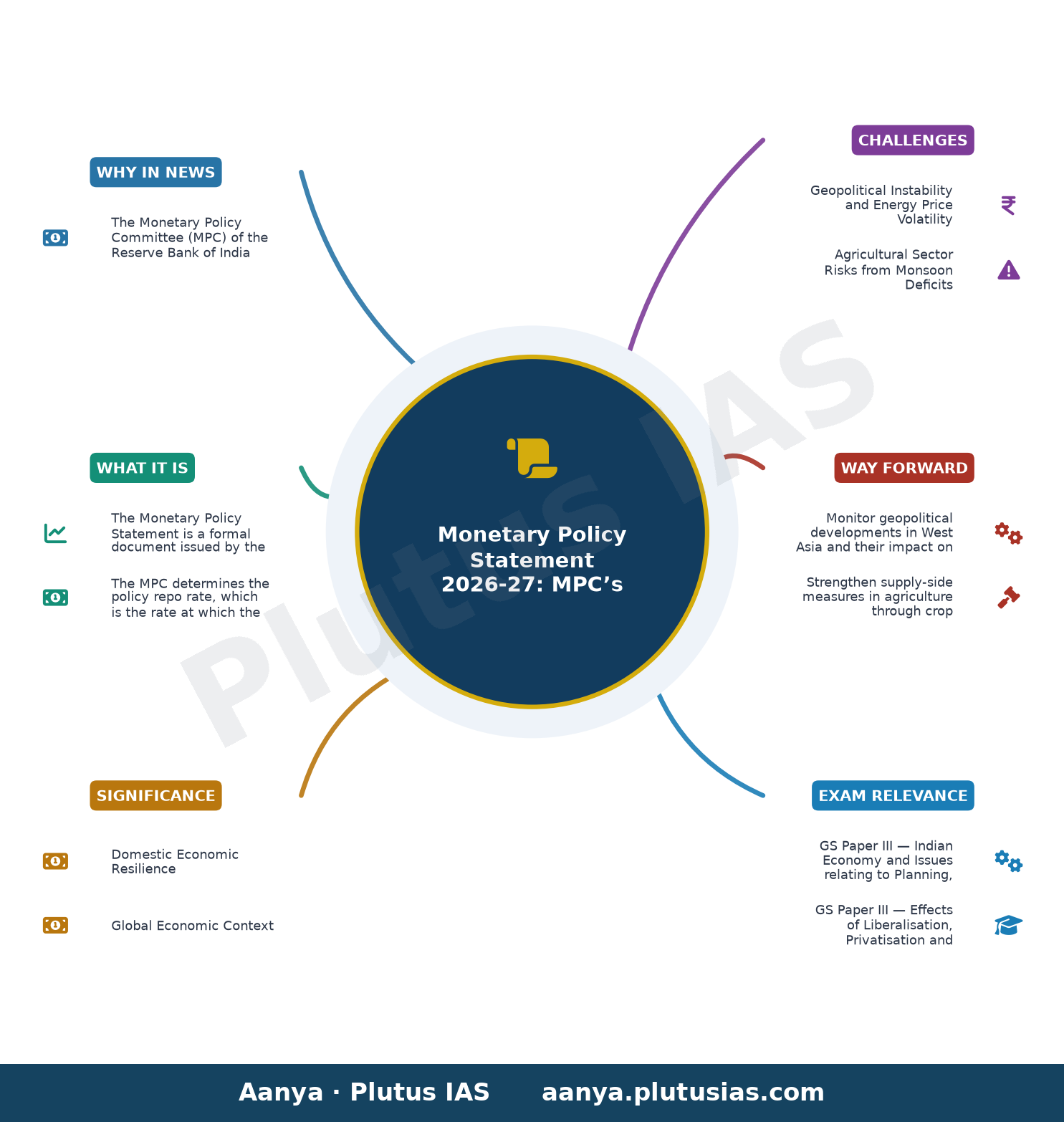
- GS Paper III — Indian Economy and Issues relating to Planning, Mobilisation of Resources, Growth, Development and Employment | GS Paper III — Effects of Liberalisation, Privatisation and Globalisation on the Economy
- Prelims: Monetary Policy Committee (MPC), Repo Rate, Standing Deposit Facility (SDF), Marginal Standing Facility (MSF), Bank Rate, Neutral Stance, CPI Inflation, GDP Growth Projection, El Niño, GST Rationalisation
- Essay: Economic Resilience in a Volatile Global Order: Lessons from India’s Monetary Policy 2026-27, Sustainable Development and Climate-Resilient Agriculture: Policy Interventions in the Face of El Niño
Quick Revision: The MPC’s unanimous decision to maintain the repo rate at 5.25% and retain a neutral stance underscores its focus on balancing growth objectives with inflation control amid global economic volatility.
Why is this in the news?
The Monetary Policy Committee (MPC) of the Reserve Bank of India (RBI) concluded its 62nd meeting on August 5, 2026, announcing a unanimous decision to maintain the policy repo rate at 5.25%, alongside a neutral stance, in response to evolving macroeconomic conditions. This decision is significant as it reflects the RBI’s assessment of domestic resilience amid global economic turbulence, including persistent inflation, geopolitical conflicts, and volatile commodity prices.
Background
- The Monetary Policy Committee (MPC), established under the RBI Act, 1934, is a statutory body responsible for determining the benchmark policy interest rate to achieve the inflation target while supporting growth.
- The MPC operates with a quorum of four members and a casting vote for the Chairperson, ensuring collective decision-making in monetary policy formulation.
- India’s monetary policy has historically balanced inflation control with growth stimulation, particularly in the post-liberalisation era where external sector integration has increased.
- The global economic environment in 2026 has been marked by heightened uncertainty, including geopolitical tensions in West Asia, volatile oil prices, and divergent monetary policy stances among major central banks.
- Domestic economic indicators such as private consumption, investment, and services exports have shown resilience despite global headwinds, underscoring India’s structural strengths.
- The persistence of El Niño conditions in 2026 has raised concerns about agricultural output and rural demand, necessitating policy interventions to mitigate adverse impacts.
What is the Monetary Policy Statement, and what are its key components?
- The Monetary Policy Statement is a formal document issued by the RBI’s Monetary Policy Committee (MPC) after its bi-monthly meetings, outlining decisions on policy rates, stance, and forward guidance.
- The MPC determines the policy repo rate, which is the rate at which the RBI lends to commercial banks under the Liquidity Adjustment Facility (LAF), influencing broader interest rates in the economy.
- The neutral stance adopted by the MPC implies that the RBI does not have a bias towards either tightening or easing monetary policy, allowing flexibility to respond to evolving economic conditions.
- The Standing Deposit Facility (SDF) rate, Marginal Standing Facility (MSF) rate, and Bank Rate are auxiliary rates that complement the repo rate to manage liquidity and provide emergency funding to banks.
- The MPC’s decisions are guided by the inflation target set by the Government of India, currently at 4% with a tolerance band of ±2%, ensuring price stability while supporting economic growth.
- Forward guidance in the policy statement provides insights into the MPC’s assessment of future economic conditions, aiding market participants in their decision-making.
- The policy statement also includes projections for GDP growth and inflation, which are critical for policy planning and market expectations.
- The MPC’s decisions are based on a detailed assessment of macroeconomic and financial developments, including global trends, domestic demand, and supply-side factors.
Key Features
| Feature | Significance |
|---|---|
| Unchanged Repo Rate (5.25%) | Maintains cost of funds for banks, ensuring stability in credit markets and transmission of monetary policy. |
| Neutral Monetary Stance | Balances growth and inflation objectives without explicit tightening or loosening, allowing flexibility in policy adjustments. |
| Real GDP Growth Projection (6.7% for 2026-27) | Signals optimism about domestic economic resilience despite global headwinds, with balanced risks across quarters. |
| CPI Inflation at 4.4% (June 2026) | Indicates upward pressure on prices after prolonged sub-target levels, requiring vigilance to prevent second-round effects. |
| Supply-Side Measures for Agriculture | Mitigates risks from deficient monsoon and El Niño through crop diversification, water conservation, and climate-resilient practices. |
| Robust Services Exports | Diversification and trade agreements sustain external demand, offsetting potential declines in merchandise exports. |
Why it Matters
Domestic Economic Resilience
- Indian economy demonstrates strong fundamentals with steady private consumption and resilient investment activity despite global volatility.
- High capacity utilisation and sustained credit flow support industrial growth and infrastructure development.
- Urban demand remains stable due to employment conditions and GST rationalisation, while rural demand faces risks from monsoon deficits.
Global Economic Context
- Global markets exhibit heightened volatility due to geopolitical conflicts, persistent inflation, and shifting central bank policies.
- US dollar appreciation and AI-driven productivity gains in advanced economies create asymmetric impacts on emerging markets like India.
- West Asian conflict and volatile oil prices introduce supply chain disruptions and energy price uncertainties.
Monetary Policy Transmission
- Unchanged repo rate ensures continuity in policy transmission to lending rates, supporting credit growth and economic activity.
- Neutral stance provides room for future adjustments based on evolving inflation and growth dynamics.
- Stable SDF and MSF rates maintain liquidity management without disrupting financial markets.
Inflation Management
- CPI inflation at 4.4% (June 2026) marks a shift from prolonged sub-target levels, necessitating close monitoring to prevent demand-pull inflation.
- Supply-side measures in agriculture and energy price stabilisation are critical to containing inflationary pressures.
- Second-round effects from wage-price spirals or input cost increases could undermine inflation control efforts.
Challenges
1. Geopolitical Instability and Energy Price Volatility
- Resumption of conflict in West Asia disrupts oil supply chains, increasing energy price risks for India.
- Persistent geopolitical tensions elevate uncertainty in global trade and financial markets.
- India’s reliance on oil imports amplifies vulnerability to external shocks.
UPSC Link: GS3: Energy Security
2. Agricultural Sector Risks from Monsoon Deficits
- Deficient and uneven south-west monsoon under El Niño conditions threatens kharif crop output and rural demand.
- Water scarcity and climate change exacerbate risks to food security and farmer incomes.
- Supply-side measures like crop diversification and water conservation are necessary but may take time to yield results.
UPSC Link: GS3: Agriculture
3. Persistent Inflation Pressures
- CPI inflation at 4.4% (June 2026) reflects upward momentum, raising concerns about second-round effects.
- Sticky inflation expectations in global markets could influence domestic pricing behaviour.
- Balancing growth and inflation objectives becomes challenging under supply-side constraints.
UPSC Link: GS3: Inflation
4. Global Financial Market Volatility
- Frequent market swings driven by central bank policy shifts and geopolitical risks create uncertainty for capital flows.
- Volatility in global equity markets, particularly AI-related stocks, affects investor sentiment and risk appetite.
- US dollar appreciation and elevated yields in advanced economies pose challenges for emerging markets.
UPSC Link: GS3: External Sector
5. Supply Chain Disruptions
- Geopolitical conflicts and volatile oil prices disrupt global supply chains, affecting input costs and production.
- Fragile public finances in systemic economies reduce their capacity to absorb shocks, amplifying global spillovers.
- India’s export competitiveness may be impacted by rising input costs and reduced global demand.
UPSC Link: GS3: Industrial Policy
Challenges — UPSC Perspective
| Issue | Concern |
|---|---|
| Geopolitical Instability | Disruption in oil supply chains and elevated energy prices |
| Monsoon Deficits (El Niño) | Threat to kharif crop output and rural demand |
| Inflation Pressures | Risk of second-round effects and demand-pull inflation |
| Global Financial Volatility | Uncertainty in capital flows and investor sentiment |
| Supply Chain Disruptions | Increased input costs and reduced export competitiveness |
Way Forward
- Monitor geopolitical developments in West Asia and their impact on oil prices and supply chains.
- Strengthen supply-side measures in agriculture through crop diversification, water conservation, and climate-resilient practices.
- Enhance inflation monitoring to preempt second-round effects and maintain price stability.
- Promote export diversification and trade agreements to sustain services and merchandise exports.
- Maintain policy flexibility to adjust monetary stance based on evolving domestic and global conditions.
- Focus on infrastructure development to sustain investment activity and capacity utilisation.
- Improve rural demand through targeted interventions in agriculture and allied sectors.
- Leverage GST rationalisation to boost urban demand and formalise the economy.
UPSC Value Addition
Keywords for Mains Answer-Writing
Monetary Policy Committee (MPC) · Repo Rate · Repo Rate 5.25% · Standing Deposit Facility (SDF) · Marginal Standing Facility (MSF) · Neutral Monetary Stance · Real GDP Growth Projection 2026-27 · CPI Inflation 4.4% · West Asia Conflict Impact · El Niño and Monsoon Deficiency · Supply Side Measures · GST Rationalisation · Services Exports Resilience · Infrastructure Thrust · Macroeconomic Resilience · Inflation Targeting Framework
Concept Flow
Geopolitical conflicts in West Asia → Disruption in oil supply chains → Volatile energy prices → Inflationary pressures in India → Risk to domestic growth outlook → Deficient monsoon under El Niño → Reduced kharif crop output → Decline in rural demand → Pressure on agricultural GDP growth → Persistent inflation (CPI at 4.4%) → Risk of second-round effects → Potential wage-price spiral → Undermining inflation control → Global financial market volatility → Uncertainty in capital flows → Impact on exchange rate and export competitiveness → Risk to external sector stability → Supply-side measures in agriculture → Crop diversification and water conservation → Mitigation of monsoon risks → Sustained rural demand
Prelims Practice Questions
Q1. Consider the following statements regarding the Monetary Policy Committee (MPC) of the Reserve Bank of India (RBI):
1. The MPC is chaired by the Governor of the RBI.
2. The MPC has six members, including three external members.
3. The MPC decides the policy repo rate by a simple majority.
4. The MPC’s decisions are binding on the RBI.
How many of the above statements are correct?
- Only one
- Only two
- Only three
- All
Answer: All — Statements 1, 2, and 3 are correct. The MPC is chaired by the RBI Governor and consists of six members (three from RBI and three external members). Decisions are taken by majority vote, and the MPC’s decisions are binding on the RBI. Statement 4 is incorrect as the MPC’s decisions are not binding; they are advisory in nature.
Q2. Assertion (A): The Reserve Bank of India (RBI) maintained a neutral monetary policy stance in its August 2026 Monetary Policy Statement.
Reason (R): A neutral stance implies that the RBI aims to neither stimulate nor contract the economy through its policy rates.
Options:
A. Both A and R are true, and R is the correct explanation of A.
B. Both A and R are true, but R is not the correct explanation of A.
C. A is true, but R is false.
D. A is false, but R is true.
Answer: ? — Both the Assertion (A) and Reason (R) are true. The RBI explicitly stated in its August 2026 Monetary Policy Statement that it continued with the neutral stance. The Reason (R) correctly explains the Assertion (A), as a neutral stance indeed implies no bias towards either tightening or loosening of monetary policy.
Q3. Match the following monetary policy instruments with their respective rates as decided by the RBI in its August 2026 Monetary Policy Statement:
Column I (Instrument) Column II (Rate)
1. Policy Repo Rate A. 5.00%
2. Standing Deposit Facility (SDF) B. 5.25%
3. Marginal Standing Facility (MSF) C. 5.50%
4. Bank Rate D. 5.25%
Answer: ? —
Mains Practice Question
✍ Critically examine the Monetary Policy Committee’s decision to maintain a neutral stance and keep the policy repo rate unchanged at 5.25% in August 2026. How far does this decision align with the objectives of price stability and growth promotion in the context of India’s macroeconomic outlook for 2026-27? (15 Marks)
Approach: MODEL-ANSWER SKELETON:
1. **Introduction**: Briefly define the MPC, its composition, and the significance of the neutral stance and repo rate in monetary policy.
2. **MPC’s Decision and Rationale**:
– State the decision: repo rate at 5.25%, SDF at 5.00%, MSF and Bank Rate at 5.50%, and neutral stance maintained.
– Highlight the MPC’s assessment: global economic turbulence (West Asia conflict, volatile oil prices, sticky inflation), resilient domestic demand, and projected GDP growth of 6.7% for 2026-27.
– Note the inflation context: CPI inflation at 4.4% in June 2026 after 16 months below target.
3. **Alignment with Objectives**:
– **Price Stability**: Discuss how the neutral stance balances inflation concerns (global and domestic) with the need to anchor inflation expectations. Reference the RBI’s inflation targeting framework (CPI target of 4%, ±2%).
– **Growth Promotion**: Explain how the neutral stance supports growth by maintaining credit flow, investment activity, and consumer demand, as evidenced by high-frequency indicators (construction, capital goods, services exports).
4. **Challenges and Risks**:
– **Domestic Risks**: El Niño-induced deficient monsoon, supply chain pressures, and uneven rural demand.
– **Global Risks**: Geopolitical conflicts, volatile oil prices, and fragile public finances in systemic economies.
– **Supply-Side Measures**: Acknowledge government initiatives (crop diversification, water conservation, GST rationalisation) and their role in mitigating risks.
5. **Critical Analysis**:
– **Pros of Neutral Stance**: Avoids premature tightening that could stifle growth; supports investment and employment.
– **Cons of Neutral Stance**: May not sufficiently address inflationary pressures if supply shocks persist; limited scope for rate cuts if growth falters.
6. **Conclusion**:
– Summarise the alignment of the MPC’s decision with its dual mandate.
– Highlight the need for vigilance on inflation and proactive supply-side measures to sustain growth.
– Conclude with a forward-looking statement on the RBI’s policy flexibility in a dynamic global environment.
Source: RBI
Generated by AanyaAi for educational purpose.

- महाराष्ट्र में त्योहार जुलूसों पर बॉम्बे हाईकोर्ट का बड़ा फैसला: पटाखे, लेजर और संगीत पर रोक - September 24, 2026
- Bombay HC Bans Firecrackers, Music in Maharashtra Processions: Key UPSC Analysis - September 24, 2026
- तमिलनाडु में महिला कर्मचारियों के लिए सवैतनिक माहवारी अवकाश नीति पर HC का आदेश - September 24, 2026

No Comments