


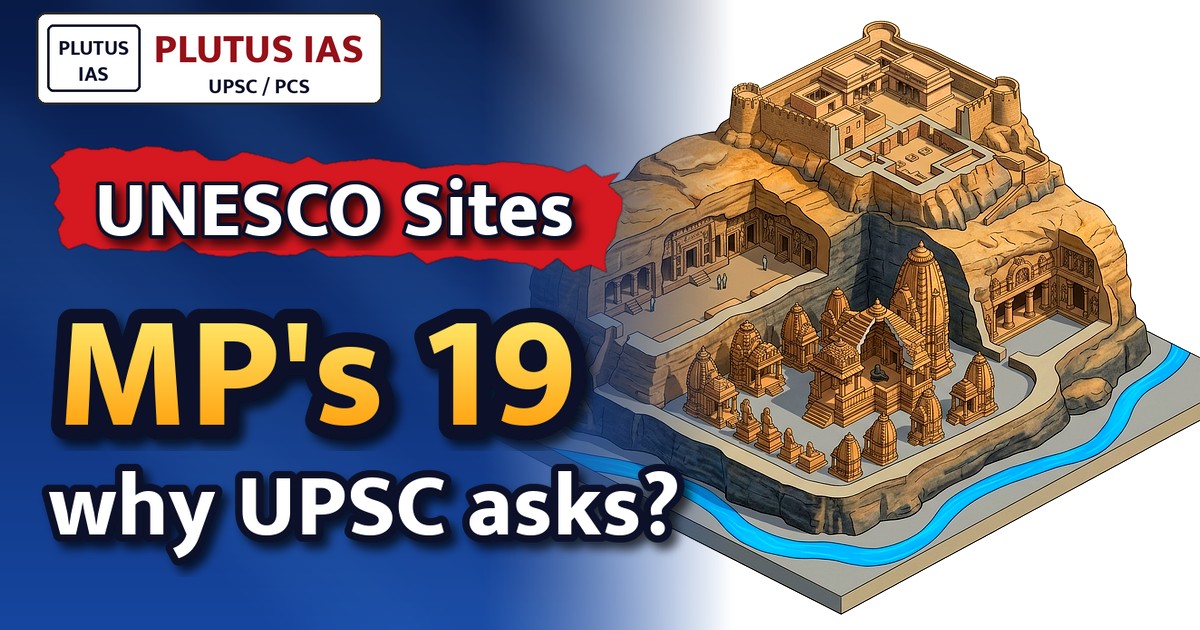
29 Sep MP’s 4 New UNESCO Tentative Sites: UPSC & State PCS Focus
✎ The UNESCO Tentative List is a strategic step toward World Heritage recognition, requiring rigorous evaluation of a site’s cultural or natural significance, authenticity, and integrity.
Subject Relevance — Where This Topic Fits
- GS Paper I — Indian Heritage and Culture | GS Paper I — History of the World
- Prelims: UNESCO Tentative List, World Heritage Sites, Cultural Heritage Conservation, Madhya Pradesh Tourism, Gond Architecture, Buddhist Rock-Cut Architecture
- Essay: Preservation of Cultural Heritage: Balancing Development and Conservation, India’s Role in Global Cultural Diplomacy
Quick Revision: The UNESCO Tentative List is a strategic step toward World Heritage recognition, requiring rigorous evaluation of a site’s cultural or natural significance, authenticity, and integrity.
Why is this in the news?
Madhya Pradesh has added four historically significant sites—Ginnorgarh Fort, Bateshwar-Padavali-Kakramath Temple Complex, and Udayagiri Caves—to UNESCO’s Tentative List, raising the state’s total to 19 sites. This inclusion marks a critical step toward potential inscription on the UNESCO World Heritage List, enhancing the state’s cultural and historical recognition on the global stage.
Background
- UNESCO’s Tentative List serves as a preliminary inventory of properties that a country intends to consider for nomination to the World Heritage List, ensuring their cultural or natural significance.
- Madhya Pradesh, known for its rich archaeological and architectural heritage, has been progressively nominating sites to strengthen its candidature for UNESCO recognition.
- The state’s existing Tentative List includes 15 sites, such as Gwalior Fort, Bhojeshwar Mahadev Temple, and the Rock Art Sites of the Chambal Valley, reflecting its diverse cultural landscape.
- The inclusion of a site in the Tentative List does not guarantee its inscription on the World Heritage List but initiates a rigorous evaluation process by UNESCO.
- The state government has emphasized heritage conservation and sustainable tourism as key priorities to leverage these recognitions for socio-economic development.
What is the UNESCO Tentative List and its significance?
- The UNESCO Tentative List is a national inventory of properties that a country believes have potential Outstanding Universal Value and may be nominated for inscription on the World Heritage List in the future.
- Inclusion in the Tentative List is the first formal step in the nomination process, followed by preparation of a nomination dossier, which undergoes evaluation by UNESCO’s advisory bodies.
- The Tentative List ensures that nominations are strategically planned and aligned with UNESCO’s criteria, including authenticity, integrity, and cultural significance.
- For Madhya Pradesh, the addition of four new sites reflects its commitment to preserving and promoting its archaeological, architectural, and cultural heritage.
- Ginnorgarh Fort exemplifies Gond architectural traditions and traditional water management systems, highlighting indigenous engineering practices.
- The Bateshwar-Padavali-Kakramath Temple Complex (8th–11th century CE) showcases the evolution of temple architecture in Central India, blending Nagara and local styles.
- Udayagiri Caves (5th century CE) are significant for their rock-cut temples and sculptures, reflecting the religious and artistic syncretism of the Gupta period.
Key Features
| Feature | Significance |
|---|---|
| Bagh Caves | A cluster of nine Buddhist rock-cut caves dating to the 4th–6th centuries CE, renowned for their mural paintings depicting contemporary social and religious life, providing primary evidence of Gupta-period art and iconography. |
| Ginnorgarh Fort | A Gond-era hill fort in Rata Pan, exemplifying pre-modern fortification techniques, water management through stepwells (bawadis), and hill-top defensive architecture adapted to the Vindhyan terrain. |
| Bateshwar–Padavali–Kakramath Temple Complex | An ensemble of eighth–eleventh century CE temples in Morena district, showcasing early Nagara and Bhumija styles, with intricate shikhara and mandapa designs reflecting regional temple architecture traditions. |
| Udayagiri Caves | A group of rock-cut cave shrines near Vidisha, associated with the Gupta period, featuring both Hindu and Jain iconography and inscriptions that illuminate the religious and political history of central India. |
Why it Matters
Cultural Heritage Preservation
- The inclusion of these four sites in UNESCO’s Tentative List marks a formal recognition of Madhya Pradesh’s rich archaeological and architectural legacy, aligning with global conservation standards.
- It strengthens the documentation and comparative study of India’s rock-cut architecture and temple traditions across different periods and regions.
- Enhances international visibility, potentially attracting research collaboration, heritage tourism, and funding for conservation under UNESCO’s World Heritage Programme.
- Provides a legal and institutional framework for long-term protection, including buffer zone demarcation and management plans.
Tourism and Socio-Economic Impact
- Promotes sustainable cultural tourism, diversifying the state’s tourism product beyond wildlife (e.g., Bandhavgarh, Kanha) to include heritage circuits.
- Creates livelihood opportunities in local communities through homestays, guides, and artisanal crafts linked to temple traditions and cave art.
- Encourages state investment in heritage infrastructure such as roads, interpretation centres, and visitor amenities, with multiplier effects on allied sectors.
- May lead to increased private sector participation in conservation through CSR initiatives and public-private partnerships.
Institutional Capacity Building
- Exposure to UNESCO’s Operational Guidelines and periodic reporting requirements builds technical capacity within state agencies like the Directorate of Archaeology and Museums.
- Facilitates adoption of best practices in site management, risk preparedness, and community engagement, aligning with the 2011 UNESCO Recommendation on the Historic Urban Landscape.
- Strengthens inter-departmental coordination between archaeology, forestry, and urban planning for integrated heritage management.
Academic and Research Value
- The sites offer primary data for art history, epigraphy, and environmental archaeology, supporting interdisciplinary research in Indian and global institutions.
- Enhances the state’s role as a living laboratory for studying the evolution of religious architecture, iconography, and socio-political structures in early medieval India.
Challenges
1. Site Conservation and Maintenance
- Natural degradation due to weathering, vegetation overgrowth, and faunal activity (e.g., bats in Bagh Caves) threatens structural integrity and mural preservation.
- Limited technical expertise in rock-art conservation and mural restoration within state agencies, necessitating external collaborations with institutions like the Archaeological Survey of India (ASI) and INTACH.
- Inadequate funding for continuous monitoring, preventive conservation, and emergency response systems.
- Risk of over-tourism leading to physical wear, pollution, and disturbance to the site’s microclimate.
UPSC Link: GS-III: Heritage Conservation
2. Legal and Administrative Coordination
- Overlapping jurisdictions between state archaeology departments, forest departments, and local bodies can delay decision-making and implementation of conservation plans.
- Lack of a unified heritage management policy in Madhya Pradesh, leading to fragmented approaches across different sites.
- Need for clear land-use regulations and buffer zone enforcement to prevent encroachment and incompatible development.
UPSC Link: GS-II: Federalism & Local Governance
3. Community Engagement and Benefit Sharing
- Ensuring equitable participation of local communities in tourism benefits and decision-making processes to prevent marginalisation.
- Addressing displacement risks and ensuring that heritage tourism does not exacerbate socio-economic inequalities.
- Cultural sensitisation programmes to prevent vandalism or commercial exploitation of sacred sites.
UPSC Link: GS-I: Social Empowerment
4. Climate Change and Disaster Resilience
- Increased frequency of extreme weather events (e.g., heavy rainfall, heatwaves) poses risks to structural stability and mural longevity.
- Need for climate vulnerability assessments and adaptation strategies, including drainage systems and microclimate control in caves.
- Integration of heritage conservation into state-level climate action plans under the National Mission on Sustainable Habitat.
UPSC Link: GS-III: Environmental Governance
5. Documentation and Research Gaps
- Incomplete epigraphic records and lack of systematic archaeological surveys for some sites, hindering comprehensive interpretation.
- Need for digital documentation (3D scanning, LiDAR) to create archival records and support virtual heritage initiatives.
- Bridging the gap between academic research and policy implementation to translate findings into conservation action.
UPSC Link: GS-I: Art & Culture
Challenges — UPSC Perspective
| Issue | Concern |
|---|---|
| Natural Decay | Accelerated deterioration of rock surfaces and murals due to environmental factors. |
| Funding Shortfall | Insufficient budgetary allocation for conservation, research, and capacity building. |
| Regulatory Gaps | Absence of a unified state heritage policy leading to fragmented management. |
| Tourism Pressure | Risk of over-commercialisation and physical damage from unregulated visitor influx. |
| Community Disconnect | Limited awareness among local populations about heritage value and conservation needs. |
| Climate Vulnerability | Increased exposure to extreme weather events and long-term climatic shifts. |
Way Forward
- Establish a dedicated State Heritage Conservation Fund with contributions from tourism revenue, CSR, and international grants to ensure sustained financing.
- Develop a State Heritage Management Plan aligned with UNESCO’s Operational Guidelines, including buffer zone regulations and periodic impact assessments.
- Strengthen inter-departmental coordination through a Heritage Steering Committee chaired by the Chief Secretary, with representation from archaeology, forestry, and local governance.
- Launch capacity-building programmes for state archaeologists, conservators, and guides in collaboration with ASI, INTACH, and international experts.
- Conduct comprehensive documentation of all 19 Tentative List sites using non-invasive technologies (3D scanning, multispectral imaging) to create a digital archive.
- Implement community-based tourism models with homestay certification, skill training, and equitable benefit-sharing mechanisms.
- Integrate heritage conservation into climate adaptation strategies, including microclimate control in caves and disaster risk reduction plans.
- Promote academic research through fellowships and grants, fostering partnerships between universities, state agencies, and global institutions.
UPSC Value Addition
Keywords for Mains Answer-Writing
UNESCO World Heritage Sites · Tentative List · Cultural Heritage · Natural Heritage · Madhya Pradesh heritage sites · Bhag Gupha · Udayagiri Caves · Ginnorgarh Fort · Bateshwar Group of Temples · World Heritage Convention 1972 · Cultural Heritage Conservation · Archaeological Survey of India · Madhya Pradesh State Archaeology · UNESCO Operational Guidelines
Concept Flow
Identification of heritage significance by state archaeology department → Nomination dossier preparation as per UNESCO Operational Guidelines → Submission to UNESCO World Heritage Centre → Evaluation by ICOMOS/ICOM and World Heritage Committee → Inclusion in Tentative List → Preparation of Management Plan and Buffer Zone Designation → Final Nomination for World Heritage Status → Inclusion in UNESCO World Heritage List → Ongoing Monitoring and Reporting under the World Heritage Convention.
Prelims Practice Questions
Q1. Consider the following statements regarding the UNESCO World Heritage Tentative List:
1. The Tentative List is a preliminary inventory of properties which a State Party intends to consider for nomination to the World Heritage List.
2. Inclusion in the Tentative List is a mandatory requirement for any property to be nominated to the World Heritage List.
3. The Tentative List is maintained by the UNESCO Secretariat and is updated annually.
How many of the above statements are correct?
- Only one
- Only two
- All three
- None
Answer: Only two — Statement 1 is correct as per UNESCO Operational Guidelines. Statement 2 is correct as inclusion in the Tentative List is a prerequisite for nomination. Statement 3 is incorrect; the Tentative List is maintained by the State Party, not the UNESCO Secretariat.
Q2. Assertion (A): The inclusion of Madhya Pradesh’s heritage sites in the UNESCO Tentative List enhances their prospects for future inscription on the World Heritage List.
Reason (R): The Tentative List is a mandatory step in the nomination process, and inclusion signifies international recognition of the site’s Outstanding Universal Value.
Options:
A. Both A and R are true, and R is the correct explanation of A.
B. Both A and R are true, but R is NOT the correct explanation of A.
C. A is true, but R is false.
D. A is false, but R is true.
Answer: ? — Both A and R are true. The Tentative List is indeed a mandatory step, and inclusion signifies preliminary recognition. R correctly explains A.
Q3. Match the following heritage sites of Madhya Pradesh with their respective districts:
Column I (Heritage Site) Column II (District)
A. Bhag Gupha 1. Vidisha
B. Ginnorgarh Fort 2. Morena
C. Bateshwar Group of Temples 3. Dhar
D. Udayagiri Caves 4. Raisen
Options:
A. A-3, B-4, C-2, D-1
B. A-1, B-2, C-3, D-4
C. A-4, B-3, C-1, D-2
D. A-2, B-1, C-4, D-3
- A
- B
- C
- D
Answer: A — Bhag Gupha is in Dhar (3), Ginnorgarh Fort is in Raisen (4), Bateshwar Group of Temples is in Morena (2), and Udayagiri Caves is in Vidisha (1).
Mains Practice Question
✍ The inclusion of four new heritage sites from Madhya Pradesh in the UNESCO World Heritage Tentative List underscores the state’s rich cultural and natural legacy. Critically examine the significance of this development for India’s heritage conservation framework and the procedural pathway to World Heritage inscription. (15 Marks)
Approach: MODEL-ANSWER SKELETON:
1. **Introduction (2 Marks)**: Define the UNESCO World Heritage Convention (1972) and the purpose of the Tentative List as a preliminary inventory for potential nominations.
2. **Significance for India (4 Marks)**:
– Enhances global recognition of India’s diverse heritage.
– Facilitates international collaboration in conservation.
– Strengthens domestic heritage management through ASI and state agencies.
– Aligns with India’s soft power diplomacy and tourism promotion.
3. **Procedural Pathway (5 Marks)**:
– Step 1: Inclusion in Tentative List (State Party submits dossier).
– Step 2: Preparation of Nomination File (detailed documentation of Outstanding Universal Value, authenticity, integrity).
– Step 3: Submission to UNESCO World Heritage Centre.
– Step 4: Evaluation by ICOMOS/ICOMOS-ICOMOS for cultural sites and IUCN for natural sites.
– Step 5: Decision by the World Heritage Committee (inscription, deferral, or rejection).
4. **Challenges and Way Forward (4 Marks)**:
– Balancing conservation with developmental pressures.
– Ensuring community participation and benefit-sharing.
– Addressing funding gaps for conservation.
– Strengthening inter-state coordination for multi-state nominations.
5. **Conclusion (1 Mark)**: Reiterate the importance of systematic heritage conservation and the role of global frameworks like UNESCO in safeguarding cultural and natural heritage.
Source: amarujala.com
Generated by AanyaAi for educational purpose.
Related guides on our sites
- Current affairs for upsc 2026
- How to prepare for GS paper 1 for UPSC CSE mains exam
- Best UPSC coaching for IFOS exam
- Best geography optional coaching

- MP’s 4 New UNESCO Tentative Sites: UPSC & State PCS Focus - September 29, 2026
- हाईकोर्ट ने पूछा: पंजाब की ‘मावां-धीयां’ योजना में वोटर आईडी क्यों अनिवार्य? - September 29, 2026
- UPSC Exam Focus: India’s Literacy Drive for Developed Nation Goal - September 29, 2026

No Comments