


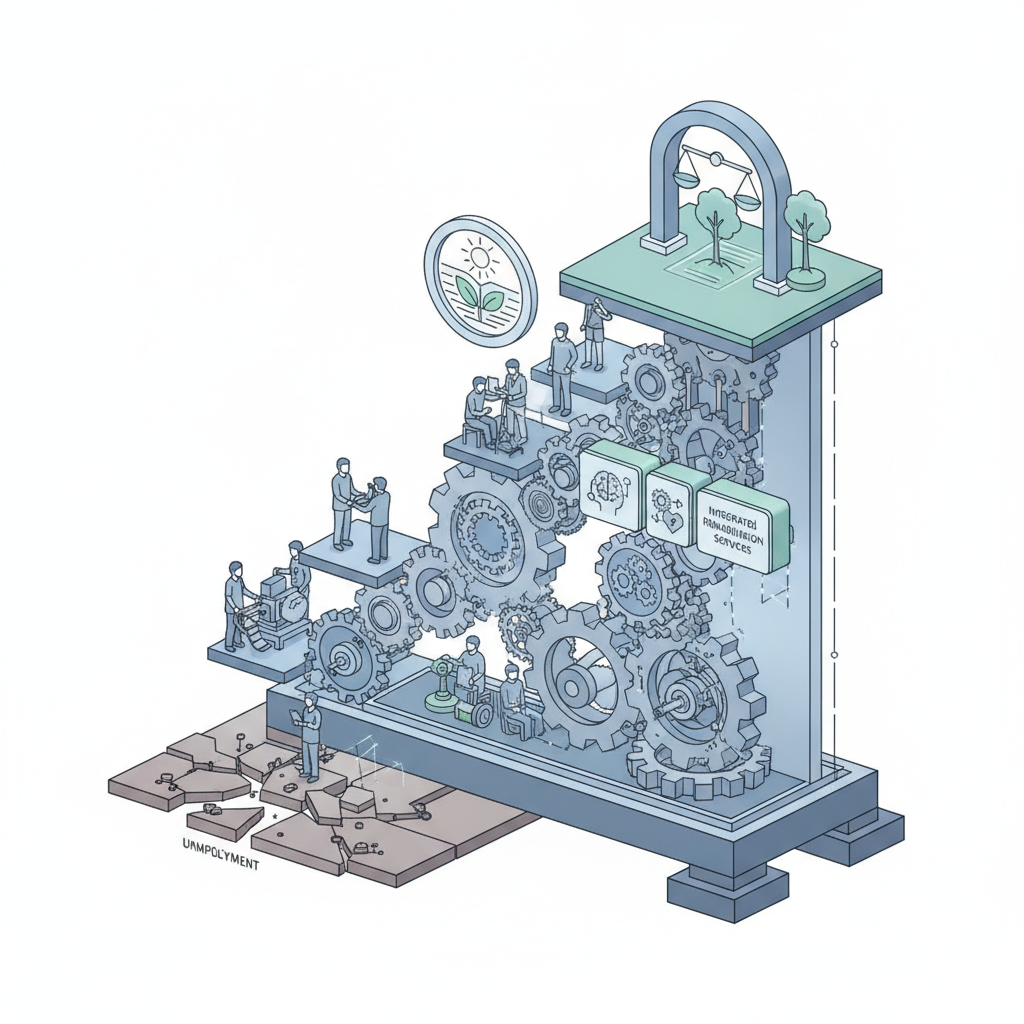
25 Sep MP’s Uday’s Journey: From Unemployment to Stability via Rehabilitation
✎ A press release from the Ministry of Social Justice and Empowerment, dated 24 September 2026, highlighted the transformative journey of a 22-year-old individual from Rewa, Madhya Pradesh, who overcame mental health challenges…
Subject Relevance — Where This Topic Fits
- GS Paper II — Social Justice and Empowerment | GS Paper III — Human Resource Development and Employment | GS Paper IV — Ethical Governance and Inclusive Development
- Prelims: Persons with Disabilities (Equal Opportunities, Protection of Rights and Full Participation) Act, 1995, Rights of Persons with Disabilities Act, 2016, Integrated Rehabilitation Centres for Persons with Disabilities (IRCPs), Deendayal Upadhyaya Grameen Kaushalya Yojana (DDUGKY), Skill India Mission
- Essay: The role of inclusive governance in fostering individual resilience and national progress, Sustainable development through equitable access to healthcare, education, and employment
Why is this in the news?
A press release from the Ministry of Social Justice and Empowerment, dated 24 September 2026, highlighted the transformative journey of a 22-year-old individual from Rewa, Madhya Pradesh, who overcame mental health challenges, unemployment, and economic hardship through integrated rehabilitation services provided by the Nivedita Kalyan Samiti’s Integrated Rehabilitation Centre (IRC). The case underscores the efficacy of holistic rehabilitation models in enabling persons with disabilities to achieve self-reliance and sustainable livelihoods.
Background
- Madhya Pradesh, with a significant population of persons with disabilities, has been actively implementing schemes under the Department of Social Justice and Empowerment to address disability-related challenges through decentralised rehabilitation services.
- Unemployment and economic vulnerability among persons with disabilities are exacerbated by societal stigma, lack of accessible infrastructure, and limited access to skill development programmes.
- The Skill India Mission aims to bridge the skill gap by providing vocational training and placement support to marginalised youth, including those with disabilities.
- The case of Uday exemplifies the intersection of health, employment, and social justice, aligning with the Sustainable Development Goals (SDGs), particularly SDG 3 (Good Health and Well-being), SDG 8 (Decent Work and Economic Growth), and SDG 10 (Reduced Inequalities).
What are Integrated Rehabilitation Centres for Persons with Disabilities (IRCPs)?
- Services offered include: (a) Medical rehabilitation (physiotherapy, occupational therapy, and psychiatric care), (b) Psychological counselling (individual, group, and family therapy), (c) Vocational training and skill development, (d) Placement support and entrepreneurship development, and (e) Assistive devices and aids.
- IRCPs collaborate with local NGOs, hospitals, and vocational training institutes to ensure multi-disciplinary support and community-based rehabilitation.
- The centres also conduct awareness campaigns to sensitise communities, employers, and educational institutions about the rights and potential of persons with disabilities.
Key Features
| Feature | Significance |
|---|---|
| Integrated Rehabilitation Centres (IRCs) | Provide holistic support including medical treatment, counselling, and skill development for individuals facing mental health challenges and unemployment. |
| Personalised Counselling | Address personal and familial conflicts, enabling emotional resilience and informed decision-making for sustainable livelihoods. |
| Medical Monitoring and Therapy | Regular psychiatric supervision, medication, and therapeutic interventions (e.g., yoga, meditation) to stabilise mental health and reduce aggression. |
| Skill Development and Employment Support | Focus on vocational training and job placement assistance to facilitate economic independence and reduce dependency. |
| Family Engagement | Involvement of family in the rehabilitation process to strengthen social support systems and reduce relapse risks. |
Why it Matters
Social Justice and Inclusive Growth
- Demonstrates the role of targeted social welfare interventions in bridging socio-economic disparities for marginalised youth.
- Highlights the intersectionality of mental health, unemployment, and poverty, necessitating multi-dimensional policy responses.
- Showcases a grassroots model of rehabilitation that aligns with constitutional principles of equity and dignity under Article 21.
Public Health and Human Capital Development
- Underscores the importance of mental health services as a public good to enhance workforce productivity and social stability.
- Illustrates the efficacy of community-based rehabilitation models in reducing long-term healthcare costs and improving quality of life.
- Emphasises preventive and promotive healthcare approaches over curative measures alone.
Economic Stability and Employment Generation
- Rehabilitation as a pathway to economic participation, reducing the burden on social security systems.
- Demonstrates how individual economic empowerment contributes to local economic growth and reduces dependency cycles.
- Aligns with national priorities under the ‘Atmanirbhar Bharat’ initiative by fostering self-reliance.
Policy Implementation and Governance
- Showcases the role of NGOs and government partnerships in delivering welfare services efficiently.
- Highlights the need for inter-departmental coordination (e.g., Social Justice, Health, Labour) for holistic outcomes.
- Serves as a case study for replicable models in other states facing similar socio-economic challenges.
Challenges
1. Access to Mental Health Services
- Stigma associated with mental health issues limits early intervention and treatment-seeking behaviour.
- Geographical disparities in the availability of specialised mental health facilities, particularly in rural areas.
- Shortage of trained mental health professionals and counsellors to meet the demand.
UPSC Link: GS II Social Justice
2. Unemployment and Skill Mismatch
- Lack of vocational training aligned with market demands hinders employability of marginalised youth.
- Informal sector dominance in employment opportunities reduces job security and benefits.
- Economic constraints prevent individuals from accessing skill development programmes.
UPSC Link: GS III Employment
3. Economic Vulnerability and Poverty Traps
- Low-income households face compounded challenges due to lack of financial resources for healthcare and education.
- Debt cycles and financial instability exacerbate mental health issues and reduce resilience.
- Limited access to credit and social safety nets perpetuates cycles of poverty.
UPSC Link: GS II Poverty
4. Social Stigma and Isolation
- Negative societal perceptions of mental health conditions and unemployment lead to social exclusion.
- Lack of peer support networks reduces motivation and confidence in seeking rehabilitation.
- Family dynamics, including conflict or lack of support, hinder recovery and reintegration.
UPSC Link: GS II Social Justice
5. Policy Fragmentation and Implementation Gaps
- Overlapping schemes without clear convergence mechanisms reduce effectiveness of welfare interventions.
- Lack of standardised monitoring and evaluation frameworks to assess impact of rehabilitation programmes.
- Insufficient funding and resource allocation for mental health and employment generation initiatives.
UPSC Link: GS II Governance
Challenges — UPSC Perspective
| Issue | Concern |
|---|---|
| Mental Health Stigma | Delays in seeking treatment and reduces participation in rehabilitation programmes. |
| Rural-Urban Divide | Limited access to mental health services and vocational training in rural areas. |
| Skill Mismatch | Unemployability due to lack of industry-relevant skills among marginalised youth. |
| Financial Constraints | Inability to afford medical treatment, counselling, or skill development programmes. |
| Social Exclusion | Marginalisation due to mental health conditions or unemployment, reducing opportunities for reintegration. |
| Governance Gaps | Fragmented implementation of welfare schemes leading to suboptimal outcomes. |
Government Initiatives — Must-Memorise for Prelims
- Skill India Mission (SIM)
Way Forward
- Strengthen public-private partnerships to expand the reach of Integrated Rehabilitation Centres (IRCs) across underserved regions.
- Enhance vocational training programmes to align with industry demands and improve employability of marginalised youth.
- Increase budgetary allocation for mental health services and incorporate tele-mental health services for remote areas.
- Launch awareness campaigns to reduce stigma associated with mental health and unemployment.
- Establish convergence mechanisms between social justice, health, and labour departments for seamless service delivery.
- Promote community-based rehabilitation models to foster peer support and reduce isolation.
- Develop standardised monitoring frameworks to assess the impact of rehabilitation programmes on employment and mental health outcomes.
- Expand social safety nets, including unemployment benefits and microfinance schemes, to reduce economic vulnerabilities.
UPSC Value Addition
Keywords for Mains Answer-Writing
Integrated Rehabilitation Centres for Addicts (IRCAs) · De-addiction and rehabilitation services under the Ministry of Social Justice and Empowerment · Sustainable livelihoods for marginalised youth · Mental health and employment linkages · Rehabilitation Policy Framework for Substance Use Disorders in India · Jeevan Aastha Programme · Counselling and family support in rehabilitation · Self-reliance through vocational training and employment · Social determinants of health and employment · National Policy for Persons with Disabilities (PwDs) · Vocational rehabilitation under the Persons with Disabilities Act, 1995 · Community-based rehabilitation (CBR) models
Constitutional & Policy Linkages
- Article 21 (Protection of Life and Personal Liberty) – Right to health and dignity.
- Article 41 (Directive Principles of State Policy) – State’s obligation to provide public assistance in cases of unemployment.
- Article 47 (DPSP) – Duty of the State to improve public health and raise the standard of living.
Concept Flow
Economic vulnerability and unemployment → Mental health deterioration → Social stigma and isolation → Limited access to rehabilitation services → Lack of skill development → Persistent unemployment → Cycle of poverty and exclusion. → Identification of vulnerable individuals → Referral to Integrated Rehabilitation Centres (IRCs) → Medical treatment and counselling → Skill development and vocational training → Employment placement → Economic independence and social reintegration. → Policy intervention at the individual level → Expansion of community-based rehabilitation models → Strengthening of public health infrastructure → Enhancement of vocational training programmes → Reduction in unemployment and mental health burdens. → Stigma reduction campaigns → Increased awareness and treatment-seeking behaviour → Early intervention in mental health issues → Improved employability and economic participation. → Convergence of social justice, health, and labour departments → Integrated service delivery → Holistic rehabilitation outcomes → Sustainable socio-economic development.
Prelims Practice Questions
Q1. Consider the following statements regarding the Integrated Rehabilitation Centres for Addicts (IRCAs) in India:
1. IRCAs are established under the Ministry of Social Justice and Empowerment.
2. IRCAs provide only medical treatment and do not offer vocational training or counselling.
3. The primary objective of IRCAs is to facilitate the reintegration of individuals with substance use disorders into society through a multi-disciplinary approach.
How many of the above statements are correct?
- Only one
- Only two
- All three
- None
Answer: All three — Statement 1 is correct as IRCAs are indeed established under the Ministry of Social Justice and Empowerment. Statement 2 is incorrect because IRCAs provide a holistic approach including medical treatment, vocational training, and counselling. Statement 3 is correct as the core objective of IRCAs is multi-disciplinary reintegration.
Q2. Assertion (A): The Persons with Disabilities (Equal Opportunities, Protection of Rights and Full Participation) Act, 1995 mandates the provision of vocational training and employment opportunities for persons with disabilities.
Reason (R): The Act aims to ensure that persons with disabilities have access to equal opportunities and full participation in society, including economic independence.
In the context of the above two statements, which of the following is correct?
- Both A and R are true, and R is the correct explanation of A
- Both A and R are true, but R is not the correct explanation of A
- A is true but R is false
- A is false but R is true
Answer: Both A and R are true, but R is not the correct explanation of A — The Persons with Disabilities Act, 1995 explicitly mandates vocational training and employment opportunities (Section 41) to promote economic independence. The Reason (R) correctly explains the Assertion (A) as it aligns with the Act’s broader objective of full participation.
Q3. Match the following rehabilitation initiatives with their respective ministries/departments:
Column I (Initiative) Column II (Ministry/Department)
A. Integrated Rehabilitation Centres for Addicts (IRCAs) 1. Ministry of Health and Family Welfare
B. National Policy for Persons with Disabilities 2. Ministry of Social Justice and Empowerment
C. Deendayal Antyodaya Yojana – National Urban Livelihoods Mission (DAY-NULM) 3. Ministry of Housing and Urban Affairs
D. Rashtriya Kishor Swasthya Karyakram (RKSK) 4. Ministry of Women and Child Development
Select the correct match:
- A-2, B-2, C-3, D-1
- A-1, B-2, C-3, D-4
- A-2, B-2, C-4, D-1
- A-1, B-3, C-2, D-4
Answer: A-1, B-2, C-3, D-4 — A matches with 2 (Ministry of Social Justice and Empowerment) as IRCAs are under this ministry. B matches with 2 (Ministry of Social Justice and Empowerment) as the National Policy for Persons with Disabilities is framed by it. C matches with 3 (Ministry of Housing and Urban Affairs) as DAY-NULM is under this ministry. D matches with 1 (Ministry of Health and Family Welfare) as RKSK is under this ministry.
Mains Practice Question
✍ The Integrated Rehabilitation Centres for Addicts (IRCAs) operate under a multi-disciplinary framework to facilitate the reintegration of individuals with substance use disorders into society. In this context, critically examine the role of counselling, vocational training, and family support in achieving sustainable livelihoods for marginalised youth. Also, analyse the challenges in implementing such programmes at scale in India. (15 Marks)
Approach: MODEL-ANSWER SKELETON:
1. **Introduction (2 marks)**
– Define IRCAs and their statutory/constitutional basis (Ministry of Social Justice and Empowerment; National Policy for Persons with Disabilities, 2006; Rehabilitation Council of India Act, 1992).
– State the objective: holistic rehabilitation including medical, psychological, social, and economic reintegration.
2. **Role of Counselling (3 marks)**
– Individual, group, and family counselling as per WHO and APA guidelines.
– Addresses co-occurring mental health disorders (e.g., depression, anxiety) and behavioural issues.
– Evidence: Studies from NIMHANS and AIIMS highlight the efficacy of cognitive-behavioural therapy (CBT) in reducing relapse rates.
– Link to the case of Uday: personalised counselling helped address emotional instability and familial conflicts.
3. **Vocational Training and Employment (3 marks)**
– Vocational rehabilitation under the Persons with Disabilities Act, 1995 (Section 41) and the Rights of Persons with Disabilities Act, 2016.
– Partnerships with private sector (e.g., Tata Strive, NSDC) for skill development and placements.
– Case study: Uday’s transition from unemployment to a private-sector job post-rehabilitation.
– Challenges: lack of industry-aligned curricula, stigma in hiring, and low awareness among employers.
4. **Family Support (2 marks)**
– Family counselling reduces relapse triggers (e.g., dysfunctional dynamics, enabling behaviours).
– Community-based rehabilitation (CBR) models (WHO) emphasise family as a support system.
– Uday’s family support as a critical factor in his sustained recovery.
5. **Challenges in Scaling Up (3 marks)**
– **Institutional**: Limited number of IRCAs (approx. 400 across India) vs. high prevalence of substance use disorders (NASSCOM report: ~2.5% of population).
– **Financial**: Budgetary constraints under the National Action Plan for Drug Demand Reduction (NAPDDR).
– **Social**: Stigma, lack of awareness, and low prioritisation in rural areas.
– **Policy**: Fragmented implementation across states; need for convergence with Ayushman Bharat and PM-KISAN for socio-economic support.
6. **Conclusion (2 marks)**
– IRCAs exemplify a rights-based, multi-disciplinary approach to rehabilitation.
– Recommendations: expand IRCAs, integrate with primary healthcare (Ayushman Bharat), and leverage CSR for vocational partnerships.
– Balanced view: while progress is evident (e.g., Uday’s case), systemic gaps persist in accessibility and quality.
Source: PIB (Press Information Bureau)
Madhya Pradesh PCS (MPPSC) — State PCS Practice
Prelims: Which of the following initiatives launched by the Madhya Pradesh government aligns with the state’s journey towards sustainable economic growth and employment generation through economic reforms?
- A. Mukhyamantri Yuva Swavlamban Yojana
- B. One District One Product (ODOP) Scheme
- C. Atal Mission for Rejuvenation and Urban Transformation (AMRUT)
- D. Pradhan Mantri Kisan Samman Nidhi (PM-KISAN)
Answer: B. One District One Product (ODOP) Scheme — The One District One Product (ODOP) Scheme in Madhya Pradesh focuses on promoting local products, fostering entrepreneurship, and generating employment, directly contributing to sustainable economic growth.
Mains: Examine how the economic reforms implemented in Madhya Pradesh have contributed to the state’s journey towards sustainability and employment generation. Discuss the role of key policies and schemes in this transformation.
Generated by AanyaAi for educational purpose.
Related guides on our sites
- Best sociology optional coaching for upsc
- Which is best sociology optional coaching for upsc
- Best teacher of sociology optional for upsc
- Best PSIR optional coaching in delhi for UPSC

- PM Modi Praises Youth-Led Nasha Mukt Yuva Abhiyan Momentum - September 27, 2026
- राजनाथ सिंह का बड़ा बयान: भारत किसी की ज़मीन कब्ज़ा नहीं करेगा, लेकिन सुरक्षा पर होगा कठोर - September 27, 2026
- Exercise Tarang Shakti 2026: India’s Mega Multi-Nation Air Power Showcase - September 27, 2026

No Comments