


31 Jul MSME Act 2023: Key Amendments for Depositors’ Rights Protection
✎ The 2023 amendments to the MSCS Act introduce a Cooperative Ombudsman, concurrent audit, prudential norms for savings and credit societies, and stricter governance standards to safeguard depositor and member rights.
Subject Relevance — Where This Topic Fits
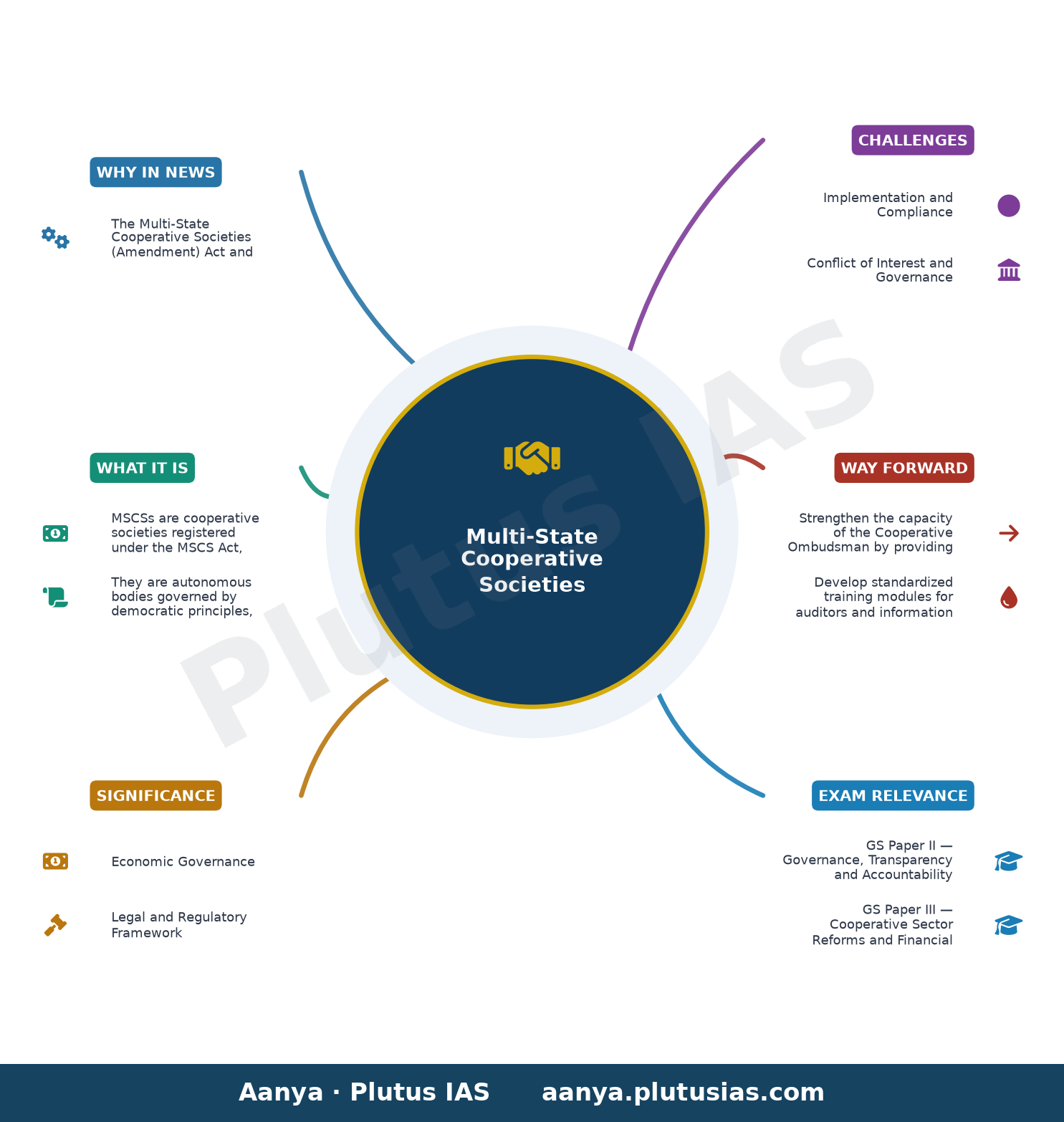
- GS Paper II — Governance, Transparency and Accountability | GS Paper III — Cooperative Sector Reforms and Financial Regulation
- Prelims: Multi-State Cooperative Societies (MSCS) Act, 2002, Cooperative Ombudsman, Concurrent Audit, Liquidity Norms for Cooperative Societies, Central Registrar of Cooperative Societies, Prudential Norms for Savings and Credit Societies
- Essay: Role of cooperatives in inclusive economic growth and financial inclusion, Balancing autonomy and regulatory oversight in India’s cooperative sector
Quick Revision: The 2023 amendments to the MSCS Act introduce a Cooperative Ombudsman, concurrent audit, prudential norms for savings and credit societies, and stricter governance standards to safeguard depositor and member rights.
Why is this in the news?
The Multi-State Cooperative Societies (Amendment) Act and Rules, 2023, notified by the Ministry of Law and Justice, introduce comprehensive reforms to enhance the protection of depositors and members of Multi-State Cooperative Societies (MSCSs). These amendments address governance deficits, financial mismanagement, and procedural lacunae exposed by frauds and malpractices in the cooperative sector, aligning with the broader objective of fostering trust and systemic stability in India’s cooperative financial ecosystem.
Background
- The Multi-State Cooperative Societies (MSCS) Act, 2002, governs cooperative societies registered across multiple states, operating as autonomous entities accountable to their members.
- MSCSs function as critical instruments of financial inclusion, particularly in rural and semi-urban areas, offering savings and credit services to marginalised communities.
- Instances of fraud, embezzlement, and mismanagement in cooperative societies have eroded public trust, necessitating stronger regulatory and governance frameworks.
- The amendments are part of a broader legislative push under the ‘Sahakar se Samriddhi’ vision to revitalise India’s cooperative movement.
- The Central Registrar of Cooperative Societies (CRCS) plays a pivotal role as the nodal authority for registration, regulation, and oversight of MSCSs.
What are Multi-State Cooperative Societies (MSCSs)?
- MSCSs are cooperative societies registered under the MSCS Act, 2002, and operate across two or more states, enabling members from different states to pool resources and undertake economic activities collectively.
- They are autonomous bodies governed by democratic principles, with members electing a board of directors responsible for policy formulation and oversight.
- MSCSs are engaged in diverse activities, including savings and credit (urban and rural cooperative banks), marketing of agricultural produce, dairy, and other allied sectors, and housing cooperatives.
- The MSCS Act, 2002, provides a legal framework for registration, governance, audit, inspection, and winding-up of societies, while ensuring member rights and financial discipline.
- MSCSs are distinct from state-level cooperatives, as they operate across state boundaries, requiring central oversight to prevent regulatory arbitrage and ensure uniformity.
- The Act empowers the Central Registrar to enforce compliance, conduct inspections, and initiate action against errant societies, including de-registration and prosecution.
- MSCSs are subject to concurrent audit, uniform accounting standards, and mandatory disclosure norms to enhance transparency and accountability.
- The cooperative sector in India comprises over 8.5 lakh cooperatives, with MSCSs playing a crucial role in financial inclusion and rural development.
Key Features
| Feature | Significance |
|---|---|
| Appointment of Cooperative Ombudsman | Establishes a dedicated grievance redressal mechanism for members/depositors of Multi-State Cooperative Societies (MSCS) to ensure timely resolution of disputes and enhance accountability. |
| Mandatory Information Officers in MSCS | Improves transparency by requiring each MSCS to appoint an information officer, facilitating access to records and fostering trust among stakeholders. |
| Concurrent Audit Framework | Introduces uniform accounting and auditing standards across MSCS, ensuring consistency, reducing financial irregularities, and strengthening governance. |
| Disclosure of Board Decisions | Requires disclosure of non-unanimous board decisions in annual reports, enhancing transparency in decision-making processes and reducing opacity. |
| Enhanced Regulatory Oversight by Central Registrar | Grants the Central Registrar broader powers to investigate fraudulent activities, ensuring stricter compliance and deterrence against malpractices. |
Why it Matters
Economic Governance
- Strengthens the financial ecosystem of MSCS by enforcing prudential norms (liquidity, risk management) in savings and credit operations, reducing systemic vulnerabilities.
- Enhances investor confidence in cooperative enterprises by improving transparency, audit compliance, and regulatory oversight, thereby attracting more capital.
- Mitigates financial fraud and mismanagement risks through concurrent audits and stricter penalties, safeguarding depositors’ interests and economic stability.
Legal and Regulatory Framework
- Clarifies the roles of investigative agencies (EOW, CBI) and courts in handling criminal offenses under MSCS Act, 2002, ensuring swift justice and deterrence.
- Introduces provisions for dissolution of fraudulently registered societies, reinforcing the integrity of the cooperative registration process.
- Expands grounds for disqualification of directors involved in conflict-of-interest cases, aligning governance practices with corporate standards.
Social and Institutional Impact
- Protects the rights of marginalized members by extending the minimum exclusion period for expelled members from 1 year to 3 years, ensuring fair treatment.
- Promotes inclusive governance by mandating disclosures of dissenting board decisions, reducing elite capture in cooperative decision-making.
- Fosters a culture of accountability and ethical conduct among cooperative societies, aligning with the cooperative principle of ‘voluntary and open membership.’
Challenges
1. Implementation and Compliance
- Ensuring uniform adoption of concurrent audit standards across diverse MSCS, particularly those operating in multiple states with varying administrative capacities.
- Balancing regulatory oversight with the autonomy of cooperative societies, as excessive intervention may undermine their grassroots democratic ethos.
- Addressing delays in grievance redressal by the Cooperative Ombudsman, which could erode stakeholder trust if not streamlined.
UPSC Link: GS-II: Cooperative Societies
2. Conflict of Interest and Governance
- Preventing circumvention of disqualification norms by directors through complex ownership structures or proxy arrangements.
- Ensuring that disclosures of non-unanimous decisions are comprehensive and not merely symbolic, to avoid greenwashing governance practices.
UPSC Link: GS-II: Governance and Transparency
3. Financial Stability and Fraud Prevention
- Mitigating risks of financial contagion in MSCS by enforcing prudential norms, particularly in credit operations where defaults could trigger systemic crises.
- Detecting and prosecuting financial frauds promptly, given the decentralized nature of cooperative societies and jurisdictional challenges.
UPSC Link: GS-III: Financial Inclusion and Regulation
Challenges — UPSC Perspective
| Issue | Concern |
|---|---|
| Varied State-Level Enforcement | Differences in state-level implementation of MSCS Act, 2002 may lead to regulatory arbitrage or inconsistent compliance. |
| Data Privacy and Transparency | Balancing transparency requirements (e.g., annual report disclosures) with the need to protect sensitive member data from misuse. |
| Capacity Building of Auditors | Ensuring auditors possess the expertise to conduct concurrent audits under uniform standards across diverse cooperative societies. |
| Jurisdictional Overlaps | Potential conflicts between central regulatory oversight (Central Registrar) and state-level cooperative authorities in enforcement actions. |
| Member Awareness | Low awareness among depositors/members about their rights and the grievance redressal mechanisms, limiting the effectiveness of reforms. |
Way Forward
- Strengthen the capacity of the Cooperative Ombudsman by providing dedicated staff and digital platforms for faster grievance resolution.
- Develop standardized training modules for auditors and information officers to ensure uniform adoption of concurrent audit and transparency norms.
- Conduct periodic reviews of MSCS compliance with prudential norms and governance disclosures, with penalties for non-adherence.
- Enhance member education programs to raise awareness about rights, governance practices, and grievance redressal mechanisms.
- Establish a centralized digital repository for MSCS records to facilitate real-time monitoring by the Central Registrar and investigative agencies.
- Collaborate with state cooperative departments to harmonize enforcement of MSCS Act, 2002, reducing regulatory fragmentation.
- Introduce whistleblower protections for members reporting financial irregularities or governance lapses in MSCS.
- Pilot a ‘Cooperative Excellence’ rating system to incentivize best practices in governance, transparency, and financial stability.
UPSC Value Addition
Keywords for Mains Answer-Writing
Multi-State Cooperative Societies (MSCS) Amendment Act 2023 · Cooperative Ombudsman · Concurrent Audit in Cooperatives · Prudential Norms for Cooperative Societies · Cooperative Governance Reforms · Protection of Depositors’ Rights in Cooperatives · Regulatory Oversight of Multi-State Cooperatives · Cooperative Audit Framework · Conflict of Interest in Cooperatives · Liquidation and Winding-up of Cooperatives
Concept Flow
Multi-State Cooperative Societies Act, 2002 → Regulatory gaps in governance and transparency → Financial frauds and mismanagement → Amendment Act and Rules, 2023 → Appointment of Cooperative Ombudsman and Information Officers → Concurrent Audit Framework → Enforcement of Prudential Norms → Strengthened Regulatory Oversight → Enhanced Member Rights and Governance → Sustainable Cooperative Ecosystem.
Prelims Practice Questions
Q1. With reference to the Multi-State Cooperative Societies (MSCS) Amendment Act, 2023, consider the following statements:
1. The Act mandates the appointment of a Cooperative Ombudsman to address member grievances.
2. It introduces concurrent audit for all multi-state cooperative societies.
3. The Act empowers the Central Registrar to investigate fraudulent registrations of cooperative societies.
4. It prohibits directors from participating in decisions where a conflict of interest exists.
How many of the above statements are correct?
- Only one
- Only two
- Only three
- All four
Answer: All four — Statements 1, 3, and 4 are correct as per the Act. Statement 2 is incorrect because concurrent audit is introduced for ‘top multi-state cooperative societies’ as per the amendment, not all societies.
Q2. Assertion (A): The Multi-State Cooperative Societies (MSCS) Amendment Act, 2023 strengthens the regulatory oversight of cooperative societies by empowering the Central Registrar to investigate fraudulent activities.
Reason (R): The Act introduces prudential norms for cooperative societies engaged in savings and credit operations to ensure financial stability.
In the context of the above two statements, which one of the following is correct?
- Both A and R are true, and R is the correct explanation of A
- Both A and R are true, but R is NOT the correct explanation of A
- A is true, but R is false
- A is false, but R is true
Answer: A is true, but R is false — Both statements are true, but R is not the correct explanation of A. The Act empowers the Central Registrar to investigate fraudulent activities (A), while prudential norms are introduced to ensure financial stability in savings and credit operations (R), which are distinct provisions.
Q3. Match the following provisions of the Multi-State Cooperative Societies (MSCS) Amendment Act, 2023 with their respective objectives:
Column I (Provision)
A. Appointment of Cooperative Ombudsman
B. Concurrent Audit
C. Disclosure of dissenting decisions in Board Reports
D. Prohibition of directors in conflict-of-interest cases
Column II (Objective)
1. Enhance transparency in governance
2. Strengthen financial oversight
3. Address member grievances
4. Prevent conflict of interest in decision-making
Select the correct match:
- A-3, B-2, C-1, D-4
- A-2, B-3, C-4, D-1
- A-1, B-4, C-2, D-3
- A-4, B-1, C-3, D-2
Answer: A-3, B-2, C-1, D-4 — The correct matches are: A-3 (Cooperative Ombudsman addresses member grievances), B-2 (Concurrent audit strengthens financial oversight), C-1 (Disclosure of dissenting decisions enhances transparency), and D-4 (Prohibition of directors in conflict-of-interest cases prevents conflict of interest).
Mains Practice Question
✍ The Multi-State Cooperative Societies (MSCS) Amendment Act, 2023 represents a paradigm shift in the regulatory framework governing multi-state cooperatives in India. Critically examine the key provisions of the Act that aim to enhance transparency, accountability, and financial stability in cooperative governance. Also, evaluate the efficacy of these measures in addressing the long-standing challenges faced by cooperative societies in India. (15 Marks)
Approach: MODEL-ANSWER SKELETON:
1. **Introduction (2 Marks)**
– Briefly define the Multi-State Cooperative Societies (MSCS) Act, 2002, and its role in regulating cooperatives operating across multiple states.
– Highlight the need for amendments, citing issues such as fraudulent registrations, lack of transparency, and financial mismanagement.
2. **Key Provisions of the MSCS Amendment Act, 2023 (6 Marks)**
– **Governance and Transparency:**
– Appointment of a Cooperative Ombudsman to address member grievances (Section X).
– Disclosure of dissenting decisions in Board Reports (Section Y).
– Prohibition of directors in conflict-of-interest cases (Section Z).
– **Financial Oversight:**
– Introduction of concurrent audit for top multi-state cooperative societies (Section A).
– Prescription of prudential norms for savings and credit operations (Section B).
– Redefinition of investment norms to ensure secure fund deployment (Section C).
– **Regulatory Strengthening:**
– Empowerment of the Central Registrar to investigate fraudulent registrations (Section D).
– Extension of the minimum period for expulsion of members from 1 year to 3 years (Section E).
3. **Efficacy of the Measures (5 Marks)**
– **Strengths:**
– Enhanced transparency through mandatory disclosures and the role of the Cooperative Ombudsman.
– Improved financial stability via concurrent audit and prudential norms.
– Strengthened regulatory oversight to curb fraudulent activities.
– **Limitations:**
– Implementation challenges, including the capacity of the Central Registrar’s office.
– Potential resistance from cooperative societies accustomed to opaque practices.
– Need for capacity-building among cooperative members and officials.
– **Comparative Perspective:**
– Contrast with the governance frameworks in other cooperative models (e.g., European cooperatives).
– Reference to the 97th Constitutional Amendment Act, 2011, which provided constitutional status to cooperatives.
4. **Conclusion (2 Marks)**
– Summarize the transformative potential of the Act while acknowledging the need for robust implementation mechanisms.
– Emphasize the importance of balancing autonomy with accountability in cooperative governance.
Source: PIB (Press Information Bureau)
Generated by AanyaAi for educational purpose.

- यूपी में पहली बार तेंदुओं का बधियाकरण: मानव-वन्यजीव संघर्ष रोकेगा अभियान - September 24, 2026
- UP’s Groundbreaking Leopard Sterilization Plan to Curb Human-Wildlife Conflict - September 24, 2026
- महाराष्ट्र में त्योहार जुलूसों पर बॉम्बे हाईकोर्ट का बड़ा फैसला: पटाखे, लेजर और संगीत पर रोक - September 24, 2026

No Comments