


01 Sep Mullaperiyar Dam Safety Report Submission in Two Weeks: Key UPSC Facts
✎ The National Dam Safety Authority (NDSA), established under the Dam Safety Act, 2021, is the apex regulatory body responsible for ensuring the safety and structural integrity of dams in India, including conducting impartial…
Subject Relevance — Where This Topic Fits
- GS Paper II — Governance, Constitution, Polity, Social Justice and International Relations (Federalism and Inter-State Relations) | GS Paper III — Disaster Management, Infrastructure, Environmental Pollution and Degradation
- Prelims: Mullaperiyar Dam, National Dam Safety Authority (NDSA), Inter-State Water Disputes Act, 1956, Dam Safety Act, 2021, National Disaster Management Authority (NDMA), Seismic Zonation, Inter-State River Water Disputes Tribunal
- Essay: Federalism and Centre-State Relations: The Case of Inter-State River Disputes, Institutional Mechanisms for Disaster Risk Reduction in India
Quick Revision: The National Dam Safety Authority (NDSA), established under the Dam Safety Act, 2021, is the apex regulatory body responsible for ensuring the safety and structural integrity of dams in India, including conducting impartial technical evaluations such as the ongoing assessment of the Mullaperiyar Dam.
Why is this in the news?
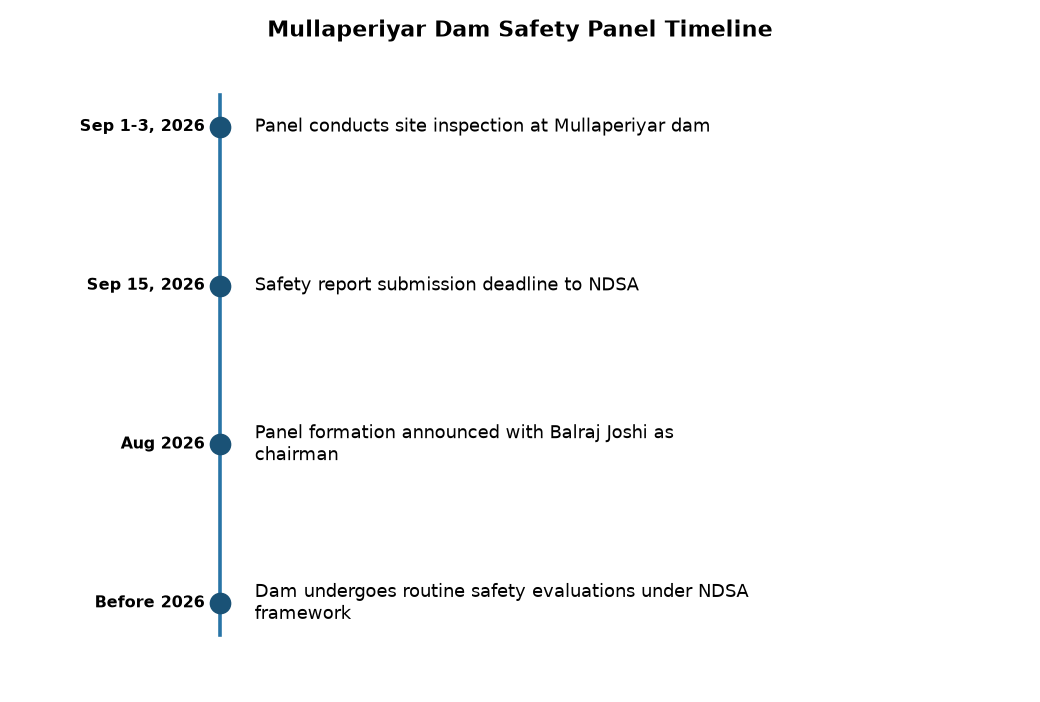
A high-level multidisciplinary safety panel, constituted under the National Dam Safety Authority (NDSA), is conducting an impartial technical assessment of the Mullaperiyar Dam in Kerala to evaluate its structural integrity, seismic resilience, and compliance with modern engineering standards. The panel’s report, due within two weeks, assumes critical importance given the dam’s age, its transboundary significance, and the constitutional framework governing inter-state water disputes and dam safety in India.
Background
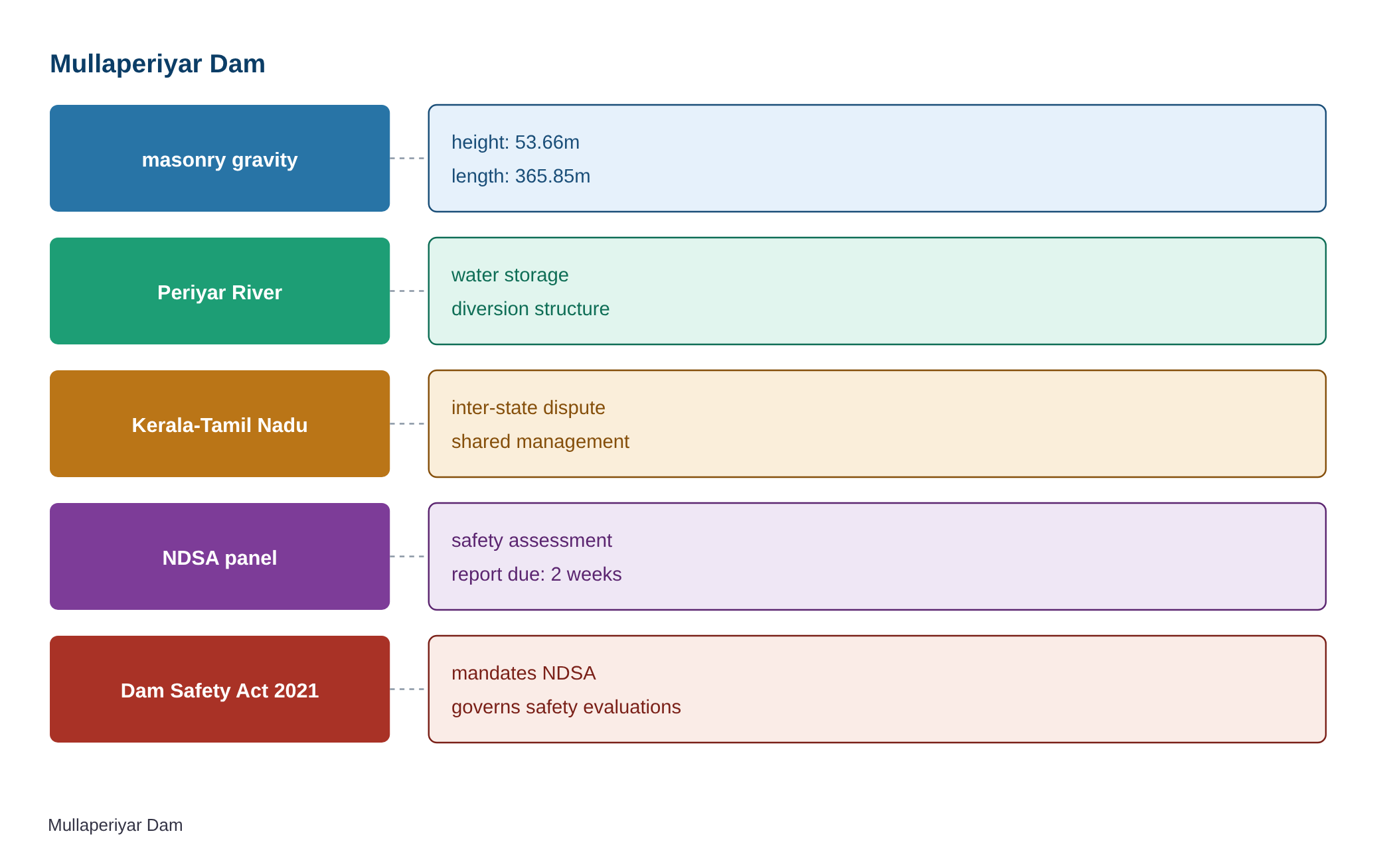
- The Mullaperiyar Dam, constructed in 1895 across the Periyar River in Kerala, is a masonry gravity dam with a height of 53.66 metres and a length of 365.85 metres. It is a key water storage and diversion structure, primarily serving Tamil Nadu for irrigation and hydroelectric power generation.
- The dam has been a subject of prolonged inter-state dispute between Kerala and Tamil Nadu, with Kerala raising concerns about its structural safety, particularly in the context of seismic activity and the dam’s age. Tamil Nadu has maintained that the dam is structurally sound and essential for its water security.
- The Dam Safety Act, 2021, enacted to institutionalise dam safety governance in India, mandates the establishment of the National Dam Safety Authority (NDSA) and State Dam Safety Organisations (SDSOs) to ensure systematic safety evaluations of dams across the country.
- The current evaluation of the Mullaperiyar Dam is being conducted under the framework of the Dam Safety Act, 2021, and the NDSA’s Terms of Reference, which emphasise impartiality, multidisciplinary expertise, and adherence to modern engineering and seismic standards.
What is the National Dam Safety Authority (NDSA)?
- The NDSA is a statutory body established under Section 10 of the Dam Safety Act, 2021, to ensure the safety, surveillance, inspection, operation, and maintenance of all specified dams in India.
- The NDSA is mandated to formulate policies, guidelines, and standards for dam safety, conduct safety inspections, and issue directives for the repair, rehabilitation, or decommissioning of dams that do not meet safety standards.
- The Authority comprises multidisciplinary experts, including civil engineers, geologists, hydrologists, and seismologists, to ensure comprehensive technical assessments of dams.
- The NDSA operates in coordination with State Dam Safety Organisations (SDSOs) and the National Committee on Dam Safety (NCDS), which provides policy oversight and technical guidance.
- The NDSA’s functions include maintaining a national database of dams, conducting risk assessments, and promoting research and development in dam safety technologies and methodologies.
- The Authority has the power to direct dam owners to undertake safety measures, including structural modifications, instrumentation upgrades, and emergency preparedness planning.
- The NDSA’s decisions are binding on dam owners, including state governments and public sector entities, and can be enforced through legal and administrative mechanisms.
- The NDSA’s role is critical in addressing the challenges posed by aging dams, climate change-induced extreme weather events, and evolving engineering and seismic standards.
Key Features
| Feature | Significance |
|---|---|
| Comprehensive Safety Panel | A multi-disciplinary team of experts is conducting an impartial evaluation of the Mullaperiyar Dam’s structural integrity, seismic resilience, and operational safety to ensure public safety and compliance with modern engineering standards. |
| National Dam Safety Authority (NDSA) | The NDSA is the nodal authority receiving the safety report, ensuring uniformity in dam safety assessments across India under the Dam Safety Act, 2021. |
| Seismic and Hydrological Assessment | The panel is evaluating the dam’s ability to withstand seismic activity and manage floodwater, critical for its long-term stability and disaster resilience. |
| Instrumentation and Monitoring | Modern instrumentation and real-time monitoring systems are being reviewed to assess the dam’s current operational efficiency and early warning capabilities. |
| Terms of Reference (ToR) | The ToR mandates a rigorous, standardised evaluation process, including site inspections, technical discussions, and report submission, to ensure transparency and accountability. |
Why it Matters
Engineering and Infrastructure
- The Mullaperiyar Dam is a critical piece of infrastructure with significant hydrological and structural implications for Kerala and Tamil Nadu, necessitating a thorough safety evaluation to prevent catastrophic failures.
- Modern engineering paradigms, including seismic resilience and flood management, must be applied to assess the dam’s suitability for continued operation over its extended lifespan.
- The dam’s age (constructed in 1895) raises concerns about its alignment with contemporary safety standards, requiring a re-evaluation of its design, materials, and maintenance practices.
- Structural integrity assessments are essential to prevent potential disasters that could affect downstream populations, agricultural lands, and regional water security.
- The evaluation underscores the importance of regular, independent safety audits for ageing infrastructure to mitigate risks associated with long-term usage.
Inter-State Water Governance
- The Mullaperiyar Dam is a focal point of inter-state water disputes between Kerala and Tamil Nadu, necessitating a neutral, technical assessment to resolve disagreements over its safety and operational viability.
- The dam’s management involves shared responsibilities, requiring coordination between state governments, central agencies, and independent experts to ensure equitable and sustainable water distribution.
- Technical evaluations serve as a neutral ground for resolving disputes, reducing the likelihood of legal interventions and fostering cooperative governance.
- The outcome of this assessment may influence future water-sharing agreements and dam management policies across India.
- Inter-state water governance frameworks must prioritise scientific assessments to balance regional demands with national water security objectives.
Disaster Risk Reduction
- Dams are high-risk structures, and their failure can lead to catastrophic flooding, loss of life, and economic damage, making safety evaluations a critical component of disaster risk management.
- Seismic activity in the region (e.g., the 2001 Bhuj earthquake) highlights the need for dams to be designed and maintained to withstand geological stresses.
- Floodwater management capacity is a key parameter, as excessive rainfall or dam failure can inundate downstream areas, necessitating robust emergency preparedness plans.
- The evaluation aligns with India’s National Disaster Management Authority (NDMA) guidelines, which emphasise proactive risk assessment and mitigation for critical infrastructure.
- Public safety is paramount, and the panel’s findings will inform emergency response strategies and long-term risk reduction measures.
Legal and Regulatory Framework
- The Dam Safety Act, 2021, provides a statutory framework for the inspection, maintenance, and safety of dams across India, ensuring uniformity in safety standards and accountability.
- The National Dam Safety Authority (NDSA) is empowered to enforce safety protocols, conduct audits, and recommend corrective measures based on expert evaluations.
- The evaluation process adheres to the NDSA’s Terms of Reference (ToR), which mandate impartiality, transparency, and adherence to engineering best practices.
- Legal recourse remains an option for states dissatisfied with the assessment, but technical evaluations aim to minimise disputes and foster consensus.
- The framework ensures that public funds invested in dam infrastructure are utilised efficiently and that risks are managed proactively.
Challenges
1. Ageing Infrastructure and Modern Safety Standards
- The Mullaperiyar Dam, constructed in 1895, predates modern engineering standards, raising concerns about its alignment with contemporary safety norms.
- Aging materials, such as masonry and concrete, may degrade over time, necessitating detailed structural assessments to identify vulnerabilities.
- Modern safety standards, including seismic resilience and flood management, may not have been considered in the dam’s original design, requiring retrofitting or reinforcement.
- The dam’s prolonged exposure to environmental stressors (e.g., water pressure, temperature fluctuations) increases the risk of material fatigue and structural weaknesses.
- Ensuring the dam’s continued operation requires balancing heritage conservation with the need for structural upgrades.
UPSC Link: GS3: Infrastructure/Disaster Management
2. Seismic Vulnerability in the Western Ghats
- The Western Ghats region is seismically active, with historical evidence of earthquakes (e.g., Koyna earthquake, 1967), necessitating a thorough seismic risk assessment for the dam.
- The dam’s location in a seismically prone zone raises concerns about its ability to withstand ground shaking and potential liquefaction risks.
- Modern seismic design codes (e.g., IS 1893) must be applied to evaluate the dam’s stability under extreme geological conditions.
- The panel’s assessment will determine whether the dam requires seismic retrofitting to enhance its resilience.
- Public safety in the event of a seismic event depends on the dam’s ability to prevent catastrophic failure and manage downstream flooding.
UPSC Link: GS1: Geophysical Phenomena
3. Inter-State Water Disputes and Technical Neutrality
- The Mullaperiyar Dam is a subject of long-standing inter-state disputes between Kerala and Tamil Nadu, complicating the assessment process.
- Political sensitivities may influence public perceptions of the evaluation, necessitating a strictly impartial and transparent approach by the panel.
- Technical neutrality is critical to ensure that the assessment is not perceived as biased toward either state, maintaining trust in the process.
- The outcome of the evaluation may impact future water-sharing agreements, requiring careful handling to avoid escalating tensions.
- Legal recourse remains an option for states dissatisfied with the assessment, but technical evaluations aim to minimise disputes and foster consensus.
UPSC Link: GS2: Federalism
4. Limited Timeframe for Comprehensive Evaluation
- The panel has a tight deadline of two weeks to submit its report, which may constrain the depth of the evaluation, particularly for complex issues like seismic resilience and flood management.
- A single-day site inspection may not capture the full extent of the dam’s structural condition, necessitating follow-up assessments if unresolved questions arise.
- The panel’s multidisciplinary approach (seismic experts, hydrologists, engineers) may face coordination challenges within the limited timeframe.
- Ensuring the accuracy of technical data and instrumentation readings requires adequate time for analysis and validation.
- The NDSA’s framework mandates a standardised format, but the urgency of the evaluation may limit the comprehensiveness of the findings.
UPSC Link: GS3: Governance
5. Public Safety and Emergency Preparedness
- The dam’s failure could result in catastrophic flooding, endangering downstream populations, agricultural lands, and critical infrastructure.
- Emergency preparedness plans must be in place to mitigate the impact of a potential dam breach, including evacuation routes and early warning systems.
- The evaluation’s findings will inform disaster response strategies, including the deployment of specialised equipment for real-time monitoring.
- Public awareness and community engagement are essential to ensure preparedness for any potential dam-related emergencies.
- The assessment underscores the need for regular safety drills and capacity-building exercises for disaster management authorities.
UPSC Link: GS3: Disaster Management
6. Technical and Financial Constraints in Retrofitting
- Retrofitting an ageing dam to meet modern safety standards may require significant financial investments, posing challenges for resource allocation.
- Technical constraints, such as limited access to certain structural components, may complicate retrofitting efforts.
- The cost-benefit analysis of retrofitting versus decommissioning must be carefully evaluated to determine the most viable long-term solution.
- Public-private partnerships or central funding may be necessary to address the financial burden of necessary upgrades.
- The evaluation will highlight the need for a sustainable funding mechanism for the maintenance of critical infrastructure.
UPSC Link: GS3: Infrastructure Financing
Challenges — UPSC Perspective
| Issue | Concern |
|---|---|
| Structural Degradation | Aging materials and prolonged exposure to environmental stressors may compromise the dam’s integrity. |
| Seismic Risks | The dam’s location in a seismically active zone raises concerns about its ability to withstand ground shaking. |
| Inter-State Disputes | Long-standing disagreements between Kerala and Tamil Nadu may complicate the assessment process. |
| Limited Evaluation Time | A tight deadline may constrain the depth of the technical assessment, particularly for complex issues. |
| Public Safety | Failure of the dam could result in catastrophic flooding, endangering downstream populations. |
| Financial Constraints | Retrofitting the dam to modern standards may require significant investments, posing challenges for resource allocation. |
Way Forward
- Conduct a detailed seismic risk assessment using modern engineering standards (e.g., IS 1893) to evaluate the dam’s resilience to ground shaking and potential liquefaction.
- Perform a comprehensive hydrological analysis to assess the dam’s floodwater management capacity and its alignment with current safety protocols.
- Deploy specialised instrumentation and monitoring systems to gather real-time data on the dam’s structural health and operational efficiency.
- Undertake a cost-benefit analysis to determine the feasibility of retrofitting versus decommissioning, considering technical, financial, and environmental factors.
- Develop a robust emergency preparedness plan, including evacuation routes, early warning systems, and community engagement initiatives.
- Ensure strict adherence to the National Dam Safety Authority’s (NDSA) Terms of Reference (ToR) to maintain transparency and accountability in the evaluation process.
- Facilitate inter-state consultations between Kerala and Tamil Nadu to address concerns and foster consensus on the dam’s future management.
- Establish a long-term maintenance and funding mechanism for the dam, including provisions for regular safety audits and upgrades.
- Integrate the dam’s safety assessment into broader regional water governance frameworks to ensure sustainable and equitable water distribution.
- Collaborate with international experts and institutions to leverage best practices in dam safety and disaster risk reduction.
UPSC Value Addition
Keywords for Mains Answer-Writing
Mullaperiyar Dam · National Dam Safety Authority (NDSA) · Dam Safety Act 2021 · Terms of Reference (ToR) · Seismic resilience · Instrumentation and monitoring · Inter-State water disputes · Dam safety evaluation · Multi-disciplinary expert panel · Kerala-Tamil Nadu water dispute · Dam safety governance · Hydrology and flood management · Structural integrity assessment · Supreme Court oversight in inter-state disputes
Concept Flow
Inter-state water dispute over Mullaperiyar Dam → Demand for independent safety evaluation → Formation of multi-disciplinary panel under NDSA → Site inspection and technical assessment → Analysis of seismic resilience, structural integrity, and flood management → Submission of report to NDSA → Review of findings by NDSA → Decision on retrofitting, decommissioning, or continued operation → Implementation of recommendations → Long-term maintenance and monitoring → Integration into regional water governance frameworks.
Prelims Practice Questions
Q1. Consider the following statements regarding the Mullaperiyar Dam:
1. The dam is located on the Periyar River in Kerala.
2. The National Dam Safety Authority (NDSA) was established under the Dam Safety Act, 2021.
3. The Mullaperiyar Dam is a subject of dispute between Kerala and Tamil Nadu.
4. The dam is primarily used for irrigation and hydroelectric power generation.
How many of the above statements are correct?
- Only one
- Only two
- Only three
- All four
Answer: All four — Statements 1, 2, 3, and 4 are correct. The Mullaperiyar Dam is on the Periyar River in Kerala; the NDSA was established under the Dam Safety Act, 2021; the dam is a subject of inter-state dispute; and it serves irrigation and hydroelectric purposes.
Q2. Assertion (A): The National Dam Safety Authority (NDSA) is mandated to ensure the safety of all dams in India.
Reason (R): The Dam Safety Act, 2021, empowers the NDSA to issue guidelines, conduct inspections, and oversee the safety of specified dams.
In the context of the above two statements, which one of the following is correct?
- Both A and R are true, and R is the correct explanation of A.
- Both A and R are true, but R is not the correct explanation of A.
- A is true, but R is false.
- A is false, but R is true.
Answer: Both A and R are true, but R is not the correct explanation of A. — Both the assertion and reason are true. The NDSA is indeed mandated to ensure the safety of all dams under the Dam Safety Act, 2021, and the reason correctly explains the role of the NDSA.
Q3. Match the following columns related to water resource governance in India:
Column I (Institution/Act)
A. National Dam Safety Authority (NDSA)
B. Dam Safety Act, 2021
C. Inter-State Water Disputes Act, 1956
D. Cauvery Water Disputes Tribunal
Column II (Function/Purpose)
1. Resolves disputes between states over water sharing
2. Ensures safety of specified dams through guidelines and inspections
3. Constituted to adjudicate disputes over the inter-state river Cauvery
4. Provides a legal framework for dam safety governance
Select the correct match:
- A-2, B-4, C-1, D-3
- A-1, B-2, C-3, D-4
- A-3, B-1, C-4, D-2
- A-4, B-3, C-2, D-1
Answer: A-2, B-4, C-1, D-3 — The correct match is: A-2 (NDSA ensures dam safety), B-4 (Dam Safety Act provides legal framework), C-1 (Inter-State Water Disputes Act resolves inter-state disputes), D-3 (Cauvery Water Disputes Tribunal adjudicates Cauvery disputes).
Mains Practice Question
✍ The safety evaluation of aged dams like the Mullaperiyar Dam necessitates a multi-disciplinary, impartial, and technologically rigorous approach to ensure structural integrity and public safety. Critically examine the institutional and legal framework governing dam safety in India, with particular reference to the role of the National Dam Safety Authority (NDSA) and the Dam Safety Act, 2021. Also, analyse the challenges in resolving inter-state water disputes involving dam safety concerns. (15 Marks)
Approach: MODEL-ANSWER SKELETON:
1. **Introduction (2 marks)**
– Context: Aging dams like Mullaperiyar require modern safety evaluations.
– Define the Dam Safety Act, 2021, and its objectives (Section 2: Establishment of NDSA, Section 3: Functions of NDSA).
2. **Institutional Framework (4 marks)**
– **National Dam Safety Authority (NDSA)**: Composition (multi-disciplinary experts), functions (issuing guidelines, conducting inspections, overseeing safety protocols), and powers (Section 18: Directions to dam owners).
– **State Dam Safety Organisations (SDSOs)**: Role in monitoring and reporting (Section 12).
– **Dam Safety Committees**: Advisory and review functions (Section 13).
– **Technical Evaluation**: Role of expert panels (e.g., seismic resilience, instrumentation, hydrology) as seen in the Mullaperiyar case.
3. **Legal Provisions and Compliance (4 marks)**
– **Dam Safety Act, 2021**: Key provisions (Sections 4-10: Registration, inspection, emergency action plans).
– **Terms of Reference (ToR)**: Importance of impartiality and adherence to NDSA-mandated standards (e.g., seismic analyses, floodwater management).
– **Constitutional Context**: Distribution of water resources (Entry 17, State List; Entry 56, Union List) and the need for inter-state cooperation.
4. **Inter-State Water Disputes and Challenges (3 marks)**
– **Legal Framework**: Inter-State Water Disputes Act, 1956; role of Tribunals (e.g., Cauvery Water Disputes Tribunal).
– **Challenges**: Technical disagreements (e.g., structural safety vs. operational protocols), political sensitivities, and delays in tribunal awards.
– **Supreme Court Oversight**: Role in resolving disputes (e.g., reference to Article 131 or 136) and ensuring compliance.
5. **Conclusion (2 marks)**
– Emphasise the need for a **collaborative, technologically advanced, and legally robust** framework to address dam safety and inter-state disputes.
– Highlight the importance of **transparency, public trust, and adherence to NDSA guidelines** in mitigating risks.
Source: The Hindu
Generated by AanyaAi for educational purpose.
Related guides on our sites
- Best PSIR optional coaching for upsc
- Best economics optional coaching for upsc
- Best PSIR optional teacher for upsc
- Best teacher of PSIR optional for upsc

- यूपी हाईकोर्ट ने स्कूल बस सुरक्षा पर दिया सख्त आदेश, डीएम को 1 माह में रिपोर्ट देने का निर्देश - September 22, 2026
- UP High Court Directs DM & Chief Secretary on School Vehicle Safety: Key Facts for UPSC/PCS - September 22, 2026
- पेरियार टाइगर रिजर्व में 6 नई प्रजातियाँ खोजी गईं, जानिए क्या हैं विशेषताएँ - September 22, 2026

No Comments