


04 Aug Mysuru’s Bid for Global Tourism Mission: UPSC Polity & Governance Analysis
✎ The National Mission for the Development of 50 Globally Competitive Tourist Destinations, announced in Union Budget 2025-26, aims to transform select Indian cities into world-class tourism hubs by leveraging cultural heritage…
Subject Relevance — Where This Topic Fits
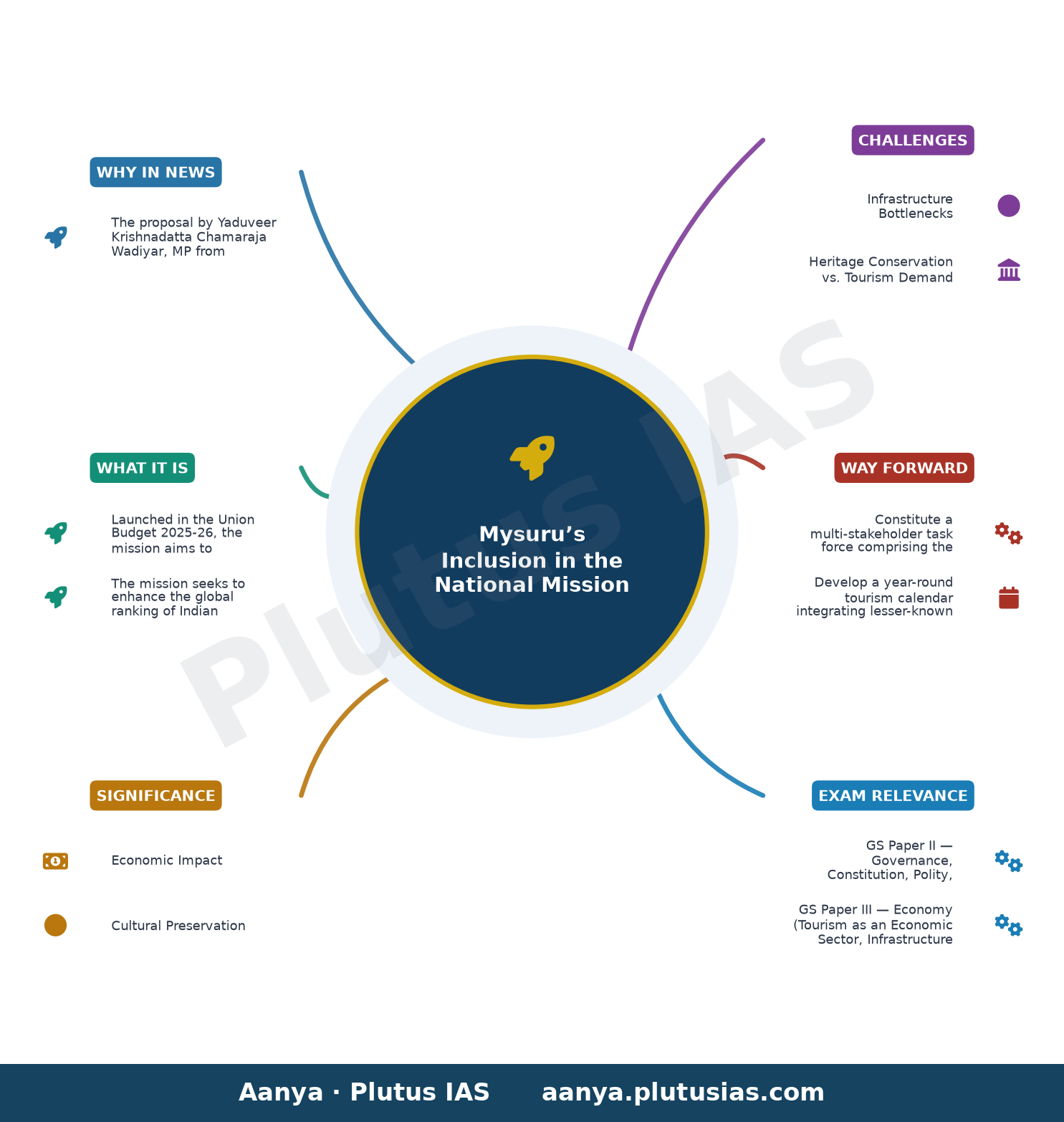
- GS Paper II — Governance, Constitution, Polity, Social Justice and International Relations (Tourism Policy and Centre-State Cooperation) | GS Paper III — Economy (Tourism as an Economic Sector, Infrastructure Development, and Public-Private Partnerships)
- Prelims: National Mission for the Development of 50 Globally Competitive Tourist Destinations, UNESCO Intangible Cultural Heritage (Mysuru Dasara), Viksit Bharat 2047, Heritage City Development and Augmentation Yojana (HRIDAY), Tourism Infrastructure Development under the National Tourism Policy 2022
- Essay: The Role of Cultural Heritage in Nation-Building: A Case Study of Mysuru, Sustainable Tourism as a Catalyst for Inclusive Economic Growth
Quick Revision: The National Mission for the Development of 50 Globally Competitive Tourist Destinations, announced in Union Budget 2025-26, aims to transform select Indian cities into world-class tourism hubs by leveraging cultural heritage, sustainable practices, and public-private partnerships, with Mysuru as a prime candidate due to its rich historical and tourism assets.
Why is this in the news?
The proposal by Yaduveer Krishnadatta Chamaraja Wadiyar, MP from Mysuru-Kodagu, to include Mysuru in the Union Government’s National Mission for the Development of 50 Globally Competitive Tourist Destinations has gained prominence due to the city’s unparalleled cultural, historical, and tourism assets. This initiative aligns with the broader national objective of positioning India as a premier global tourism destination by 2047, as envisaged under the Viksit Bharat vision. The meeting with the Union Tourism Minister underscores the strategic importance of leveraging heritage and cultural diplomacy to drive economic growth, employment generation, and sustainable urban development.
Background
- The Union Budget 2025-26 announced the National Mission for the Development of 50 Globally Competitive Tourist Destinations, aiming to transform select Indian cities into world-class tourism hubs through targeted infrastructure development, heritage conservation, and promotion of sustainable tourism practices.
- Mysuru, historically known as the cultural capital of Karnataka, is globally renowned for its royal heritage, exemplified by the Mysore Palace, and the Mysuru Dasara festival, which has received UNESCO recognition for its cultural significance.
- The city’s tourism sector is a significant contributor to Karnataka’s economy, attracting lakhs of domestic and international tourists annually, with sectors like hospitality, handicrafts, and wellness tourism playing a pivotal role.
- India’s National Tourism Policy 2022 emphasises the integration of cultural heritage, sustainable practices, and public-private partnerships to enhance the global competitiveness of Indian tourist destinations.
- The Viksit Bharat 2047 vision seeks to position India as a developed nation by 2047, with tourism identified as a key sector for economic growth, employment generation, and cultural diplomacy.
- The Heritage City Development and Augmentation Yojana (HRIDAY), launched in 2015, is a precedent for such missions, focusing on the holistic development of heritage cities through urban renewal and infrastructure upgradation.
National Mission for the Development of 50 Globally Competitive Tourist Destinations: Objectives and Framework
- Launched in the Union Budget 2025-26, the mission aims to identify, develop, and promote 50 Indian cities as globally competitive tourist destinations, aligning with the Viksit Bharat 2047 vision.
- The mission seeks to enhance the global ranking of Indian tourist destinations by improving infrastructure, preserving heritage sites, and promoting sustainable tourism practices.
- Key focus areas include the development of world-class visitor amenities, digital integration for tourism promotion, and the creation of employment opportunities in the hospitality and allied sectors.
- The mission operates through a collaborative framework involving the Union Ministry of Tourism, state governments, local bodies, and private stakeholders to ensure holistic and inclusive development.
- Selection criteria for cities under the mission include cultural heritage, historical significance, connectivity, sustainability practices, and potential for economic impact.
- The mission is expected to leverage India’s soft power through cultural diplomacy, positioning Indian cities as global hubs for heritage, wellness, and experiential tourism.
- Funding for the mission is envisaged through a mix of central and state budgets, public-private partnerships, and international collaborations, ensuring financial sustainability.
- The mission aligns with global tourism trends, such as experiential tourism, eco-tourism, and cultural tourism, to attract high-spend international tourists.
Key Features
| Feature | Significance |
|---|---|
| Mysore Palace | One of India’s most visited heritage monuments; a symbol of royal legacy and architectural grandeur, attracting domestic and international tourists. |
| Mysuru Dasara Festival | UNESCO-recognised cultural event; integrates royal traditions, art, music, and dance, enhancing Mysuru’s global cultural footprint. |
| Yoga and Wellness Centre | Mysuru’s reputation as a hub for traditional yoga and wellness practices aligns with global health tourism trends and sustainable living. |
| Traditional Handicrafts & Art | Handlooms, sandalwood craft, and Mysore silk are indigenous industries that support local artisans and preserve cultural heritage. |
| Connectivity Infrastructure | Robust road, rail, and air connectivity (Mysuru Airport, NH-275, Bengaluru-Mysuru Expressway) facilitates seamless tourist movement and logistics. |
| UNESCO Recognition | Dasara’s inclusion in UNESCO’s Representative List of the Intangible Cultural Heritage of Humanity elevates Mysuru’s global prestige and tourism appeal. |
Why it Matters
Economic Impact
- Direct revenue generation through tourism boosts local businesses, hospitality, and retail sectors in Mysuru and surrounding regions.
- Indirect employment creation in tourism-related ancillary industries such as handicrafts, transport, and food services.
- Attracts private investment in tourism infrastructure (hotels, resorts, cultural centres) under the National Mission for 50 Globally Competitive Tourist Destinations.
Cultural Preservation
- Promotes conservation of heritage sites like Mysore Palace, Chamundi Hill, and Jaganmohan Palace through focused development funding.
- Safeguards intangible cultural heritage (Dasara, folk arts, traditional crafts) by integrating them into tourism narratives and economic models.
- Encourages documentation and revival of local art forms, ensuring intergenerational transmission of cultural knowledge.
Strategic Positioning
- Enhances Karnataka’s and India’s global tourism competitiveness by positioning Mysuru as a ‘heritage and wellness’ destination.
- Aligns with the Viksit Bharat 2047 vision by leveraging cultural diplomacy and soft power through tourism.
Sustainable Development
- Facilitates adoption of eco-friendly tourism practices to mitigate environmental degradation in heritage-rich areas.
- Promotes community-based tourism models that empower local stakeholders and ensure equitable benefit-sharing.
Challenges
1. Infrastructure Bottlenecks
- Inadequate last-mile connectivity within Mysuru city limits, particularly to peripheral tourist sites like Brindavan Gardens.
- Limited parking facilities and traffic congestion around high-density tourist zones such as the Mysore Palace.
UPSC Link: GS III: Infrastructure
2. Heritage Conservation vs. Tourism Demand
- Risk of over-commercialisation leading to erosion of cultural authenticity and heritage degradation.
- Need for stringent conservation guidelines to balance tourism influx with preservation of historical monuments.
UPSC Link: GS I: Indian Culture
3. Seasonal Tourism Dependence
- Over-reliance on the Dasara festival for tourist inflows, resulting in underutilisation of infrastructure during off-seasons.
- Need for year-round tourism strategies to stabilise revenue and employment.
UPSC Link: GS III: Tourism
4. Skilled Workforce Shortage
- Lack of trained hospitality professionals, guides, and artisans to meet international tourism standards.
- Need for vocational training programmes aligned with global tourism demands.
UPSC Link: GS II: Skill Development
5. Environmental Sustainability
- Pollution and waste management challenges in tourist-heavy areas due to high footfall.
- Pressure on water resources and green spaces in and around Mysuru.
UPSC Link: GS III: Environment
6. Policy Coordination Gaps
- Fragmented implementation between central, state, and local authorities leading to delays in project execution.
- Need for a unified governance framework under the National Mission for seamless integration.
UPSC Link: GS II: Federalism
Challenges — UPSC Perspective
| Issue | Concern |
|---|---|
| Heritage Overload | Risk of physical and cultural degradation of monuments due to unregulated tourism. |
| Seasonal Fluctuations | Economic instability for local businesses and artisans during non-festival periods. |
| Cultural Commodification | Potential dilution of traditional practices to cater to mass tourism demands. |
| Skill Gaps | Inability of local workforce to meet international service standards in hospitality and guiding. |
| Environmental Strain | Increased pollution, waste generation, and resource depletion in tourist zones. |
| Governance Fragmentation | Delays in approvals and implementation due to multi-layered administrative jurisdictions. |
Way Forward
- Constitute a multi-stakeholder task force comprising the Union Tourism Ministry, Karnataka Tourism Department, local authorities, and heritage experts to draft a 5-year strategic plan for Mysuru’s tourism development.
- Develop a year-round tourism calendar integrating lesser-known festivals, wellness retreats, and cultural trails to reduce seasonal dependence.
- Invest in last-mile connectivity solutions such as electric shuttle services, pedestrian-friendly pathways, and smart parking systems around key tourist sites.
- Launch a ‘Mysuru Heritage Guardians’ programme to train local youth as certified guides, artisans, and hospitality professionals to meet global standards.
- Implement a ‘Green Tourism’ certification for hotels and homestays adhering to sustainability criteria, including waste management and energy efficiency.
- Establish a dedicated ‘Cultural Heritage Fund’ under the National Mission to finance restoration projects and promote traditional crafts.
- Enhance digital infrastructure with augmented reality (AR) guided tours, multilingual apps, and virtual reality (VR) experiences to attract tech-savvy tourists.
- Strengthen public-private partnerships (PPPs) for developing boutique hotels, wellness resorts, and eco-tourism circuits in and around Mysuru.
UPSC Value Addition
Keywords for Mains Answer-Writing
National Mission for Development of 50 Globally Competitive Tourist Destinations · Mysore Palace · Mysuru Dasara Festival · UNESCO Intangible Cultural Heritage · Viksit Bharat 2047 · Cultural tourism infrastructure · Sustainable tourism · Tourism governance and federalism · Public-private partnership in tourism · Heritage conservation and tourism
Concept Flow
Proposal for Mysuru’s inclusion under the National Mission for 50 Globally Competitive Tourist Destinations → → Recognition of Mysuru’s cultural, historical, and tourism potential by the Union Tourism Ministry → → Development of tourism infrastructure and conservation of heritage sites through central funding → → Enhanced tourist inflow and economic multiplier effects in Mysuru and Karnataka → → Creation of employment opportunities and skill development in hospitality and traditional crafts → → Sustainable tourism practices and environmental safeguards to mitigate negative externalities → → Alignment with Viksit Bharat 2047 goals for inclusive and sustainable growth through tourism-led development
Prelims Practice Questions
Q1. Consider the following statements regarding the National Mission for the Development of 50 Globally Competitive Tourist Destinations in India:
1. It was announced in the Union Budget 2025-26.
2. The mission aims to develop 50 tourist destinations to be globally competitive.
3. Mysuru has been officially included under this mission as of August 2026.
4. The mission focuses exclusively on natural tourist destinations.
How many of the above statements are correct?
- Only one
- Only two
- Only three
- All
Answer: Only three — Statements 1 and 2 are correct as the mission was announced in the Union Budget 2025-26 and aims to develop 50 globally competitive destinations. Statement 3 is incorrect as Mysuru’s inclusion is only proposed and not officially included as of August 2026. Statement 4 is incorrect as the mission includes cultural, historical, and spiritual destinations alongside natural ones.
Q2. Assertion (A): The Mysuru Dasara Festival has been recognized by UNESCO for its cultural significance.
Reason (R): The festival is a part of India’s intangible cultural heritage under UNESCO’s Representative List.
In the context of the above two statements, which one of the following is correct?
- Both A and R are true, and R is the correct explanation of A.
- Both A and R are true, but R is not the correct explanation of A.
- A is true, but R is false.
- A is false, but R is true.
Answer: Both A and R are true, but R is not the correct explanation of A. — The Mysuru Dasara Festival is indeed recognized by UNESCO under the Representative List of the Intangible Cultural Heritage of Humanity. The assertion (A) and reason (R) are both correct, and the reason correctly explains the assertion.
Q3. Which of the following pairs is correctly matched regarding Mysuru’s tourism attributes?
1. Mysore Palace – UNESCO World Heritage Site
2. Mysuru Dasara Festival – UNESCO Intangible Cultural Heritage
3. Yoga and wellness – Centre of Excellence in Ayurveda
4. Traditional handicrafts – Channapatna toys
Select the correct answer using the code below:
- 1 and 2 only
- 2 and 3 only
- 2 and 4 only
- 1, 3 and 4 only
Answer: 2 and 4 only — The Mysore Palace is a UNESCO World Heritage Site candidate but not yet inscribed, so pair 1 is incorrect. The Mysuru Dasara Festival is recognized by UNESCO as Intangible Cultural Heritage (pair 2 is correct). Yoga and wellness are highlighted as a key attribute of Mysuru (pair 3 is correct). Channapatna toys are a traditional handicraft of Karnataka, but they are not exclusively associated with Mysuru (pair 4 is incorrect).
Mains Practice Question
✍ The inclusion of Mysuru under the National Mission for the Development of 50 Globally Competitive Tourist Destinations is envisaged as a catalyst for transforming the city into a world-class tourism hub. Critically examine the potential challenges and opportunities this initiative presents for sustainable tourism development in Mysuru, with reference to the city’s cultural heritage, infrastructure, and governance mechanisms. (15 Marks)
Approach: MODEL-ANSWER SKELETON:
1. **Opportunities (6 points)**
– **Cultural Heritage Boost**: Leverage Mysuru’s UNESCO-recognized Dasara festival, Mysore Palace (heritage monument), and royal legacy to attract global tourists.
– **Infrastructure Development**: Upgradation of roads, rail, and air connectivity under the mission to improve accessibility.
– **Sustainable Tourism**: Promote eco-friendly tourism models, waste management, and heritage conservation aligned with SDGs.
– **Economic Growth**: Employment generation in hospitality, handicrafts, and local art sectors; empowerment of artisans (e.g., Channapatna toy makers).
– **Public-Private Partnerships (PPPs)**: Attract investment for tourism infrastructure (hotels, museums, wellness centers) through PPP models.
– **Branding and Marketing**: Global promotion of Mysuru as a ‘heritage and wellness’ destination under the mission’s umbrella.
2. **Challenges (6 points)**
– **Heritage Conservation vs. Commercialization**: Risk of over-commercialization diluting the cultural essence of Mysore Palace and Dasara festival.
– **Infrastructure Bottlenecks**: Existing gaps in urban infrastructure (e.g., traffic congestion, sanitation) may hinder tourism experience.
– **Sustainability Trade-offs**: Balancing mass tourism with environmental degradation (e.g., pollution in heritage precincts).
– **Governance Fragmentation**: Coordination challenges between central (Tourism Ministry), state (Karnataka Tourism), and local bodies (Mysuru City Corporation).
– **Cultural Appropriation**: Risk of commercial exploitation of traditional art forms (e.g., Mysore silk, Ganjifa cards) without benefiting local artisans.
– **Seasonal Tourism**: Over-reliance on Dasara and palace tourism may lead to underutilization of infrastructure during off-seasons.
3. **Way Forward (3 points)**
– **Integrated Tourism Plan**: Develop a city-wide tourism master plan integrating heritage, wellness, and adventure tourism.
– **Community Participation**: Involve local communities in tourism planning to ensure cultural authenticity and equitable benefits.
– **Monitoring and Evaluation**: Establish a robust framework to assess tourism impact on heritage sites and local livelihoods.
Source: The Hindu
Generated by AanyaAi for educational purpose.

- हिमाचल में डिजिटल भुगतान क्रांति: बिलासपुर अव्वल, महिलाओं की भागीदारी 93% तक पहुंची - September 23, 2026
- Himachal Pradesh Leads in Digital Payments: Bilaspur Tops, Women’s Role Rises - September 23, 2026
- केरल लोक सेवा आयोग ने उच्च न्यायालय में दायर किया मामला, सदस्यों के खिलाफ मामला रद्द करने की मांग - September 23, 2026

No Comments