


04 Aug Mysuru’s Push for Global Tourism Mission: Centre’s Nod Sought
✎ The National Mission for the Development of 50 Globally Competitive Tourist Destinations is a strategic intervention to transform India’s tourism sector by leveraging heritage assets, improving infrastructure, and promoting…
Subject Relevance — Where This Topic Fits
- GS Paper II — Governance, Constitution, Polity, Social Justice and International Relations (Centre-State relations, tourism policy) | GS Paper III — Indian Economy (Tourism as an economic sector, infrastructure development, PPP models) | GS Paper I — Indian Heritage and Culture (Cultural tourism, heritage conservation)
- Prelims: National Mission for the Development of 50 Globally Competitive Tourist Destinations, UNESCO Intangible Cultural Heritage, Viksit Bharat 2047, PPP in tourism infrastructure, Cultural tourism circuits, Heritage conservation funding, Tourism employment generation
- Essay: The Role of Heritage in National Development: Balancing Conservation and Commercialisation, Tourism as a Catalyst for Socio-Economic Transformation: Lessons from Mysuru
Quick Revision: The National Mission for the Development of 50 Globally Competitive Tourist Destinations is a strategic intervention to transform India’s tourism sector by leveraging heritage assets, improving infrastructure, and promoting sustainable tourism practices, with Mysuru as a potential exemplar.
Why is this in the news?
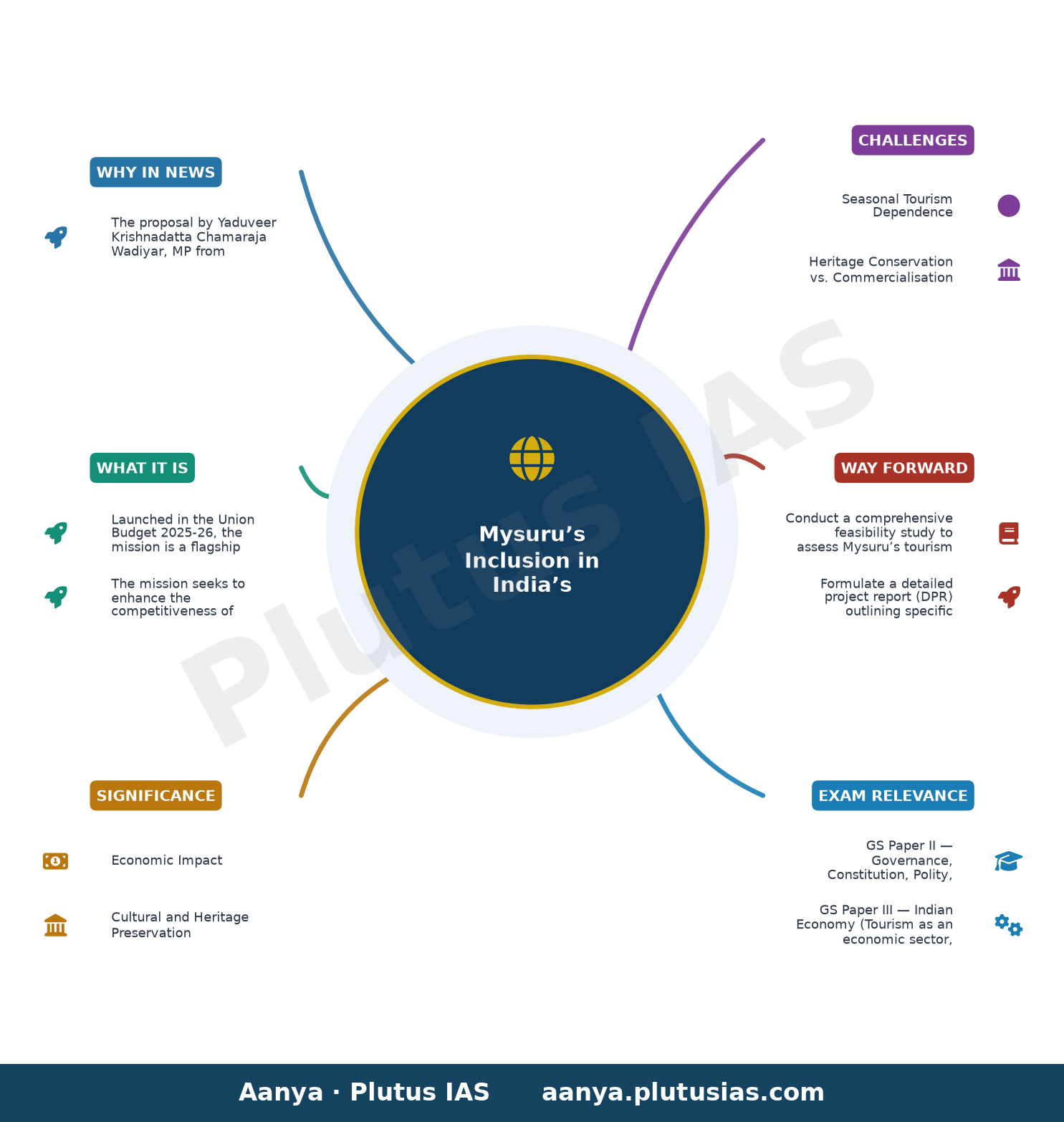
The proposal by Yaduveer Krishnadatta Chamaraja Wadiyar, MP from Mysuru-Kodagu, to include Mysuru under the Union Government’s National Mission for the Development of 50 Globally Competitive Tourist Destinations has brought renewed focus on the city’s untapped potential as a global tourism hub. The initiative aligns with the broader vision of Viksit Bharat 2047 and underscores the need for integrated heritage conservation, infrastructure augmentation, and sustainable tourism practices to position Mysuru as a premier international destination.
Background
- The Union Budget 2025-26 announced the National Mission for the Development of 50 Globally Competitive Tourist Destinations, aiming to transform India’s tourism landscape by leveraging heritage, cultural, and natural assets.
- Mysuru, historically known as the cultural capital of Karnataka, boasts a rich legacy of the Wadiyar dynasty, with the Mysore Palace being one of India’s most visited heritage monuments.
- The Mysuru Dasara festival, a 10-day cultural extravaganza, has received UNESCO recognition for its cultural significance, highlighting the city’s global cultural significance.
- Karnataka’s tourism sector contributes approximately 8.5% to the state’s GSDP, with Mysuru alone attracting over 10 million domestic and international tourists annually, underscoring its economic relevance.
- The mission builds on earlier initiatives such as the Swadesh Darshan Scheme (2014) and PRASAD Scheme (2014-15), which aimed at integrated tourist circuit development and religious tourism promotion, respectively.
- The proposal comes at a time when India is positioning itself as a ‘destination of choice’ under the G20 tourism track, with a focus on sustainable and inclusive tourism models.
What is the National Mission for the Development of 50 Globally Competitive Tourist Destinations?
- Launched in the Union Budget 2025-26, the mission is a flagship programme of the Ministry of Tourism, Government of India, aimed at identifying, developing, and promoting 50 globally competitive tourist destinations across India.
- The mission seeks to enhance the competitiveness of selected destinations by improving infrastructure, visitor amenities, and service delivery, thereby attracting higher footfall and foreign exchange earnings.
- Each selected destination will receive targeted financial and technical support for heritage conservation, digital integration, skill development, and marketing, with a focus on sustainability and inclusivity.
- The mission adopts a ‘whole-of-government’ approach, involving multiple stakeholders including state governments, local bodies, private sector, and civil society organisations.
- Eligibility criteria for inclusion include: cultural and historical significance, tourism potential, existing infrastructure, connectivity, and the ability to generate employment and livelihoods.
- The mission aligns with the ‘Dekho Apna Desh’ initiative, which encourages domestic tourism and aims to make India a top-50 global tourist destination by 2030.
- Funding for the mission is envisaged through a mix of central and state contributions, public-private partnerships (PPPs), and multilateral funding, with an estimated outlay of ₹5,000 crore over five years.
- The mission includes a ‘Destination Management Plan’ for each selected site, outlining strategies for conservation, marketing, and community engagement.
Key Features
| Feature | Significance |
|---|---|
| Mysore Palace | One of India’s most visited heritage monuments, symbolising the royal legacy of the Wadiyar dynasty and attracting lakhs of domestic and international tourists annually. |
| Mysuru Dasara Festival | UNESCO-recognised cultural event, enhancing global visibility and showcasing Karnataka’s rich traditions, performing arts, and heritage. |
| Yoga and Wellness Centre | Mysuru’s established reputation as a global centre for yoga and wellness tourism, aligning with India’s push for holistic tourism. |
| Traditional Handicrafts and Art | Vibrant art and handicrafts sector, including sandalwood carving and silk weaving, providing livelihoods and cultural authenticity. |
| Connectivity Infrastructure | Robust road, rail, and air connectivity, including the Mysuru Airport and proximity to Bengaluru, facilitating seamless tourist movement. |
Why it Matters
Economic Impact
- Direct employment generation in hospitality, tourism services, and allied sectors, particularly benefiting local artisans, guides, and small businesses.
- Enhanced revenue streams through increased tourist footfall, boosting state and central tax collections from tourism-related activities.
- Catalysing private investment in hotels, resorts, and tourism infrastructure, aligning with the ‘Viksit Bharat 2047’ vision of inclusive growth.
Cultural and Heritage Preservation
- Inclusion under the national mission would prioritise conservation of heritage sites like the Mysore Palace, ensuring sustainable tourism without compromising authenticity.
- Promotion of intangible cultural heritage through festivals like Dasara, safeguarding traditional arts, crafts, and performing arts for future generations.
Strategic and Diplomatic Significance
- Elevates India’s global tourism profile by positioning Mysuru as a premier heritage and wellness destination, competing with international tourist hubs.
- Strengthens cultural diplomacy by showcasing Karnataka’s historical and spiritual heritage to global audiences, fostering people-to-people ties.
Sustainable Development Goals Alignment
- Supports SDG 8 (Decent Work and Economic Growth) by creating livelihood opportunities and SDG 11 (Sustainable Cities and Communities) through heritage conservation.
- Promotes SDG 12 (Responsible Consumption and Production) via sustainable tourism practices, minimising environmental degradation.
Challenges
1. Seasonal Tourism Dependence
- Heavy reliance on the Dasara festival and winter months for tourist inflow, leading to underutilisation of infrastructure during off-seasons.
- Risk of overcrowding during peak seasons, straining local resources and necessitating robust crowd management strategies.
UPSC Link: GS3: Tourism infrastructure
2. Heritage Conservation vs. Commercialisation
- Balancing the preservation of heritage sites with the demands of mass tourism, including wear-and-tear of monuments and loss of authenticity.
- Need for strict regulatory frameworks to prevent commercial exploitation of cultural assets while ensuring community participation.
UPSC Link: GS1: Cultural heritage
3. Connectivity and Last-Mile Infrastructure
- Limited direct air connectivity beyond Bengaluru, increasing travel time and costs for international tourists.
- Inadequate public transport, parking facilities, and pedestrian-friendly pathways in and around Mysuru’s heritage precincts.
UPSC Link: GS3: Infrastructure development
4. Human Resource Development
- Shortage of trained guides, hospitality professionals, and artisans with expertise in traditional crafts, affecting service quality.
- Need for upskilling programmes to align local workforce with global tourism standards, including language proficiency and digital literacy.
UPSC Link: GS2: Skill development
5. Environmental Sustainability
- Risk of environmental degradation due to unregulated tourism activities, including pollution, waste management, and strain on water resources.
- Pressure on fragile ecosystems like the Western Ghats, necessitating eco-friendly tourism policies and carrying capacity assessments.
UPSC Link: GS3: Environmental conservation
Challenges — UPSC Perspective
| Issue | Concern |
|---|---|
| Seasonal Tourism | Underutilisation of infrastructure during off-seasons and overcrowding during peak periods. |
| Heritage vs. Commercialisation | Risk of cultural dilution and physical degradation of heritage sites. |
| Connectivity Gaps | Limited direct air links and inadequate public transport affecting tourist experience. |
| Skill Shortages | Lack of trained professionals in hospitality and traditional crafts impacting service quality. |
| Environmental Strain | Unregulated tourism leading to pollution, waste, and ecosystem degradation. |
Government Initiatives — Must-Memorise for Prelims
- National Mission for the Development of 50 Globally Competitive Tourist Destinations in India (Union Budget 2025-26)
Way Forward
- Conduct a comprehensive feasibility study to assess Mysuru’s tourism potential, including heritage conservation needs and infrastructure gaps.
- Formulate a detailed project report (DPR) outlining specific interventions under the national mission, such as heritage restoration, skill development, and eco-tourism initiatives.
- Strengthen last-mile connectivity by improving public transport, pedestrian pathways, and parking facilities in and around heritage sites.
- Develop a year-round tourism calendar to mitigate seasonal dependence, including cultural festivals, wellness retreats, and adventure tourism.
- Establish a dedicated skill development centre for hospitality professionals, guides, and artisans to enhance service quality and preserve traditional crafts.
- Implement sustainable tourism practices, including waste management systems, water conservation measures, and carrying capacity assessments for fragile sites.
- Foster public-private partnerships (PPPs) to attract investment in hotels, resorts, and tourism-related infrastructure while ensuring community benefits.
- Promote Mysuru’s tourism globally through targeted marketing campaigns, leveraging digital platforms and collaborations with international tourism bodies.
UPSC Value Addition
Keywords for Mains Answer-Writing
National Mission for the Development of 50 Globally Competitive Tourist Destinations · Yaduveer Krishnadatta Chamaraja Wadiyar · Mysuru Dasara festival · UNESCO recognition · Viksit Bharat 2047 · Sustainable tourism infrastructure · Cultural heritage conservation · Tourism-led employment generation · Union Budget 2025-26 · Heritage tourism in India · Tourism infrastructure development · Public-private partnership in tourism
Concept Flow
Mysuru’s proposal for inclusion in the National Mission for 50 Globally Competitive Tourist Destinations → → Union Tourism Minister’s consideration of the proposal → → Potential approval and allocation of funds for infrastructure development → → Enhanced tourism infrastructure and amenities → → Increased tourist inflow and revenue generation → → Economic growth, employment creation, and cultural preservation → → Alignment with Viksit Bharat 2047 and Sustainable Development Goals.
Prelims Practice Questions
Q1. Consider the following statements regarding the National Mission for the Development of 50 Globally Competitive Tourist Destinations in India:
1. The mission was announced in the Union Budget 2025-26.
2. The mission aims to develop 50 tourist destinations to global competitiveness.
3. The mission includes provisions for heritage conservation and sustainable tourism.
4. The mission is solely funded by the central government without any state participation.
How many of the above statements are correct?
- Only one
- Only two
- Only three
- All four
Answer: Only three — Statements 1, 2, and 3 are correct as per the Union Budget 2025-26 announcement and the mission’s stated objectives. Statement 4 is incorrect because the mission encourages state participation and public-private partnerships.
Q2. Assertion (A): The Mysuru Dasara festival has received UNESCO recognition for its cultural significance.
Reason (R): The festival is a 10-day celebration of the Hindu goddess Durga’s victory over the demon Mahishasura, symbolizing the triumph of good over evil.
In the context of the above two statements, which one of the following is correct?
- Both A and R are true, and R is the correct explanation of A
- Both A and R are true, but R is not the correct explanation of A
- A is true, but R is false
- A is false, but R is true
Answer: A is true, but R is false — The Mysuru Dasara festival is indeed renowned for its cultural significance and has been recognized by UNESCO. However, the Reason (R) does not directly explain the Assertion (A), as UNESCO recognition is based on broader criteria such as intangible cultural heritage and community participation, not solely on the festival’s mythological narrative.
Q3. Which of the following statements about the National Mission for the Development of 50 Globally Competitive Tourist Destinations is NOT correct?
- It aims to develop tourism infrastructure and improve visitor amenities.
- It includes provisions for the conservation of heritage sites.
- It mandates the inclusion of all state capitals under the mission.
- It encourages sustainable tourism practices and public-private partnerships.
Answer: It mandates the inclusion of all state capitals under the mission. — The mission does not mandate the inclusion of all state capitals; it focuses on 50 globally competitive tourist destinations, which may or may not include state capitals.
Mains Practice Question
✍ Critically examine the role of the National Mission for the Development of 50 Globally Competitive Tourist Destinations in achieving the objectives of Viksit Bharat 2047. Substantiate your answer with reference to the proposal for Mysuru’s inclusion under the mission. (15 Marks)
Approach: MODEL-ANSWER SKELETON:
1. **Introduction**: Define the National Mission for the Development of 50 Globally Competitive Tourist Destinations and its alignment with Viksit Bharat 2047. Highlight the mission’s objectives: infrastructure development, heritage conservation, sustainable tourism, and employment generation.
2. **Mysuru’s Proposal**: Discuss Mysuru’s unique attributes—Mysore Palace, Dasara festival (UNESCO recognition), yoga and wellness hub, traditional handicrafts, and connectivity. Explain how inclusion under the mission would enhance these strengths.
3. **Role in Viksit Bharat 2047**: Link the mission to the vision of a developed India by 2047. Discuss how tourism-led development can contribute to economic growth, employment, and cultural preservation. Cite the potential for public-private partnerships and sustainable practices.
4. **Challenges and Criticisms**: Address potential challenges such as over-commercialization, environmental degradation, and equitable distribution of benefits. Discuss the need for balanced development and community participation.
5. **Conclusion**: Summarize the mission’s significance in achieving Viksit Bharat 2047, with a balanced view of its potential and limitations. Emphasize the importance of inclusive and sustainable tourism policies.
Source: The Hindu
Generated by AanyaAi for educational purpose.

- UPSC Civil Services (Main) Examination 2026 — Philosophy Optional Paper II: Questions with Model Answers | Plutus IAS - September 21, 2026
- कर्नाटक हाईकोर्ट ने KPSC घोटाले की जांच के लिए डीजीपी अलोक कुमार की अध्यक्षता में SIT गठित की - September 21, 2026
- Karnataka HC forms SIT to probe KPSC recruitment scam: Key facts for UPSC - September 21, 2026

No Comments