


08 Aug Nadda chairs CEO Roundtable at India Medical Device 2026: Key Takeaways for UPSC
✎ India’s medical device sector must prioritise evidence-based reimbursement frameworks, transparent HTA processes, and sustainable financing models to ensure equitable access to innovative therapies under the Universal Health…
Subject Relevance — Where This Topic Fits
- GS Paper II — Health, Human Resource Development and Related Services | GS Paper III — Science and Technology in Governance, Industrial Policy and Investment
- Prelims: Medical Devices Rules 2017, Production-Linked Incentive Scheme for Medical Devices, National Medical Devices Policy 2023, Health Technology Assessment (HTA) in India, Universal Health Coverage (UHC) and Reimbursement Frameworks
- Essay: The role of innovation in achieving Sustainable Development Goal 3: Good Health and Well-being, Balancing affordability and quality in healthcare delivery: Lessons from India’s medical device sector
Quick Revision: India’s medical device sector must prioritise evidence-based reimbursement frameworks, transparent HTA processes, and sustainable financing models to ensure equitable access to innovative therapies under the Universal Health Coverage paradigm.
Why is this in the news?
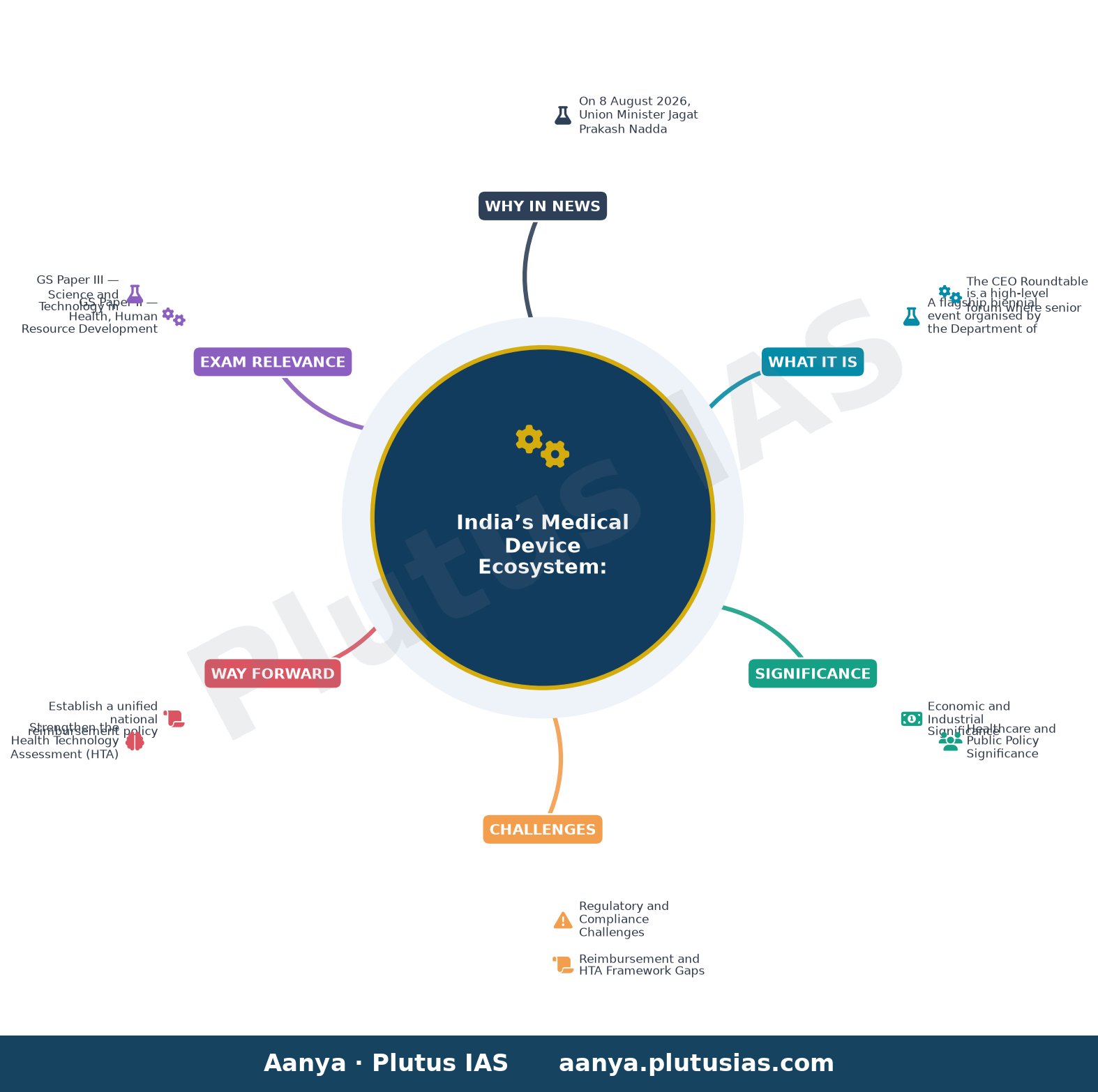
On 8 August 2026, Union Minister Jagat Prakash Nadda chaired the CEO Roundtable at ‘India Medical Device 2026’, a high-level platform convened by the Department of Pharmaceuticals under the Ministry of Chemicals and Fertilizers in collaboration with FICCI. The event brought together senior policymakers, CEOs of global and domestic MedTech firms, and MSMEs to deliberate on strengthening India’s medical device ecosystem, fostering innovation, enhancing domestic manufacturing, and expanding global market access. The discussions underscored the need for evidence-based decision-making, transparent HTA processes, sustainable reimbursement systems, and robust clinical evidence to ensure equitable access to innovative therapies within India’s Universal Health Coverage framework.
Background
- The medical device sector in India is a critical component of the healthcare value chain, with applications ranging from diagnostics and implants to life-saving equipment.
- India’s medical device market is valued at approximately USD 12 billion (2025 estimates), with domestic manufacturing contributing about 30% and imports accounting for the remainder.
- The sector has witnessed rapid growth due to increasing demand from both public and private healthcare systems, driven by rising non-communicable diseases and technological advancements.
- Policy initiatives such as the National Medical Devices Policy 2023 and the Production-Linked Incentive (PLI) Scheme for Medical Devices aim to reduce import dependence, promote local innovation, and enhance export competitiveness.
- The Medical Devices Rules, 2017, provide a regulatory framework for the manufacture, import, and sale of medical devices in India, aligning with global standards.
- Universal Health Coverage (UHC) remains a strategic priority for India, with the Ayushman Bharat scheme serving as a foundational pillar for equitable healthcare access.
What is the ‘India Medical Device 2026’ Summit and the CEO Roundtable?
- A flagship biennial event organised by the Department of Pharmaceuticals, Ministry of Chemicals and Fertilizers, in partnership with FICCI, to foster dialogue between government, industry, and academia on the future of India’s MedTech sector.
- The CEO Roundtable is a high-level forum where senior executives of global and domestic medical device companies, MSMEs, and policymakers deliberate on strategic interventions to strengthen the ecosystem.
- Key focus areas include innovation, investment, domestic manufacturing, global market access, and the adoption of evidence-based reimbursement frameworks for innovative therapies.
- The summit aligns with India’s broader healthcare goals, particularly the achievement of Universal Health Coverage (UHC) through affordable, accessible, and sustainable healthcare solutions.
- The event serves as a platform for knowledge exchange, policy advocacy, and the identification of actionable recommendations to address challenges in the medical device sector.
- The participation of senior government officials such as the Secretary, Department of Pharmaceuticals; NITI Aayog Member; Secretary, Department of Health Research and DG, ICMR; and CEO, National Health Authority underscores the government’s commitment to collaborative policymaking.
- Discussions at the CEO Roundtable are expected to inform the design of future policies, including those related to Health Technology Assessment (HTA), reimbursement mechanisms, and procurement frameworks.
Key Features
| Feature | Significance |
|---|---|
| ‘इंडिया मेडिकल डिवाइस 2026’ (IMD 2026) | A national platform facilitating dialogue between policymakers, industry leaders, and global stakeholders to shape the future of India’s MedTech sector, aligning with the vision of ‘Atmanirbhar Bharat’ in healthcare. |
| CEO Roundtable Conference | A high-level deliberation mechanism to address strategic challenges in medical device innovation, investment, and market access, ensuring policy coherence between regulatory, reimbursement, and procurement frameworks. |
| Evidence-Based Decision Making (EBDM) | Emphasis on robust clinical evidence, cost-effectiveness analysis, and Health Technology Assessment (HTA) to validate medical innovations, ensuring equitable and sustainable healthcare outcomes. |
| Reimbursement Ecosystem | Focus on creating a balanced reimbursement system that ensures affordability of innovative technologies while maintaining financial sustainability for healthcare systems. |
| Public-Private Partnership (PPP) | Collaboration between the Department of Pharmaceuticals (DoP), FICCI, and industry leaders to foster innovation, domestic manufacturing, and global competitiveness in the MedTech sector. |
Why it Matters
Economic and Industrial Significance
- India’s MedTech sector, valued at approximately USD 11 billion (2023), is projected to grow at a CAGR of 15-20%, driven by increasing healthcare demand and government initiatives like ‘Make in India’ and ‘Production-Linked Incentive (PLI) Scheme for Medical Devices’.
- Strengthening domestic manufacturing of medical devices reduces import dependency, enhances supply chain resilience, and aligns with the ‘Atmanirbhar Bharat’ initiative.
- The sector’s growth can generate significant employment opportunities, particularly in MSMEs and startups, while attracting foreign direct investment (FDI).
- India’s position as a global hub for affordable and innovative medical technologies can be reinforced through strategic policy interventions and industry-academia collaborations.
Healthcare and Public Policy Significance
- Innovative medical devices are critical for achieving Universal Health Coverage (UHC) by improving diagnostic accuracy, treatment efficacy, and patient outcomes, particularly in rural and underserved areas.
- A robust reimbursement and HTA framework ensures that cutting-edge technologies are accessible to patients without imposing unsustainable financial burdens on the healthcare system.
- Strengthening the MedTech ecosystem supports the National Health Mission (NHM) and Ayushman Bharat Digital Mission (ABDM) by integrating advanced technologies into primary and secondary healthcare delivery.
- Evidence-based policymaking ensures that public health investments yield measurable health benefits, optimizing resource allocation and reducing inefficiencies.
Strategic and Geopolitical Significance
- India’s emergence as a key player in the global MedTech supply chain can reduce dependence on imports from China and other countries, enhancing strategic autonomy in healthcare.
- Collaboration with global MedTech firms can facilitate technology transfer, skill development, and knowledge sharing, positioning India as a leader in affordable healthcare innovation.
- The ‘India Medical Device 2026’ platform serves as a diplomatic tool to strengthen international partnerships in healthcare, aligning with India’s Act East Policy and global health diplomacy initiatives.
Challenges
1. Regulatory and Compliance Challenges
- Complex and fragmented regulatory frameworks across states and union territories create barriers to market entry for innovative medical devices.
- Delays in approvals due to stringent and overlapping compliance requirements deter investment and innovation in the sector.
- Lack of harmonization between domestic regulations and global standards (e.g., ISO, FDA, CE marking) limits the global competitiveness of Indian MedTech products.
- Inadequate post-market surveillance mechanisms undermine patient safety and trust in domestic medical devices.
UPSC Link: GS3: Regulatory frameworks for medical devices
2. Reimbursement and HTA Framework Gaps
- Absence of a unified national reimbursement policy for medical devices leads to inequities in access and affordability across states.
- Limited integration of Health Technology Assessment (HTA) in decision-making processes delays the adoption of cost-effective innovations.
- Insufficient data on cost-effectiveness and clinical outcomes for indigenous medical technologies hampers their inclusion in reimbursement schemes.
- Bureaucratic delays in reimbursement approvals create financial instability for healthcare providers and manufacturers.
UPSC Link: GS2: Health financing and reimbursement policies
3. Domestic Manufacturing and Supply Chain Constraints
- Over-reliance on imported raw materials and components increases production costs and supply chain vulnerabilities.
- Limited R&D investment in indigenous medical technologies restricts innovation and competitiveness in the global market.
- Inadequate infrastructure for testing, certification, and quality control delays product commercialization.
- Skilled workforce shortages in advanced manufacturing and regulatory affairs impede sectoral growth.
UPSC Link: GS3: Industrial policy and manufacturing competitiveness
4. Market Access and Global Competitiveness
- High import duties on raw materials and components increase the cost of domestic manufacturing, making Indian products less competitive globally.
- Limited awareness and adoption of indigenous medical technologies among healthcare providers and patients.
- Challenges in obtaining international certifications (e.g., FDA, CE) due to stringent regulatory requirements and lack of support infrastructure.
- Competition from low-cost imports from countries like China and Vietnam undermines the growth of domestic MedTech firms.
UPSC Link: GS3: Export promotion and global trade
5. Data Privacy and Ethical Concerns
- Inadequate safeguards for patient data collected through medical devices, raising concerns about privacy and cybersecurity.
- Ethical dilemmas in the adoption of AI-driven diagnostic tools and robotic surgeries, including accountability and liability issues.
- Lack of standardized protocols for data sharing and interoperability between medical devices and healthcare systems.
UPSC Link: GS4: Ethical governance in healthcare technology
Challenges — UPSC Perspective
| Issue | Concern |
|---|---|
| Fragmented Regulatory Framework | Delays in approvals, compliance burdens, and lack of harmonization with global standards. |
| Limited HTA Integration | Absence of evidence-based decision-making in reimbursement and procurement policies. |
| Supply Chain Vulnerabilities | Over-reliance on imports, high production costs, and infrastructure gaps. |
| Reimbursement Inequities | Unequal access to innovative technologies across states and healthcare systems. |
| Skilled Workforce Shortage | Inadequate talent pool in advanced manufacturing, regulatory affairs, and R&D. |
| Global Market Competition | High import duties, lack of international certifications, and competition from low-cost imports. |
Government Initiatives — Must-Memorise for Prelims
- Production-Linked Incentive (PLI) Scheme for Medical Devices
Way Forward
- Establish a unified national reimbursement policy for medical devices to ensure equitable access and affordability across states.
- Strengthen the Health Technology Assessment (HTA) framework by integrating clinical evidence, cost-effectiveness analysis, and patient outcomes into decision-making processes.
- Enhance domestic manufacturing capabilities through targeted investments in R&D, infrastructure, and skill development under the PLI Scheme for Medical Devices.
- Promote public-private partnerships to facilitate technology transfer, knowledge sharing, and global market access for Indian MedTech firms.
- Develop standardized protocols for data privacy, cybersecurity, and interoperability to ensure ethical and secure adoption of medical technologies.
- Expand the scope of the ‘India Medical Device 2026’ platform to include international collaborations and joint ventures for technology innovation.
- Increase funding for indigenous R&D in medical devices, particularly in areas like AI-driven diagnostics, robotic surgery, and telemedicine.
- Improve post-market surveillance mechanisms to ensure patient safety, quality control, and compliance with global standards.
UPSC Value Addition
Keywords for Mains Answer-Writing
Medical Devices Policy 2023 · Universal Health Coverage (UHC) · Health Technology Assessment (HTA) · Medical Devices (Amendment) Rules, 2020 · National Medical Devices Policy · Pharmaceuticals Department · FICCI MedTech Committee · ICMR-DHR · Reimbursement Framework for Medical Technologies · Evidence-Based Healthcare Decision Making · MedTech Innovation Ecosystem · Public-Private Partnership in Healthcare · Clinical Evidence Standards · Ayushman Bharat Digital Mission (ABDM) · Make in India for Medical Devices
Concept Flow
India’s MedTech sector growth → Increased demand for innovative medical devices → Need for robust regulatory and reimbursement frameworks → Evidence-based policymaking (HTA, clinical trials) → Strengthening domestic manufacturing (PLI, PMMDP) → Enhancing global competitiveness (export promotion, international certifications) → Achieving Universal Health Coverage (UHC) through affordable and accessible healthcare technologies → Sustainable and resilient healthcare ecosystem.
Prelims Practice Questions
Q1. Consider the following statements regarding the Medical Devices (Amendment) Rules, 2020:
1. The rules classify medical devices into four risk-based classes.
2. The rules mandate clinical trials for all classes of medical devices.
3. The rules exempt certain low-risk devices from the requirement of prior approval.
4. The rules are notified by the Ministry of Health and Family Welfare.
How many of the above statements are correct?
- Only one
- Only two
- Only three
- All four
Answer: Only three — Statements 1 and 3 are correct. The Medical Devices (Amendment) Rules, 2020 classify devices into four risk-based classes (A, B, C, D) and exempt low-risk devices (Class A) from prior approval. Statement 2 is incorrect as clinical trials are not mandatory for all classes. Statement 4 is incorrect as the rules are notified by the Ministry of Chemicals and Fertilizers (Pharmaceuticals Department).
Q2. Assertion (A): The National Medical Devices Policy, 2023 aims to reduce India’s dependence on imports by promoting domestic manufacturing.
Reason (R): The policy includes provisions for setting up medical device parks and clusters under the ‘Make in India’ initiative.
Options:
A. Both A and R are true, and R is the correct explanation of A.
B. Both A and R are true, but R is not the correct explanation of A.
C. A is true, but R is false.
D. A is false, but R is true.
Answer: ? — Both Assertion (A) and Reason (R) are true. The National Medical Devices Policy, 2023 explicitly aims to reduce import dependence and promote domestic manufacturing through initiatives like medical device parks. Reason (R) correctly explains Assertion (A).
Q3. Match the following committees/initiatives with their respective roles in the medical devices ecosystem:
Column I
1. FICCI Medical Devices Committee
2. ICMR-DHR
3. National Medical Devices Policy, 2023
4. Ayushman Bharat Digital Mission (ABDM)
Column II
A. Formulates reimbursement frameworks for innovative technologies
B. Promotes industry collaboration and policy advocacy
C. Establishes digital health infrastructure and standards
D. Provides strategic direction for domestic manufacturing and innovation
Options:
1. 1-B, 2-A, 3-D, 4-C
2. 1-A, 2-B, 3-C, 4-D
3. 1-D, 2-C, 3-B, 4-A
4. 1-C, 2-D, 3-A, 4-B
Answer: ? — Correct matches: 1-B (FICCI Medical Devices Committee promotes industry collaboration), 2-A (ICMR-DHR formulates reimbursement frameworks), 3-D (National Medical Devices Policy provides strategic direction for manufacturing and innovation), 4-C (ABDM establishes digital health infrastructure).
Mains Practice Question
✍ The integration of evidence-based decision-making in healthcare is critical for achieving Universal Health Coverage (UHC) in India. In this context, critically examine the role of Health Technology Assessment (HTA) in shaping the reimbursement and adoption of medical devices. Also, discuss the challenges in establishing a robust HTA framework in the country. (15 Marks)
Approach: MODEL-ANSWER SKELETON:
1. **Introduction (2 marks)**
– Define UHC and its significance in India’s healthcare goals.
– Briefly introduce HTA as a tool for evidence-based healthcare decision-making.
2. **HTA’s Role in Medical Devices Reimbursement (6 marks)**
– Explain HTA’s function in evaluating the clinical efficacy, cost-effectiveness, and safety of medical devices.
– Discuss how HTA informs reimbursement policies under schemes like Ayushman Bharat and state-level health insurance programs.
– Highlight the role of ICMR-DHR and the proposed HTA India initiative in standardizing HTA processes.
– Reference the recent emphasis on evidence-based reimbursement frameworks in the ‘India Medical Devices 2026’ CEO Roundtable.
3. **Challenges in Establishing HTA Framework (5 marks)**
– Lack of standardized clinical evidence generation for indigenous devices.
– Limited capacity and expertise in HTA institutions.
– Fragmented reimbursement systems across states and schemes.
– Resistance from industry due to perceived delays in approvals.
– Need for robust data infrastructure and real-world evidence generation.
4. **Way Forward (2 marks)**
– Strengthen institutional capacity through collaborations with global HTA bodies (e.g., NICE, CADTH).
– Integrate HTA with digital health initiatives like ABDM for real-time data collection.
– Foster public-private partnerships to align industry incentives with HTA outcomes.
**Balanced View Required:** Acknowledge both the potential of HTA in improving healthcare outcomes and the practical hurdles in its implementation.
Source: PIB (Press Information Bureau)
Generated by AanyaAi for educational purpose.

- Hyderabad’s 4 Police Commissionerates: Why the Latest Rejig Matters for UPSC - October 5, 2026
- सुप्रीम कोर्ट में सीईसी के एकतरफा निर्णयों पर चुनौती, जानिए पूरा मामला - October 5, 2026
- UPSC Alert: India-Bangladesh Methanol Cargo Flagged Off from Dibrugarh - October 5, 2026

No Comments