


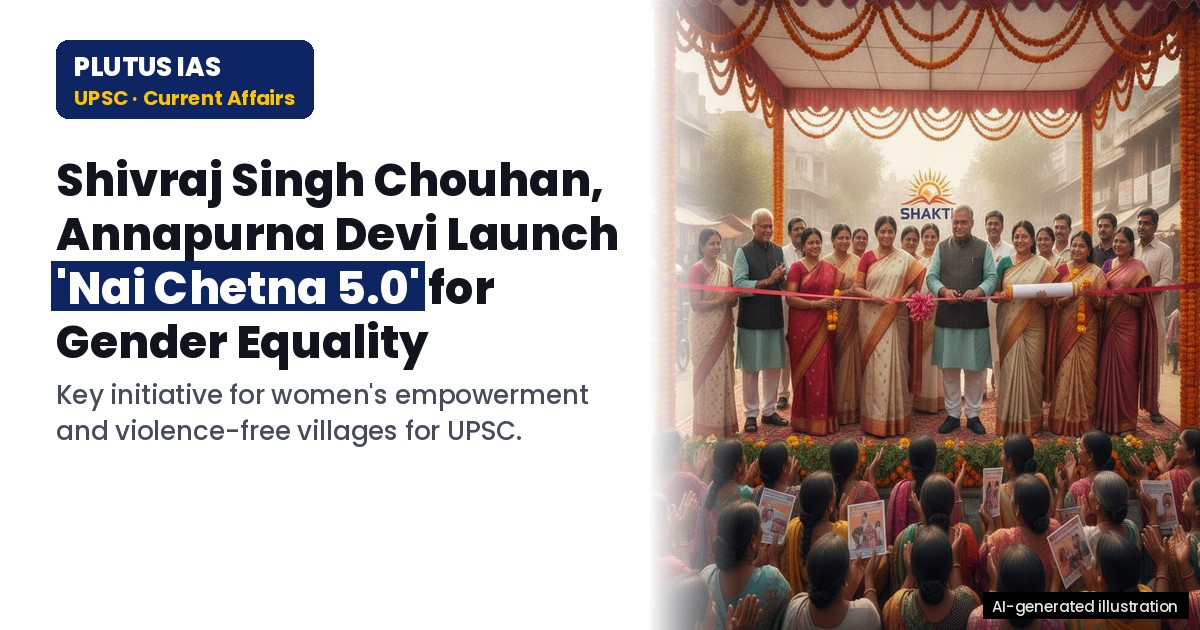
26 Nov Nai Chetna 5.0: Gender Equality, Violence-Free Villages Initiative
✎ The 'Nai Chetna 5.0' campaign, along with a quadripartite agreement, integrates various governmental and legal aid services to establish violence-free villages and ensure comprehensive support for women, underscoring a…
Subject Relevance — Where This Topic Fits
- GS Paper I — Society and Social Issues; Role of Women and Women’s Organization | GS Paper II — Government Policies and Interventions for Development in various sectors and Issues arising out of their Design and Implementation; Welfare Schemes for Vulnerable Sections of the Population by the Centre and States and the Performance of these Schemes; Mechanisms, Laws, Institutions and Bodies constituted for the Protection and Betterment of these Vulnerable Sections.
- Prelims: Nai Chetna 5.0, Gender Equality, Women Empowerment, Violence-Free Villages, DAY-NRLM, One Stop Centres, National Legal Services Authority (NALSA), Mahila Helpline 181, Disha 2.0, Gender Resource Centres
- Essay: The imperative of gender equality for a developed India., Community participation as a cornerstone for social transformation and women’s safety.
Quick Revision: The ‘Nai Chetna 5.0’ campaign, along with a quadripartite agreement, integrates various governmental and legal aid services to establish violence-free villages and ensure comprehensive support for women, underscoring a multi-ministerial commitment to gender equality and empowerment.
Why is this in the news?
The fifth edition of the ‘Nai Chetna: Pehal Badlav Ki’ campaign, titled ‘Nai Chetna 5.0’, was launched by the Union Ministers for Rural Development & Agriculture and Farmers Welfare, and Women & Child Development. This national campaign, focused on promoting gender equality and women’s empowerment, will run across all states and union territories from November 25 to December 23, 2026. A significant highlight was the signing of a quadripartite agreement to establish violence-free villages, involving the Department of Rural Development, Ministry of Women and Child Development, Department of Justice, and the National Legal Services Authority (NALSA).
Background
- The ‘Nai Chetna’ campaign, initiated as a nationwide public movement, aims to address gender-based violence and promote women’s empowerment.
- Previous editions of the campaign have focused on raising awareness and establishing Gender Resource Centres (GRCs) at the grassroots level.
- The campaign has evolved from an awareness program into a broader movement, engaging millions of people and establishing thousands of GRCs.
- The ‘Lakhpati Didis’ initiative, under which approximately 3.75 crore women have become economically self-reliant, underscores the government’s commitment to women’s economic empowerment.
- Existing support mechanisms for women include One Stop Centres, Mahila Helpline 181, Disha 2.0, and various legal aid services provided by NALSA and its associated bodies.
- The broader vision of ‘Viksit Bharat’ (Developed India) integrates women’s empowerment, dignity, and respect as crucial components for national progress.
What is the ‘Nai Chetna 5.0’ Campaign and the Quadripartite Agreement?
- ‘Nai Chetna 5.0’ is the fifth iteration of a national campaign launched by the Ministry of Rural Development and the Ministry of Women and Child Development, aimed at fostering gender equality and women’s empowerment.
- The campaign is a month-long initiative, scheduled from November 25 to December 23, 2026, to be implemented across all states and union territories of India.
- It seeks to move beyond mere awareness generation, focusing on providing effective support, legal assistance, and timely justice to women.
- A key component is the quadripartite agreement signed between the Department of Rural Development, Ministry of Women and Child Development, Department of Justice, and the National Legal Services Authority (NALSA).
- This agreement aims to create ‘violence-free villages’ by integrating the Gender Resource Centres (GRCs) of the DAY-NRLM with One Stop Centres, Mahila Helpline 181, Disha 2.0, and legal aid services.
- The integration will ensure that women facing violence receive comprehensive support, including safety, legal assistance, and rehabilitation, from a single coordinated platform.
- Initially, this integrated initiative will be implemented in nine states and union territories, with the objective of ensuring that no woman affected by violence has to struggle to find help.
- The campaign also emphasizes the importance of community institutions, Self-Help Groups (SHGs), Anganwadi workers, and local communities in disseminating information about women’s assistance services and promoting a societal shift towards gender equality.
- 15 ministries and departments have joined hands for women’s safety, empowerment and gender equality.
Key Features
| Feature | Significance |
|---|---|
| Launch of ‘Nai Chetna 5.0’ Campaign | Marks the fifth iteration of a national campaign aimed at promoting gender equality and women’s empowerment across all states and Union Territories. |
| Quadripartite Agreement for Violence-Free Villages | A collaborative effort between the Department of Rural Development, Ministry of Women and Child Development, Department of Justice, and National Legal Services Authority (NALSA) to create safe rural environments. |
| Integration of Support Services | Links Gender Resource Centres of DAY-NRLM with One Stop Centres, Women Helpline 181, Disha 2.0, and legal aid services to provide comprehensive support to women facing violence. |
| Multi-Ministerial Collaboration | Involves 15 ministries and departments, signifying a holistic governmental approach to women’s safety, gender equality, and empowerment. |
| Focus on Awareness and Effective Aid | Beyond awareness generation, the campaign now emphasizes providing effective assistance, legal aid, and timely justice to women. |
| Initial Implementation in 9 States/UTs | The violence-free village initiative will be rolled out in select regions to ensure targeted support and refine implementation strategies. |
Why it Matters
Social Empowerment
- Aims to foster a societal shift towards gender equality and respect for women, crucial for building an inclusive and equitable society.
- Promotes the creation of violence-free villages, enhancing the safety and dignity of women in rural areas and addressing deep-rooted social issues.
- Encourages community participation, including Self-Help Groups (SHGs) and Anganwadi workers, in driving social change and awareness at the grassroots level.
Governance and Policy Integration
- Demonstrates a coordinated approach across multiple government ministries and departments, ensuring a comprehensive policy framework for women’s welfare.
- Strengthens the institutional mechanism for addressing gender-based violence by integrating various support services under a single framework.
- Highlights the government’s commitment to implementing constitutional mandates related to gender equality and social justice through programmatic interventions.
Legal and Justice Access
- Enhances access to legal aid and justice for women, particularly in rural and remote areas, by connecting legal services with community-level support structures.
- Increases awareness about legal provisions and women’s helplines, empowering women to seek timely assistance and redressal.
- Facilitates the rehabilitation of women affected by violence, ensuring their holistic recovery and reintegration into society.
Economic Linkage
- Recognizes the contribution of women, particularly ‘Lakhpati Didis’ in the rural economy, linking economic empowerment with safety and dignity.
- Emphasizes that economic self-reliance must be complemented by security, respect, and equal opportunities for true women’s empowerment.
Challenges
1. Deep-rooted Patriarchal Norms
- Overcoming traditional mindsets and societal biases that perpetuate gender inequality and violence against women.
- Changing entrenched social behaviors and attitudes requires sustained efforts and community-level engagement beyond campaign periods.
UPSC Link: Social Justice: Issues relating to development and management of Social Sector/Services relating to Health, Education, Human Resources.
2. Awareness and Accessibility in Remote Areas
- Ensuring that information about support services and legal provisions reaches women in the most remote and marginalized communities.
- Bridging the digital divide and ensuring physical access to support centers and legal aid in geographically dispersed regions.
UPSC Link: Social Justice: Welfare schemes for vulnerable sections of the population by Centre and States and the performance of these schemes.
3. Effective Coordination and Implementation
- Ensuring seamless coordination among 15 ministries and departments, as well as various state-level agencies and community organizations.
- Monitoring the effective delivery of services and ensuring accountability across different levels of implementation.
UPSC Link: Governance: Important aspects of governance, transparency and accountability, e-governance- applications, models, successes, limitations, and potential.
4. Sustainability of Initiatives
- Maintaining the momentum of the campaign and the integrated support system beyond the initial launch phase.
- Securing adequate financial and human resources for the long-term operation of Gender Resource Centres, One Stop Centres, and legal aid services.
UPSC Link: Social Justice: Issues relating to poverty and hunger.
5. Addressing Substance Abuse Linkages
- Integrating the ‘Nasha Mukt Bharat Abhiyan’ effectively to address the correlation between substance abuse and domestic violence.
- Developing comprehensive strategies that tackle both issues simultaneously at the village level.
UPSC Link: Social Justice: Issues relating to development and management of Social Sector/Services relating to Health, Education, Human Resources.
Challenges — UPSC Perspective
| Issue | Concern |
|---|---|
| Social Stigma | Fear of social ostracization often prevents women from reporting violence and seeking help. |
| Lack of Awareness | Many women, especially in rural areas, are unaware of their rights and available support mechanisms. |
| Accessibility Barriers | Geographical distance, lack of transport, and limited infrastructure can hinder access to support services. |
| Coordination Gaps | Potential for fragmented service delivery if various departments and agencies do not collaborate effectively. |
| Resource Constraints | Sustaining the extensive network of Gender Resource Centres and other support services requires continuous funding and trained personnel. |
| Implementation Fidelity | Ensuring that the campaign’s objectives and service standards are consistently met across diverse regions and contexts. |
Government Initiatives — Must-Memorise for Prelims
- DAY-NRLM (Deendayal Antyodaya Yojana – National Rural Livelihoods Mission)
- One Stop Centres (OSCs)
- Women Helpline 181
- Disha 2.0
- Nasha Mukt Bharat Abhiyan
Way Forward
- Strengthen community-level institutions and Self-Help Groups (SHGs) to act as first responders and facilitators for women seeking assistance.
- Launch targeted awareness campaigns using local languages and cultural contexts to educate women about their rights and available support services.
- Enhance training and capacity building for frontline workers, including Anganwadi workers and paralegal volunteers, to provide sensitive and effective support.
- Establish robust monitoring and evaluation mechanisms to track the progress of the campaign and ensure accountability in service delivery.
- Promote inter-ministerial and inter-departmental convergence at the district and block levels for seamless implementation of integrated services.
- Leverage technology for wider outreach and efficient service delivery, including digital platforms for legal aid and complaint redressal.
- Encourage male engagement and sensitization programs to foster a collective responsibility towards gender equality and violence prevention.
- Allocate dedicated financial resources and ensure their optimal utilization for the long-term sustainability of support infrastructure and programs.
UPSC Value Addition
Keywords for Mains Answer-Writing
Gender Equality · Women Empowerment · Violence-Free Villages · Multi-sectoral Convergence · Legal Aid Services · One Stop Centres · DAY-NRLM · National Legal Services Authority (NALSA) · Community Mobilisation · Sustainable Development Goals
Constitutional & Policy Linkages
- Article 14: Equality before law and equal protection of laws.
- Article 15: Prohibition of discrimination on grounds of religion, race, caste, sex or place of birth.
- Article 21: Protection of life and personal liberty.
- Article 39A: Equal justice and free legal aid.
- Article 42: Provision for just and humane conditions of work and maternity relief.
Concept Flow
Gender inequality and violence against women persist in society. → Government launches ‘Nai Chetna 5.0’ campaign with multi-ministerial support. → Quadripartite agreement integrates support services (DAY-NRLM, OSCs, Helplines, Legal Aid). → Women receive comprehensive support (safety, legal aid, rehabilitation). → Increased awareness and access to justice empower women. → Villages become violence-free, fostering gender equality and dignity.
Prelims Practice Questions
Q1. Consider the following statements regarding the ‘Nai Chetna 5.0’ campaign:
1. It is a national campaign aimed at promoting gender equality and women’s empowerment.
2. It involves a quadripartite agreement between the Department of Rural Development, Ministry of Women and Child Development, Department of Justice, and the National Legal Services Authority (NALSA).
3. The campaign seeks to link Gender Resource Centres under DAY-NRLM with One Stop Centres, Women Helpline 181, Disha 2.0, and legal aid services.
How many of the above statements are correct?
- Only one
- Only two
- Only three
- None
Answer: Only three — Statement 1 is correct: The campaign ‘Nai Chetna: Pehal Badlav Ki’ is indeed focused on gender equality and women’s empowerment. Statement 2 is correct: A quadripartite agreement was signed between the specified entities to foster violence-free villages. Statement 3 is correct: The agreement explicitly aims to integrate Gender Resource Centres with various support services for women.
Q2. Which of the following initiatives are intended to provide legal aid and support to women in India?
1. NALSA
2. Tele-Law
3. Nyaya Bandhu
4. Para Legal Volunteers
Select the correct answer using the code given below:
- 1 and 2 only
- 1, 2 and 3 only
- 1, 2, 3 and 4
- 2, 3 and 4 only
Answer: 1, 2, 3 and 4 — NALSA (National Legal Services Authority) provides free legal services to eligible persons. Tele-Law connects beneficiaries with lawyers through video conferencing. Nyaya Bandhu is a pro-bono legal services programme. Para Legal Volunteers are community-based intermediaries who provide basic legal information and assistance. All four are mentioned in the context of providing legal aid and support to women.
Mains Practice Question
✍ The ‘Nai Chetna 5.0’ campaign exemplifies a multi-sectoral approach to addressing gender-based violence and promoting women’s empowerment. Discuss the significance of such convergent initiatives in achieving Sustainable Development Goal 5 (Gender Equality). (15 Marks)
Approach: MODEL-ANSWER SKELETON:
1. **Introduction:** Briefly introduce ‘Nai Chetna 5.0’ as a national campaign for gender equality and women’s empowerment, highlighting its multi-ministerial and multi-departmental collaboration.
2. **Core Components of Nai Chetna 5.0:**
* Quadripartite agreement: Department of Rural Development, Ministry of Women and Child Development, Department of Justice, NALSA.
* Integration of services: Linking DAY-NRLM’s Gender Resource Centres with One Stop Centres, Women Helpline 181, Disha 2.0, and legal aid services.
* Focus on violence-free villages and economic empowerment (Lakhpati Didis).
* Community mobilisation and awareness generation.
3. **Significance of Convergent Initiatives for SDG 5:**
* **Holistic Approach:** Addresses the multifaceted nature of gender inequality (economic, social, legal, safety) through coordinated efforts, rather than siloed interventions.
* **Resource Optimisation:** Prevents duplication of efforts and ensures efficient utilisation of resources across ministries and departments.
* **Enhanced Outreach and Accessibility:** Extends services to rural and remote areas, ensuring that vulnerable women can access support (e.g., legal aid, rehabilitation, safety).
* **Systemic Change:** Fosters a shift in societal attitudes and norms by involving various stakeholders, including local communities, Self-Help Groups, and frontline workers.
* **Improved Outcomes:** Leads to more effective prevention of violence, timely justice, and sustainable empowerment by addressing root causes and providing comprehensive support.
* **Alignment with SDG 5 Targets:** Directly contributes to targets such as ending all forms of discrimination, eliminating violence against women, recognising unpaid care work, ensuring women’s full participation, and undertaking reforms to give women equal rights to economic resources.
4. **Challenges and Way Forward:** Briefly mention potential challenges (e.g., inter-departmental coordination, resource allocation, monitoring) and suggest measures for sustained impact (e.g., robust monitoring mechanisms, capacity building, continued community engagement).
5. **Conclusion:** Reiterate the critical role of convergent, multi-sectoral strategies like ‘Nai Chetna 5.0’ in accelerating progress towards gender equality and women’s empowerment, aligning with India’s commitment to the SDGs.
Source: PIB (Press Information Bureau)
Generated by AanyaAi for educational purpose.
Related guides on our sites
- Anthropology VS PSIR
- Best PSIR optional coaching
- Best PSIR optional coaching online
- Best sociology optional coaching

- Nai Chetna 5.0: Gender Equality, Violence-Free Villages Initiative - November 26, 2026
- समावेश और ई-अनुदान पोर्टल: डिजिटल शासन में नवाचार और कल्याणकारी वितरण - November 26, 2026
- MSDE-Jal Shakti Pact: Skilling 1 Lakh Youth for JJM 2.0 - November 26, 2026

No Comments