


21 Jul National Cooperative Policy 2025: Key Institutions & Database Insights for UPSC
Subject Relevance — Where This Topic Fits
- GS Paper II — Government Policies and Interventions for Development in various sectors | GS Paper III — Agriculture, Food Processing and Related Sectors | GS Paper III — Role of Digital Technology in Governance
- Prelims: Cooperative Societies Act, 1912 (amended 2023), National Cooperative Policy (NCP) 2025, National Cooperative Database (NCD), Primary Agricultural Credit Societies (PACS), Multi-purpose Cooperative Societies (MPACS), NABARD, NDDB, NCDC, NFDB, NCCF, VaMNiKoM
- Essay: Cooperative federalism and inclusive rural development, Digital governance as a catalyst for socio-economic transformation
Quick Revision: The National Cooperative Policy, 2025, operationalises cooperative federalism through two apex committees—the National Steering Committee (Union Minister-led) and the Policy Implementation and Monitoring Committee (Secretary-led)—while the National Cooperative Database serves as a digital backbone for data-driven governance of India’s 8.5 lakh cooperatives.
Why is this in the news?
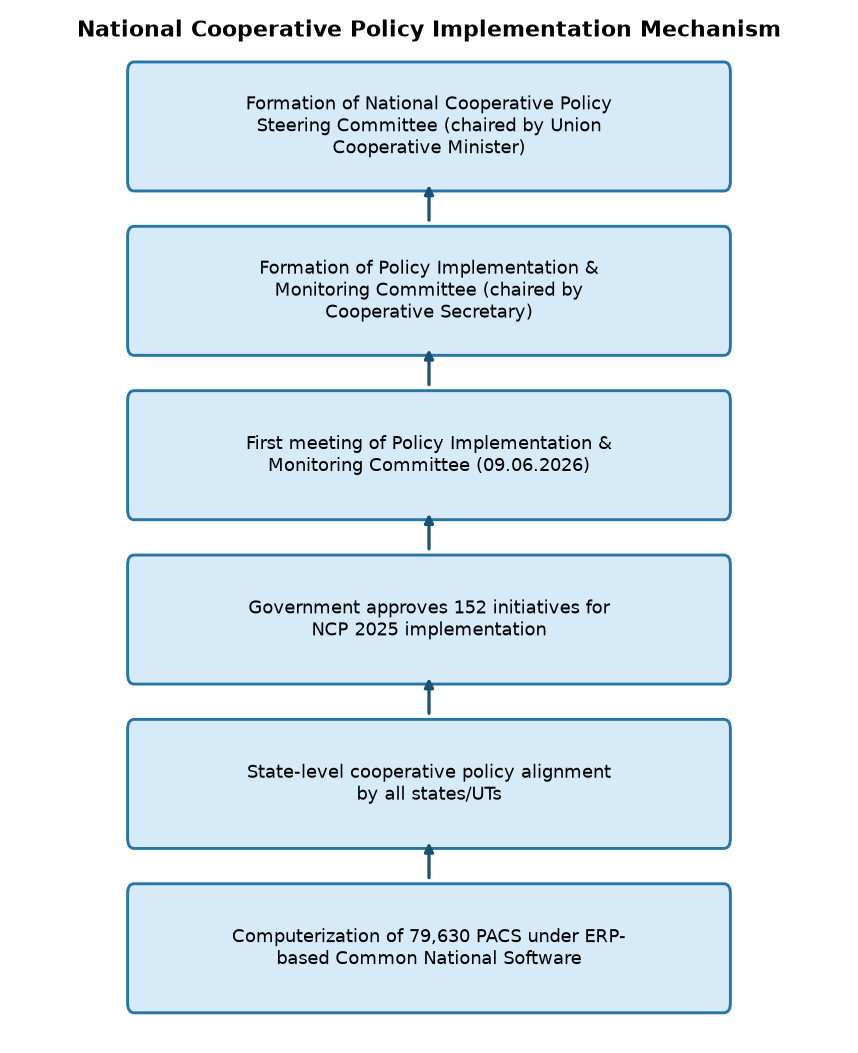
The Union Ministry of Cooperation, through a press release dated 21 July 2026, announced the operationalisation of institutional mechanisms for the implementation of the National Cooperative Policy (NCP), 2025, and provided an update on the National Cooperative Database (NCD). It highlighted the establishment of two apex committees—the National Steering Committee on Cooperative Policy chaired by the Union Minister of Cooperation and the Policy Implementation and Monitoring Committee chaired by the Secretary, Cooperation—and reported progress on the computerisation of over 79,000 Primary Agricultural Credit Societies (PACS) under a centrally sponsored scheme with a financial outlay of ₹2,925.39 crore. Additionally, the Ministry reported the registration of 10,225 new multi-purpose cooperatives (MPACS) in agriculture, dairy and fisheries since February 2023, aimed at covering all panchayats and villages.
Background
- The cooperative movement in India traces its origins to the late 19th century, with the first cooperative credit society established in 1904 under the Cooperative Credit Societies Act, 1904.
- The Cooperative Societies Act, 1912, provided the legal framework for the registration and regulation of cooperative societies, which was subsequently amended in 2002 to enhance governance and digital integration.
- The 97th Constitutional Amendment Act, 2011, inserted Part IXB into the Constitution, providing constitutional status to cooperatives and mandating state regulation and promotion of cooperatives as democratic institutions.
- The Union Ministry of Cooperation was established in July 2021 to provide focused attention to the cooperative sector, which includes over 8.5 lakh cooperatives with approximately 30 crore members.
- The National Cooperative Policy (NCP), 2025, is a comprehensive policy framework for the cooperative sector, aligning with the vision of ‘Sahkar se Samriddhi’ (Prosperity through Cooperation).
- The National Cooperative Database (NCD) was launched to create a single-window repository of cooperative society data across 30 economic sectors, enabling evidence-based policy formulation and targeted interventions.
What is the National Cooperative Policy, 2025, and the National Cooperative Database?
- The National Cooperative Policy (NCP), 2025, is a strategic roadmap for the systematic and holistic development of India’s cooperative sector, formulated to enhance the efficiency, transparency, and competitiveness of cooperatives through multi-stakeholder collaboration.
- The Policy mandates the establishment of two apex institutional mechanisms: (a) the National Steering Committee on Cooperative Policy, chaired by the Union Minister of Cooperation, to provide overall guidance and periodic review; and (b) the Policy Implementation and Monitoring Committee, chaired by the Secretary, Cooperation, to coordinate centre-state efforts, resolve implementation challenges, and ensure periodic monitoring and review.
- The Policy Implementation and Monitoring Committee includes representatives from relevant Union ministries, state cooperative departments, NITI Aayog, national cooperative federations (e.g., NAFED, AMUL, NDDB), and apex financial institutions such as NABARD, NCDC, and NFDB, ensuring a cooperative federalism approach.
- The National Cooperative Database (NCD) is a digital platform developed by the Ministry of Cooperation in collaboration with state nodal officers, serving as a single-point access to real-time data on over 8.5 lakh cooperatives across 30 economic sectors, covering approximately 30 crore members.
- The NCD enables evidence-based policymaking by providing granular data on cooperative societies, including their geographical distribution, sectoral composition, financial health, and membership demographics, thereby facilitating targeted interventions and monitoring of policy outcomes.
- The NCP, 2025, emphasises the computerisation of PACS through a central sector scheme with a financial outlay of ₹2,925.39 crore, aiming to integrate 79,630 PACS with NABARD via state cooperative banks (STCBs) and district central cooperative banks (DCCBs) using ERP-based common national software.
- The Policy also promotes the establishment of new multi-purpose cooperatives (MPACS) in agriculture, dairy, and fisheries, with a target to cover all panchayats and villages, and reports 10,225 such cooperatives registered since February 2023.
Key Features
| Feature | Significance |
|---|---|
| National Cooperative Policy (NCP) 2025 | Provides a structured roadmap for the systematic and holistic development of the cooperative sector, integrating central and state-level efforts with institutional mechanisms for implementation and periodic review. |
| National Cooperative Database (NCD) | A single-point access repository containing data on over 8.5 lakh cooperative societies across 30 economic sectors, covering approximately 30 crore members, enabling evidence-based policy formulation and monitoring. |
| Computerisation of PACS (Primary Agricultural Credit Societies) | Aims to integrate 79,630 PACS with state cooperative banks and district central cooperative banks via ERP-based common national software, enhancing transparency, efficiency, and financial inclusion. |
| Multi-Purpose PACS (M-PACS) Scheme | Approved in February 2023, this scheme targets the establishment of new multi-purpose PACS, dairy, and fisheries cooperatives to cover all panchayats and villages, with 10,225 M-PACS registered by July 2026. |
| Institutional Monitoring Framework | Includes the ‘National Cooperative Policy Steering Committee’ chaired by the Union Minister of Cooperation and the ‘Policy Implementation and Monitoring Committee’ chaired by the Cooperation Secretary, ensuring inter-ministerial coordination and state-level alignment. |
Why it Matters
Economic Integration and Financial Inclusion
- Facilitates the integration of 79,630 PACS with the formal banking system through ERP-based software, enhancing their role in rural credit delivery and financial inclusion.
- Supports the expansion of multi-purpose PACS, dairy, and fisheries cooperatives, thereby diversifying income sources for rural households and strengthening the rural economy.
- Enables data-driven decision-making for cooperative societies, improving resource allocation and operational efficiency across 30 economic sectors.
Policy Coordination and Governance
- Establishes a robust institutional framework for inter-ministerial and centre-state coordination, ensuring alignment between national and state-level cooperative policies.
- Promotes cooperative federalism by involving state governments, union territories, and key stakeholders such as NABARD, NDDB, and NCDC in policy implementation and monitoring.
- Facilitates periodic reviews and corrective measures through structured committees, enhancing the responsiveness of cooperative policies to ground realities.
Data-Driven Governance
- The National Cooperative Database (NCD) serves as a critical tool for monitoring the health and performance of cooperative societies, enabling targeted interventions.
- Provides a unified platform for tracking the progress of schemes such as the computerisation of PACS and the establishment of M-PACS, ensuring accountability and transparency.
- Supports evidence-based policymaking by providing real-time data on the distribution and functioning of cooperative societies across regions and sectors.
Rural Development and Livelihood Enhancement
- The expansion of multi-purpose PACS, dairy, and fisheries cooperatives directly contributes to rural employment generation and poverty alleviation.
- Enhances access to credit, inputs, and markets for small and marginal farmers, thereby improving agricultural productivity and income security.
- Strengthens the cooperative ecosystem, fostering collective action and economies of scale in rural areas.
Challenges
1. Data Accuracy and Timeliness
- The reliability of the National Cooperative Database (NCD) depends on the regular updation of data by state nodal officers, which may face challenges due to administrative delays or lack of capacity.
- Inaccuracies in data entry could lead to misallocation of resources or ineffective policy interventions, undermining the database’s utility.
UPSC Link: GS Paper 2: Governance
2. Integration with Existing Systems
- The computerisation of PACS requires seamless integration with state cooperative banks (STCBs) and district central cooperative banks (DCCBs), which may face technical or administrative hurdles.
- Legacy systems in some states may lack the infrastructure or expertise to adopt ERP-based software, leading to implementation gaps.
UPSC Link: GS Paper 3: Economic Development
3. State-Level Policy Alignment
- While the NCP 2025 provides a national framework, the onus of aligning state-level policies rests with individual states, which may vary in their commitment and capacity.
- Divergent state policies could create inconsistencies in the implementation of cooperative schemes, affecting their reach and effectiveness.
UPSC Link: GS Paper 2: Federalism
4. Resource Mobilisation and Sustainability
- The financial outlay for the computerisation of PACS (₹2,925.39 crore) is substantial, and ensuring its optimal utilisation across states remains a challenge.
- Long-term sustainability of cooperative societies, particularly in the face of market fluctuations or policy changes, requires robust financial management and member participation.
UPSC Link: GS Paper 3: Resource Mobilisation
5. Awareness and Capacity Building
- Limited awareness among cooperative members and functionaries about the benefits of computerisation and digital tools may hinder adoption and utilisation.
- Capacity-building initiatives for state officials and cooperative leaders are essential to ensure effective implementation of NCP 2025 and related schemes.
UPSC Link: GS Paper 4: Ethics and Governance
Challenges — UPSC Perspective
| Issue | Concern |
|---|---|
| Data Gaps in NCD | Incomplete or outdated data in the National Cooperative Database may lead to flawed policy decisions and misallocation of resources. |
| Technical Barriers in Computerisation | Legacy systems and lack of technical expertise in some states may delay the integration of PACS with ERP-based software. |
| State-Level Policy Divergence | Variations in state policies may create inconsistencies in the implementation of cooperative schemes, affecting their reach and effectiveness. |
| Financial Sustainability of Cooperatives | Ensuring long-term financial viability of cooperative societies, particularly in the face of market risks, remains a persistent challenge. |
| Low Member Participation | Limited awareness and participation among cooperative members may undermine the effectiveness of digital tools and governance reforms. |
| Monitoring and Evaluation Gaps | Periodic reviews and corrective measures may be constrained by administrative delays or lack of robust monitoring mechanisms. |
Government Initiatives — Must-Memorise for Prelims
- Computerisation of Primary Agricultural Credit Societies (PACS) Scheme
- Multi-Purpose PACS (M-PACS) Scheme
Way Forward
- Strengthen the National Cooperative Database (NCD) by ensuring real-time data updation and verification through state nodal officers and third-party audits.
- Accelerate the computerisation of remaining PACS by addressing technical and administrative bottlenecks, including capacity-building for state officials and cooperative leaders.
- Enhance inter-ministerial and centre-state coordination by holding regular meetings of the ‘National Cooperative Policy Steering Committee’ and ‘Policy Implementation and Monitoring Committee’.
- Develop state-specific action plans for aligning state-level cooperative policies with NCP 2025, with clear timelines and accountability mechanisms.
- Promote awareness campaigns to educate cooperative members about the benefits of digital tools, financial inclusion, and governance reforms.
- Establish a dedicated fund for the long-term sustainability of cooperative societies, with provisions for risk mitigation and member support.
- Conduct periodic reviews of the NCP 2025 implementation, with a focus on addressing challenges such as data gaps, technical barriers, and state-level divergence.
- Leverage partnerships with academic institutions and industry experts to provide technical assistance and capacity-building support to states.
UPSC Value Addition
Keywords for Mains Answer-Writing
National Cooperative Policy (NCP) 2025 · Cooperative federalism · National Cooperative Database (NCD) · Primary Agricultural Credit Societies (PACS) · Computerisation of PACS · Multi-purpose PACS (M-PACS) · NABARD · Cooperative sector reforms · Institutional mechanisms for policy implementation · National Cooperative Policy Implementation and Monitoring Committee · National Cooperative Policy National Steering Committee · Cooperative data integration
Concept Flow
Policy Announcement (NCP 2025) → Institutional Framework Establishment (Steering & Monitoring Committees) → Data Collection & Database Creation (NCD) → Scheme Implementation (PACS Computerisation, M-PACS) → Monitoring & Review (Periodic Assessments) → Feedback Loop (Corrective Measures & Policy Refinement)
Prelims Practice Questions
Q1. Which of the following is NOT a key feature of the National Cooperative Policy (NCP) 2025?
- Establishment of a National Cooperative Policy National Steering Committee under the Union Cooperation Minister.
- Mandatory state-level cooperative policies aligned with NCP 2025.
- Direct financial allocation to all Primary Agricultural Credit Societies (PACS) for digitisation.
- Creation of a National Cooperative Database (NCD) for real-time data integration.
Answer: Direct financial allocation to all Primary Agricultural Credit Societies (PACS) for digitisation. — The NCP 2025 does not mandate direct financial allocation to all PACS for digitisation; instead, it approves a central sector scheme for computerisation with a specified financial outlay. The other options are explicitly mentioned in the policy framework.
Q2. Consider the following statements regarding the National Cooperative Database (NCD): 1. It covers over 8.5 lakh cooperative societies across 30 economic sectors. 2. It provides single-point access to data on approximately 30 crore members. 3. The database is maintained solely by the central government without state involvement. Which of the statements given above is/are correct?
- 1 and 2 only
- 2 and 3 only
- 1 and 3 only
- 1, 2 and 3
Answer: 1 and 2 only — Statements 1 and 2 are correct as per the NCD framework. Statement 3 is incorrect because the database is maintained through collaboration between the central government and state/UT nodal officers.
Q3. Which of the following institutions is NOT explicitly mentioned as a member of the ‘Policy Implementation and Monitoring Committee’ under the National Cooperative Policy 2025?
- NABARD
- NDDB
- SEBI
- NCDC
Answer: SEBI — SEBI (Securities and Exchange Board of India) is not listed among the members of the ‘Policy Implementation and Monitoring Committee’. The other institutions—NABARD, NDDB, and NCDC—are explicitly mentioned.
Mains Practice Question
✍ Examine the institutional mechanisms envisaged under the National Cooperative Policy (NCP) 2025 for ensuring its effective implementation. How does the policy leverage cooperative federalism and data-driven governance to strengthen the cooperative sector in India?
Approach: The answer should delineate the two-tier institutional framework: (i) the National Cooperative Policy National Steering Committee chaired by the Union Cooperation Minister for overall guidance and inter-ministerial coordination, and (ii) the Policy Implementation and Monitoring Committee chaired by the Cooperation Secretary for centre-state coordination, problem resolution, and periodic review. Highlight the role of the National Cooperative Database (NCD) in enabling data-driven governance, including its coverage of 8.5 lakh societies and 30 crore members. Emphasise the policy’s emphasis on cooperative federalism through state-level policy alignment and the collaborative maintenance of the NCD by central and state authorities. Conclude by linking these mechanisms to the broader objective of systematic and holistic development of the cooperative sector.
Source: PIB (Press Information Bureau)
Generated by AanyaAi for educational purpose.

- तमिलनाडु में बस किराए में संशोधन: सरकार को चार सप्ताह और समय मिला, उच्च न्यायालय का फैसला - September 22, 2026
- Madras HC gives Tamil Nadu 4 weeks to revise bus fares amid diesel price surge - September 22, 2026
- कुल्लू: NHPC की पार्वती-2 परियोजना के खिलाफ एफआईआर, 12 सदस्यीय जांच समिति गठित - September 21, 2026

No Comments