


24 Jul National Natural Farming Mission: Progress, Coverage & UPSC Relevance 2026
Subject Relevance — Where This Topic Fits
- GS Paper III — Agriculture, Environment and Ecology, Government Schemes
- Prelims: Natural Farming, Chemical-Free Agriculture, Soil Health, Ecosystem Restoration, Zero Budget Natural Farming, Mission LiFE, Agroecology, Paramparagat Krishi Vikas Yojana
- Essay: Sustainable agriculture as the cornerstone of India’s climate-resilient growth, Balancing productivity with ecological integrity: The case for natural farming in India
Quick Revision: NMNF is India’s flagship agroecological mission (2024–26) promoting chemical-free farming through a cluster-based, farmer-led model, targeting 20.9 lakh farmers and 10.32 lakh hectares by 2026, with technical support from KVKs, SAUs, and LNFIs.
Why is this in the news?
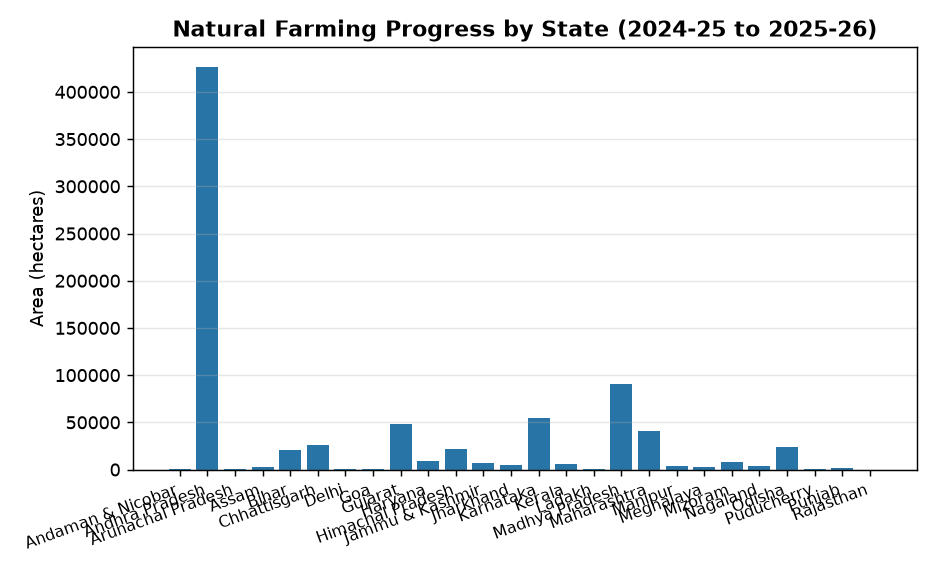
The Union Cabinet approved the National Mission on Natural Farming (NMNF) as a centrally sponsored scheme on 25 November 2024 to mainstream chemical-free, climate-resilient agricultural practices across India. As of July 2026, the mission has enrolled over 20.9 lakh farmers and covered 10.32 lakh hectares under natural farming through 18,893 clusters, with significant state-wise disparities in adoption. This initiative aligns with India’s commitment to the Sustainable Development Goals (SDGs), particularly SDG 2 (Zero Hunger), SDG 12 (Responsible Consumption and Production), and SDG 13 (Climate Action), while addressing the agrarian distress exacerbated by input costs and soil degradation.
Background
- The Green Revolution (1960s–1980s) prioritised high-yielding varieties and synthetic inputs, leading to long-term soil degradation, groundwater depletion, and chemical residue accumulation, undermining agricultural sustainability.
- Post-2015, global and domestic policy shifts emphasised agroecological approaches, culminating in the UN’s 2030 Agenda for Sustainable Development and India’s National Mission for Sustainable Agriculture (NMSA, 2014–15).
- Natural farming is rooted in traditional Indian agricultural practices (e.g., *ZBNF*—Zero Budget Natural Farming) and global agroecological models, focusing on biodiversity, soil microbiomes, and closed-loop nutrient cycles.
- The mission builds on earlier initiatives like Paramparagat Krishi Vikas Yojana (PKVY) and Mission Organic Value Chain Development for North Eastern States (MOVCDNER), but distinguishes itself through a pan-India, cluster-based, farmer-centric implementation strategy.
What is the National Mission on Natural Farming (NMNF)?
- NMNF is a centrally sponsored scheme launched by the Government of India in November 2024 to promote chemical-free, climate-resilient agriculture across all agro-climatic zones.
- It operationalises natural farming—a holistic, agroecological system that integrates livestock, diversified cropping, and traditional knowledge to restore soil health and ecosystem balance.
- The mission’s core objectives include reducing input costs for farmers, enhancing soil organic carbon, improving water-use efficiency, and mitigating greenhouse gas emissions from agriculture.
- NMNF employs a cluster-based approach, with 18,893 clusters established across 31 states/UTs, each comprising 100–250 farmers practicing natural farming on contiguous land parcels.
- Implementation is facilitated through 527 Krishi Vigyan Kendras (KVKs), 76 State Agricultural Universities (SAUs), and 194 Local Natural Farming Institutes (LNFIs), which provide technical guidance, training, and resource support to farmers.
- Training infrastructure includes 18 Centres of Natural Farming (CONFs) that mentor KVK/SAU scientists, district/block officials, and Farmer Master Trainers (FMTs) in natural farming techniques.
- As of July 2026, 33,257 Community Resource Persons (CRPs) and agricultural Sakhis have been trained to serve as on-ground facilitators, ensuring grassroots-level adoption and knowledge dissemination.
- The mission prioritises marginal and smallholder farmers, leveraging India’s traditional knowledge systems (e.g., *Panchagavya*, *Jeevamrit*, and *Beejamrit*) to enhance resilience against climate variability and market shocks.
UPSC Value Addition
Keywords for Mains Answer-Writing
National Mission on Natural Farming (NMnF) · Natural Farming · Chemical-free agriculture · Soil health restoration · Ecosystem restoration · Climate-resilient agriculture · Cluster-based implementation · Paramparagat Krishi Vikas Yojana (PKVY) · Zero Budget Natural Farming (ZBNF) · Agroecological practices · Community Resource Persons (CRP) · Krishi Vigyan Kendra (KVK) · Soil organic carbon · Sustainable agriculture · Farmers’ livelihoods · Sub-Mission on Agroforestry (SMAF)
Prelims Practice Questions
Q1. Which of the following is NOT a stated objective of the National Mission on Natural Farming (NMnF)?
- Promotion of chemical-free agricultural practices
- Restoration of soil health through agroecological methods
- Mandatory conversion of 50% of agricultural land to natural farming by 2026
- Integration of livestock and traditional knowledge systems
Answer: Mandatory conversion of 50% of agricultural land to natural farming by 2026 — The NMnF promotes natural farming but does not mandate any percentage of land conversion; its objectives focus on voluntary adoption, soil health restoration, and ecosystem-based practices.
Q2. The National Mission on Natural Farming (NMnF) is implemented through a cluster-based approach. Which of the following institutions is NOT directly involved in the implementation at the cluster level?
- Krishi Vigyan Kendra (KVK)
- State Agricultural Universities (SAUs)
- Local Natural Farming Institutes (LNFIs)
- National Bank for Agriculture and Rural Development (NABARD)
Answer: National Bank for Agriculture and Rural Development (NABARD) — NABARD is not listed among the implementing agencies at the cluster level; KVKs, SAUs, and LNFIs are explicitly mentioned as nodal agencies for training and guidance.
Q3. Which of the following statements best describes the core principle of natural farming as envisaged under the NMnF?
- It relies solely on synthetic fertilisers and pesticides to enhance productivity
- It integrates livestock, traditional knowledge, and ecosystem-based practices to restore soil health and biodiversity
- It mandates the use of genetically modified crops to reduce input costs
- It promotes large-scale monoculture farming to achieve economies of scale
Answer: It integrates livestock, traditional knowledge, and ecosystem-based practices to restore soil health and biodiversity — Natural farming under NMnF is defined as a chemical-free, livestock-integrated, and traditional knowledge-based agricultural system aimed at restoring soil health and ecosystem balance.
Mains Practice Question
✍ Examine the significance of the National Mission on Natural Farming (NMnF) in the context of India’s agricultural transformation. How does it align with the broader goals of sustainable agriculture, climate resilience, and farmers’ livelihoods? Substantiate your answer with relevant examples from the mission’s implementation.
Approach: Begin by defining the NMnF and its core principles, such as chemical-free farming, livestock integration, and traditional knowledge systems. Highlight its alignment with India’s sustainable agriculture goals, including soil health restoration, biodiversity conservation, and reduction in input costs. Discuss its role in climate resilience by mitigating greenhouse gas emissions and adapting to climate change through agroecological practices. Analyse the cluster-based implementation model, citing data from the mission’s progress (e.g., 20.93 lakh registered farmers, 10.32 lakh hectares covered) to demonstrate scalability and inclusivity. Conclude by linking the mission to farmers’ livelihoods through reduced input dependency, improved soil fertility, and market access for organic produce. Reference the mission’s integration with existing schemes like Paramparagat Krishi Vikas Yojana (PKVY) and Sub-Mission on Agroforestry (SMAF) to underscore its comprehensive approach.
Source: PIB (Press Information Bureau)
Generated by AanyaAi for educational purpose.

- Trump Defends Iran War at UNGA: Key Implications for UPSC & State PCS - September 22, 2026
- अंडमान-निकोबार के उपराज्यपाल ने प्रधानमंत्री से की बैठक, जानें मुख्य बिंदु - September 22, 2026
- UPSC Alert: Andaman & Nicobar LG Meets PM on 22 Sep 2026 - September 22, 2026

No Comments